
3task Doorman: REST API & MCP Access Control
| 开发者 | 3task |
|---|---|
| 更新时间 | 2026年10月27日 00:35 |
| PHP版本: | 7.4 及以上 |
| WordPress版本: | 7.1 |
| 版权: | GPLv2 or later |
| 版权网址: | 版权信息 |
详情介绍:
/wp-json/wp/v2/users lists the login names of your authors, and /wp-json/ lists every route, and with it most of your plugins. Newer WordPress versions also bring the Abilities API, and some plugins bring an MCP server along that lets AI agents work on your site. Many site owners do not know that these doors exist.
Doors
One click closes a door. The first four are closed after activation, because guests never need them:
- User list for guests:
/wp/v2/usersno longer reveals login names. The block editor keeps working. - Route directory for guests: the REST index and the root of every namespace stay closed for guests.
- Batch endpoint for guests:
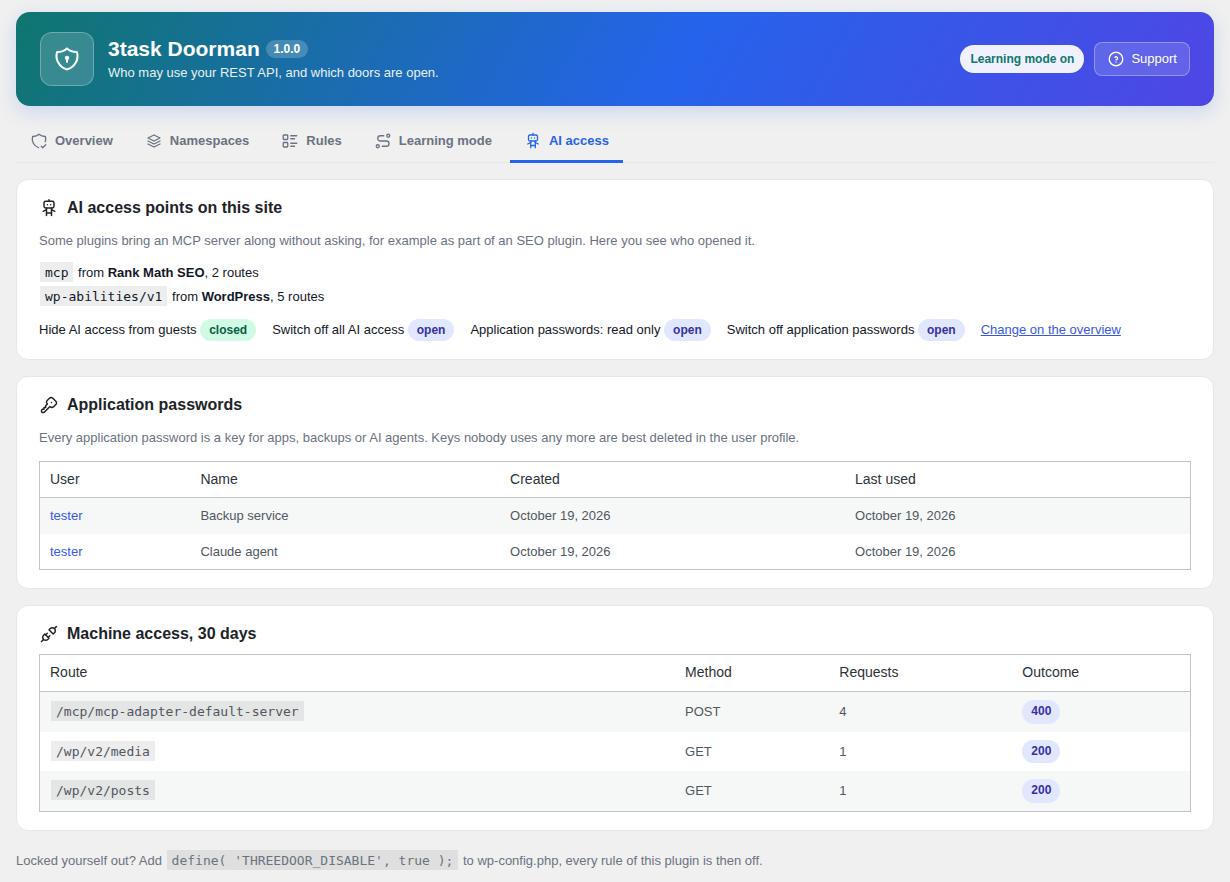
/batch/v1runs several requests in one. Guests do not need it. Every request inside a batch is checked on its own as well. - Hide AI access from guests: MCP servers and the Abilities API are invisible to guests.
- Switch off all AI access: blocks MCP and Abilities for every machine login, you in the browser keep access.
- Application passwords: read only: apps and agents may read, but not write, delete or publish.
- Switch off application passwords, switch off XML-RPC, remove REST hints from the page head.
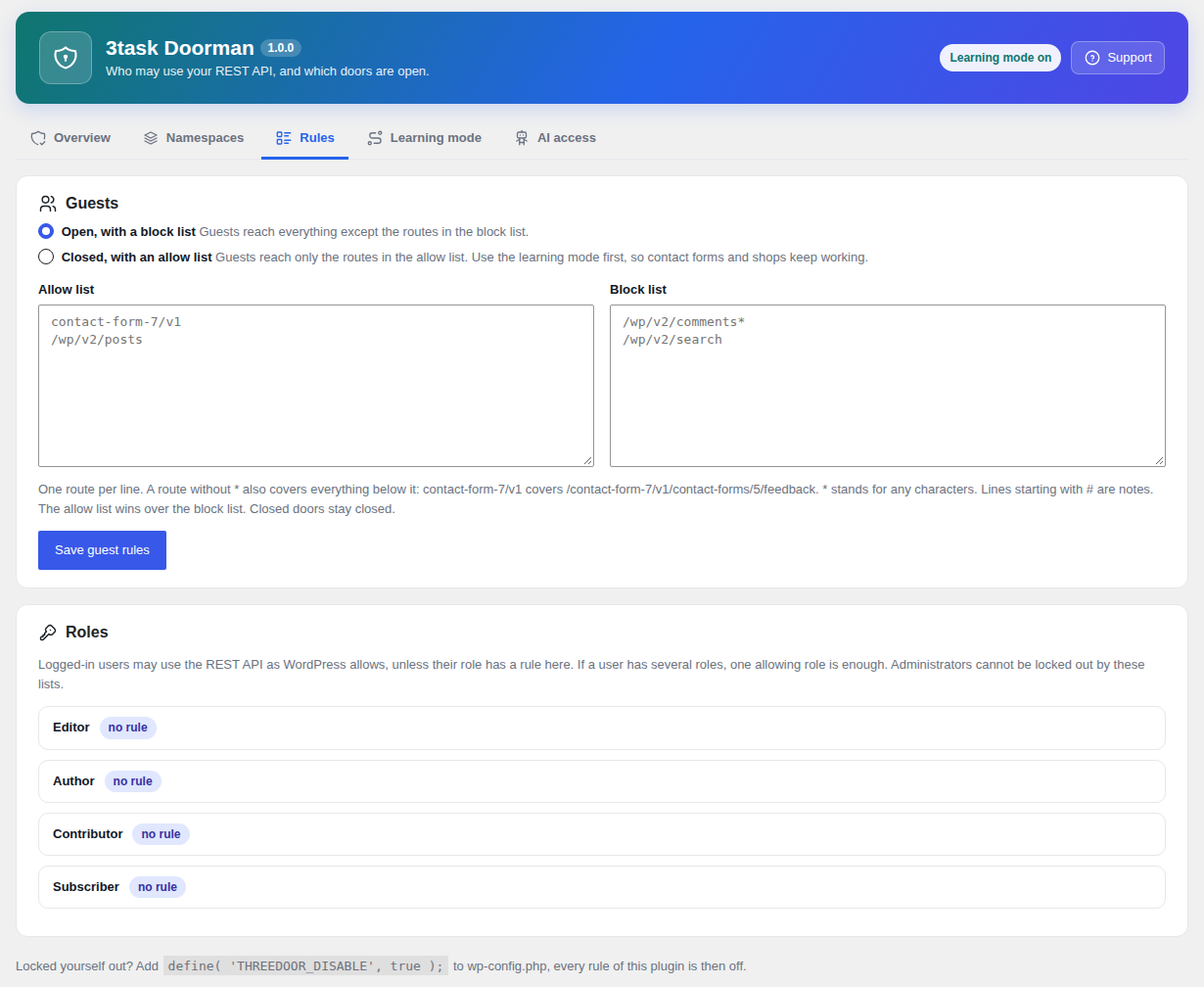
- Open with a block list or closed with an allow list, for guests and for every role.
- One route per line. A route without
*also covers everything below it:contact-form-7/v1covers/contact-form-7/v1/contact-forms/5/feedback.*stands for any characters. - Administrators cannot be locked out by the role lists.
- Refusals answer with 401 or 403 and
Cache-Control: no-store. A closed route does not reveal parameter names, even when the request is invalid.
安装:
- Install and activate the plugin.
- Open Doorman in the admin menu. Four doors are already closed.
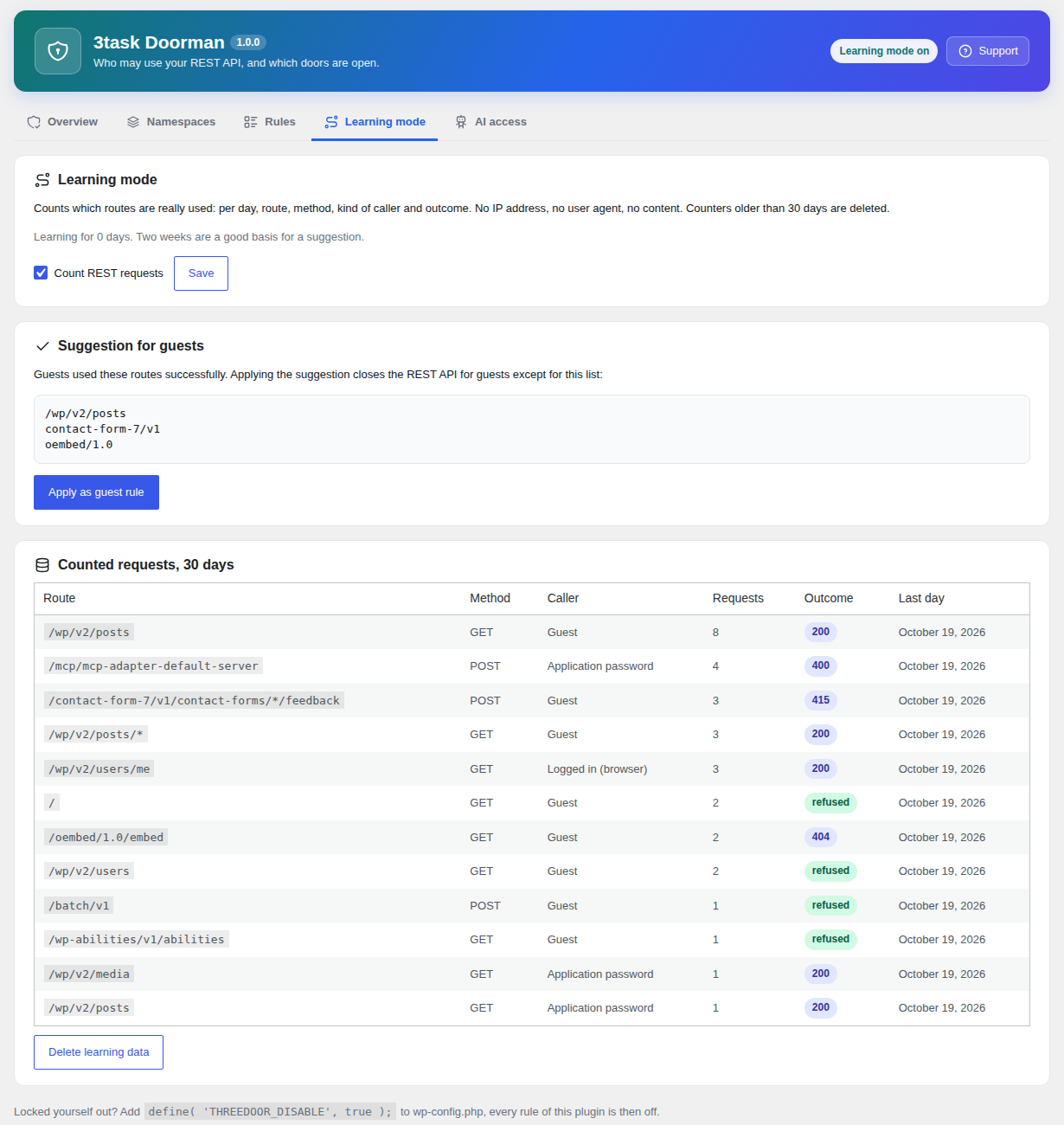
- Leave the learning mode on for about two weeks, then look at the suggestion under Learning mode.
屏幕截图:
常见问题:
I locked myself out. What now?
Add define( 'THREEDOOR_DISABLE', true ); to wp-config.php. Every rule of the plugin is then off and you can correct the settings.
Will my contact form still work?
The doors closed after activation do not affect forms. If you switch guests to "closed, with an allow list", use the learning mode first: forms like Contact Form 7 send to their own REST route, and the suggestion contains it once a visitor used it.
Does this replace WordPress updates?
No. Updates fix vulnerabilities. Closing doors that nobody needs is a second lock.
Does this protect against PHP2Shell (CVE-2026-109618)?
No. That flaw is in PHP itself and is triggered before WordPress loads, so no plugin can close it. Only the PHP update from your host does (8.2.35, 8.3.36, 8.4.27, 8.5.12 or newer; some hosts backport the fix without changing the version number, ask them). The same is true for every WordPress plugin, whatever it promises.
What does the plugin store?
Its settings and the daily counters of the learning mode (route, method, kind of caller, outcome, number). No IP addresses, no user agents, no request content. Uninstalling removes everything.
Does the plugin contact any external service?
No.
Where do the AI access points come from?
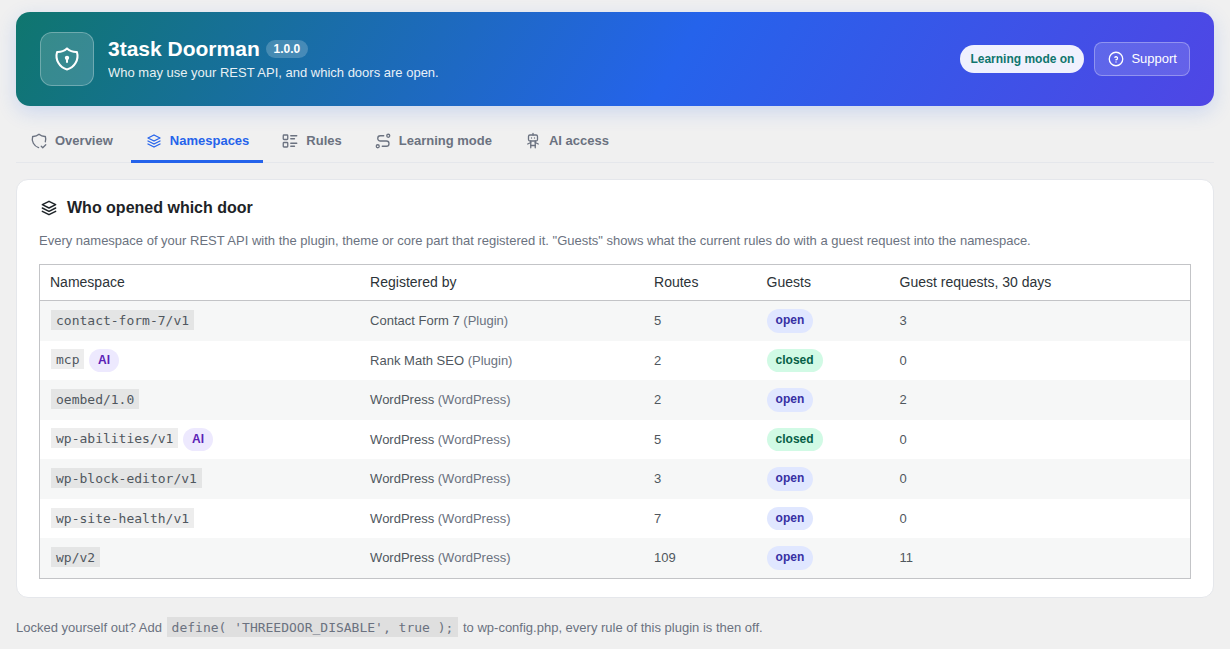
WordPress itself registers the Abilities API (wp-abilities/v1). An MCP server (mcp) is added by plugins that bundle the WordPress MCP adapter, for example some SEO plugins. The namespace overview shows which one.
Does the plugin ask for a review?
Once, at the earliest 14 days after you first opened the plugin and once Doorman turned away 250 requests in the last 30 days (counted by the learning mode), on the Overview and Learning mode tabs of the plugin only, never as a notice elsewhere. "Maybe later" asks one more time after 90 days, "I already did" and the × close it for good. A review is not required for anything, and nothing changes in the plugin, whatever you choose.
更新日志:
- New: a thank-you card asks once for an honest review on WordPress.org, at the earliest 14 days after the plugin page was first opened and once Doorman turned away 250 requests in the last 30 days, on the Overview and Learning mode tabs only. Review and help sit side by side. "Maybe later" asks one more time after 90 days, "I already did" and the × close it for good.
- Plugin name, short description and tags now say more clearly what the plugin does. No code change.
- First release.
- Translations: German (formal and informal), Spanish, French, Italian.