
Advanced IP Blocker
| 开发者 | inilerm |
|---|---|
| 更新时间 | 2026年10月23日 18:03 |
| 捐献地址: | 去捐款 |
| PHP版本: | 8.1 及以上 |
| WordPress版本: | 7.1 |
| 版权: | GPLv2 or later |
| 版权网址: | 版权信息 |
标签
下载
详情介绍:
Important Note on PHP Version: To ensure maximum security and access to all features, we strongly recommend using PHP 8.1 or higher. Some advanced features (like the local MaxMind database or full 2FA management via WP-CLI) require PHP 8.1.Key Features:
- File Integrity Scanner (Beta): Instantly detect unauthorized changes to core WordPress files and your active plugins/themes. A vital tool to detect malware infections or backdoor placements on your server.
- Admin Access Control: Granular control over which administrators can access the plugin's configuration dashboard. Restrict plugin management while keeping firewall rules intact for all editors and admins.
- Hardening & Core Protection: Powerful tools to disable WordPress application passwords, turn off the dangerous built-in file editor, block PHP execution in the uploads folder, and hide the WordPress version from attackers.
- Intelligent Zero-Day WAF Sync: Automatically download and apply critical WAF signatures from the AIB Central Server every day. Stay protected against zero-day vulnerabilities (like wp2shell) without needing to update the plugin manually! The rules run completely independent of your custom WAF configuration.
- Block Ghost IPs: Automatically block IPs without ASN and Reverse DNS to stop anonymous traffic (Warning: Could cause false positives if rDNS is misconfigured by ISPs).
- Captcha Integrations (Turnstile & hCaptcha): Seamlessly integrate modern verification challenges like Cloudflare Turnstile and hCaptcha, with granular control per module and a smart fallback to our invisible JS Challenge to prevent accidental lockouts.
- Rate Limiting Advanced Rules: Create highly specific rate limits for different endpoints. For example, set a strict limit with a Turnstile challenge for
/login, while keeping a more generous limit with a temporary block for your main API, all without affecting the rest of the site. - Distributed Attack Protection (Auto-Panic): Automatically shields your entire site with a global JS challenge during massive traffic spikes, keeping your server online while intelligently bypassing trusted bots and excluded routes.
- IP & ASN Diagnostics Tool: A complete Inspector tool integrated directly into the admin bar. Quickly audit any IP or ASN against your Geolocation database, Threat Scoring system, Spamhaus drops, and manual blocking rules in real-time.
- Advanced Rules Import/Export: Seamlessly migrate or backup your complex custom security rules across multiple WordPress websites. With full JSON validation, structural deduplication, and "cost-zero" client-side file generation, agency users can clone their perfect firewall setups in seconds.
- Granular JS Challenge Modes: You can now choose exactly how the security challenge behaves. Select "Managed" for ultimate security requiring human interaction (a checkbox), or "Automatic" for an invisible, transparent Proof-of-Work execution that stops bots silently. Apply different modes per module!
- Country Selector Copy/Paste: Say goodbye to manually selecting 50+ countries. You can now instantly copy and paste a raw list of 2-letter country codes directly into Geoblocking, Geo-Challenge, and Whitelist Login fields.
- AIB Cloud Network V3: Upgrade to the next-generation distributed threat intelligence network. The new API V3 provides secure, individual API Keys per site, drastically improving synchronization reliability, threat telemetry, and global network stability.
- Whitelist Login Countries (with Threat Scoring Integration): Take absolute control over administrative access. Easily restrict your WordPress login page and XML-RPC to only allow connections from specific, whitelisted countries, automatically accumulating Threat Score points and triggering global hard-blocks for persistent bots while keeping the door open for legitimate travelers.
- (IMPROVED) Bulk Import/Export for Blocked IPs & Whitelist: Seamlessly import massive lists of IPs via CSV or manual entry. The system now features a bulletproof "Bulk Import" type, strict duration inheritance, and intelligent conflict resolution.
- Internal Security & Forensics: A complete audit suite solely for WordPress. Track every sensitive event (plugin installs, settings changes, user logins) and monitor your critical files for unauthorized modifications with the integrated File Integrity Monitor.
- Activity Audit Log: Gain complete visibility into what's happening on your site. Who deactivated a plugin? Who changed a setting? The Audit Log answers these questions with timestamped, immutable records.
- Deep Scan Email Reports: Get a weekly security summary delivered to your inbox, detailing pending updates, vulnerability status, and recent attack trends.
- Username Blocking & Rules: Gain granular control over login security. Creating Advanced Rules to block, challenge, or score specific usernames (e.g., "admin", "test").
- Enhanced Lockdown Notifications: Distributed Lockdowns (404/403) now fully support Email and Push notifications, ensuring you never miss a critical security event.
- Improved Logging: New "Endpoint Challenge" event type provides deeper visibility into challenges served during automated lockdowns.
- **Server IP Reputation Check. Instantly audit your web server's IP address against major blacklists (Spamhaus, AbuseIPDB) to diagnose SEO and email delivery issues.
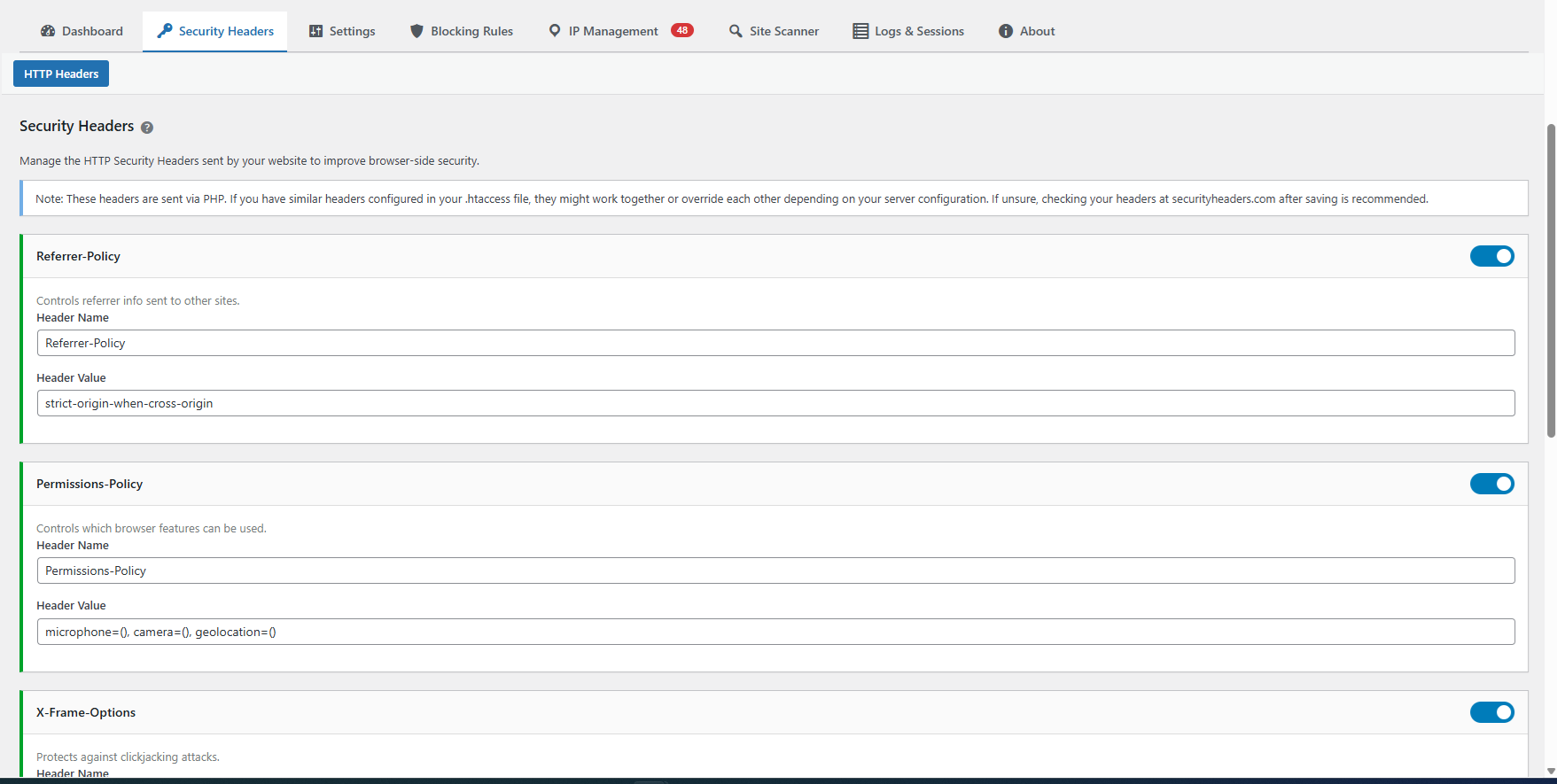
- HTTP Security Headers. Easily configure essential security headers like HSTS, X-Frame-Options, and Permissions-Policy to harden your site against clickjacking, sniffing, and other browser-based attacks. Includes a "Report-Only" mode for CSP.
- **Site Health & Vulnerability Scanner. Audit your WordPress environment instantly. Detects outdated plugins, insecure PHP versions, and checks your installed plugins against a database of 30,000+ known vulnerabilities.
- **PERFORMANCE BOOST: High-Speed Community Database. Migrated the "Community Defense Network" blocklist to a dedicated, indexed database table. This allows checking thousands of malicious IPs in microseconds with zero impact on site memory usage.
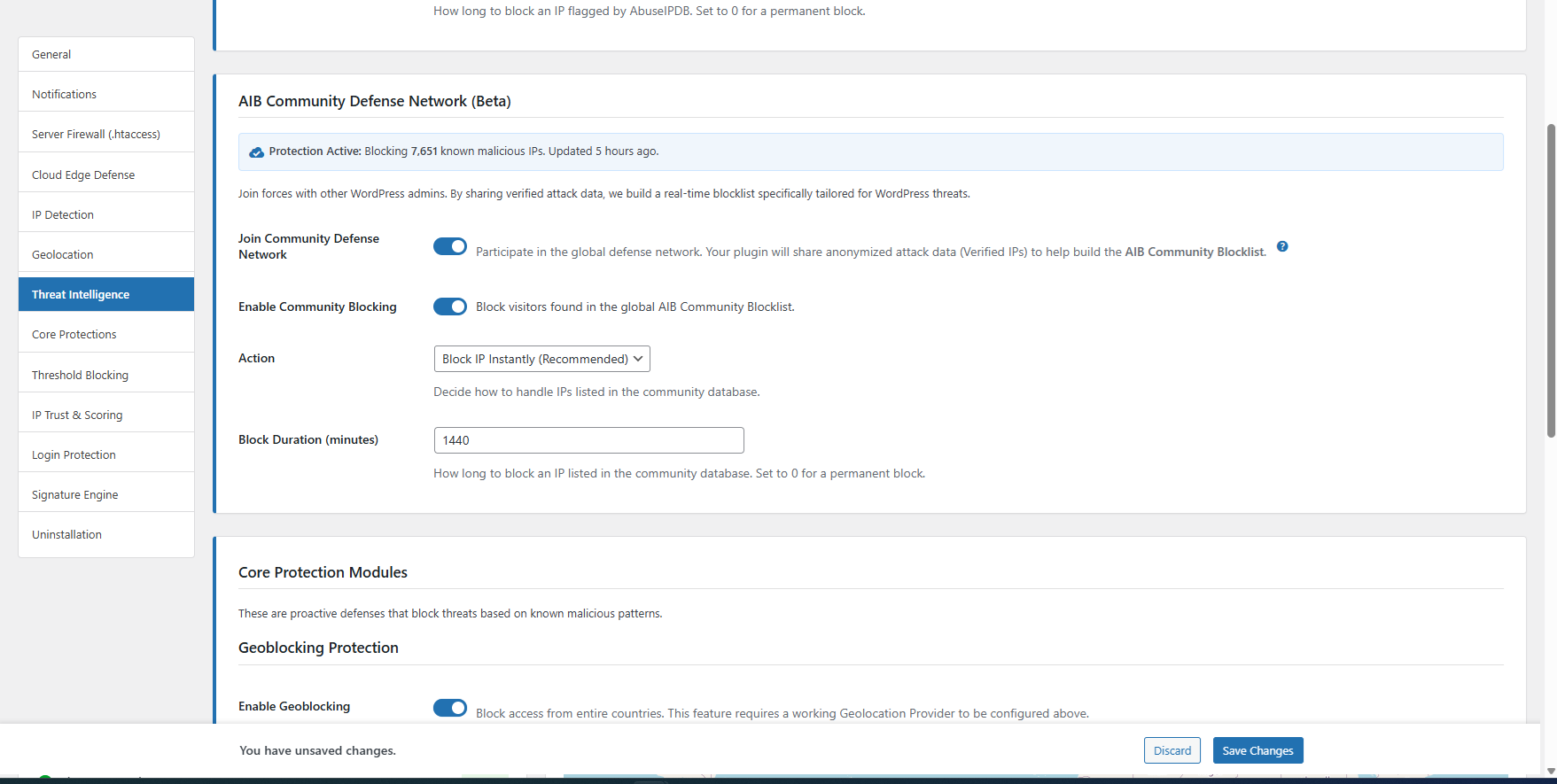
- **Community Defense Network. Join forces with other WordPress admins. The plugin now shares anonymous attack data to build a global, real-time blocklist of verified threats. Protect your site with community-powered intelligence.
- **Auto-Cleaning Logic. Smart expiration handling ensures your blocklists stay fresh and performant, automatically removing stale IPs from both the database and external firewalls (Cloudflare/.htaccess).
- **Cloud Edge Defense (Cloudflare). Connect your site directly to Cloudflare's global network. Automatically sync your blocklists to the cloud to stop attackers before they reach your server. Zero server load protection.
- **Server-Level Firewall (.htaccess). Extreme performance upgrade. Write blocking rules and file hardening protections directly to your .htaccess file. Blocks threats instantly without loading PHP or WordPress.
- **IMPROVED: Smart Bot Verification. Enhanced logic to correctly identify legitimate traffic from iOS devices (iCloud Private Relay) and social media previews, eliminating false positives while keeping impostors out.
- File Hardening. Protect your most sensitive files (
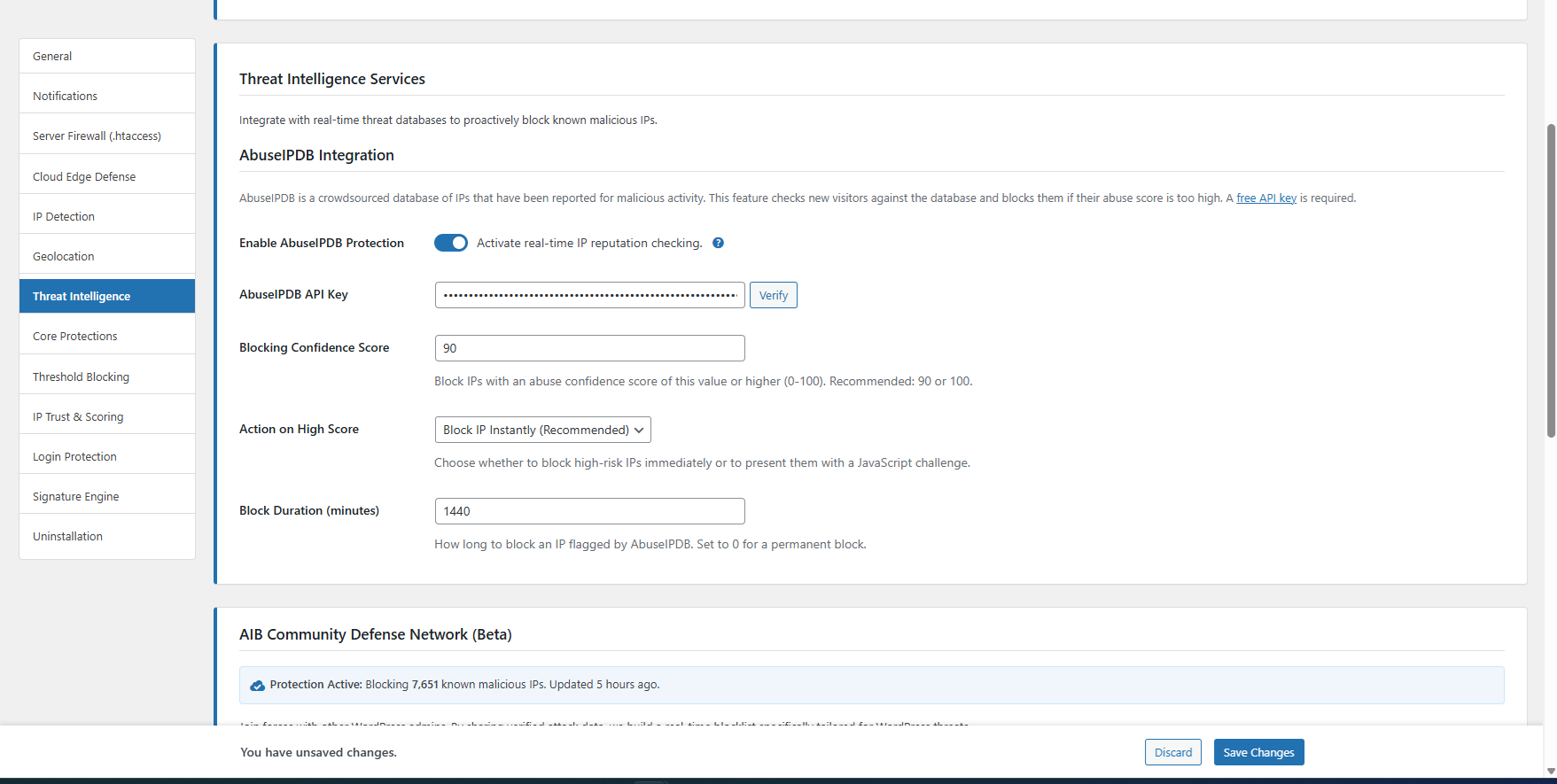
wp-config.php,readme.html,.git) at the server level with a single click. - AbuseIPDB Integration. Proactively block attackers before they strike. The plugin can now check visitor IPs against AbuseIPDB's real-time, crowdsourced database of malicious IPs and block those with a high abuse score on their very first request.
- Edge Firewall Mode! Protect any PHP file or standalone application within your WordPress directory (even if it's not part of WordPress). Ideal for securing custom scripts, legacy applications, or folders like
/scan/. (Requires manual configuration). - Advanced Rules Engine! Create powerful, custom security rules with multiple conditions (IP, Country, ASN, URI, User-Agent, Request Method, Referer) and actions (Block, Challenge, or add Threat Score).
- Known Bot Verification. A powerful new security layer that uses reverse DNS lookups to verify legitimate crawlers like Googlebot and Bingbot. This completely neutralizes attackers who try to bypass security rules by faking their User-Agent, assigning high threat scores to impostors.
- Verify Monitoring Bots (IP List). A brand new feature that downloads and caches official IP lists from popular uptime monitoring services (like UptimeRobot and Pingdom) to ensure they are never incorrectly blocked or challenged.
- Onboarding Setup Wizard. A brand new step-by-step wizard that guides new users through the essential security configurations (IP whitelisting, WAF, and bot traps) in under a minute, ensuring a strong security posture from day one.
- Major Refactor: Codebase Modernization. The entire plugin architecture has been refactored into a modern, modular structure. Logic for admin pages, AJAX, actions, and settings is now handled by dedicated classes, making the plugin more stable, performant, and easier to maintain and extend in the future.
- Advanced IP Spoofing Protection. A zero-trust "Trusted Proxies" system ensures the plugin always identifies the true visitor IP, even behind complex setups like Cloudflare or a custom reverse proxy. It neutralizes attacks that attempt to fake their IP, preventing block evasion and the framing of innocent users.
- Geo-Challenge. A smarter way to handle traffic from high-risk countries. Instead of a hard block, it presents a quick, invisible JavaScript challenge that stops bots but is seamless for human visitors. This reduces unwanted traffic without affecting potential legitimate users.
- ENHANCEMENT: Full Bulk-Action Support. IP management is now faster than ever. Both the Whitelist and the Blocked IPs list now support full bulk actions, allowing you to select and remove multiple entries at once, or unblock all IPs with a single click.
- Endpoint Lockdown Mode: Automatically shields
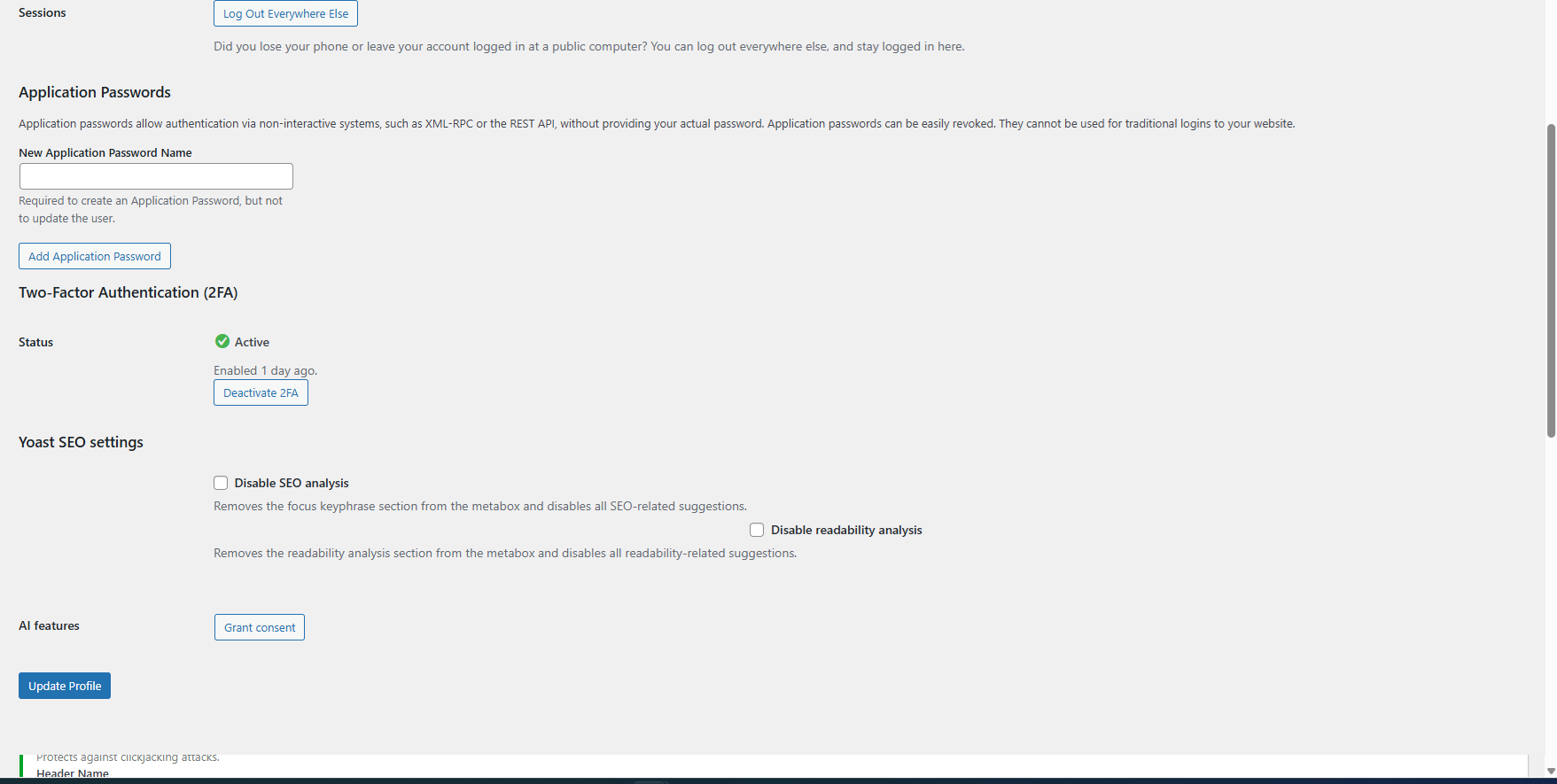
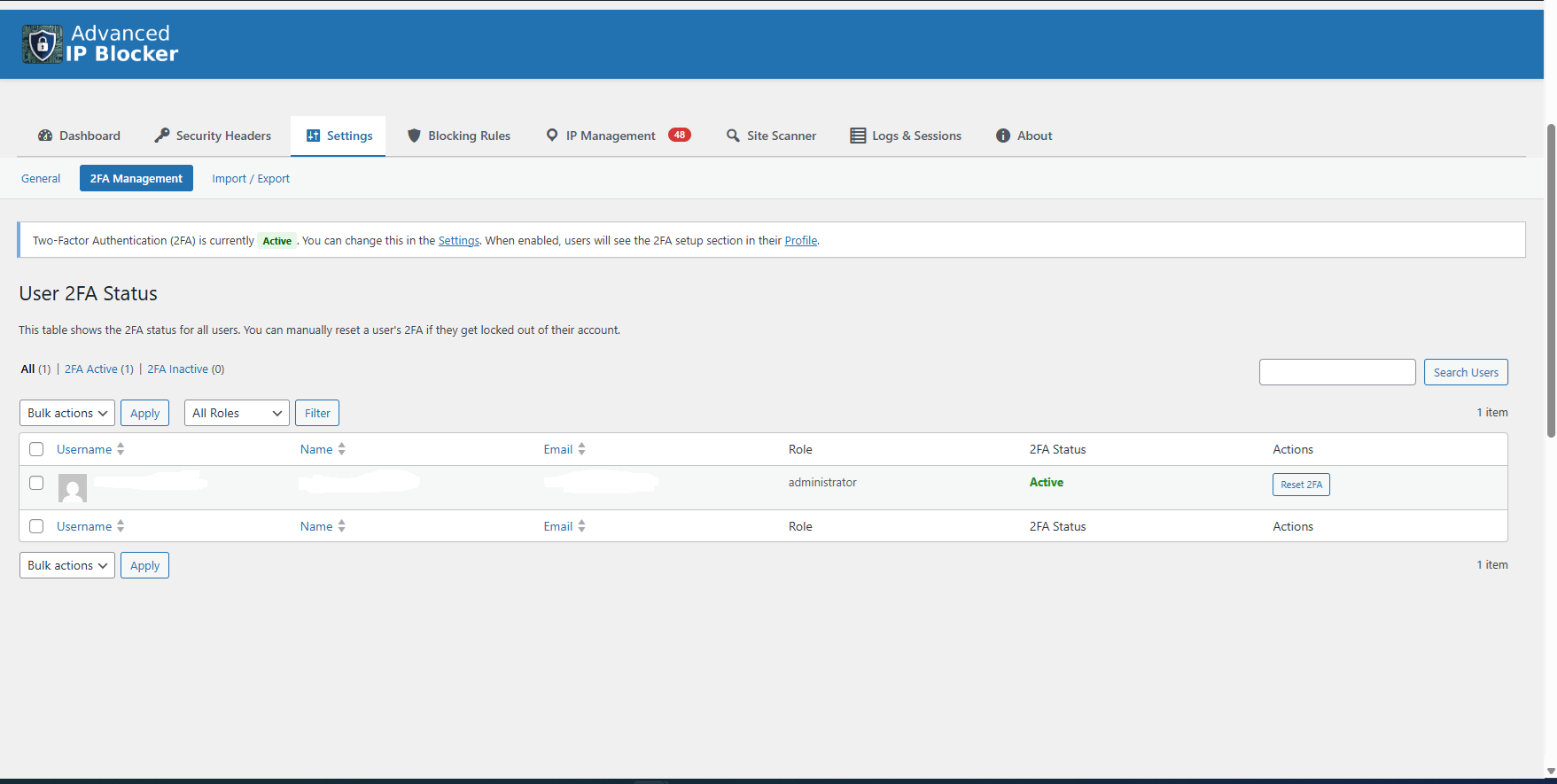
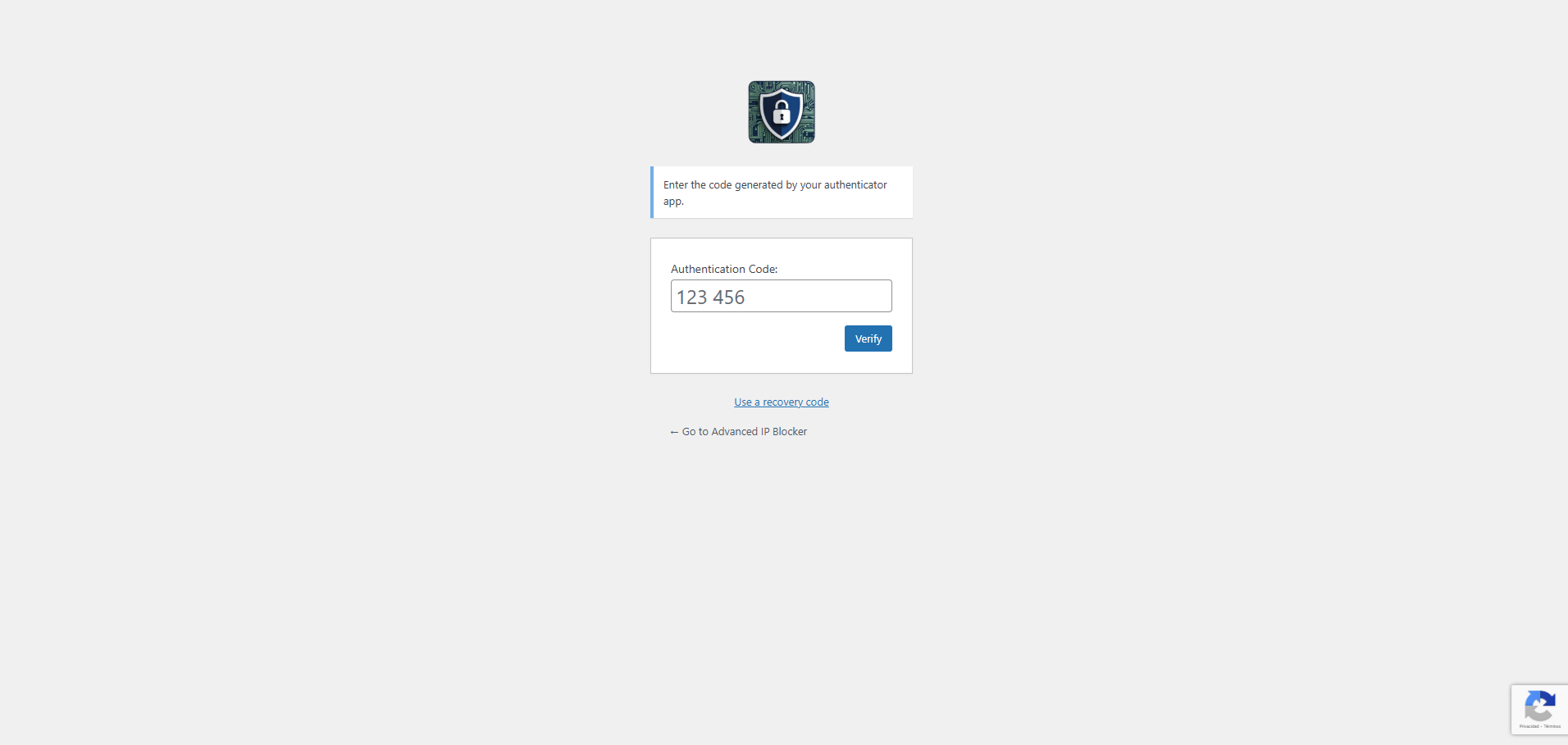
wp-login.phpandxmlrpc.phpwith a JavaScript challenge during sustained distributed attacks, preventing server overload. - Two-Factor Authentication (2FA): Secure user accounts with industry-standard TOTP authentication, backup codes, role enforcement, and a central admin management dashboard.
- IP Trust & Threat Scoring System: An intelligent defense that assigns "threat points" to IPs for malicious actions, blocking them only when they reach a configurable score. More accurate and context-aware than simple rules.
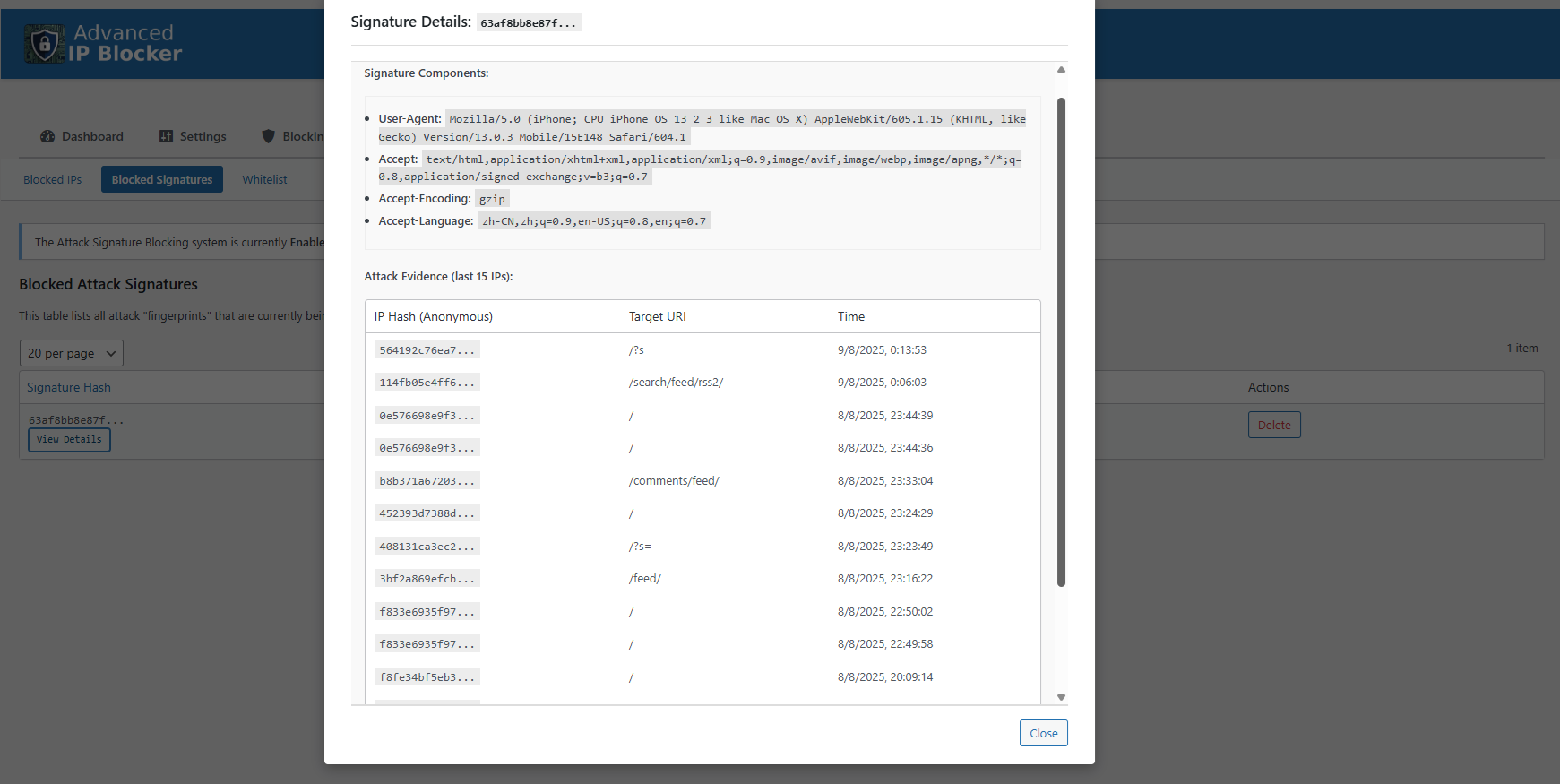
- Attack Signature Engine: Proactively stops distributed botnet attacks by identifying and blocking the attacker's "fingerprint" (signature) instead of just individual IPs.
- Web Application Firewall (WAF): Block malicious requests (SQLi, XSS, etc.) with a customizable ruleset.
- File Integrity Monitor & Quarantine Vault: Automatically scans WordPress core files and the uploads directory for malware, unauthorized modifications, and hidden PHP shells. Safely neutralize threats by moving them to an encrypted Quarantine Vault.
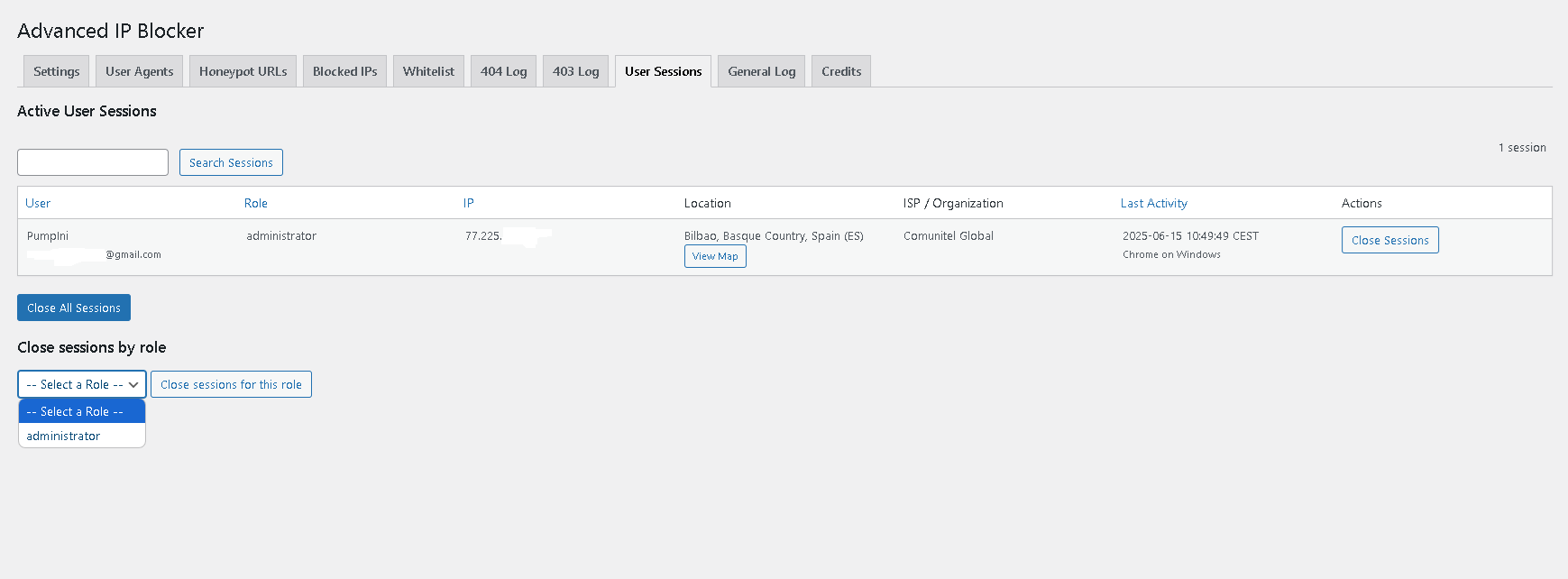
- And much more: Rate Limiting, Country & ASN Blocking (with Spamhaus support), ASN Whitelisting, Push Notifications, Google reCAPTCHA, Honeypots, Active User Session Management, and Full WP-CLI Support.
安装:
- Upload the
advanced-ip-blockerfolder to the/wp-content/plugins/directory. - Activate the plugin through the 'Plugins' menu in WordPress.
- A new "Security" menu item will appear in your admin sidebar. All settings are located there.
- Crucial: Visit
Security > Dashboard > System Statusto ensure your IP and your server's IP are whitelisted. Use the one-click buttons if they are not.
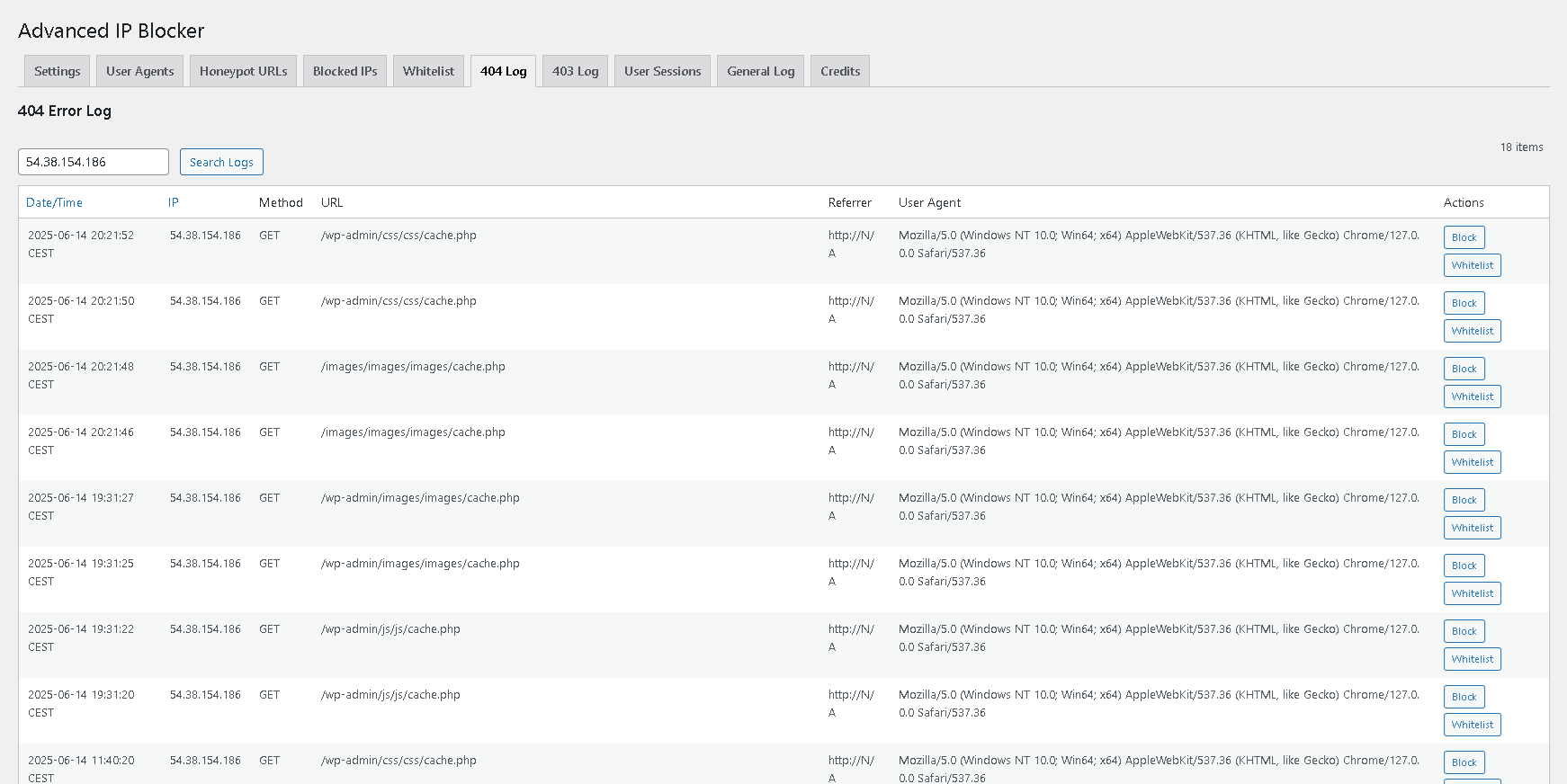
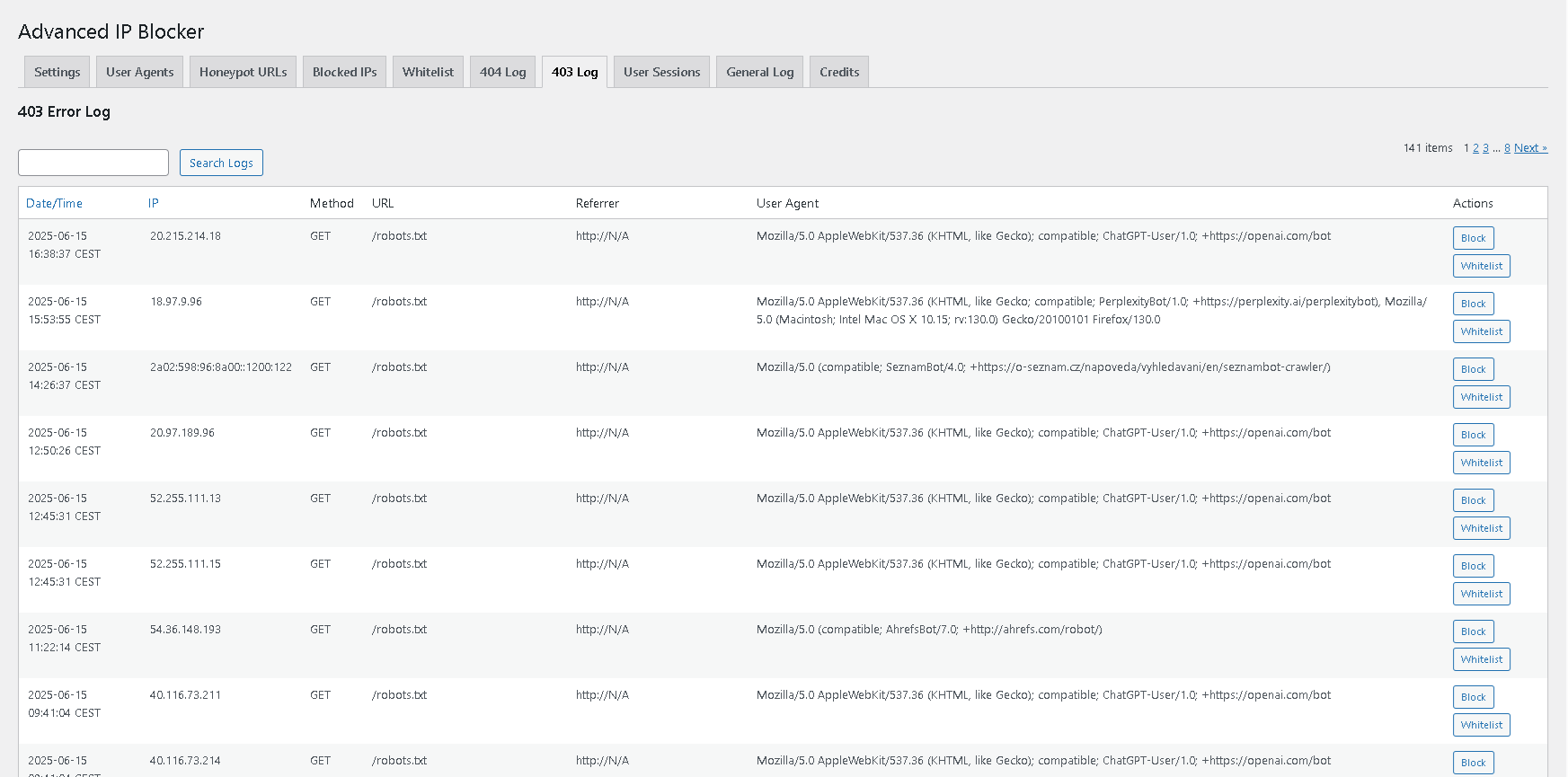
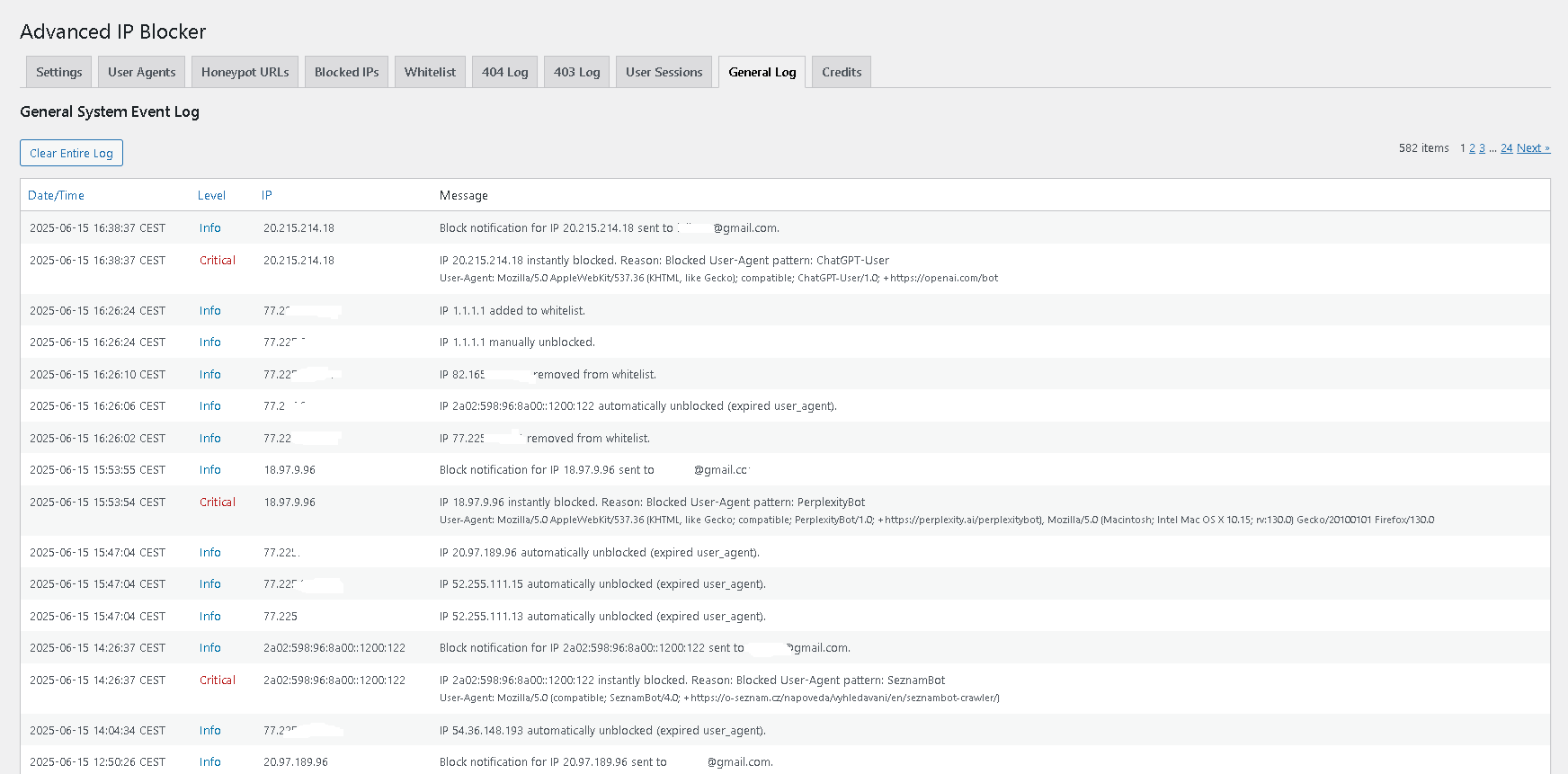
屏幕截图:
常见问题:
How does Admin Access Control work?
By default, all users with the Administrator role can access and configure Advanced IP Blocker. If you have multiple administrators but only want specific users to manage security settings, you can explicitly select them in the "Hardening & Core Protection" tab. The primary admin (ID 1) is always protected from lockouts. Other admins will not even see the "Security" menu.
Can I block PHP execution in the Uploads folder?
Yes! In the "Hardening & Core Protection" section, you can enable "Block PHP in Uploads". The plugin will automatically place a specialized .htaccess file in your uploads directory to prevent any uploaded scripts from being executed, which is a common backdoor technique used by attackers.
What is the Intelligent Zero-Day WAF Sync?
This is a game-changing feature that automatically synchronizes your site's Web Application Firewall with our Central Security Server. Once a day, the plugin securely downloads the latest zero-day vulnerability signatures (e.g., for critical CVEs or widespread exploits) and injects them directly into the scanning engine. This means your site is protected instantly against new threats without waiting for a plugin update. Importantly, these rules run in a dedicated, invisible layer and will NEVER overwrite or interfere with your own custom WAF rules.
What is Block Ghost IPs?
This feature automatically blocks incoming traffic from IP addresses that lack an Autonomous System Number (ASN) and Reverse DNS (rDNS) record. Since legitimate traffic almost always has these identifiers, Ghost IPs are often malicious actors trying to hide. Please note that this can cause false positives if a legitimate Internet Service Provider (ISP) has misconfigured their rDNS.
What are Captcha Integrations (Turnstile & hCaptcha)?
Our new Captcha Integrations allow you to seamlessly connect modern verification challenges like Cloudflare Turnstile and hCaptcha to your security modules. You can set a Global Default Engine and even apply different challenges granularly per module. To ensure your site never breaks, it includes a smart fallback to our invisible JS Challenge if your API keys are ever misconfigured or missing.
How do Rate Limiting Advanced Rules work?
Instead of a single global rate limit for your entire site, Advanced Rules allow you to define custom limits for specific URLs or endpoints. You can define the maximum number of requests, the time window, and the specific action (like returning a 429 error, a 403 block, or triggering a Turnstile/hCaptcha challenge) for each endpoint independently. This is ideal for protecting sensitive areas like login pages or APIs with stricter limits while allowing normal traffic on the rest of the site.
What is Distributed Attack Protection (Auto-Panic)?
This feature automatically engages a global JavaScript challenge to protect your server resources from massive spikes in malicious traffic. It monitors the number of blocks within a specific time window and, if the threshold is reached, it shields the entire site. Legitimate administrators, verified bots (like Googlebot), and explicitly excluded URLs are bypassed. You can configure the thresholds and notification preferences under Security > Settings > Core Protections.
What is the IP & ASN Diagnostics Tool (IP Inspector)?
It is a powerful built-in utility located in your Security menu (and top admin bar) that allows you to manually inspect any IP address or Autonomous System Number (ASN). It instantly cross-references the subject against your Geolocation databases, Threat Scoring system, AbuseIPDB, Spamhaus drops, and local whitelists/blocklists. It is the ultimate tool for investigating suspicious traffic or verifying if a legitimate user was blocked by a specific rule.
How does the Vulnerability Scanner work?
The scanner checks your site in two ways: Local Scan: Checks for outdated PHP versions, WordPress core updates, debug mode risks, and SSL status. This runs locally and instantly. Deep Scan (Vulnerability Audit): Checks your installed plugins and themes against our central database of known security vulnerabilities (CVEs). This process is manual (you click a button) to ensure it never slows down your site during normal operation.
What is the new Audit Log?
The Audit Log is your site's "black box". It records critical administrative actions such as plugin activations, settings changes, and file modifications. This helps you identify "who did what and when," which is essential for troubleshooting and security forensics.
How does the File Integrity Monitor (FIM) work?
The FIM acts as a forensic security layer. It takes cryptographic fingerprints of your most critical core files (like wp-config.php) to detect unauthorized modifications. Additionally, it recursively scans your wp-content/uploads/ media folder to detect and alert you of hidden PHP web shells. If an anomaly is found, you can neutralize it instantly by sending it to the encrypted Quarantine Vault.
Why did you move the Community Blocklist to a custom table?
To ensure maximum performance as the network grows. Storing thousands of IPs in standard WordPress options (wp_options) can slow down a site. By moving this data to a dedicated, indexed database table (wp_advaipbl_community_ips), we ensure that lookups are lightning-fast (O(1) complexity) and consume negligible memory, regardless of how many threats we track.
What is the Community Defense Network?
It is a collaborative security feature where users share anonymized data about verified attacks (like SQL injections caught by the WAF or IPs flagged by AbuseIPDB). Our central server aggregates this data to create a global blocklist of active threats. You can choose to contribute data ("Join") and/or use the global list to protect your site ("Enable Blocking").
Does the Community Network slow down my site?
No. The data sharing happens in the background via a low-priority scheduled task (Cron) just a few times a day. The global blocklist is downloaded locally and cached, so checking an IP against it is instant (microseconds) and does not require external API calls.
How do I set up Cloud Edge Defense (Cloudflare)?
You need a free Cloudflare account and your domain must be using Cloudflare's nameservers.
- Go to Security > Settings > Cloud Edge Defense.
- Enter your Cloudflare API Token (with "Zone > Firewall Services > Edit" permissions) and Zone ID.
- Click "Verify" and save. The plugin will now automatically push your blocked IPs to Cloudflare's Firewall. For a step-by-step guide with screenshots, click the help icon in the settings or visit our website.
Is the Server-Level Firewall (.htaccess) safe?
Yes. Safety is our priority.
- Backups: The plugin automatically creates a timestamped backup of your .htaccess file in a protected folder every time it writes new rules.
- Compatibility: It automatically detects your server type and generates valid syntax for Apache 2.2 or 2.4.
- Safety Limit: It includes a safety limit on the number of IPs written to the file to prevent server memory issues.
What if I use Nginx instead of Apache?
The "Server-Level Firewall (.htaccess)" feature relies on Apache/LiteSpeed specific files. If you use Nginx (without Apache), these local rules will be ignored by the server. Recommendation: For Nginx users, we strongly recommend enabling the Cloud Edge Defense (Cloudflare) feature. It provides the same "pre-execution" blocking benefits but works on any server environment since the blocking happens in the cloud.
How should I configure the plugin for my specific website?
While every website's security needs are unique, here is a general guide to get you started. For a deep dive into every feature, please consult our Comprehensive Feature Guide.
- Essential First Steps (All Sites): After installation, run the Setup Wizard or manually go to
Security > Dashboard > System Statusto whitelist your IP and your server's IP. Then, enable logging. - Blogs/Business Sites: Enable the "IP Trust & Threat Scoring System", "WAF", "Rate Limiting", and "Spamhaus ASN Protection".
- E-commerce/Membership Sites: Enable "Two-Factor Authentication (2FA)" for admin roles and use "Geo-Challenge" instead of hard geoblocking for countries where you have customers. Do not use "Whitelist Login Access".
- Sites with a CDN (Cloudflare): Go to
Security > Settings > IP Detectionand add your CDN's ASN (e.g.,AS13335for Cloudflare) to the "Trusted Proxies" list. This is critical for accurate IP detection.
What is AbuseIPDB Protection and how does it work?
AbuseIPDB is a global, crowdsourced project that tracks and reports malicious IP addresses in real-time. Our new integration allows the plugin to check the reputation of a new, unknown visitor against this database on their first visit. If the IP has been recently reported by others for activities like hacking, spam, or brute-force attacks, and its "abuse confidence score" is above your configured threshold, the plugin will block it instantly. This acts as a proactive shield against known bad actors, stopping them before they even have a chance to test your defenses. You can enable it and add your free API key under Security > Settings > Threat Intelligence.
What is "Known Bot Verification"?
This is an advanced security feature that checks if visitors claiming to be from major search engines (like Googlebot) are legitimate. It performs a DNS lookup to verify their IP address. If the check fails, the visitor is identified as an "impersonator" and receives a high threat score, preventing them from exploiting the trust given to real crawlers. This feature is enabled by default under Settings > Core Protections.
What is "Verify Monitoring Bots (IP List)"?
This feature ensures your uptime monitoring services (like UptimeRobot, Pingdom, StatusCake, etc.) can always reach your site to check its status. By automatically downloading and updating official IP lists from these providers, the plugin safely whitelists them from rate limiting or blocking without exposing your site to attackers who might spoof their user agents.
What is "Trusted Proxies" and why do I need it?
This is a critical security feature that prevents IP spoofing. If your site is behind a service like Cloudflare, Varnish, or another reverse proxy, the server's direct connection IP (REMOTE_ADDR) will always be the proxy's IP, not the visitor's. The real visitor IP is sent in an HTTP header (e.g., CF-Connecting-IP). An attacker can fake this header. The "Trusted Proxies" setting tells the plugin: "Only trust these headers if the request comes from an IP address I know is my proxy." You can add IPs, CIDR ranges, or ASNs (like AS13335 for Cloudflare) to this list under Security > Settings > IP Detection.
What is Geo-Challenge? How is it different from Geoblocking?
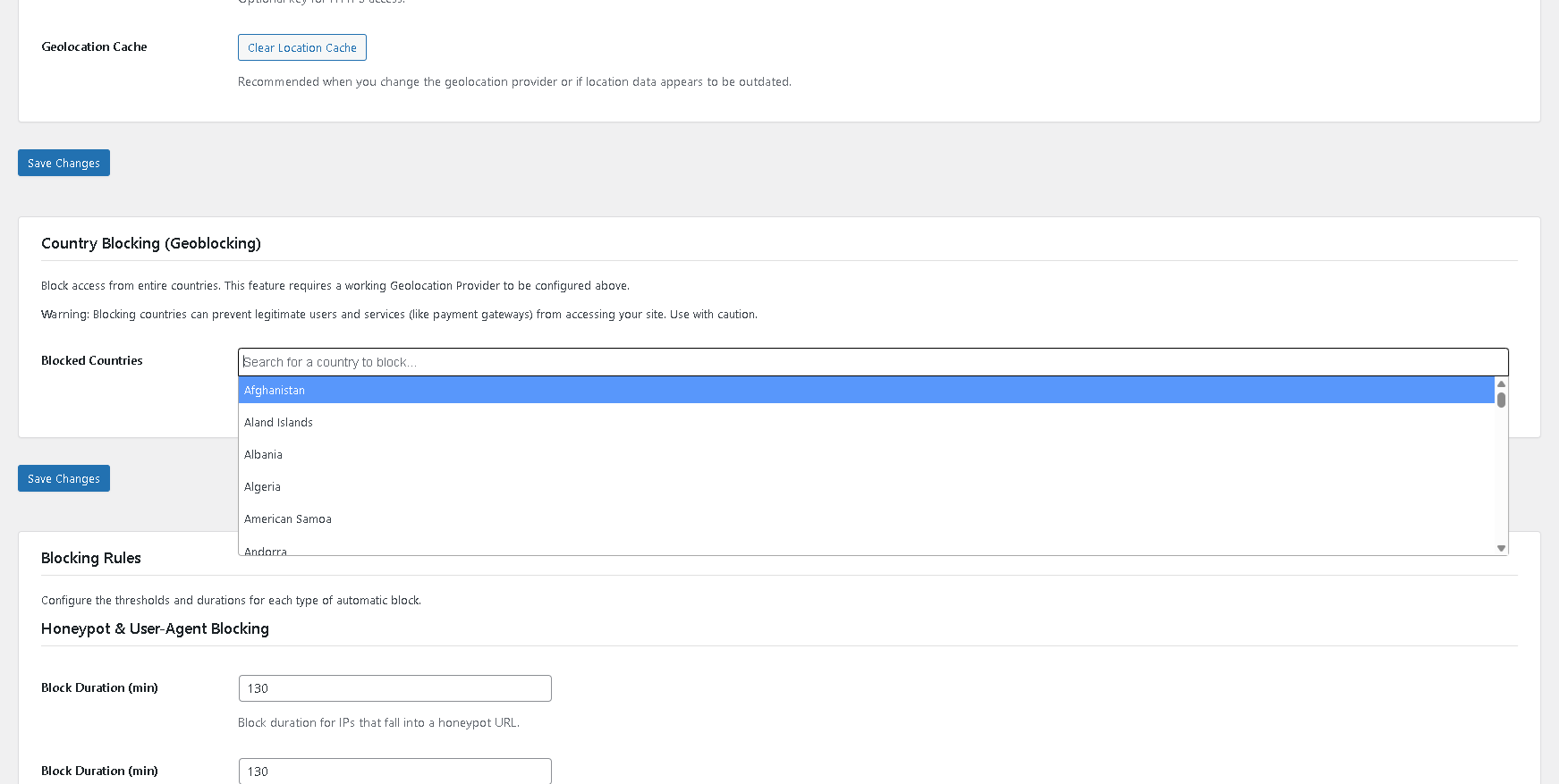
Geoblocking is a hard block. It shows a "403 Access Denied" page to visitors from selected countries.
Geo-Challenge is a soft block. It shows a quick, automated JavaScript test to visitors from selected countries. Legitimate humans pass instantly, while most bots are stopped. This is useful for regions you are suspicious of but do not want to block entirely. You can, for example, block Country A and challenge Country B. You can configure it in Security > Settings > Core Protections.
What is the difference between Automatic and Managed JS Challenge Modes?
Automatic (Transparent execution): The plugin runs a silent Proof-of-Work (PoW) mathematical challenge in the background. If the visitor's browser solves it within 5 seconds, they are automatically redirected to their destination without needing to click anything. Great for a frictionless user experience. Managed (Human interaction required): The visitor must manually click a checkbox ("I am human") and optionally wait a few seconds. This mode is the ultimate defense against advanced headless browsers and intelligent bots that can solve mathematical scripts but cannot simulate human mouse interactions.
How do I solve issues with the JavaScript challenge and caching plugins?
The JavaScript challenge (used by Geo-Challenge, Signature Engine, and Endpoint Lockdown) requires dynamic content. Aggressive page caching can interfere with it. If you experience issues (like a challenge loop or a "Verification failed" error), you must configure your caching plugin (e.g., WP Rocket, WP Fastest Cache, LiteSpeed Cache) to NOT cache pages for visitors who do not have the advaipbl_js_verified cookie. Most caching plugins have a setting like "Never cache pages that use this cookie."
How do I solve issues with the JavaScript challenge and cookie consent (RGPD/GDPR) plugins?
Cookie consent plugins (like CookieYes) may block our security cookie from being set. To fix this, you must go into your cookie plugin's settings and classify the cookie named advaipbl_js_verified as "Strictly Necessary" or "Essential". This will allow the security challenge to function correctly.
What is the new "Local Database" Geolocation Method?
For maximum performance, the plugin offers two ways to identify an IP's location (Security > Settings > Geolocation):
- Real-time API (Default): Easy to set up and great for most websites.
- Local Database (Highest Performance): Downloads the MaxMind GeoLite2 database to your server for instant, offline lookups with zero external API calls. Recommended for high-traffic sites. Requires a free MaxMind license key.
How do I set up Two-Factor Authentication (2FA)?
- Admin: Go to
Security > Settings > Login & User Protectionand enable 2FA globally. You can also enforce it for specific user roles. - User: Go to your WordPress Profile page. You will find a new section to set up 2FA by scanning a QR code with an authenticator app and saving your backup codes.
What is the "Attack Signature Engine"?
This is an advanced defense that stops botnets by blocking the attacker's "fingerprint" (signature), not just their IP. It works in three phases you can enable in Security > Settings > Signature Engine: Logging, Analysis (a background task that finds patterns), and Blocking (presents a JS challenge to malicious signatures). You can manage detected signatures in IP Management > Blocked Signatures.
What is the difference between the WAF, Signature Engine, and Advanced Rules?
Think of them as three layers of defense:
- WAF (Web Application Firewall): The simplest layer. It blocks requests based on simple malicious patterns (e.g.,
union select). It's fast and stops common, generic attacks. - Attack Signature Engine: The automated layer. It looks for patterns of attack from many different IPs (botnets) and blocks the attack's "fingerprint" (signature) for all visitors. You don't create these rules; the plugin does.
- Advanced Rules Engine: The manual control layer. This is where you build your own specific, multi-conditional rules. For example: "IF the visitor is from China AND is trying to access
/wp-admin/THEN Block them permanently." It gives you the ultimate power to create a security policy tailored exactly to your site's needs.
How should I configure the plugin for my specific website?
While every website's security needs are unique, here is a general guide to get you started based on your site's profile. For a deep dive into every feature, please consult our Comprehensive Feature Guide. 1. Essential First Steps (For ALL Websites) No matter your site type, do these three things immediately after installation to ensure a strong baseline security without locking yourself out:
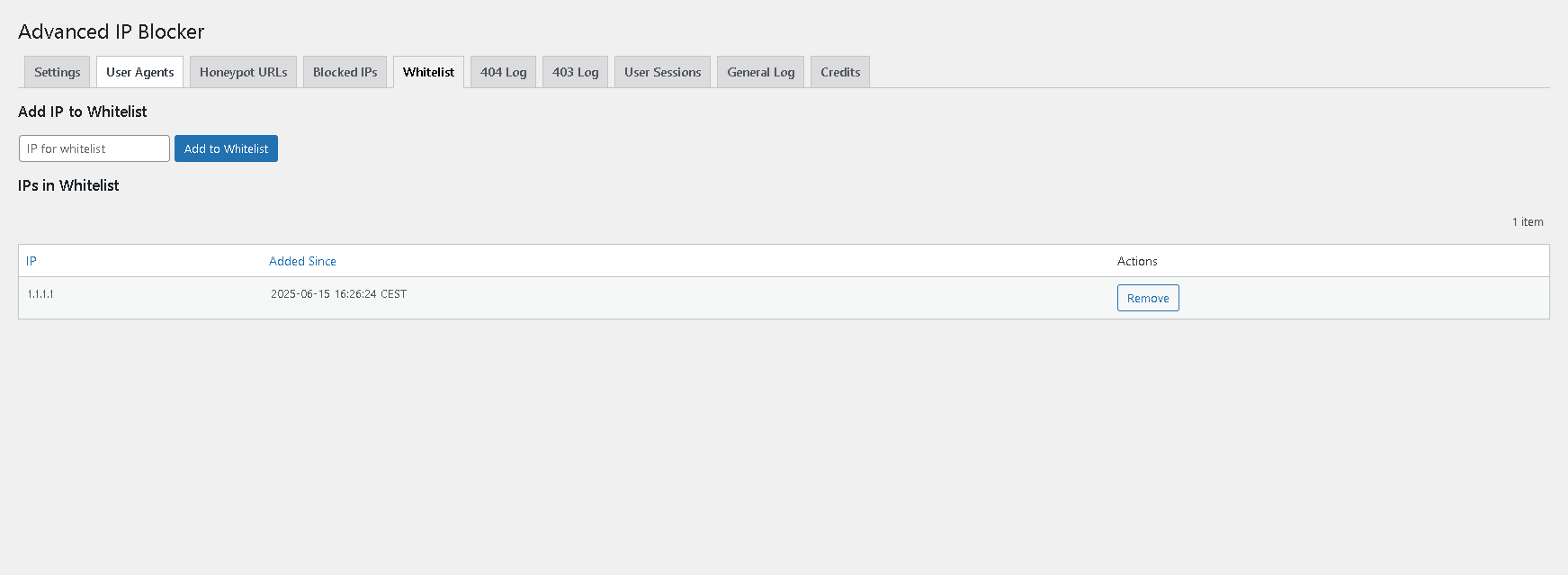
- Whitelist Your IPs: Go to
Security > Dashboard > System Statusand use the one-click buttons to add your current IP and your server's IP to the whitelist. This is the most critical step. - Activate Trap Defenses: Go to
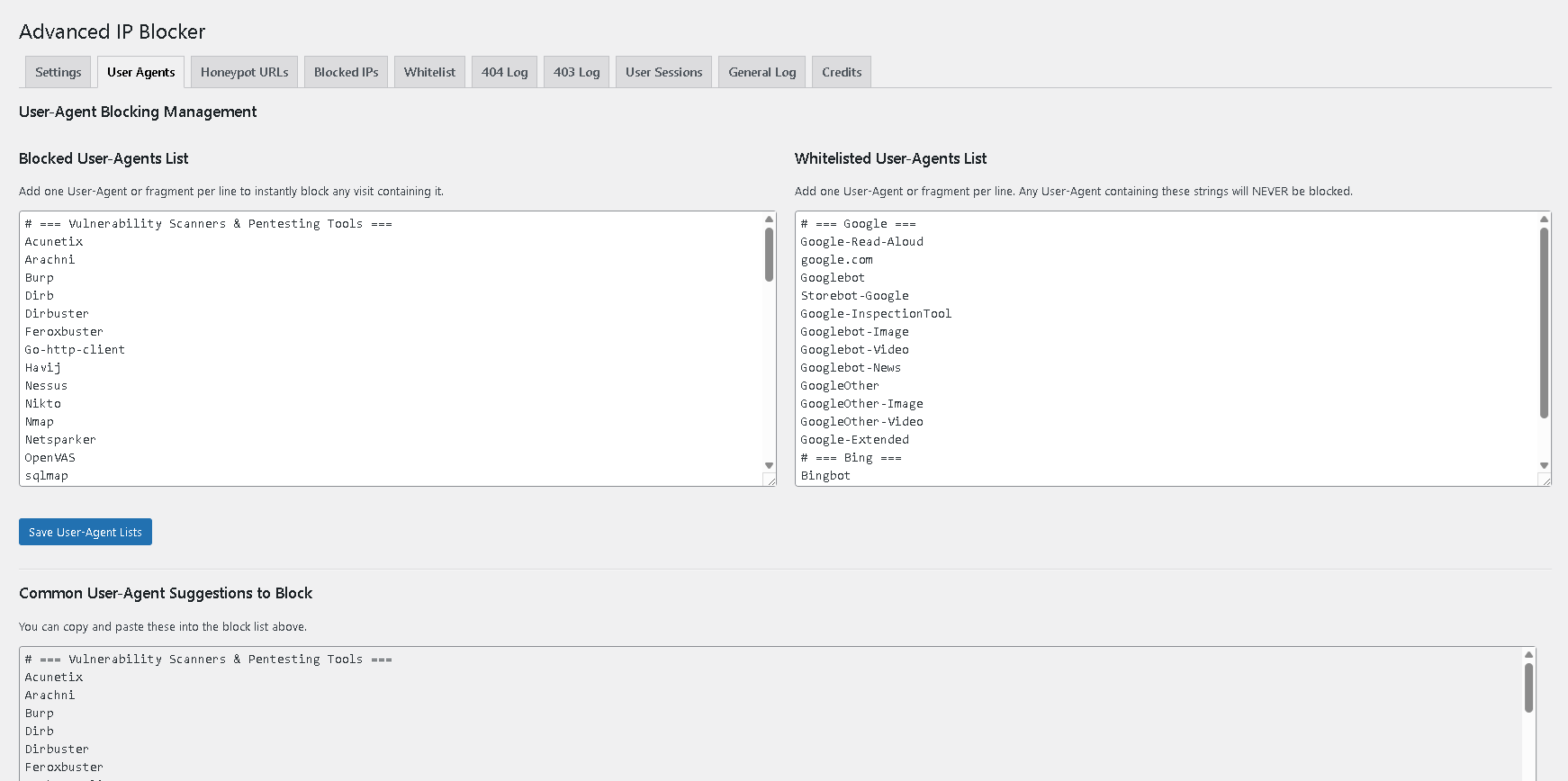
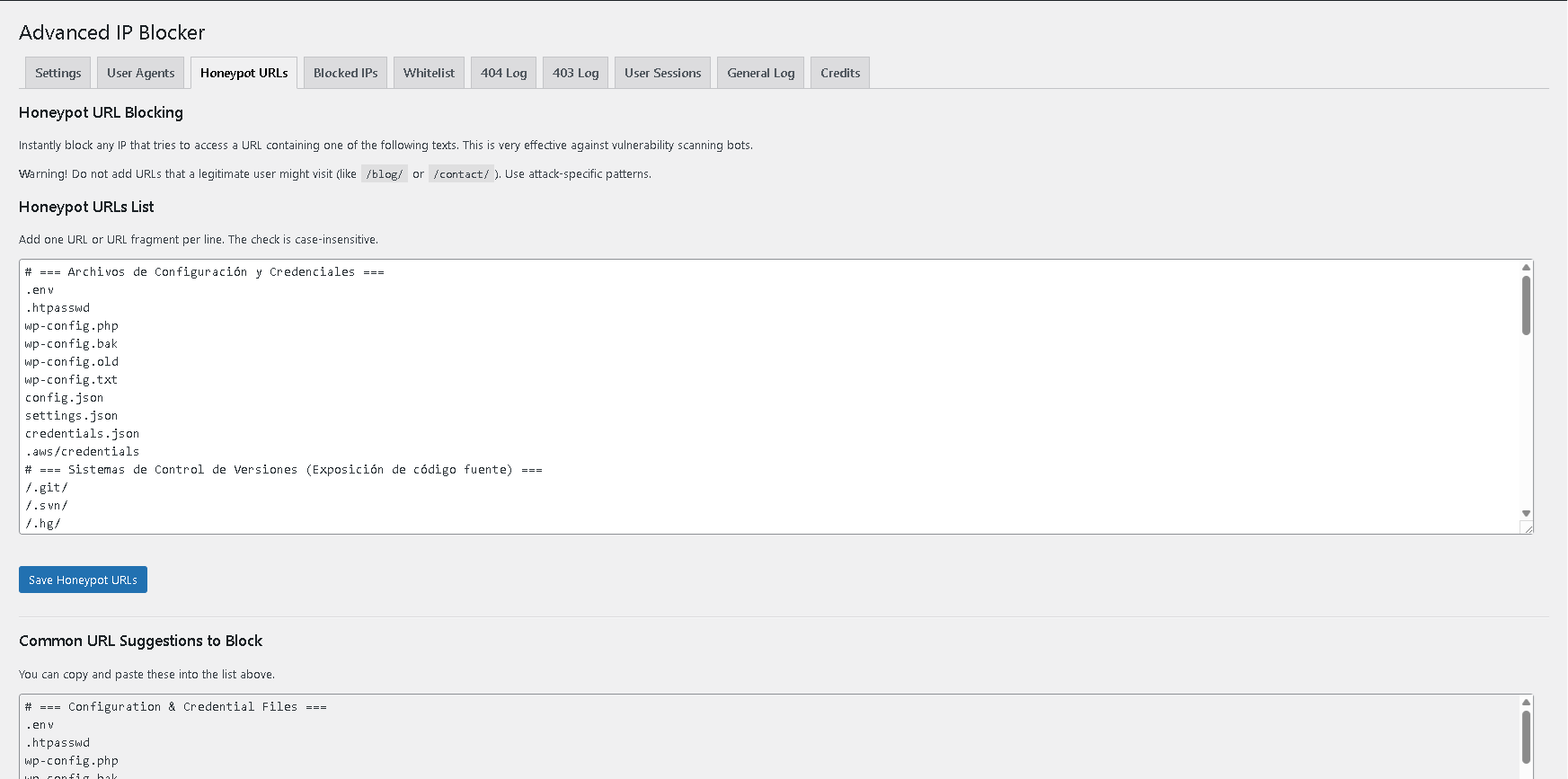
Security > Blocking Rules, and in the "User Agents" and "Honeypot URLs" tabs, copy the suggested lists into the active blocklist text areas. This provides immediate protection from thousands of common bots. - Enable Logging: Go to
Security > Settings > Generaland ensure "Enable Logging" is turned on. This gives you the visibility you need to understand what is happening on your site.
- Enable the IP Trust & Threat Scoring System: This is the smartest way to block bad actors contextually. The default point values are an excellent starting point. (Found in
Settings > IP Trust & Threat Scoring). - Enable the WAF and Rate Limiting: These are powerful proactive defenses. (Found in
Settings > Core ProtectionsandThreshold Blocking). -
Enable Spamhaus ASN Protection: Let the plugin automatically block thousands of known malicious networks for you. (Found in
Settings > Core Protections). For an E-commerce or Membership Site (WooCommerce, etc.): You need to protect your site while ensuring legitimate customers from around the world are never blocked. -
Enable Two-Factor Authentication (2FA): This is the single best way to protect administrator and shop manager accounts. Enforce it for these roles in
Settings > Login & User Protection. - Use Geo-Challenge Instead of Geoblocking: If you receive attacks from a specific country but also have customers there, use the Geo-Challenge feature instead of a hard block. This will stop bots without affecting human users.
- CRITICAL: DO NOT USE "Whitelist Login Access". This feature will lock out your customers.
- WAF Exclusions: Double-check that URLs for your payment gateways (like Stripe or PayPal webhooks) are in the WAF exclusion list to ensure payments are processed correctly. For Any Site Using a CDN or Reverse Proxy (like Cloudflare): Your top priority is ensuring the plugin detects the correct visitor IP address.
-
Configure Trusted Proxies: Go to
Security > Settings > IP Detection. Add the IPs or, even better, the ASNs of your CDN/proxy service to this list. For Cloudflare, simply addAS13335on a new line. This is essential for the accuracy of all other security features.
How can I protect a non-WordPress folder on my site?
This plugin includes an advanced "Edge Firewall Mode" that allows you to extend its protection to any PHP script on your server. This is perfect for securing custom applications or directories that are not managed by WordPress. To enable it, you need to add a single line of code to the beginning of the PHP file you want to protect. This manual step ensures that the protection is explicit and works on any server environment. For a complete step-by-step guide, please see our documentation: How to Protect Non-WordPress Folders.
What are HTTP Security Headers and why do I need them?
HTTP Security Headers are instructions sent by your website to the visitor's browser. They tell the browser how to behave to prevent specific types of attacks.
- HSTS: Forces the browser to use a secure HTTPS connection.
- X-Frame-Options: Prevents other sites from embedding your site in an iframe (Clickjacking protection).
- X-Content-Type-Options: Prevents the browser from "guessing" the file type (MIME sniffing protection).
- Permissions-Policy: Controls which features (camera, mic, etc.) legitimate sites can use.
You can configure all of these (and more!) in
Security > Settings > Security Headers.
What does the "Username Blocking" feature do?
It allows you to create aggressive, targeted rules to block login attempts based on the username provided. For example, if you know you never use the username "admin", you can create a rule: IF Username IS "admin" THEN Block. This stops brute-force attacks instantly before they can even guess a password.
Why was the "Direct File Access" warning added for the loader file?
We improved our security compliance checks. The advaipbl-loader.php file is a special file designed to run outside of WordPress in "Edge Mode". We added a specific security check to ensure it can only be run via the auto_prepend_file mechanism and cannot be accessed directly by a browser, further hardening the plugin against probing.
更新日志:
- NEW FEATURE: Enhanced Remote Security Advisories (
ADVAIPBL_Remote_Notices) with intelligent local environment filtering, allowing security alerts to target specific vulnerable PHP branches (including EOL branches) or specific installed/active plugins and themes by slug and version threshold. - ENHANCEMENT: Linked File Integrity Monitor (FIM) critical file modification email alerts to the master "Enable Email Notifications" toggle (
enable_email_notifications) for consistent centralized email notification control. - UI/UX: Clarified the "Enable Email Notifications" setting description to indicate that it governs both IP block notifications and system/security event alerts (such as AbuseIPDB quota warnings and FIM alerts).
- SECURITY: Hardened Two-Factor Authentication (2FA) by enforcing on-demand initialization of
ADVAIPBL_2FA_Manageracross all authentication contexts (including frontend login forms like WooCommerce/my-account/and custom login URLs), adding server-side expiration (advaipbl_2fa_step1_expires) to Step-1 interim tokens, and automatically revoking Step-1 tokens upon reaching the brute-force lockout threshold. - SECURITY: Upgraded the native JavaScript Challenge engine (Automatic & Managed modes) from static arithmetic to a cryptographic FNV-1a 32-bit Proof-of-Work (PoW) challenge with split-seed reconstruction, headless browser detection (
navigator.webdriver), trusted DOM event verification (event.isTrusted), IP/mode HMAC binding, minimum execution time enforcement, and anti-replay protection. - BUGFIX: Fixed IPv6 geolocation failures when using the MaxMind GeoLite2 Local Database by adding fallback resolution to
registeredCountry,representedCountry, andGeoLite2-Country.mmdb, as well as triggering external API fallback when local records only contain ASN data without a country code. - BUGFIX: Resolved a File Integrity Monitor (FIM) false-positive alert on subdirectory WordPress installations (where
siteurlandhomediffer) caused by.htaccesspath resolution mismatches between the.htaccessFirewall Manager (root/.htaccess) and the FIM scanner (ABSPATH . '.htaccess'). - ENHANCEMENT: Hardened root
.htaccesspath resolution inADVAIPBL_Htaccess_Managerto deterministically compute the home directory fromABSPATHacross frontend, WP-Cron, and CLI execution contexts. - BUGFIX: Removed a duplicate warning log entry when a JS Challenge verification fails.
- ENHANCEMENT: File Integrity Monitor (FIM) now captures cryptographic hash and file size deltas (e.g.,
old_size->new_size,old_hash->new_hash) in alert emails and the Audit Log, helping administrators instantly distinguish between byte-level line-ending changes and file modifications. - ENHANCEMENT: Added file size tracking to the baseline snapshots (
advaipbl_fim_baseline_hashes) with full backward compatibility for existing installations. - BUGFIX: Fixed an issue in the FIM baseline updater where newly discovered or added files were not being committed to the stored baseline.
- BUGFIX: Resolved File Integrity Monitor (FIM) false-positive alert loop where updated baseline hashes were not committed after sending modification alerts for critical files (wp-config.php and .htaccess).
- NEW FEATURE: Added a one-click "Reset Baseline Hashes" button in Internal Security settings allowing administrators to immediately re-synchronize FIM snapshots after making legitimate server modifications.
- ENHANCEMENT: Added support for
wp-config.phplocated in the parent directory above the WordPress root (standard WordPress hardening architecture). - ENHANCEMENT: Enhanced path normalization and matching in the File Verifier engine across Apache, Nginx, and Windows server environments.
- PERFORMANCE: Optimized Security Dashboard map loading during large DDoS and botnet attacks. The live attack map now pre-sorts and limits attack events to the 200 most recent entries before performing geolocation lookups, completely eliminating 30-second PHP execution timeouts and AJAX errors when thousands of IPs are blocked.
- UI/UX: Updated the Security Dashboard map widget title to "Live Attack Map (Latest 200 Attacks)" to clearly differentiate the rendered map markers from the total blocked IPs counter badge.
- Security (Critical): Fixed an Authentication Bypass vulnerability where users with Two-Factor Authentication (2FA) enabled could bypass 2FA checks via XML-RPC using their standard password.
- Security: Hardened the 2FA authentication flow by migrating the interim Step-1 token from URL parameters to a secure, HttpOnly cookie, preventing token leakage in server access logs and browser history.
- Enhancement: Integrated the 'Login Whitelist Block' restriction into the core Threat Score engine. Repeated unauthorized login attempts now accumulate points and trigger network-level bans (Cloudflare/.htaccess).
- Feature: Added 'Login Whitelist Block' to the Threat Score configuration UI so administrators can customize the penalty points.
- Fix: Corrected a visual bug in the Security Audit Log where access rejections (such as Login Whitelist, Geo-blocking) were erroneously displayed as "Blocked: Permanent". They are now accurately labeled as "Request Rejected".
- Fix: Fixed an issue where the attacker's IP was displayed as "N/A" in the Security Log for Login Whitelist block events.
- Security: Enhanced 2FA brute-force protection. Administrators can now configure the "Max 2FA Failures" and "Lockout Duration" directly from the Login Security settings.
- Security: Differentiated generic login failures from 2FA failures. The Audit Log now flags failed 2FA attempts as "Critical - Password Compromised" instead of generic invalid credentials.
- Security (Critical): Fixed an Authentication Bypass vulnerability in the Two-Factor Authentication (2FA) login flow.
- Security: Implemented strict anti-brute-force rate limiting for 2FA TOTP verification (accounts are temporarily locked for 15 minutes after 5 failed attempts).
- Security: Failed 2FA attempts now correctly trigger the native WordPress wp_login_failed hook, ensuring compatibility with server-level IP banning tools like Fail2Ban.
- I18n: Added missing translation strings for the new 2FA security prompts to the .pot file.
- COMPATIBILITY: Full Nginx Environment Support. The plugin now intelligently detects Nginx servers and automatically adapts its UI to disable unsupported
.htaccessfeatures in the Setup Wizard and Settings pages. - ENHANCEMENT: Added a built-in Nginx Vhost snippet generator. Nginx users are now provided with exact copy-paste configuration rules to protect sensitive plugin directories and block malicious PHP execution in the uploads folder.
- ENHANCEMENT: The HTTP Security Headers module now explicitly notifies Nginx users of its dynamic PHP fallback mechanism and provides guidance for static file protection.
- ENHANCEMENT: The System Status dashboard now accurately reports
.htaccesscore file permission checks as 'Not Applicable' on Nginx servers instead of showing misleading errors. - BUGFIX: Resolved a critical MySQL syntax error triggered during the "Unblock All IPs" and expired IP cleanup routines, caused by a misplaced code validation comment inside the database query.
- NEW FEATURE: Zero-Day Advanced Telemetry. The dashboard now tracks exact analytics (
first_seen,unique_ips,unique_sites) for each blocked Zero-Day attack to provide deeper threat intelligence. - NEW FEATURE: Manual Sync for the Community Defense Network. Added a "Sync Now" button with AJAX feedback to manually force the latest community threat feed update.
- ENHANCEMENT: Advanced Rules Engine can now seamlessly parse and flatten
multipart/form-datapayloads (including$_FILES), drastically improving the interception of Arbitrary File Upload zero-day exploits. - ENHANCEMENT: Increased the responsiveness of the Remote Security Notices synchronization by updating the local cron interval from 24 hours to 6 hours.
- BUGFIX: Implemented an API transient lock for the Wordfence Vulnerability Importer to protect the free tier API quota from being suspended by repetitive WP-Cron executions.
- ENHANCEMENT: Integrated the "Whitelist Login Countries" feature with the Threat Scoring Engine. Failed login attempts from unauthorized countries now accumulate threat score points (default: 25) instead of just showing a soft block, leading to an automatic hard block for persistent bots.
- OPTIMIZATION: Drastically improved WordPress Admin performance by implementing a Smart Transient Cache system for database pagination
COUNT()queries. This allows viewing the full history of millions of records (e.g. 100,000+ pages) without crashing the server or triggering MySQL 'Slow Queries'. - BUGFIX/OPTIMIZATION: Resolved 'API Required' map errors on the IP Inspector tab by replacing the CARTO map tiles with an embedded OpenStreetMap iframe. This change also eliminates unnecessary map-related Javascript (Leaflet) from loading on this tab, improving dashboard performance.
- BUGFIX: Fixed an issue where critical plugin notifications (AIB Alerts, Force 2FA, Setup Wizard, and Threat Feed Status) were being incorrectly suppressed within the plugin's own dashboard pages.
- SECURITY: Implemented a new internal authentication header (
X-AIB-Auth) across all API endpoints to improve communication security and bypass restrictive firewall/CGI configurations that strip standard authorization headers. - ENHANCEMENT: Added version tracking parameters to all API requests to ensure better backward compatibility and diagnostic capabilities with the central server.
- BUGFIX: Resolved a critical MySQL
max_allowed_packeterror that caused the File Integrity Monitor (FIM) malware signatures synchronization to fail on local environments (like XAMPP) and restrictive shared hosting. Signatures are now smartly chunked into smaller payloads before being saved to the database.
- ENHANCEMENT: Upgraded the Advanced WAF Rules Engine to use
apache_request_headers()as a fallback, ensuring sensitive headers (likeAuthorization) can be evaluated even on restrictive Apache/LiteSpeed environments that hide them from$_SERVER. - BUGFIX: Added the fallback header to the V4 Community Blocklist fetch routine to ensure API tokens are reliably transmitted and bypass strict CGI server configurations.
- NEW FEATURE: Introduced a Remote Admin Notifications system. You will now receive important security alerts, zero-day warnings, and feature updates directly in your WordPress dashboard without needing a plugin update.
- ENHANCEMENT: True 'Hybrid' Dual-Logging for Telemetry. Telemetry events are now reliably tracked in the database without altering or duplicating the native
debug.logformats. - BUGFIX: Fixed a UI layout issue in the Security Logs where massive Captured Request Payloads (like reCAPTCHA tokens) stretched the container horizontally. Added proper CSS word-wrapping.
- BUGFIX: Resolved a PHP Fatal Error caused by a missing variable (
$stripe_webhook_ips) during array merging for immune IPs. - TWEAK: Added Redsys and Paddle to the global immune IPs list to prevent accidental blocks on legitimate payment webhooks.
- SECURITY: Added Zero-Day WAF protection against the Bookly AI IDOR vulnerability (CVE-2026-89063) via Advanced Rate Limiting.
- BUGFIX: Resolved a PHP Fatal Error (500 Internal Server Error) triggered by the Advanced Rules engine when a rate limit (
429) action was executed. - BUGFIX: Fixed an issue where Advanced Rule rate limit blocks were not being displayed in the Security Logs dashboard.
- SECURITY: Patched a critical Arbitrary File Move (Path Traversal) vulnerability in the File Integrity Monitor quarantine endpoint.
- SECURITY: Added strict IP-based transient rate limiting to legacy V1 and V2 telemetry endpoints to prevent database poisoning and bot spam.
- SECURITY: Security Audit completed. Verified 100% CSRF (Nonce) and Privilege Escalation protection across all 40+ AJAX and Admin Post endpoints.
- BUGFIX: Fixed WAF payload parsing for
multipart/form-datato accurately block zero-day exploits hidden in file uploads.
- NEW FEATURE: Rate Limiting in Advanced Rules. You can now apply granular rate limits (reqs/secs) to specific URIs or payloads.
- NEW FEATURE: Dynamic Rate Limit Fallbacks. Define custom penalty actions (e.g., Turnstile Challenge, 403 Block, or 429 Slow Down) when a rate limit is exceeded.
- ENHANCEMENT: Hardened Zero-Day WAF Generic rules for XSS and SQLi to drastically reduce false positives on valid payloads.
- BUGFIX: Fixed a pagination bug in the Advanced Rules UI that prevented editing rules on pages 2 and beyond.
- BUGFIX: Fixed a CSS layout issue where very long Regex payloads caused the action buttons to break out of their container.
- BUGFIX: Patched the rules evaluation engine loop that caused premature termination on non-blocking actions.
- PERFORMANCE: Massive 200x speed optimization in the File Integrity Monitor (FIM). Over 10,000 RegEx malware signatures are now compiled dynamically into a single unified pattern to prevent Deep Scan timeouts.
- NEW FEATURE: FIM now automatically quarantines highly confident threats (MD5 & SHA256 matches) immediately upon detection, accompanied by an automatic email/push notification alert.
- NEW FEATURE: Added a configurable "Deep Scan Chunk Size" setting under Internal Security. Users on shared hosting can now lower the batch size to completely prevent server execution timeouts during deep scans.
- SECURITY: Built a new anti-breakage safeguard into the FIM Engine. The scanner strictly protects WordPress core files (e.g., wp-config.php, index.php), active themes, and plugins from being auto-quarantined to prevent site downtime.
- BUGFIX: Resolved a false-positive issue in FIM caused by structural changes in the upstream signatures payload format.
- TWEAK: Expanded default FIM exclusions to include safe cache/backup directories (advaipbl-backups, redux, wpforms) to prevent empty index.php false positives.
- SECURITY: Added Zero-Day WAF rules.
- ENHANCEMENT: Added a new "User-Agent URI Exclusions" text box in Settings. Site administrators can now specify particular URIs (like
/wp-json/) that will completely bypass User-Agent blocking and scoring, providing granular control for APIs and webhooks. - BUGFIX: Unified the default User-Agent blocked list structure. The UI now dynamically syncs with the core configuration to guarantee both lists always reflect the same active protections, preventing legacy tools from being erroneously restored.
- BUGFIX: Fixed an issue where the "Whitelist Login Access" engine failed to generate a Security Log event when blocking a request. Added a dedicated "Login Whitelist" filter to the Security Logs UI.
- ENHANCEMENT: Standardized the plugin's branding signature ("Performance & security by Advanced IP Blocker") across all blocking screens, Captchas, and JS Challenges to improve brand visibility and consistency.
- TWEAK: Optimized the early-init login restrictions (Whitelist and Geo-blocking) to bypass the threat scoring system and 403-challenge interceptions, instantly blocking attackers and saving server resources.
- SECURITY: Added Zero-Day WAF rules for recent critical vulnerabilities including All-in-One WP Migration SQLi (CVE-2026-19949) and Gravity Forms Arbitrary File Upload (CVE-2026-19513).
- ENHANCEMENT: Advanced Rules Import/Export now intelligently filters out dynamically synced Cloud Zero-Day Rules (
ar_zd_) to prevent rule duplication and false positives across different sites, automatically triggering a background cloud sync after import. - NEW FEATURE: Fully self-documented WP-CLI Interface. The plugin's command-line interface now includes comprehensive help screens (
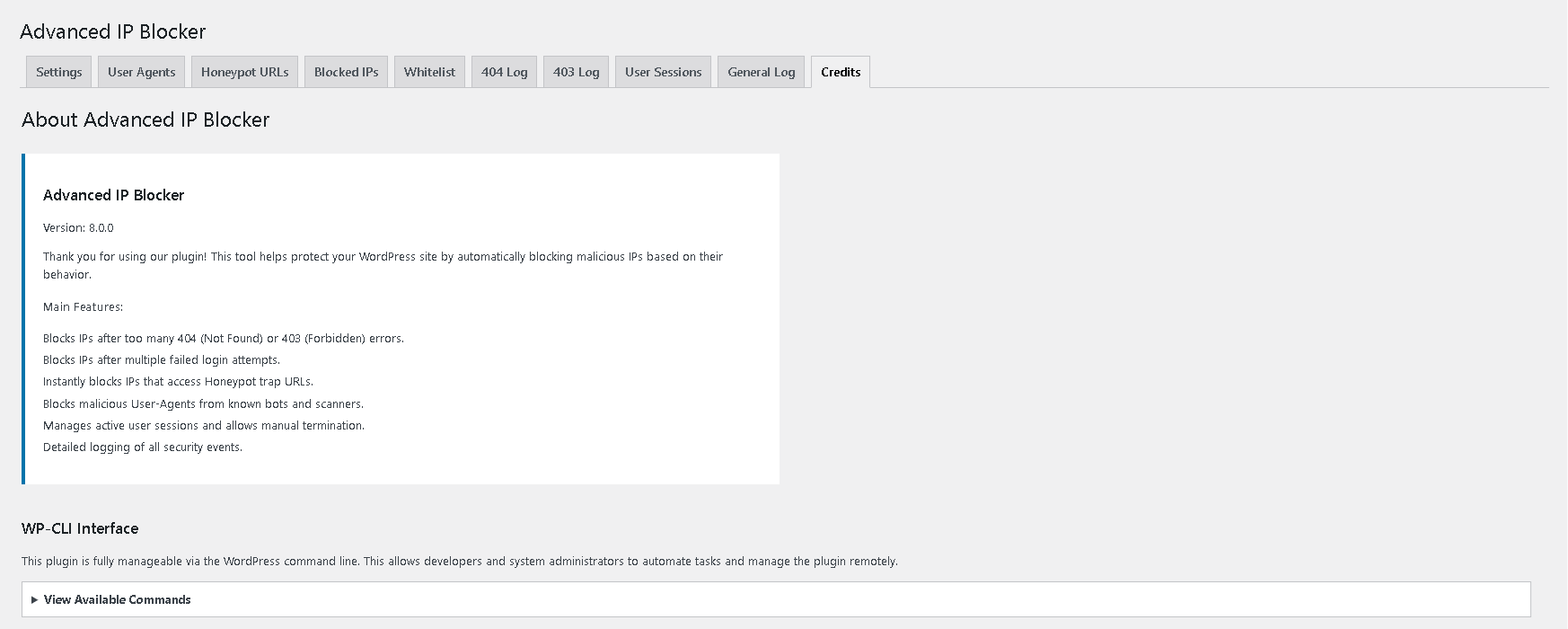
## SYNOPSIS,## OPTIONS, and## EXAMPLES) for all commands, automatically parsed by WP-CLI. - ENHANCEMENT: Updated the "Key Features Overview" panel in the Credits tab to include our newest security modules: File Integrity Monitoring (FIM), Manual Integrity Scanner, Advanced Rules Cloud Sync, and Comprehensive Audit Logging.
- ENHANCEMENT: The "WP-CLI Interface" section in the plugin's dashboard now displays a complete, logically grouped list of all available CLI commands to help system administrators automate their workflows.
- ENHANCEMENT: Rebuilt and synchronized the official plugin translation template (
.potfile) to include all the new user interface strings. - BUGFIX: Removed legitimate Android OS signatures (
okhttp,Dalvik/) and developer tools (Go-http-client,PostmanRuntime) from the default blocked User-Agent list to prevent false positive bans on mobile users and APIs. - BUGFIX: Resolved WPCS warnings related to the
DONOTCACHEPAGEconstant across multiple challenge and verification classes.
- HOTFIX: Refactored the File Integrity Monitor engine to fetch malware signatures dynamically from the Central API and store them in the database. This prevents the plugin's internal malware dictionary from triggering false positives in server-side antiviruses (e.g., CPGuard, Imunify360).
- NEW FEATURE: Added a "Manage Whitelist" UI to the FIM Dashboard for manually excluding files from scans.
- ENHANCEMENT: The FIM scanner now automatically ignores the plugin's own directory to prevent false positives caused by security-related localization strings.
- HOTFIX: Refactored the File Integrity Monitor engine to store malware signatures as ASCII integer arrays. This eliminates false positives caused by server-side antiviruses (like CPGuard or Imunify360) incorrectly flagging the plugin's internal malware dictionary during static scans.
- NEW FEATURE: File Integrity Monitor (Phase 2): Uploads Malware Scanner. The FIM now extends beyond core files to recursively scan the
wp-content/uploads/directory for suspicious executable files (e.g., hidden.phpshells), alerting administrators immediately without causing false positives on legitimate index files. - NEW FEATURE: Quarantine Vault. A secure backend interface to safely encrypt and isolate malicious or suspicious files detected by the File Integrity Monitor, preventing them from being executed by attackers while preserving them for forensic analysis.
- NEW FEATURE: Advanced Payload Logging. The WAF and Block engines now capture, sanitize, and log the raw HTTP payload (POST data) of malicious requests, providing invaluable context for administrators investigating complex attacks like SQL injections or XSS.
- ENHANCEMENT: The FIM alert notification system now dynamically checks your security configuration and will append a highly visible recommendation to enable "Block PHP in Uploads" if an anomaly is detected and the feature is currently disabled.
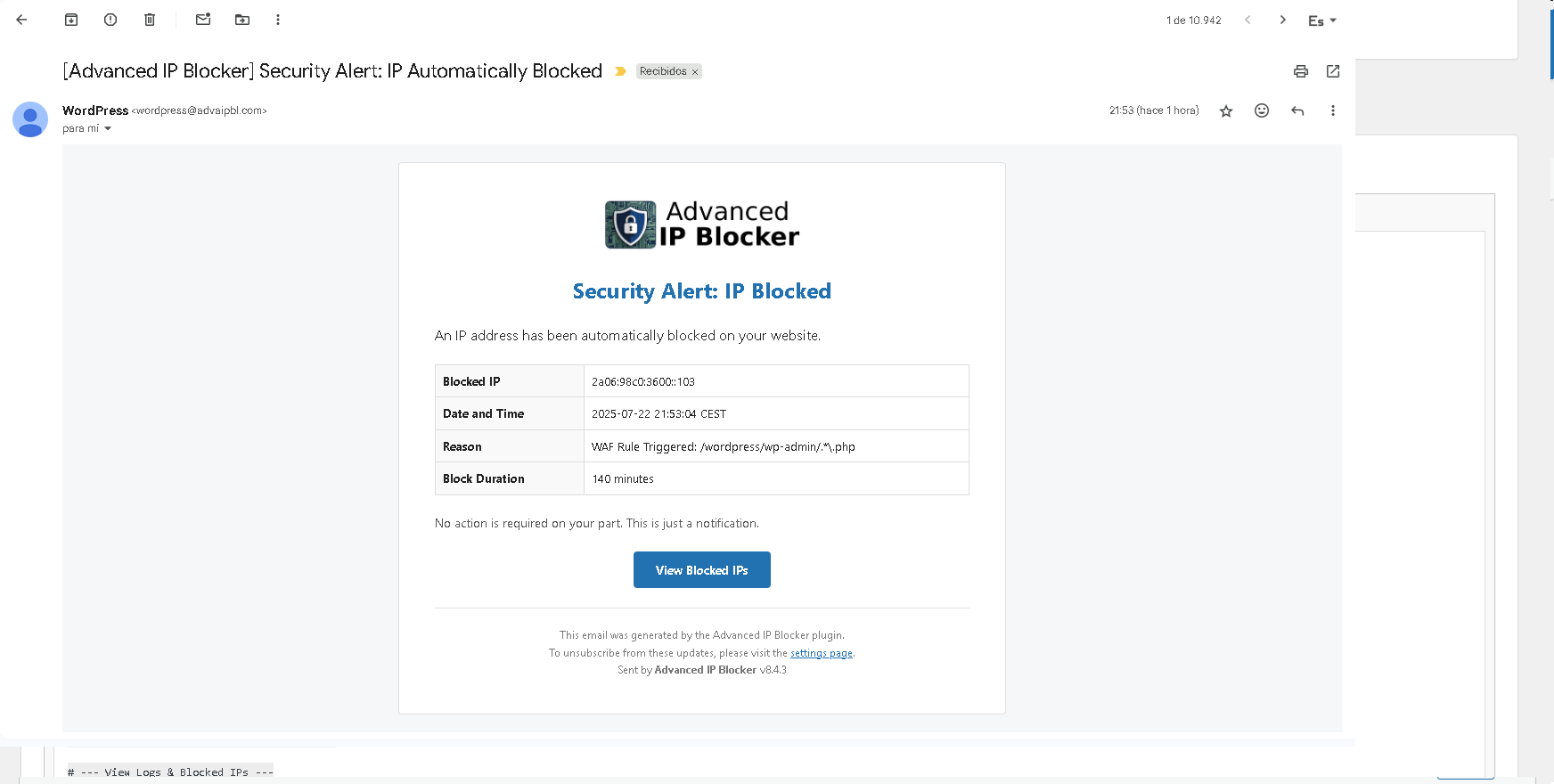
- ENHANCEMENT: FIM alert emails now feature color-coded event types for improved scannability (e.g., orange for suspicious files, red for deleted core files).
- ENHANCEMENT: Modernized Admin UI. Redesigned all configuration inputs across the plugin to feature dynamic floating labels, sleek borderless designs, and premium dark background filters for a better user experience.
- ENHANCEMENT: Optimized Local WAF Rules. Refined the default and suggested regular expressions (e.g. Path Traversal) to be highly precise, eliminating false positives caused by overly aggressive legacy patterns (like
/?author=or trailing hyphens). - BUGFIX: Resolved a persistent PHPCS linting error (
OutputNotEscaped) in the WAF status tag renderer.
- NEW FEATURE: File Integrity Scanner (Phase 1). A brand new security module designed to scan WordPress core files, active plugins, and themes against their official WordPress.org checksums to detect unauthorized modifications or malware infections.
- BUGFIX: Resolved a critical race-condition flaw in the centralized
block_ip_instantlyengine. Stale database locks (e.g., from interrupted script executions) would silently prevent the plugin from executing new blocks, affecting Thresholds, Threat Scores, and Advanced Rules. - BUGFIX: The "Threshold Reached" block notifications (Email and Push) now correctly display the dynamic number of errors that triggered the block (e.g., 4) instead of a hardcoded "1".
- ENHANCEMENT: The threshold blocking engine (404, 403, and Login) has been modernized to use the centralized blocking architecture and bypass legacy option tables, significantly improving performance on high-traffic sites.
- ENHANCEMENT: Minor UI improvements in the Security Dashboard layout and Environmental Summary panel.
- NEW FEATURE: Community Minimum Threat Score. You can now define how many unique community reports an IP must have before your local plugin imports and blocks it, drastically reducing false positives from the global network.
- ENHANCEMENT: Upgraded the AIB Central API integration to retrocompatibly support Threat Scores. The local IP Inspector now displays real-time community report counts directly in the UI.
- ENHANCEMENT: Manual ASN blocks are no longer transmitted to the AIB Community Network, preventing edge-case configurations from polluting the global threat database.
- BUGFIX: Resolved a critical logical flaw where failures or rate-limits in external Geolocation APIs (e.g., ipquery.io fallback) would falsely classify legitimate servers without rDNS as Ghost IPs.
- BUGFIX: Fixed a character encoding issue (mojibake) that caused emojis in Distributed Attack Protection (Auto-Panic) webhook notifications to render incorrectly in Slack and Discord.
- ENHANCEMENT: Tested and verified full compatibility with the upcoming WordPress 7.1 core release.
- ENHANCEMENT: Brand new CDN Manager architecture with a Quick Add dropdown to easily auto-fill trusted proxies like Cloudflare and QUIC.cloud.
- SECURITY: Added Zero-Day WAF rules for recent critical vulnerabilities including Wishlist Member X (CVE-2026-12949) and User Profile Builder (CVE-2026-15826).
- NEW FEATURE: Admin Access Control. You can now restrict access to the plugin's configuration dashboard to specific administrators. Users not on the allowed list will not see the Security menu, while User ID 1 is always protected against lockouts.
- NEW FEATURE: Hardening & Core Protections. Added a new section to securely hide the WordPress version, disable the built-in file editor, disable application passwords, disable ImageMagick (Imagick), and block PHP execution in the uploads folder via a managed
.htaccess. - ENHANCEMENT: Central Telemetry Update. The plugin now securely transmits the adoption rate of the new Hardening features (including Restricted Admins) for aggregated community statistics.
- ENHANCEMENT: Audit Logging. Changes to the authorized administrators list are now tracked and logged in the Activity Audit Log.
- BUGFIX: Resolved HTML rendering bug in the Admin Access Control multi-select field.
- BUGFIX: Fixed PHPCS warnings in the uninstaller file regarding interpolated variables and standard filesystem writes.
- BUGFIX: Resolved Content Security Policy (CSP) console errors on challenge pages caused by Cloudflare Web Analytics (beacon.min.js) auto-injection.
- BUGFIX: Ensured the Zero-Day WAF Lightweight Ping cron task is properly cleared upon plugin deactivation and uninstallation.
- BUGFIX: Zero-Day WAF synchronization now preserves informational comments for the UI while correctly excluding them from both the active WAF engine evaluation and the rules count log.
- BUGFIX: Fixed an issue where importing settings templates failed on Windows server environments (like XAMPP) due to backslashes being stripped from temporary upload file paths.
- BUGFIX: Updated hardcoded URLs in email templates and system redirects to correctly point to the new top-level
admin.phpmenu structure instead of the legacyoptions-general.phplocation. - IMPROVEMENT: Removed emojis from WordPress admin notices and email templates to prevent character encoding issues on certain server environments, keeping them exclusively for push webhook notifications (Slack, Discord, etc.).
- IMPROVEMENT: The "Unblock ALL IPs" bulk action now properly resets the Threat Score of all unblocked IPs to 0, ensuring consistent UX with individual unblocking and preventing immediate re-blocking upon minor infractions.