
AEOmatic – AEO for AI Search: llms.txt, Schema & AI Crawler Check
| 开发者 | mmtushar |
|---|---|
| 更新时间 | 2026年10月17日 00:35 |
| PHP版本: | 7.4 及以上 |
| WordPress版本: | 7.1 |
| 版权: | GPLv2 or later |
| 版权网址: | 版权信息 |
详情介绍:
- Whether AI crawlers get your real pages. AEOmatic requests your pages as GPTBot, OAI-SearchBot, ChatGPT-User, ClaudeBot, Claude-SearchBot, PerplexityBot, Googlebot and Bingbot, and compares each answer with a normal browser. A block, a bot-challenge page or a 404 shows up by name.
- What AI actually reads on a page: the text a crawler that does not run JavaScript receives, and the sentences that only appear after JavaScript runs.
- Your AI readiness score and the three fixes worth doing first, each linked to the page that needs it.
- Which posts are hard to quote: answers buried under filler, missing author signals, orphan pages, thin content. Some have a one-click fix.
- No promises it cannot keep. No plugin can guarantee a citation in ChatGPT or Google AI Overviews, and AEOmatic does not claim to. It measures readiness, the part you control, and the dashboard is labelled that way.
- Every score shows its working. Each check says whether it is a direct check or a heuristic.
- Honest about llms.txt. Google has said it does not use llms.txt, and AI crawlers rarely request it so far. AEOmatic generates it automatically because it costs nothing to keep and some AI tools can use it, not because it is a ranking switch.
- Your data stays on your server. No account, no API key, no telemetry, and no external calls on the front end. The AI crawler log stores no IP addresses.
- Safe beside your SEO plugin. It never edits your titles, meta descriptions, canonicals, sitemaps or another plugin's settings, and it resolves schema overlap on its own side.
- Clean uninstall. Deleting the plugin removes everything it created.
- Publishes the signals AI systems read. JSON-LD structured data across 21 schema types, an
llms.txtindex at your site root, a/llms-full.txtfull-text endpoint, and per-bot crawl directives inrobots.txt. - Scores how extractable your content is. A site-wide AI readiness score across three categories, plus per-post audits that name the specific thing to fix rather than handing you a number.
- Reports what actually happened. A server-side log of every recognised AI crawler request — which bot, which URL, and the HTTP status your site returned. If you are quietly serving 404s to GPTBot, this is where you find out.
post_content and stop. If your pages are built in Elementor or Divi, or your copy lives in ACF fields, that means your schema and your scores are computed against an almost-empty string.
AEOmatic runs one normalising extraction pass that understands Gutenberg, the Classic Editor, Elementor, Divi, Beaver Builder, Bricks, Oxygen and WPBakery, plus ACF text, textarea, wysiwyg, repeater and flexible-content fields. Everything downstream — schema generation, the audit, readiness scoring, llms.txt — reads that single extraction, so a page assembled in a builder is scored on what it actually renders.
Built to sit beside your SEO plugin, not replace it
AEOmatic writes only its own settings and its own post meta. It never touches your titles, meta descriptions, canonicals or XML sitemaps, and it never modifies another plugin's configuration.
It detects Yoast SEO, Rank Math, All in One SEO, SEOPress and The SEO Framework, can import your organisation details from whichever you run, and flags the case where two plugins would emit the same JSON-LD type on one page — with a one-click fix that adjusts AEOmatic's output, never theirs.
Check what AI crawlers actually get
Settings pages tell you what you asked for. AI Access tells you what happens:
- Crawler check — reads the robots.txt your site is really serving (including a physical file that overrides WordPress), then requests your home page and recent pages as OAI-SearchBot, ChatGPT-User, Claude-SearchBot, PerplexityBot, Googlebot, Bingbot, GPTBot, ClaudeBot and more, and compares each answer with a normal browser. A firewall, CDN or security plugin that blocks AI crawlers, a bot challenge page, or a crawler-specific noindex shows up by name.
- What AI sees — ChatGPT, Claude and Perplexity crawlers do not run JavaScript. This shows the text they get for a page and lists the sentences from your editor that only appear after JavaScript runs.
- AI readiness audit, three levels. Site-wide across three categories (Technical readiness, Content readiness, AI crawler access), per post across five categories (Content, Trust, Authority, Entities, Technical), and a per-post 0–100 content rubric of thirteen weighted checks. Every category states whether it is a direct check or a heuristic.
- Visual schema editor for 21 types — Article, BlogPosting, NewsArticle, TechArticle, Recipe, Review, Product, SoftwareApplication, Service, LocalBusiness, Event, JobPosting, Course, Dataset, Book, Movie, WebPage, AboutPage, ContactPage, CollectionPage, ProfilePage. Fields Google requires are marked, and every node links by @id to one Organization, WebSite and WebPage. The type is auto-detected from your content and every field is editable in the block-editor sidebar with a live JSON-LD preview.
- Type-specific property extraction — Recipe posts get ingredients and instructions, JobPosting posts get salary ranges, Event posts get dates and venue, LocalBusiness gets address and opening hours. Not generic Article schema on everything.
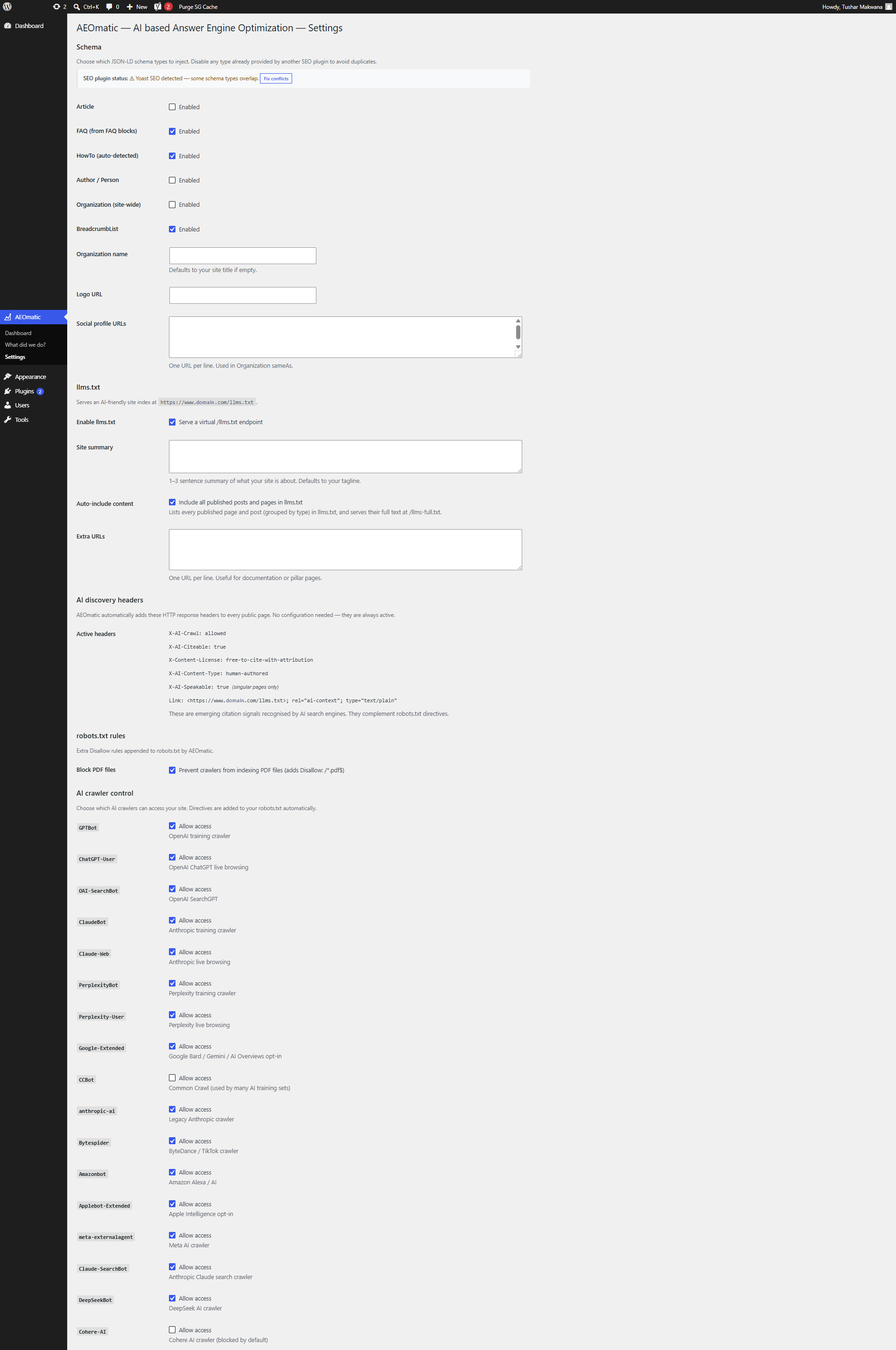
/llms.txtgenerator — a spec-compliant Markdown index at your site root: site summary, curated key pages from your nav menu, then every published item grouped by post type./llms-full.txtendpoint — the extracted body text of your published content at one URL, so an AI crawler can ingest the site in a single request. Bounded and cached so it cannot become a load problem.- AI crawler control — per-bot Allow/Disallow toggles in
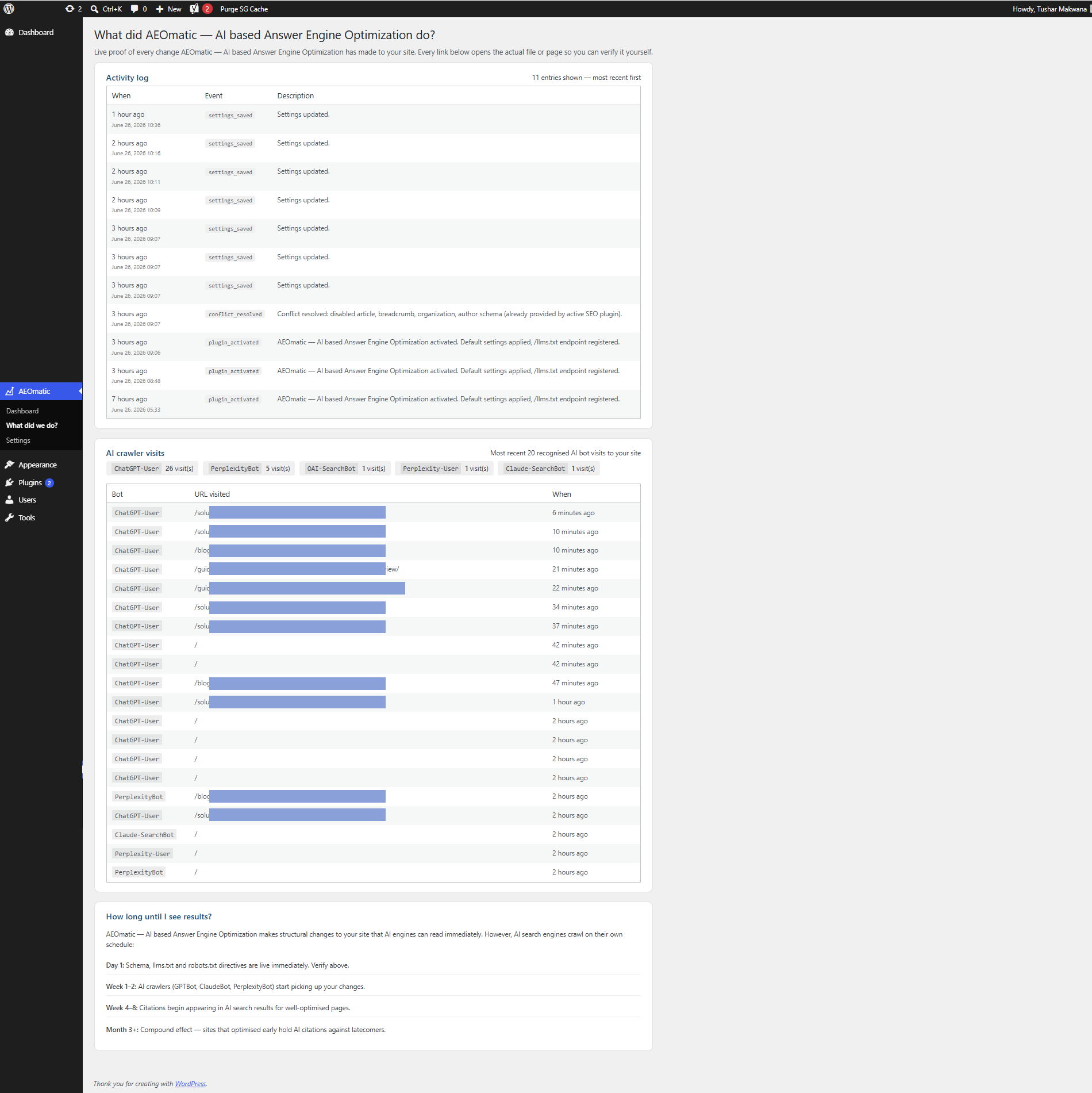
robots.txtfor 18 AI crawlers: GPTBot, ChatGPT-User, OAI-SearchBot, ClaudeBot, Claude-User, Claude-SearchBot, PerplexityBot, Perplexity-User, Google-Extended, CCBot, Bytespider, Amazonbot, Applebot-Extended, meta-externalagent, Meta-ExternalFetcher, DeepSeekBot, Cohere-AI, DuckAssistBot. Twenty user agents recognised in the visit log. - AI crawler log and breakdown — which AI bots requested which URLs, what HTTP status you served them, and when. A 404 or 403 being served to OAI-SearchBot is the kind of thing you want to know. Records bot name, URL, user agent and status only: no IP addresses, no cookies, no visitor data, nothing leaves your server.
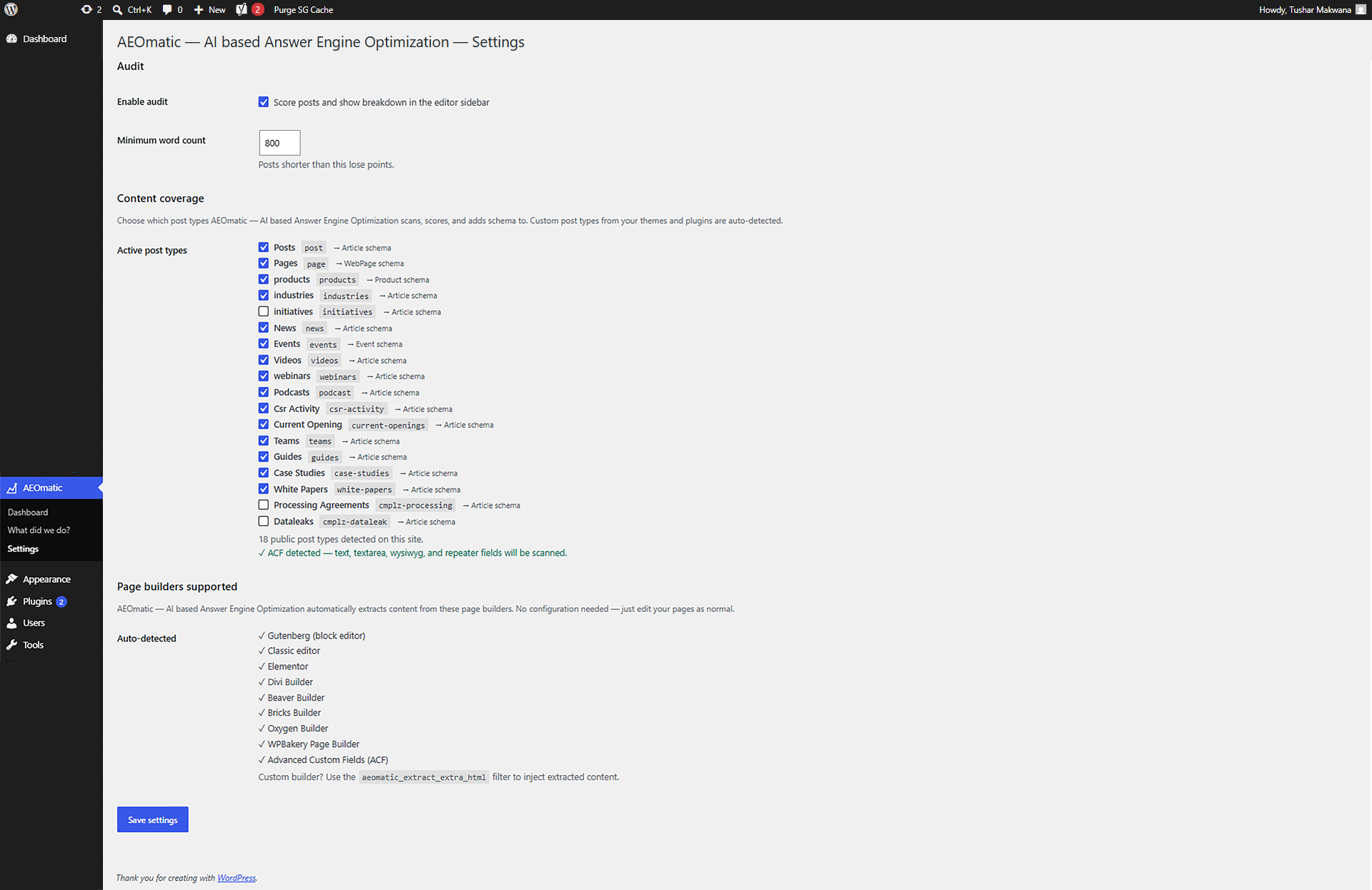
- Page-builder support — content is read from Gutenberg, Classic Editor, Elementor, Divi, Beaver Builder, Bricks, Oxygen and WPBakery, plus ACF text, textarea, wysiwyg, repeater and flexible-content fields. Scoring reflects what your pages actually render.
- WooCommerce Product schema — price, availability, SKU, brand, ratings and sale dates auto-filled; variable products get AggregateOffer with a min/max range.
- Answer-first fixes — finds answers buried below filler under a question heading ("What is X?" answered in the fourth sentence) and moves them to the top of the section in one click on block-editor and Classic posts. WordPress keeps a revision, so you can undo it.
- AI Citation Gaps — seventeen local rules-based checks that name why a page is unlikely to be quoted: orphan pages, no opening answer, thin body, no FAQ block, no question heading, schema type mismatch, missing author signal, missing from llms.txt, low outbound links, low alt coverage, no citation hook, no related links, sibling-topic gaps by category, question headings without a snippet-length answer, steps not in a numbered list, missing meta description, buried answers. Three ship a one-click fix.
- Entity Scanner — scans content, schema, headings and metadata for Organization, Person, Service, Product, LocalBusiness and FAQ entities, returning a coverage score with per-entity confidence, detected signals, missing signals and recommendations.
- FAQ block — a native Q&A block producing accessible
<details>/<summary>markup, written for featured snippets. The visible Q&A carries lightweight schema.org FAQPage microdata; no FAQPage JSON-LD is added.[aeo_faq]/[aeo_qa]shortcodes for the Classic Editor. - Setup wizard with a real first audit — six skippable steps: welcome, import from your existing SEO plugin, organisation details, AI crawler access, your first readiness audit, verify. The audit step shows your score and the three highest-value fixes with direct links, so you finish onboarding knowing what to do next.
- SEO plugin conflict detection — detects Yoast SEO, Rank Math, All in One SEO, SEOPress and The SEO Framework, and checks whether each is currently emitting overlapping schema. One click disables only the overlapping types in AEOmatic; your other plugin's configuration is never modified.
- AI HTTP discovery headers —
X-AI-Crawl,X-AI-Citeable,X-Content-License,X-AI-Content-Type,X-AI-Speakableheaders plus aLink: rel="ai-context"pointer to your llms.txt. These are proposed conventions, not a ratified standard, and no AI vendor has committed to reading them. They are on by default and can be switched off under AEOmatic → Settings → AI discovery headers.X-Content-License(free-to-cite-with-attribution) andX-AI-Content-Type(human-authored) state a licence and an authorship claim for your content, so they are off unless you turn them on in the same section. - Ask AI tab — type a question, then open ChatGPT, Perplexity, Google AI or Claude in a new tab with it pre-filled, to see for yourself how those engines answer. The plugin only builds the link; nothing is sent from your server.
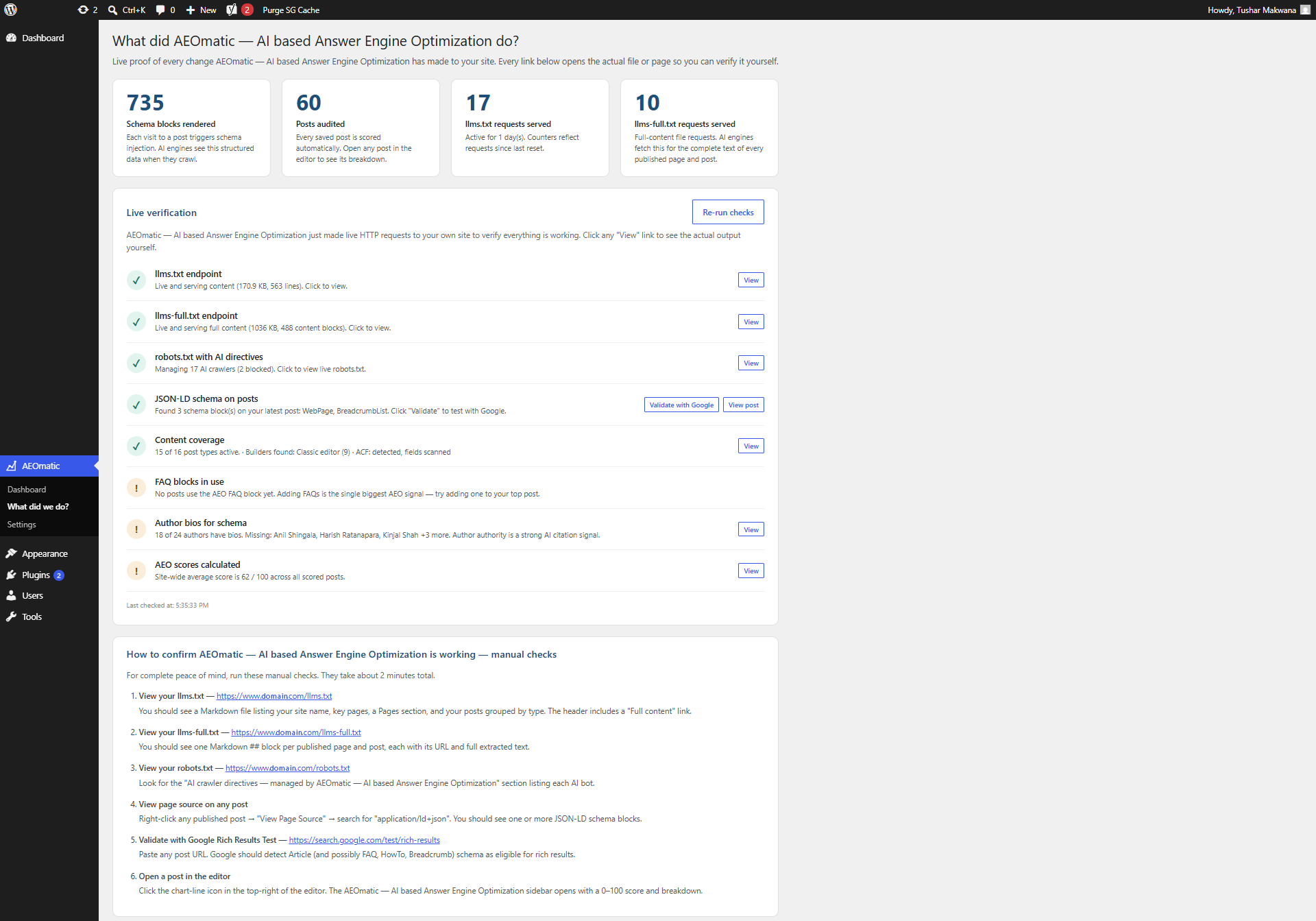
- Live verification panel — makes HTTP requests to your own site and shows what is actually being served: llms.txt with size and line count, robots.txt with AI bot count, schema blocks on your latest post with a direct Google Rich Results Test link.
- VideoObject, Speakable, WebSite and WebPage schema, an author-profile panel, a wp-admin dashboard widget, and a bulk re-audit action on post list screens.
- ChatGPT / ChatGPT Search (OpenAI) — GPTBot, OAI-SearchBot, ChatGPT-User
- Claude / Claude Search (Anthropic) — ClaudeBot, Claude-User, Claude-SearchBot
- Perplexity — PerplexityBot, Perplexity-User
- Google AI Overviews / Gemini — Google-Extended controls Gemini training; AI Overviews retrieval uses Googlebot
- Microsoft Copilot — no dedicated AI user agent; retrieves from the Bing index via Bingbot
- Meta AI — meta-externalagent, Meta-ExternalFetcher
- DeepSeek — DeepSeekBot
- Apple Intelligence — Applebot-Extended
- Cohere — Cohere-AI
- DuckDuckGo AI answers — DuckAssistBot
- Amazon — Amazonbot
- ByteDance — Bytespider
- Common Crawl — CCBot
- Business owners and bloggers who see AI answers replacing clicks and want to know whether AI can even read their site
- SEO consultants and agencies who need evidence to show clients, not a vanity score, and a repeatable audit across sites
- Elementor, Divi, Bricks and ACF sites that tools reading only the post content score against a nearly empty page
- Publishers and media who want to be quoted by AI as a source
- Businesses and SaaS companies who want their entity data to be unambiguous to AI systems
- Local businesses and WooCommerce stores who need correct LocalBusiness and Product data
- WordPress developers — 19 filters, a documented REST namespace, and analyzer interfaces to extend
安装:
- Install from Plugins → Add New and search for "AEOmatic", or upload the
aeomaticfolder to/wp-content/plugins/, or use Plugins → Add New → Upload Plugin. - Activate through the Plugins menu. Activation registers the
/llms.txtand/llms-full.txtendpoints and flushes rewrite rules for you. - The setup wizard opens automatically. Six skippable steps, ending with your first readiness audit and top three fixes.
- Visit AEOmatic → Dashboard for your site AI readiness score, category breakdown, top recommendations and AI crawler activity.
- Open any post in the block editor and click the AEOmatic icon in the top-right toolbar for the schema editor, audit breakdown, citation gaps, AI readiness and entity coverage.
/llms.txt returns a 404, confirm Settings → Permalinks is not set to "Plain", then click Save Changes there once.屏幕截图:




常见问题:
Will this get me cited by ChatGPT or ranked in AI search?
No plugin can promise that, and AEOmatic does not. What it does is fix the technical and content signals you control: crawler access, parseable structured data, an llms.txt index, and content shaped so an answer can be extracted. Whether an AI engine then cites you depends on that engine's own ranking and retrieval, which nobody outside those companies controls. Any plugin promising guaranteed AI citations is guessing.
Is AEO different from SEO?
Mostly not, and be careful with anyone who says otherwise. Google says AI Overviews and AI Mode use the same crawling and indexing as normal search, with no special AI markup required. What is different is practical: CDNs and firewalls often block AI crawlers while letting Googlebot through, most AI crawlers do not run JavaScript, and AI answers are lifted from pages that state the answer plainly. AEOmatic focuses on those differences.
Does llms.txt actually help?
It is not a ranking factor. Google does not use it, and public crawl data shows AI crawlers rarely request it so far. Some AI tools can use it when they are pointed at a site. AEOmatic generates and updates it automatically, so it costs you nothing to have, and you can switch it off under AEOmatic → Settings.
I already use Yoast SEO or Rank Math. Do I need this?
They handle classic SEO, and AEOmatic does not replace them. It adds checks they are not built around: whether AI crawlers really get through your CDN or firewall, what a crawler that does not run JavaScript reads, which AI bots visit and what status they get, and how easily an answer can be quoted from each post.
Is it free?
Yes. Everything described on this page is in this plugin, with no account, no API key and no usage limits.
What is the difference between AI readiness and AI visibility?
AI readiness is how well-prepared your site is — measurable from your own database and settings, which is what AEOmatic scores. AI visibility is whether AI systems actually surface or cite you — measurable only by querying those engines from outside your site, which AEOmatic does not do. The dashboard is labelled "AI Readiness" for that reason.
Why does the crawler check say a crawler is blocked when the crawler log shows it visiting?
The check sends requests from your own server using each crawler's name. Some firewalls also verify a crawler's IP address, so they block this test while letting the real crawler in. When the AI crawler log shows successful real visits from that crawler, the check says so and marks it for review instead of blocked.
Does the crawler check contact any AI company?
No. Every request goes to your own site. The test requests are tagged so the AI crawler log does not record them as real visits.
Does the crawler log tell me if a page was cited?
No. It tells you a crawler requested a URL and what status you served. Whether that page was retained, used, or quoted in an AI answer is not visible in crawler traffic, and no AI vendor exposes it there. Treat crawler visits as access evidence, not citation evidence.
Does this conflict with Yoast SEO or Rank Math?
It is designed to run beside them. AEOmatic writes only its own settings and its own post meta and never modifies another plugin's configuration. Because several SEO plugins also emit Article, Organization and Breadcrumb schema, AEOmatic detects that overlap and offers a one-click fix that disables only the overlapping types in AEOmatic. The detector checks whether the other plugin's schema module is actually switched on, so it does not nag you about a conflict that is not happening. Until you resolve a real overlap, both plugins emit their types and the site readiness score reports it as a failing technical check.
Can I import my existing SEO plugin's settings?
Yes — organisation name, logo and social profiles from Yoast SEO, Rank Math, SEOPress, All in One SEO or The SEO Framework. Import is per-plugin, opt-in, one-directional, and never overwrites a value you have already set in AEOmatic.
What is /llms-full.txt?
A single URL returning the extracted body text of your published content, so an AI crawler can ingest the site in one request instead of following dozens of links. It is capped at 200 items per post type by default and says so in its own output when it truncates; raise or remove the cap with the aeomatic_llms_full_max_items filter.
My llms.txt or /llms-full.txt shows a 404. How do I fix it?
Check that Settings → Permalinks is not set to "Plain" — the endpoints need a rewrite rule, which plain permalinks do not support. Then click Save Changes on that screen once. Also confirm llms.txt is enabled under AEOmatic → Settings.
Does the plugin work with Elementor, Divi, or other page builders?
Content extraction does. AEOmatic reads content from Gutenberg, Classic Editor, Elementor, Divi, Beaver Builder, Bricks, Oxygen and WPBakery, plus ACF fields, so schema and scoring reflect what your pages actually render. It does not add builder-native widgets.
Will this slow down my site?
Schema is generated server-side and cached in post meta. /llms.txt and /llms-full.txt are cached for an hour and flushed when content changes. The crawler log writes only when a recognised AI bot requests a page, and defers its single database write to the end of that request. There are no external requests and no third-party assets on public pages. Admin CSS and JS load only on AEOmatic screens.
What schema types does it support?
Twenty-one page-level types (Article, BlogPosting, NewsArticle, TechArticle, Recipe, Review, Product, SoftwareApplication, Service, LocalBusiness, Event, JobPosting, Course, Dataset, Book, Movie, WebPage, AboutPage, ContactPage, CollectionPage, ProfilePage) plus Organization, WebSite, WebPage, Author/Person, Breadcrumb, VideoObject and Speakable. FAQPage and HowTo JSON-LD and the sitelinks search box are not emitted: Google no longer shows them. The FAQ block keeps FAQPage microdata on its visible questions and answers.
Does it work with WooCommerce?
Yes. Product schema with price, availability, SKU, brand and ratings; variable products get AggregateOffer with a min/max price range.
How do I know the schema is actually working?
Open AEOmatic → What did we do? for the live verification panel. It fetches your own URLs and shows what is being served, with a direct link to Google's Rich Results Test for your latest post.
Does the plugin send my data anywhere?
No. No external API calls on the front end, no telemetry, no analytics, no account. The only server-side HTTP requests are the verification panel fetching your own site, for administrators only.
Is the audit score reliable?
It is a rubric, and it is honest about which parts are heuristic. The Technical and AI crawler access categories are direct checks — a setting is either on or off. Content readiness is explicitly labelled a heuristic: it uses pattern matching to estimate how answer-shaped your content is. Category scores are combined with an unweighted mean, because no public evidence supports specific relative weights and inventing some would be false precision.
What happens when I uninstall AEOmatic?
Deleting the plugin removes every option, transient, scheduled task and post-meta key it created. Deactivating alone leaves your settings intact so reactivating does not lose your configuration.
更新日志:
- Fix: related content in ACF relationship fields is now counted. Relationship, Post Object, Page Link and Link fields (including inside repeaters, groups and flexible content) are read as links, so related resources chosen in ACF count toward the audit's internal-links check and the citation gaps. Click Re-run in the Audit tab, or update the post, to refresh an existing score.
- Fix: the audit's internal-links check now counts relative links (
/guide/), treatswww.and letter case as the same site, counts each page once, and ignores links to the post itself, in-page anchors, admin pages and uploaded files. The hint now shows how many pages were found. - Fix: "No matches found for expression .aeomatic-speakable" in schema validators on Article, NewsArticle, TechArticle and other posts without a manual excerpt. The excerpt AEOmatic builds for the page description used up the speakable mark, so the visible paragraph never got the class. The mark now goes on the paragraph visitors see, and speakable is left out when there is none.
- Changed: licence and authorship headers are opt-in.
X-Content-License: free-to-cite-with-attributionandX-AI-Content-Type: human-authoredare no longer sent unless you turn on Settings → AI discovery headers → Licence and authorship headers. They state a licence and an authorship claim for your content, so the site owner should choose them. The other discovery headers are unchanged. - Changed: honest wording on "What did we do?" The "How long until I see results?" timeline predicted AI citations by week 4–8. It is replaced by "What happens next?", which covers only what your site controls and points to the crawler log and the Ask AI tab.
- Changed: setup wizard no longer says it sets defaults for Google AI Overviews (Google-Extended controls Gemini training; AI Overviews uses Googlebot), and describes the discovery headers as optional.
- Changed: author, verification and audit hints no longer describe author bios, word count or first-hand experience as proven AI citation factors.
- Fix: entity recommendations named a filter that does not exist. Product, Service and LocalBusiness hints for Classic Editor and page-builder posts now point to the AEOmatic schema editor (Classic Editor metabox or the AEOmatic button in your page builder) instead of an
aeomatic_schema_overridesfilter. - Changed: the FAQ block description now matches what it does (visible Q&A), and the readme documents its FAQPage microdata, the full crawler list, all 19 filters and the Ask AI tab, with screenshot captions that match the screenshots.
- Fix: "Missing field 'item' (in 'itemListElement')" in breadcrumb schema. Every breadcrumb now carries its URL. Author, date and post-type archives link to themselves, and a breadcrumb whose link cannot be found is left out instead of printed without one.
- Fix: breadcrumbs with no name. An untitled post or an empty archive title uses the page title instead, so the schema no longer fails with "Missing field 'name'".
- New: AI Access → Crawler check. Requests your pages as each AI and search crawler, using the robots.txt your site actually serves, and compares the result with a normal browser visit. Flags robots.txt blocks, firewall and CDN blocks (403, 429, bot challenges), pages that return "not found" only to crawlers, stripped pages and crawler-specific noindex. Warns when a physical robots.txt file overrides AEOmatic's crawler settings, and cross-checks results with the AI crawler log.
- New: AI Access → What AI sees. Shows the text a crawler that does not run JavaScript receives, the heading outline, title and description, and which sentences from the editor are missing from the HTML.
- New: answer-first fix. A citation gap finds answers buried below a question heading or question-style title, and a one-click fix moves them to the top of the section on block-editor and Classic posts. A revision is saved. Page-builder pages get the suggestion only.
- New: SoftwareApplication and Dataset schema types.
- New: Organization details in Settings — legal name, address, contact details and registry IDs (D-U-N-S, LEI, NAICS, VAT, tax ID).
- New: live page check. After you save a published post, AEOmatic loads the live page in the background. FAQs printed by your theme, templates or other plugins then count in the audit, citation gaps and entity scan, and duplicate structured data is recorded.
- New: citation gaps for question headings without a short (40–50 word) answer, and for steps not in a numbered list. They replace the FAQ and HowTo schema gaps.
- New: the site readiness score includes the last AI Access crawler check.
- Improved: schema follows Google's current required fields for every type, and Organization, WebSite, WebPage and each post are linked into one graph.
- Improved: FAQs are recognised from any editor, theme or plugin — Elementor (including nested accordions), ACF, Yoast, Rank Math, Spectra, Kadence and ARIA accordions no longer trigger "No FAQ" warnings.
- Improved: runs on PHP 7.4 and later (was 8.0).
- Fix: /llms.txt and /llms-full.txt no longer redirect to a trailing-slash URL.
- Fix: llms.txt is plain text again — no more ">" or HTML codes for apostrophes, and no empty summary line.
- Fix: cached results no longer break when text contains a quote mark — citation gaps, AI readiness, entity scan, audit and saved schema field edits. Cached citation gaps could show an empty list.
- Fix: the "Set schema type" quick fix always failed.
- Fix: "cssSelector" errors in schema validators — Speakable now points at a paragraph that exists on the page.
- Fix: the AEOmatic sidebar loads on WordPress 6.6 and later.
- Fix: AEOmatic's own test requests are no longer recorded in the AI crawler log.
- Fix: replaced a deprecated WordPress user query argument.
- Fix: uninstall now also removes AI Access data, live page check data and a leftover citation-gap timestamp.
- Changed: honest wording. Hints no longer claim that FAQ or HowTo schema, meta descriptions, author bios or freshness are proven AI citation factors.
- Removed: FAQPage, HowTo, Q&A page and sitelinks search box schema, and their Settings options — Google no longer shows them. FAQ blocks still display on the page.
- New: edit schema inside page builders — Elementor, Beaver Builder, Bricks, Divi, Oxygen and WPBakery get a floating AEOmatic button that opens the full editor.
- Improved: wider Gutenberg sidebar with all tabs visible, plus an Expand button for a large view.
- Fix: Schema type dropdown keeps your selection — it reverted to the auto-detected type.
- Fix: edited schema fields no longer go blank after saving — including Average rating, Review count, Item reviewed and dates. Values saved by earlier versions reappear.
- Fix: dropdown fields show "— Select —" when unset instead of an option that was never saved.
- Fix: saving the Schema tab keeps unedited fields automatic, so the modified date and WooCommerce price and rating stay up to date.
- Fix: FAQ Q&A pairs, postcodes, SKUs, ISBNs and phone numbers now save correctly — FAQ pairs were stored as "Array" and leading zeros and "+" were dropped.
- Fix: the page now outputs the schema type you chose straight after saving, instead of the default type.
- New: visual editor now uses a tab layout — Schema, Audit, Gaps, Readiness, Entities, Ask AI. Same layout in the Gutenberg sidebar and the Classic Editor metabox.
- New: Classic Editor gets the full visual editor as a metabox below the content area.
- Fix: JSON-LD preview updates in real time — was showing the last-saved state.
- Fix: setup wizard "not allowed to access" error on WordPress 6.5+ / Playground. Now a visible submenu under AEOmatic → Setup wizard.
- Fixed: JSON-LD output is now readable. Schema was emitted as a single unbroken line with every
&written as&, every<as<, every/as/, and every accented or non-Latin character as an escape sequence. It was valid and search engines accepted it, but it looked broken in page source and in validators — and on non-English sites a headline became nothing but escape codes. Output is now pretty-printed with slashes and Unicode intact. Nothing about which schema is generated has changed, only how it is written.
- Fixed: custom post types now stay selected under Settings → Content coverage. Your saved selections were never lost, only displayed wrongly — nothing needs re-saving.
- Fixed: page-builder and ACF pages are no longer scored as empty. Six readiness checks were reading the post body directly and missing Elementor, Divi, Bricks, Oxygen, Beaver Builder and WPBakery content. Expect readiness scores to rise on those sites — that is the correction, not new optimisation.
- Fixed: Elementor headings and widget links are now visible to the analysers.
- Fixed: post types whose slug is not plain lowercase (for example MyCPT) can now be disabled.
- Fixed: the setup wizard no longer promises AI citations, and no longer triggers a PHP deprecation notice.
- Fixed: saving settings no longer leaves the upgrade routine re-running on every admin page load.
- Renamed to "AEOmatic — AEO, AI SEO, llms.txt & Schema".
- New: AI Readiness dashboard. One site score across three categories — Technical readiness, Content readiness and AI crawler access — with an issue count and your top three fixes. Every category states whether it is a direct check or a heuristic.
- New: the setup wizard runs a real audit and shows your score plus the three highest-value fixes.
- New: the AI crawler log records the HTTP status served to each bot, so a 404 or 403 served to GPTBot is visible.
- New: AI discovery headers are now a setting you can switch off.
- Fixed: two readiness checks that were silently degraded; uninstall now removes everything it created; robots.txt no longer advertises llms.txt as a sitemap.
- Performance: /llms.txt and /llms-full.txt are now cached and bounded, and running an audit no longer discards built schema.
- Security: the per-post citation-gaps endpoint is now gated per post rather than on a general capability.
- Renamed, with rewritten documentation and new build tooling.
- Fix: SEO-plugin conflict warning no longer fires when Yoast or Rank Math has its schema module turned off. Previously the detector treated "plugin installed & active" as "plugin is emitting schema", so users who had disabled Rank Math's Schema (Structured Data) module or set every CPT's Yoast schema page/article type to "None" still saw the yellow "Schema conflict detected" banner. The detector now inspects each plugin's own settings: Rank Math conflicts only report when
rich-snippetis present in therank_math_modulesoption; Yoast conflicts short-circuit to empty when its Schema Framework master switch (wpseo.enable_schema) is off, otherwise they are gated per-key onwpseo_titles—breadcrumbneedsbreadcrumbs-enable,article/authorneed at least one realschema-article-type-*value, andorganizationneedscompany_or_personset alongside at least one realschema-page-type-*value. Also adds a newaeomatic_seo_conflicts_detectedfilter so sites with unusual overrides can drop or adjust entries programmatically. - New: conflict detector diagnostic panel in Settings. Under the "SEO plugin status" line there is now a collapsible "why is this warning firing?" section (admin-only) that dumps the exact
wpseo_titleskeys,rank_math_modulesvalue, and computed conflict decision the detector used. Makes it possible to see at a glance which Yoast setting is still emitting schema without hand-inspecting the database. Warning banner also now includes the exact Yoast menu path required to actually disable Yoast schema (Search Appearance → Content Types → set Default Page type and Default Article type to None, plus disable breadcrumbs and clear "Company or person"), since Yoast has no single "disable schema" toggle. - Fix: post-type checkboxes in Settings → Content coverage now persist for custom post types. 1.1.7 fixed the built-in
postandpagecheckboxes by flushing theAEOMATIC_Post_Typesin-memory map after a save, but CPTs from other plugins (WooCommerce, CPT UI, JetEngine, ACF, Pods, etc.) could still revert to unchecked after saving. Root cause was inAEOMATIC_Settings::sanitise()— it iterated only the rawget_post_types( public=>true )list atadmin_inittime, and any CPT that either (a) was filtered into the plugin's own supported-post-types list viaaeomatic_supported_post_types_listbut not registered aspublic=>truein core, or (b) registered on a hook that fires afteradmin_init, was silently dropped from the saved payload. The sanitiser now builds its slug list from three sources: the same filtered list the settings view renders, the raw public post types, and every slug submitted in$_POST— so no checkbox the user actually saw can be lost. - Hardening:
AEOMATIC_Settings::save()now also busts the WordPress options cache and repopulates its own request-level cache with the freshly-written array. Guards against persistent object caches (Redis, Memcached) returning the pre-save value on the remainder of the same request, and against any downstream reader seeing an intermediatenull-cache state betweenupdate_option()and the nextall()call.
- Fix: post-type checkboxes in Settings → Content coverage now persist their checked state after saving. The
AEOMATIC_Post_Typesin-memory map is populated oninit(before theadmin_initsave handler runs) and was not being invalidated after a save, so the settings view re-rendered from a stale map and boxes appeared unchecked even though the DB was correct.AEOMATIC_Settings::save()now flushes the Post_Types cache immediately afterupdate_option(). - Fix: Entity Scanner now sees ACF and page-builder content. The Signal Collector was calling a non-existent
AEOMATIC_Content_Extractor::extract_text()method and silently falling back towp_strip_all_tags( $post->post_content )— so every text signal (keyword patterns, founding-date, NAP pattern) and every heading-based signal missed ACF fields, Elementor, Divi, Beaver, Bricks, Oxygen, and WPBakery content entirely. The collector now calls the realAEOMATIC_Content_Extractor::extract()API which merges all supported sources. ACF wysiwyg headings are now detected too. - Fix: Entity Scanner respects the Organisation name / logo / sameAs set in Settings. The Signal Collector was reading org config from a non-existent
organizationsettings section, soorganization_setting('name')andorganization_setting('logo')always returned empty strings — the Organization detector permanently reported "Organisation name is not set" and "Organisation logo not configured" even when both were filled in. It now reads from the correctschema.org_name/schema.org_logo/schema.org_sameaskeys. - Fix: Entity Scanner LocalBusiness detector accepts per-page address. The detector now also credits address / streetAddress / addressLocality set on the page's LocalBusiness schema via the Schema Generator sidebar, not only site-wide address settings. Recommendation text updated to reflect both paths.
- Fix: Entity Scanner FAQ detection now covers ACF and every supported page builder. The FAQ signal only matched Gutenberg
wp:aeomatic/faqblock markers; it now also credits FAQs surfaced by the content extractor (ACF FAQ repeaters, Elementor / Divi / WPBakery accordions, shortcode Q&As, universal HTML detection). - New: Entity Scanner recommendations now adapt to your editor. The Signal Collector exposes the detected editor / page builder (Gutenberg, Classic, Elementor, Divi, Beaver Builder, Bricks, Oxygen, WPBakery) to every detector. Recommendations that used to say "insert the AEOmatic FAQ block" or "in the Schema Generator sidebar" now emit builder-appropriate wording — an Elementor site is told to add a Toggle / Accordion widget; a Divi site is told to add a Toggle / Accordion module; ACF-only sites are told to use the
aeomatic_schema_overridesfilter. Signals themselves are unchanged; only the recommendation strings adapt. - Improved: ACF FAQ detection now covers flexible_content layouts and nested containers. Previous behaviour only recognised Q&As inside a top-level ACF repeater. It now walks the full ACF field tree, so Q&As are also picked up from: flexible_content layouts whose sub-fields include "question" + "answer"; repeaters nested inside a flexible_content layout; repeaters nested inside a group; groups whose fields directly contain "question"/"answer". Detection is name-based — any field whose name contains
questionand another whose name containsanswerqualifies, so common variants likefaq_question/faq_answer/question_text/answer_textall work.
- New: Entity Scanner module. Scans every post across four sources (content, schema, headings, metadata) for six entity types — Organization, Person, Service, Product, LocalBusiness, FAQ — and returns a coverage score, list of missing entities, and per-entity recommendations to raise confidence. New AEOmatic → Entity Scanner admin page and Gutenberg sidebar panel. New REST endpoint
GET /aeomatic/v1/entity-scan/{id}. Fingerprint-cached in post meta. Filter hookaeomatic_entity_detectorsfor custom detectors. Ships one reusable signal-collector service consumed by all six detectors — no code duplication with existing extraction.
- New: AI Readiness module. A second scoring lens complementing the existing AEO Audit. Every post is scored 0–100 across five explicit categories — Content, Trust, Authority, Entities, Technical — with a per-category list of issues plus recommendations so you know precisely which axis needs work. Overall score is the mean of the five categories.
- New: AEOmatic → AI Readiness admin page. Pick any published post from the recent-posts dropdown to run the analyzer on demand, or open a post via
?post={id}. "Recompute (skip cache)" button forces a fresh analysis. - New: "AI Readiness" panel in the block-editor sidebar. Sits alongside the existing Schema, Audit, and Citation Gaps panels. Auto-loads on open, auto-refreshes after save, has its own recompute button.
- New REST endpoint:
GET /aeomatic/v1/ai-readiness/{id}?force=false— returns{ overall_score, categories[], fingerprint, cached }. Same auth model as/audit/{id}(edit_post capability check). - Fingerprint-based caching in post meta
_aeomatic_ai_readiness(payload) +_aeomatic_ai_readiness_fingerprint(invalidation key) +_aeomatic_ai_readiness_score(overall score, exposed via REST). Cache auto-invalidates onsave_post. - Analyzer registry is filterable via
aeomatic_ai_readiness_analyzersso third-party code can add or replace categories without patching core. - Zero duplication: reuses
AEOMATIC_Content_Extractor,AEOMATIC_Schema_Analyzer,AEOMATIC_Schema_Generator,AEOMATIC_LLMs_Txt,AEOMATIC_Post_Types, andAEOMATIC_Settings.
- New: Setup Wizard. Five-step guided onboarding runs automatically on activation. Auto-imports your organisation name, logo, and social profiles from Yoast SEO, Rank Math, SEOPress, All in One SEO, or The SEO Framework — never overwrites values you already set in AEOmatic. Live JSON-LD preview updates as you type. Fully offline; no accounts, no external calls. Re-runnable any time from the Plugins list.
- New: WordPress dashboard widget "AEO Readiness". A compact tile on the native wp-admin dashboard showing average AEO score, count of posts with citation gaps, top three AI-bot visitors with a mini bar chart, and log-retention health. Colour-coded score chip so status reads at a glance.
- New: Bulk audit action on Posts/Pages/CPT list screens. Select any rows, choose "AEOmatic — refresh audit & gaps," and recompute audit scores and citation gaps for all selected posts in one pass. Results appear in a dismissible admin notice with average scores, total gaps flagged, and an expandable per-post table. Safety cap of 50 posts per batch. Everything runs on your own server.
- New: Hybrid crawler-log retention. The AI bot visit log now uses a daily WP-Cron purge (default 90-day retention, configurable 7–365 days from AEOmatic → Settings → Crawler visit log) plus a 500-entry safety ceiling, replacing the previous fixed 200-entry cap. The new Settings section also shows live log status: entries kept, age of the oldest row, and the last purge outcome.
- New AI crawlers recognised:
DuckAssistBot(DuckDuckGo AI) andMeta-ExternalFetcher(Meta's per-user fetcher, distinct from the training UAmeta-externalagent). Both added to detection and to the default allow-list. Total recognised: 20 AI user agents. - Refactor: extracted
AEOMATIC_Audit::site_summary()andAEOMATIC_Citation_Gaps::site_summary()as reusable public entry points so the dashboard widget, bulk-action notice, and REST endpoints all share one code path.
- New: Ask AI — "Am I cited?" panel. A new block-editor sidebar panel with four one-click buttons — Ask ChatGPT, Ask Perplexity, Ask Google AI, Ask Claude. Each button opens the AI engine in a new tab with your post title pre-filled as the question, so you can see with your own eyes whether your site is quoted in the AI's answer. No API keys, no accounts, no external calls from your server — the plugin only builds the link; your browser does the rest. Turns "did my AEO work?" from a guess into a 5-second test.
- New: AI Citation Gaps. Sixteen local, rules-based checks that flag exactly why a page is unlikely to be cited by AI engines and what to change. Runs entirely on your own server — no external calls, no keys, no account.
- Five internal-coverage rules: orphan pages, low internal-link count, sibling-topic gaps by category, thin body for depth-heavy schema types, and missing "related reading" hooks.
- Eleven answer-shape rules: no direct opening answer, no question-style headings, missing FAQ block, FAQ content without FAQPage schema, HowTo content without HowTo schema, low-confidence schema type match, low image alt-text coverage, no citation hook (list/table/bold summary) near the top, missing author signal, missing meta description, and posts missing from the emitted
/llms.txt. - New AEOmatic → Citation Gaps admin subpage with a filterable, paginated table across all posts and pages, plus a scanner-style summary strip (pages scanned / with gaps / clean / average score). Sorts worst-scoring first so you can triage. Filters: title search, post type, author, severity, gap type, score range, modified date range.
- New AI Citation Gaps panel in the block editor sidebar — shows the top high/medium gaps for the open post with a one-line fix hint each and a one-click quick-fix button where a structural fix is possible. Available on every enabled post type (posts, pages, WooCommerce products, and any registered public CPT).
- Fingerprint-based caching on post save — results persist in post meta and only rebuild when content, title, or schema type changes.
- Filter hook
aeomatic_citation_gap_resultsso power users can register their own rules.
- AI crawler list updated to match Anthropic's current published user agents. Added
Claude-User(Anthropic's user-triggered live-fetch UA, equivalent toChatGPT-User) to the default allow-list and audit detection. Removed deprecatedClaude-Webandanthropic-aifrom the default allow-list for new installs; they remain recognised by the visit log for backward compatibility. Source: Anthropic crawler documentation. - Existing installations do not need to re-flush permalinks.
- Documentation: updated readme with clearer feature breakdown, AI engines supported, and comparison guidance.
- No code changes. Existing installations do not need to re-flush permalinks.
- llms.txt now includes all published pages and posts (previously capped at 25 most recent per type; pages were skipped if not in the primary nav menu).
- New dedicated
## Pagessection in llms.txt — lists every published page (parent and child), ordered bymenu_orderthen title. - New
/llms-full.txtvirtual endpoint — emits the full markdown body of every included page and post, designed for direct LLM ingestion. Advertised from llms.txt via aFull content:line. - New activity counter
llms_full_servesrecords hits to the new endpoint. - Settings copy updated to reflect the new behaviour.
- Upgrade step: after updating, go to Settings → Permalinks → Save Changes once to register the new
/llms-full.txtrewrite rule.
- Initial public release.
- Visual schema editor in Gutenberg sidebar — auto-populates all fields from page content, every field editable.
- Intelligent schema type detection — 6 scoring rules, 22 supported schema types.
- Type-specific property extraction — Recipe ingredients/instructions, JobPosting salary, Event dates, LocalBusiness address/hours.
- Support for Gutenberg, Classic Editor, Elementor, Divi, Beaver Builder, Bricks, Oxygen, WPBakery, ACF.
- WooCommerce Product schema with price, availability, SKU, ratings (auto-filled, all editable).
- WebSite schema with SearchAction on homepage — enables Google sitelinks search box.
- VideoObject schema — auto-detected from YouTube and Vimeo embeds in post content.
- Speakable schema (WebPage + SpeakableSpecification) on all singular pages for voice AI.
- AI discovery HTTP headers (X-AI-Crawl, X-AI-Citeable, X-Content-License, X-AI-Content-Type, X-AI-Speakable) emitted automatically on all public pages.
- AI crawler visit log — records last 200 AI bot visits, viewable in admin under "What did we do?".
- llms.txt virtual endpoint following the llmstxt.org specification, with spec-compliant Ignore section.
- AI crawler control via robots.txt (GPTBot, ClaudeBot, Claude-SearchBot, PerplexityBot, Google-Extended, DeepSeekBot, Cohere-AI and more).
- AEO content audit engine — 10-criteria scoring with actionable suggestions in the editor sidebar.
- FAQ Gutenberg block with automatic FAQPage schema generation.
- SEO plugin conflict detection (Yoast, Rank Math, AIOSEO, SEOPress, The SEO Framework).
- One-click conflict resolution — disables duplicate schema types only.
- Live verification panel — proves every feature is working with clickable links.
- Schema cache with content fingerprinting — regenerates automatically on content changes.
- Request-level settings cache — single DB read per page load.
- Deferred activity counter writes — no DB writes on front-end page views.
- All public custom post types auto-detected and supported.