
API for Ninja Forms
| 开发者 | sightfactory |
|---|---|
| 更新时间 | 2026年9月15日 23:22 |
| PHP版本: | 8.1 及以上 |
| WordPress版本: | 7.1 |
| 版权: | GPLv2 or later |
| 版权网址: | 版权信息 |
详情介绍:
- Forms Discovery Endpoint: Query authorized forms, submission counts, and field definitions with strict per-key access control.
- Cursor & Offset Pagination: Seamlessly paginate large historical datasets with
page/per_pageor cursor sync viasince_id/before_id. - Single Record Retrieval: Instant lookup of specific submissions (
/form/{id}/submission/{sub_id}) with cross-form ownership validation. - Unparalleled Multi-Format Exports: Stream submissions on-demand in 6 versatile formats: JSON, Excel (XLSX), PDF document reports, CSV spreadsheets, XML, and NDJSON/JSONL.
- Military-Grade Payload Encryption: Protect sensitive customer and form data with state-of-the-art AEAD response encryption (AES-256-GCM, AES-128-GCM, and Sodium Secretbox).
- Advanced Rate Limiting Protection: Safeguard your server against scraping, probing, and brute-force key exploitation with admin-controlled rate limits per minute, hour, or day.
- Granular Form Access Control: Issue form-specific API keys with instant 1-click test suite tools and single-page key management.
- Lightning-Fast & Ultra-Optimized: Zero-overhead streaming designed for high throughput, low memory footprint, and maximum performance.
安装:
- Download the plugin ZIP file.
- Upload the extracted folder to the
/wp-content/plugins/directory. - Activate the plugin through the 'Plugins' menu in WordPress.
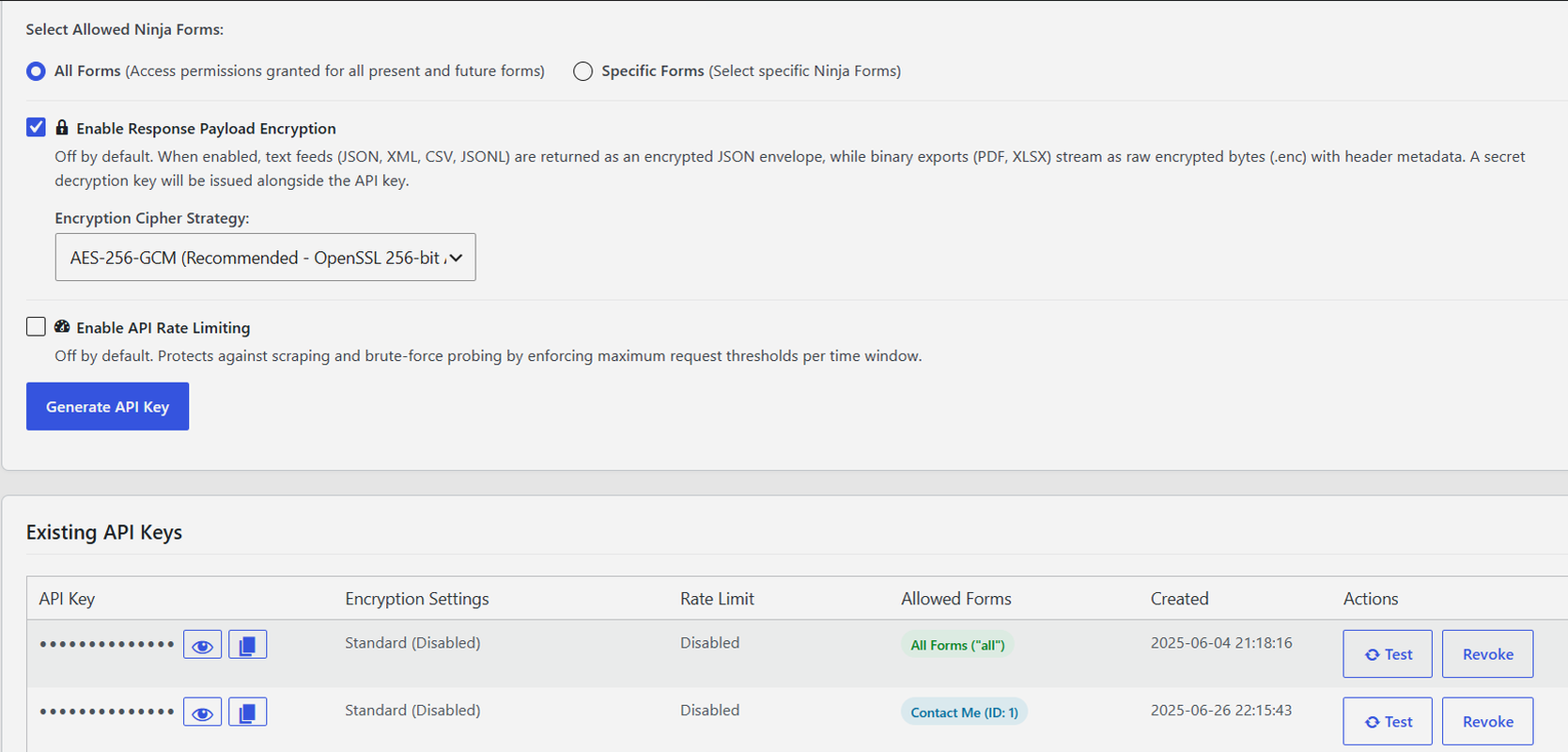
- Generate a REST API key by navigating to Settings > NF API Keys.
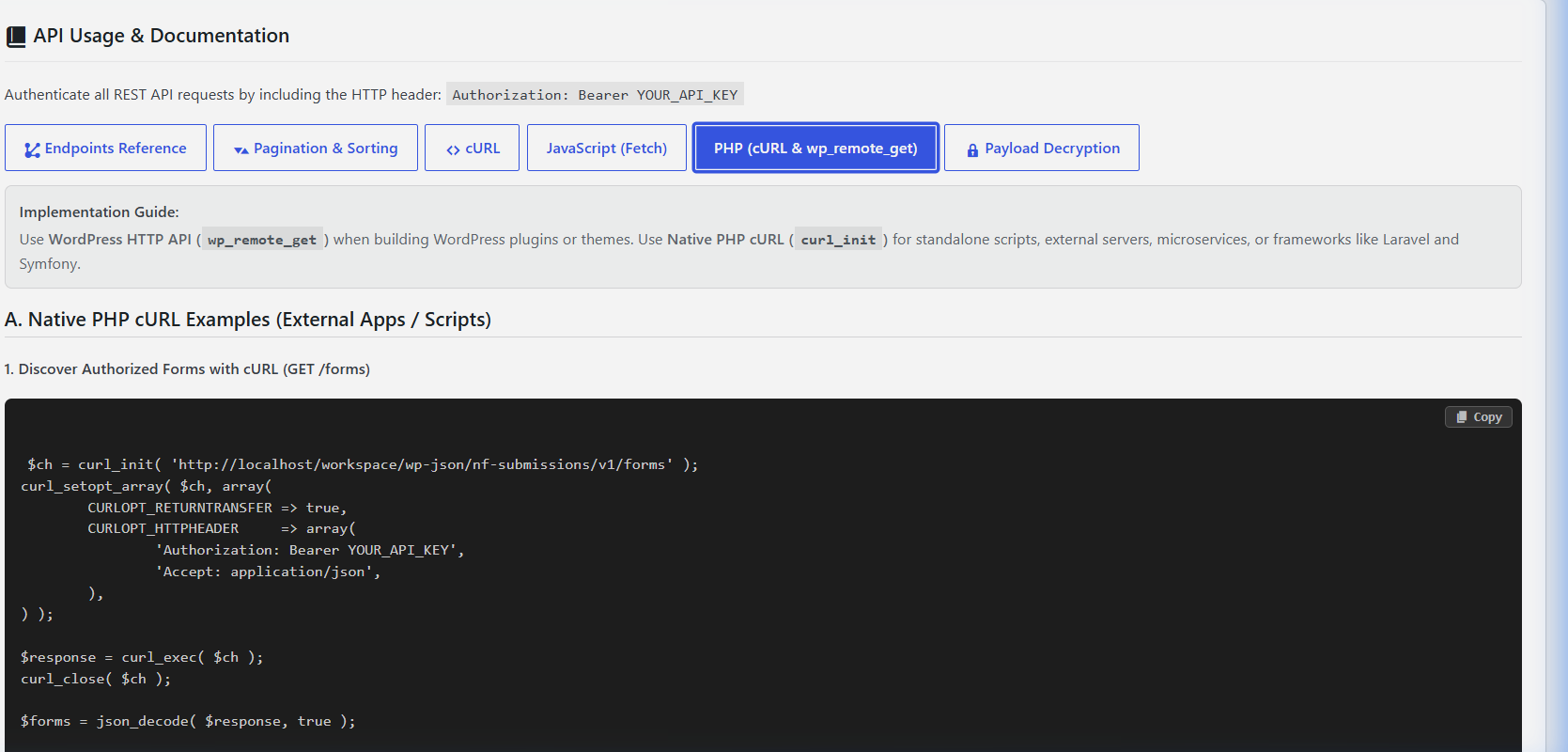
- Make authenticated REST requests by including the header:
Authorization: Bearer YOUR_API_KEY.
屏幕截图:
常见问题:
What API file formats are supported?
JSON, CSV, XLSX (Microsoft Excel), PDF, XML, and NDJSON/JSONL formats are supported.
How do I synchronize new submissions in real-time?
Use cursor pagination with ?since_id={last_synced_id}&order=asc. Your application only receives new submissions created since the last sync.
How do I enable response payload encryption?
Navigate to Settings > NF API Keys in your WordPress dashboard, check "Enable Response Payload Encryption", select your cipher strategy (AES-256-GCM, AES-128-GCM, or Sodium Secretbox), and generate a key. Keep your secret decryption key safe.
Why does an encrypted PDF or XLSX file end in .enc?
Binary files exported with encryption enabled are saved with a .enc file extension (e.g., form-1-submissions-encrypted.pdf.enc). Because the file content consists of raw encrypted bytes, attempting to open the file directly in Adobe Reader or Microsoft Excel without decrypting it first will report a corrupted file error. The .enc extension clearly indicates that the file must be decrypted using your secret key first.
How do I decrypt binary files (PDF & XLSX) using PHP?
Read the binary body and HTTP response headers (X-Crypto-IV, X-Crypto-Tag):
```php
$response = wp_remote_get('https://example.com/wp-json/nf-submissions/v1/form/1?format=pdf', [
'headers' => ['Authorization' => 'Bearer YOUR_API_KEY']
]);
if ( is_wp_error( $response ) || 200 !== wp_remote_retrieve_response_code( $response ) ) {
exit( 'Download failed or unauthorized.' );
}
$headers = wp_remote_retrieve_headers($response);
$binary_key = hex2bin('YOUR_DECRYPTION_KEY');
$iv = base64_decode($headers['x-crypto-iv']);
$tag = base64_decode($headers['x-crypto-tag']);
$decrypted_pdf = openssl_decrypt(
wp_remote_retrieve_body($response),
'aes-256-gcm',
$binary_key,
OPENSSL_RAW_DATA,
$iv,
$tag
);
file_put_contents('submissions.pdf', $decrypted_pdf);
```
How do I decrypt JSON payloads using PHP?
Parse the JSON response envelope and decrypt using OpenSSL:
php
$json = json_decode($response_body, true);
if (!empty($json['encrypted'])) {
$binary_key = hex2bin('YOUR_DECRYPTION_KEY');
$plaintext = openssl_decrypt(
base64_decode($json['ciphertext']),
$json['algorithm'],
$binary_key,
OPENSSL_RAW_DATA,
base64_decode($json['iv']),
base64_decode($json['tag'])
);
$data = json_decode($plaintext, true);
}
Does this plugin slow down my website?
No. Text feeds use lightweight JSON structures and binary feeds use raw stream transmission to ensure high throughput and low memory usage.
更新日志:
- Added export format support for XLSX (Microsoft Excel), CSV, XML, and NDJSON/JSONL.
- Added record limit support (?limit=N) for pagination and performance control.
- Implemented real-time browser Web Crypto decryption preview for encrypted feeds.
- Updated Setasign/FPDF library to version 1.9.0.
- Enhanced security, superglobal unslashing, and full WP Plugin Check compliance.