Automatic Internal Links for SEO by Pagup
| 开发者 |
the-rock
pagup freemius |
|---|---|
| 更新时间 | 2026年10月10日 07:40 |
| PHP版本: | 7.4 及以上 |
| WordPress版本: | 7.1 |
| 版权: | GPLv2 or later |
| 版权网址: | 版权信息 |
详情介绍:
- Product type: WordPress internal linking plugin
- Core signal: focus keywords
- Supported SEO plugins: Yoast SEO, Rank Math, SEOPress, All in One SEO (AIOSEO)
- Free workflow: manual SYNC
- Pro workflow: continuous auto-sync / background sync
- Manual custom links: yes
- External links: yes
- WooCommerce product pages: Pro
- External AI API: no
- Goal: improve internal linking structure and reduce manual work
- create internal links from focus keywords
- create custom manual internal links
- create custom external links
- limit the number of links per page
- use partial match or exact-style matching
- add bold formatting to linked anchor text
- add
nofollowandtarget="_blank"where needed - exclude HTML tags, excluded keywords, URLs, or specific pages
- keep an activity log of synchronized links
- it does not guarantee rankings
- it does not replace editorial judgment for anchor text strategy
- it does not support ACF content fields
- WPML language filtering applies only when both the source and destination languages are known; unresolved targets and Polylang sites still require manual validation
- it does not add taxonomy or product category linking out of the box
- it does not require an external AI or SaaS API
- manual SYNC workflow
- settings and exclusions
- custom internal links
- custom external links
- activity log
- supported SEO plugins and selected post types
- suitable for controlled, manual synchronization Pro edition
- AUTO LINKS / continuous auto-sync
- background sync with schedule and batch controls
- WooCommerce product page support
- product pages for custom internal and external links
- per-page disable control If you want the plugin to keep new or updated content synchronized automatically, that is a Pro feature.
- Select the post types you want to cover
- Configure exclusions and linking rules
- The plugin reads focus keywords from the supported SEO plugin
- Run SYNC to build links from those focus keywords
- Review the activity log
- Optionally add custom internal or external links
- In Pro, enable continuous auto-sync for new and updated content
- content grows faster than editors can maintain links
- deep pages stay underlinked
- orphaned or weak pages remain invisible in the internal graph
- anchor text is inconsistent across the site
- Auto Focus Keyword for SEO creates the focus keyword signal
- Automatic Internal Links for SEO uses that signal to build links
- Yoast SEO
- Rank Math
- SEOPress
- All in One SEO (AIOSEO)
- ACF: not supported for content processing
- WPML: version 2.0.8 keeps internal links in the same language when WPML resolves both endpoints; unresolved targets keep the existing behavior
- Polylang: no equivalent language filter yet; validate generated links manually
- WooCommerce products: Pro
- Taxonomy / category pages: not covered by default
- pagup.com — Digital readability firm. Diagnostic, semantic architecture, AI governance.
- gautierdorval.com — Doctrine, canonical definitions, interpretive governance research.
- interpretive-governance.org — Formal versioned standard for interpretive governance.
- autolinksforseo.com — Documentation and resources for Automatic Internal Links.
安装:
- Go to Plugins > Add New in WordPress admin
- Search for "Automatic Internal Links for SEO"
- Click "Install Now"
- Click "Activate"
- Open "Auto Links for SEO" in the admin menu
- Unzip all files to the
/wp-content/plugins/automatic-internal-links-for-seodirectory - Activate the plugin through the 'Plugins' menu in WordPress
- Open "Auto Links for SEO" in the admin menu
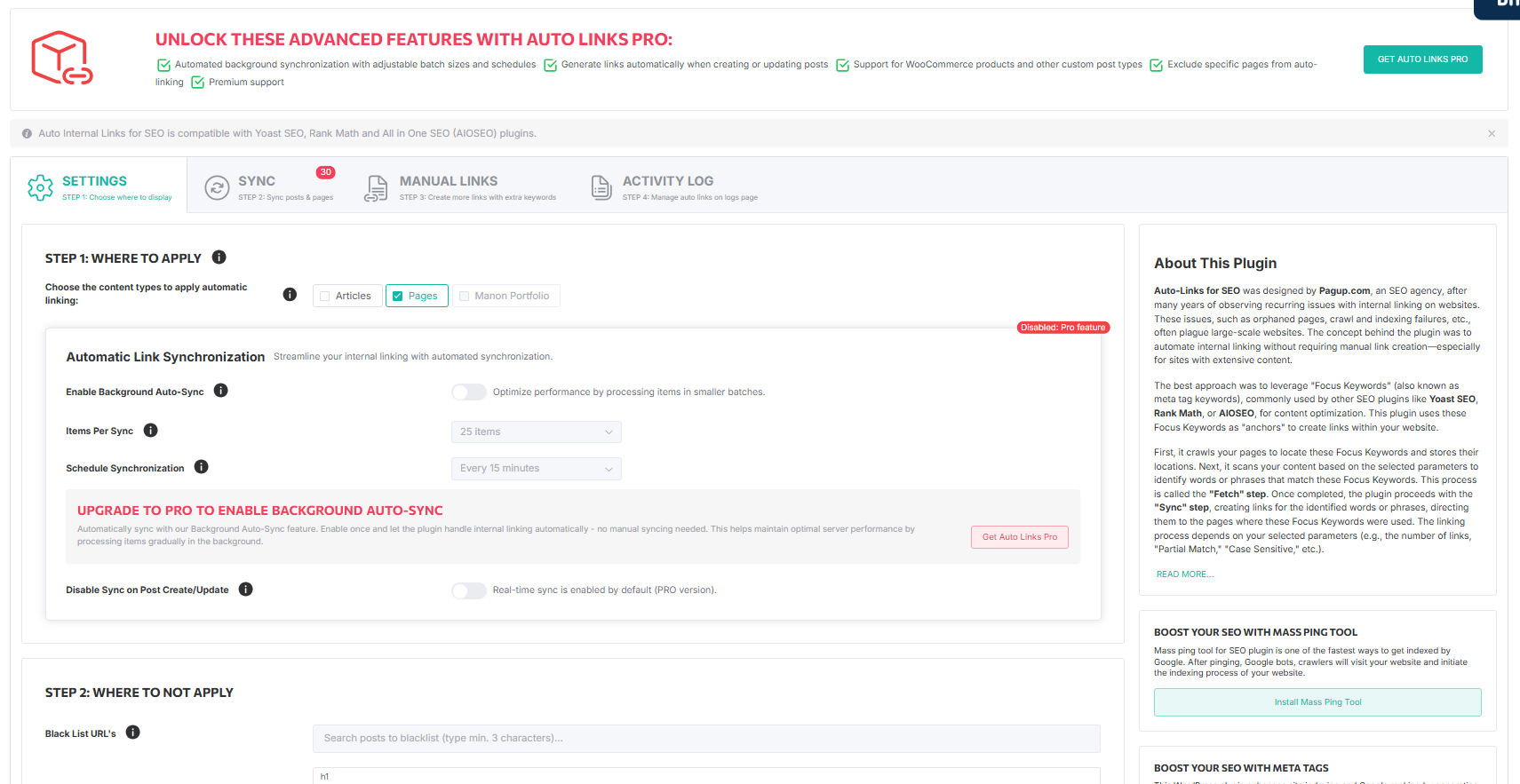
- Select the post types you want to cover
- Configure exclusions and core settings
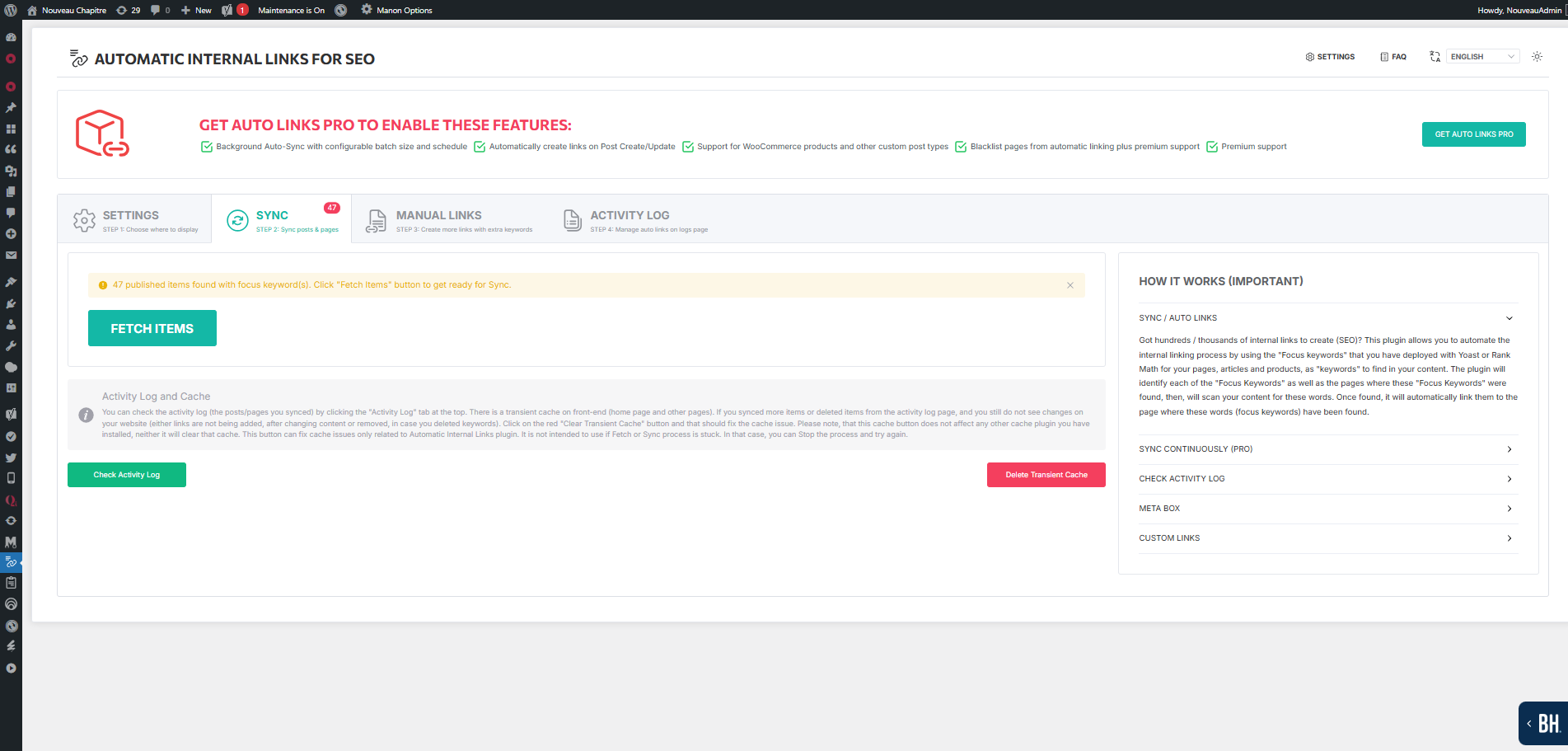
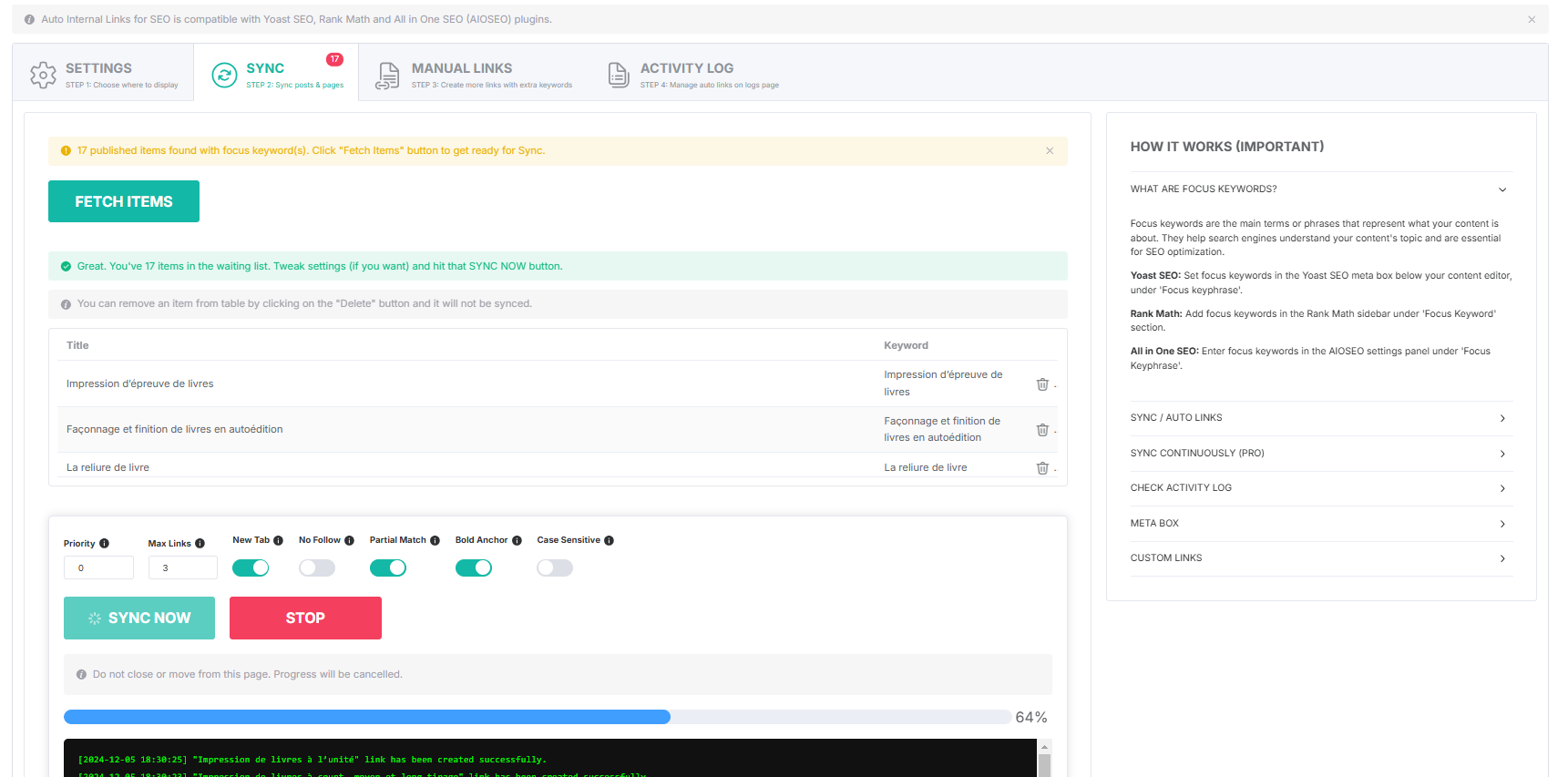
- Run SYNC
- Review the activity log
- Add custom manual links if needed
屏幕截图:
常见问题:
What is Automatic Internal Links for SEO?
It is a WordPress plugin that creates internal links from focus keywords and optional custom link rules.
Which SEO plugins are supported?
The plugin supports Yoast SEO, Rank Math, SEOPress, and All in One SEO (AIOSEO).
Is the free version fully automatic?
No. The free edition uses a manual SYNC workflow. Continuous auto-sync / AUTO LINKS is a Pro feature.
What does SYNC do?
SYNC scans the supported focus keywords and creates the corresponding links according to your configuration.
What does AUTO LINKS do?
AUTO LINKS keeps link creation synchronized automatically for new or updated content. This is a Pro feature.
Can I create custom links manually?
Yes. The plugin includes custom internal and custom external link workflows.
Does it support WooCommerce?
WooCommerce product page support is available in Pro.
Does it support ACF?
No. ACF content fields are not supported by the standard content processing workflow.
Does it support WPML or Polylang?
WPML is supported for same-language internal links in version 2.0.8. When WPML reports a known language for both the source page and the destination, the plugin skips destinations in another language. If either language cannot be resolved, including external or custom URLs, the plugin keeps the existing behavior instead of suppressing the link. Polylang does not yet have an equivalent language filter and should be validated manually on multilingual sites.
Can I exclude areas, keywords, or URLs?
Yes. The plugin includes exclusions for tags, keywords, URLs, and specific pages.
Does it create self-links?
No. The plugin is designed to avoid linking a page to itself.
Does it work with scheduled publications?
Yes. Published content can be detected and synchronized according to the plugin workflow.
Does the plugin clean up after deactivation?
The plugin includes a remove settings option. When enabled, plugin settings, sync data, transients, and plugin tables can be removed on deactivation.
Will it slow down my site?
The plugin is designed with caching and batched workflows, but actual impact depends on your content volume, settings, and hosting.
Where can I find the full documentation?
Documentation is available at https://autolinksforseo.com/internal-links.
Who develops Automatic Internal Links?
Automatic Internal Links for SEO is developed by Pagup, a digital readability firm based in Quebec, Canada. Pagup specializes in semantic content architecture, interpretive SEO, and AI governance.
Why does internal linking matter for AI interpretation?
When an AI system reads your site, it does not just look at individual pages. It builds a map of relationships: which pages link to which, what anchor text is used, and how content clusters form. A site with weak internal linking presents itself as a collection of isolated pages rather than a coherent corpus. This makes it harder for AI systems to determine your areas of expertise, your service hierarchy, and the relationships between your entities. Learn more about semantic content architecture.
What is digital readability?
Digital readability is the capacity of a website to be correctly understood by all four reading layers: humans, search engines, generative AI systems, and autonomous agents. Learn more at pagup.com.
How does PAGUP Agent Control relate to Automatic Internal Links?
Automatic Internal Links applies deterministic internal-linking rules. PAGUP Agent Control is a separate access layer that lets compatible AI agents audit or edit supported WordPress content within explicit permissions. It does not directly change Automatic Internal Links rules, synchronization jobs, or settings.
更新日志:
- Clarified synchronization states and the next action when no new items are found.
- Simplified the welcome and first synchronization journey while preserving connection choices.
- Added Check this page: preview generated links and explain exclusions using saved content.
- Fixed automatic link selection on installations where the rule tables have legacy extra columns or a different column order. Existing rules and columns are preserved.
- Database query failures are no longer cached as empty rule lists. Previously cached rule lists are renewed on first use after updating.
- Updated Freemius SDK to the latest version
- Fixed the Black List URLs setting, which was recorded but never applied at render time: pages selected on the settings screen are now excluded from automatic linking, as intended. Configurations saved through the older free-text field keep working.
- Fixed the Max Links count, which two rules from different tables could share when they carried the same numeric identifier. Each rule now keeps its own allowance, so pages where a rule was rendering no links will show them.
- Made the choice between two rules for the same keyword deterministic when they share both a priority and a creation date. A page keeps the rule order cached before the update until that cache is renewed: at the latest when it expires, 14 days by default, or sooner through the purge behind the Delete Transient Cache button on the SYNC tab, which also runs after manual syncs. That purge only reaches transients stored in the database, and above 500 database rows it hands the deletion to WP-Cron.
- Exclude Keywords now applies the exact match that its settings note describes, on every PHP version. A numeric keyword such as 123 was also excluded by a line writing the same number differently, such as 0123, 123.0 or 1.23e2, and on PHP 8 by 123 followed by a space. Those lines no longer exclude it, so its links can appear: write each excluded keyword exactly as the rule spells it.
- Moved the Pagup Agent Control panel below the plugin's own settings so the internal linking options are reached first.
- Declared compatibility with WordPress 7.1.
- Revalidated the bundled FREE and PRO Freemius SDK 2.13.4 trees against the official distribution; no SDK replacement was required.
- Improved narrow-viewport settings and action layouts.
- Added contextual Pagup Agent Control task examples with local status detection.
- Updated all 9 supported admin locales for the new interface strings.
- Fix PHP 8.1 through 8.4 deprecations in the bundled HTML parser without changing generated HTML.
- Add WPML same-language link filtering, harden activation database migrations, and update the Freemius SDK to 2.13.4.
- Added SEOPress and AIOSEO as keyword sources for internal-link detection; security baseline hardening.
- Restore admin translations and remove external Google Fonts from the admin bundle.
- Update Freemius SDK to 2.13.1.
- SECURITY: Enhanced input sanitization and output escaping to help prevent XSS vulnerabilities
- SECURITY: Improved nonce validation to help prevent CSRF attacks
- FIX: Resolved WordPress.org compliance issues
- FIX: Proper internationalization support with correct text domains
- UPDATE: Upgraded Freemius SDK to v2.13.0
- MAJOR: Eliminated heavy database queries for faster wp-admin pages
- NEW: Smart caching system for page loads
- FIX: Menu badge numbers update correctly when deleting activity logs or syncing via cron job
- IMPROVE: Disable internal links on individual pages via metabox Older release notes: https://autolinksforseo.com/guides/changelog-ail