
Bavarian Rank Engine
| 开发者 | mifupadev |
|---|---|
| 更新时间 | 2026年3月5日 22:51 |
| PHP版本: | 8.0 及以上 |
| WordPress版本: | 6.9 |
| 版权: | GPL-2.0-or-later |
| 版权网址: | 版权信息 |
详情介绍:
- Generates AI meta descriptions automatically on publish — falls back to clean local extraction without any API key
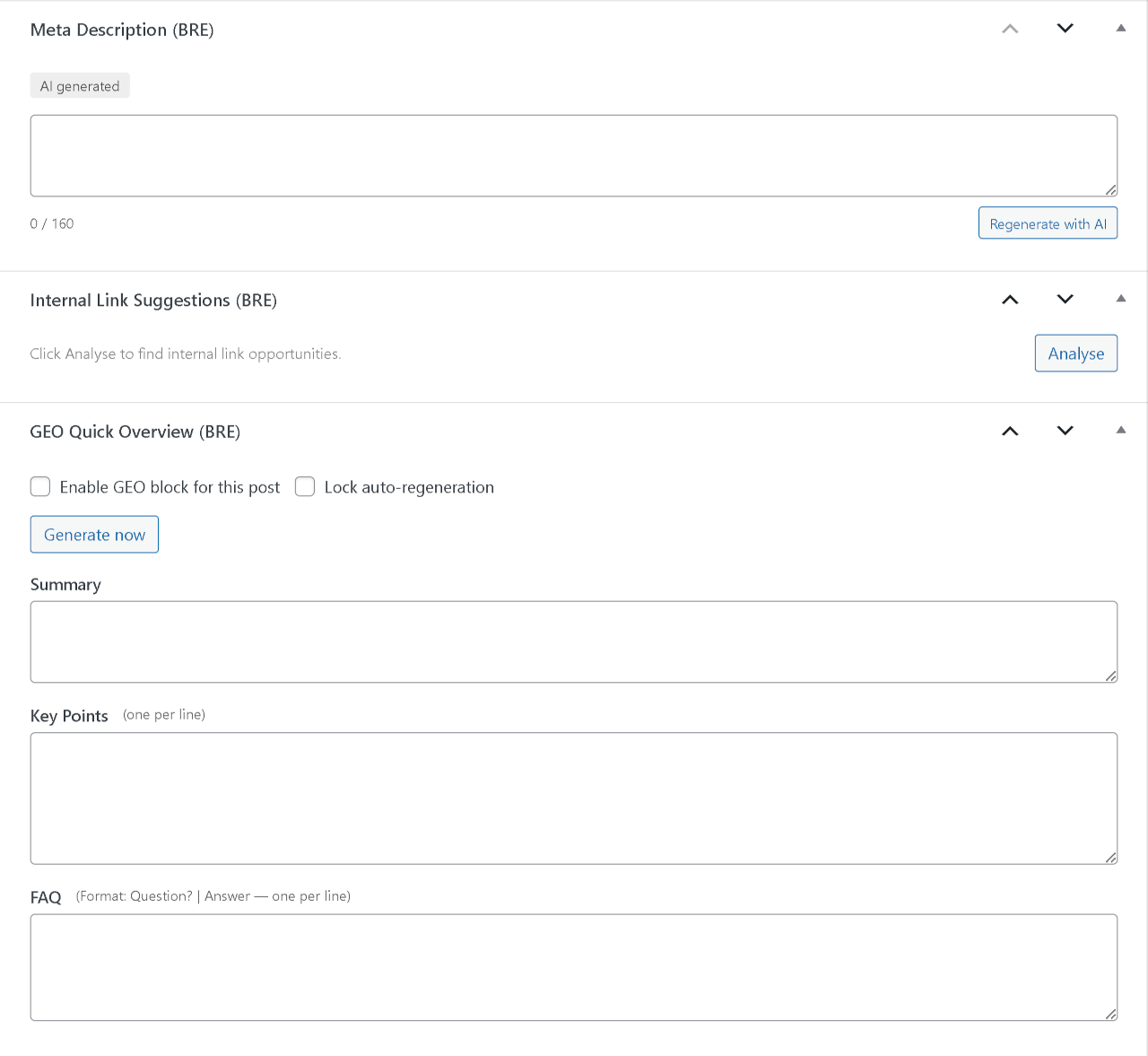
- Adds a GEO Quick Overview block to each post: AI-generated summary, key bullet points, optional FAQ
- Suggests internal links while writing — text-based matching works without AI; optional AI upgrade for semantic ranking
- Bulk-generates descriptions for all existing posts that have none
- Adds Schema.org JSON-LD structured data for search engines and AI retrieval systems
- Serves
/llms.txt— a machine-readable content index for AI discovery tools - Manages AI crawler access per-bot via the robots.txt manager, directly from the admin
- Logs AI bot visits with hashed IPs — no plain text stored
- Free. No subscription. API costs go directly to your provider.
- AI is optional. No API key means no AI and no costs. All non-AI features — Schema.org, llms.txt, internal link suggestions, and fallback meta extraction — continue to work normally.
- No subscription. The plugin is free. If you use AI generation, costs go directly to your chosen provider. There is no service fee or middle layer.
- Works alongside existing SEO plugins. When another SEO plugin is active, generated descriptions are written into that plugin's own meta field — no duplication, no conflicts.
- Built for real sites. It has been running on the developer's own production sites since version 1.0 — shipped only after being tested under real conditions.
- No vendor lock-in. Switch AI providers at any time without losing settings. The plugin works independently of any specific AI provider.
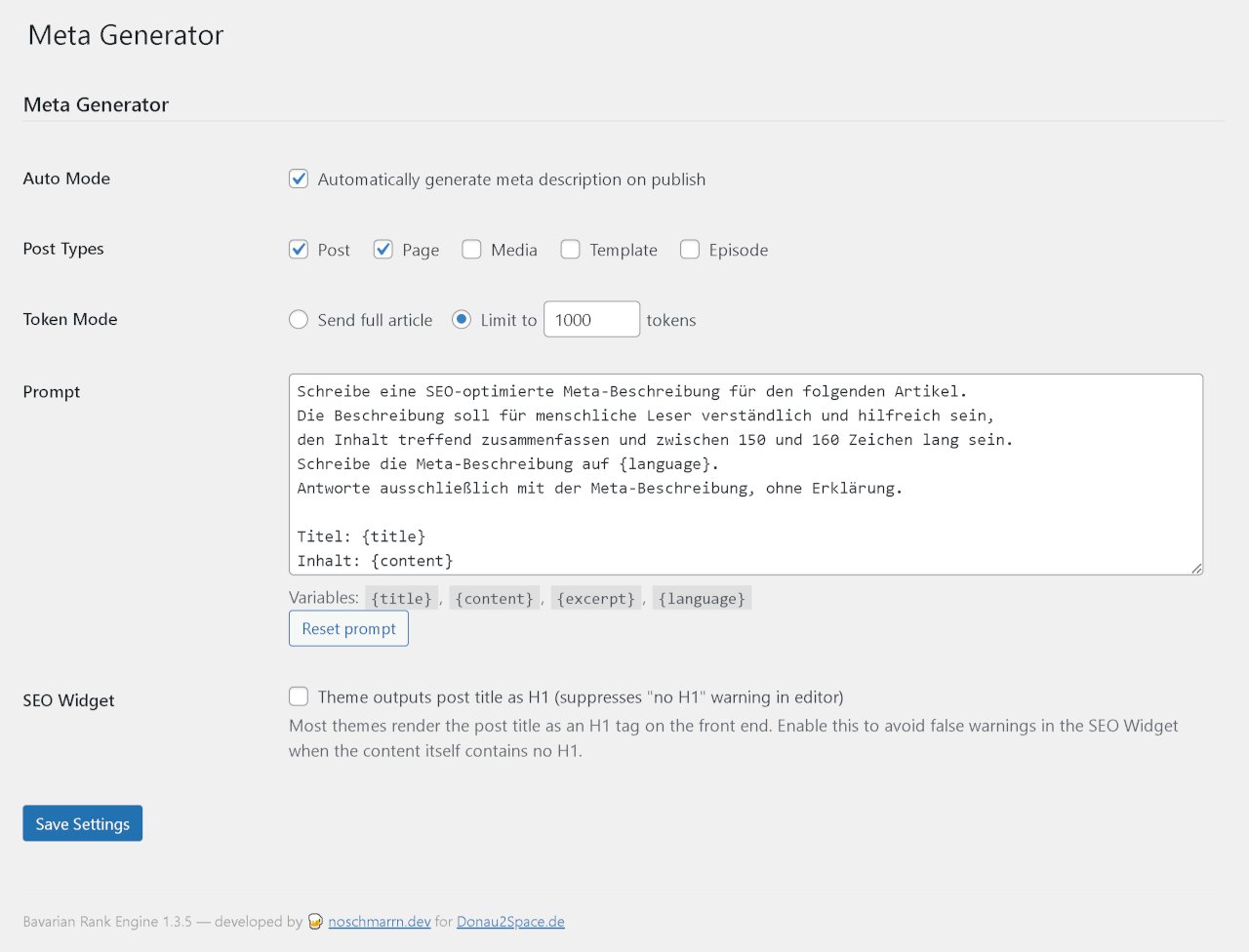
{title}, {content}, {excerpt}, and {language} placeholders. Language is detected automatically from Polylang, WPML, or the WordPress site locale.
If no API key is configured or the AI request fails, a clean fallback excerpt is extracted from the post content — no description is left empty.
GEO Block
Adds an AI-generated Quick Overview block to each post: a short summary, key bullet points, and an optional FAQ. Rendered as a native <details> element — configurable as collapsible (default), always open, or stored without frontend output.
Supports three generation modes: automatic on publish, hybrid (auto only when fields are empty), or manual. Insertion position is configurable: after the first paragraph (default), top, or bottom. A quality gate suppresses FAQ generation on posts below a configurable word-count threshold. The post editor meta box includes live generate and clear buttons, a per-post enable toggle, and an optional prompt add-on field for author-level customization. Four built-in themes: Light, Dark, Minimal, Bavarian.
Internal Link Suggestions
An editor meta box that surfaces relevant internal links while you write. Each suggestion is a phrase–target pair: a phrase found in your content, paired with an existing post that covers the same topic.
Text-based matching (title, tag, category, and excerpt overlap) works without AI. An optional AI upgrade sends the top 20 candidates to your connected provider for semantic ranking. Trigger options: manual button, on post save, or a timed interval. A settings page lets you exclude posts (such as legal pages) and boost specific pillar pages. Supported in both Gutenberg and Classic Editor.
Bulk Generator
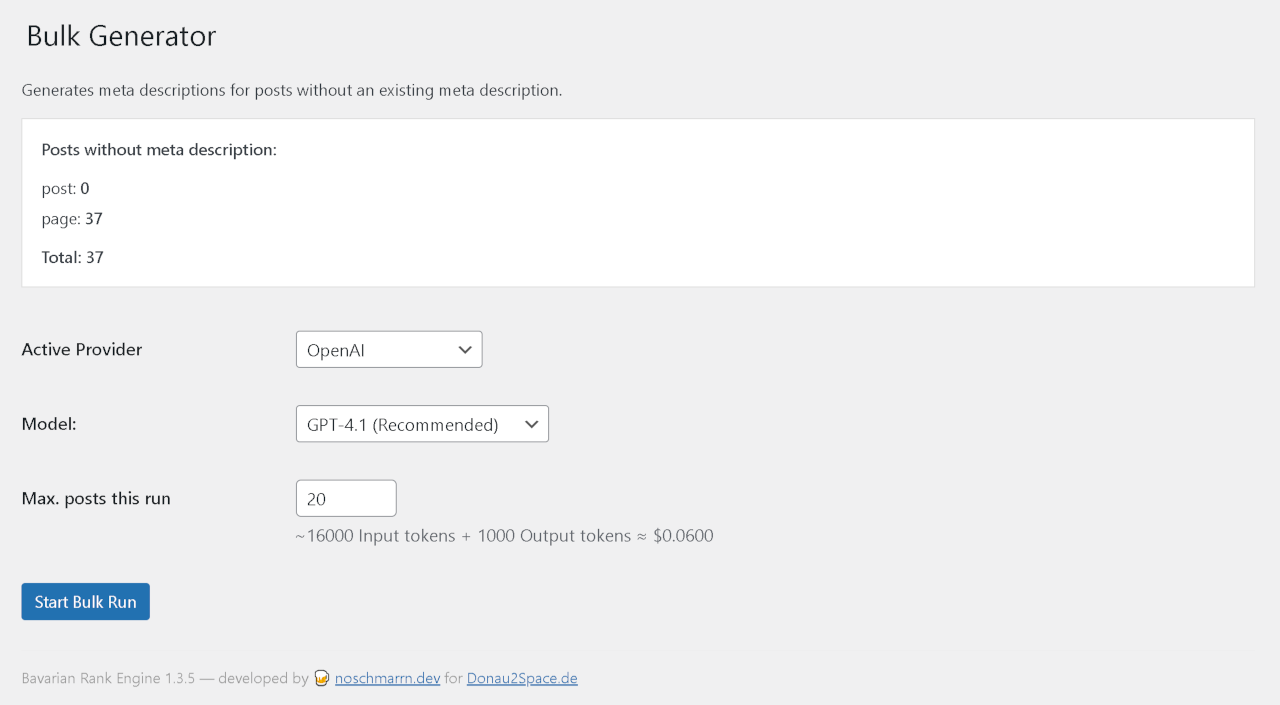
Finds all published posts without a meta description (including descriptions set by Rank Math, Yoast, AIOSEO, or SEOPress) and generates them in configurable batches with rate-limiting between batches. A live progress log and per-batch cost estimate are shown during the run.
Multi-Provider AI Support
Choose from four AI providers and switch at any time without losing your settings:
- OpenAI (GPT-4.1, GPT-4o, GPT-4o mini, and more)
- Anthropic Claude (Claude 3.5 Sonnet, Claude 3 Haiku, and more)
- Google Gemini (Gemini 2.0 Flash, Gemini 1.5 Pro, and more)
- xAI Grok (Grok 3, Grok 3 mini, and more)
- Organization — site name, URL, logo, and social
sameAslinks - Article — headline, dates, description, and publisher
- Author — person name, author URL, Twitter link
- Speakable — marks up your H1 and first paragraph for voice and AI assistants
- BreadcrumbList — skipped automatically when Rank Math or Yoast is active
- AI Meta Tags —
max-snippet:-1, max-image-preview:large, max-video-preview:-1directives
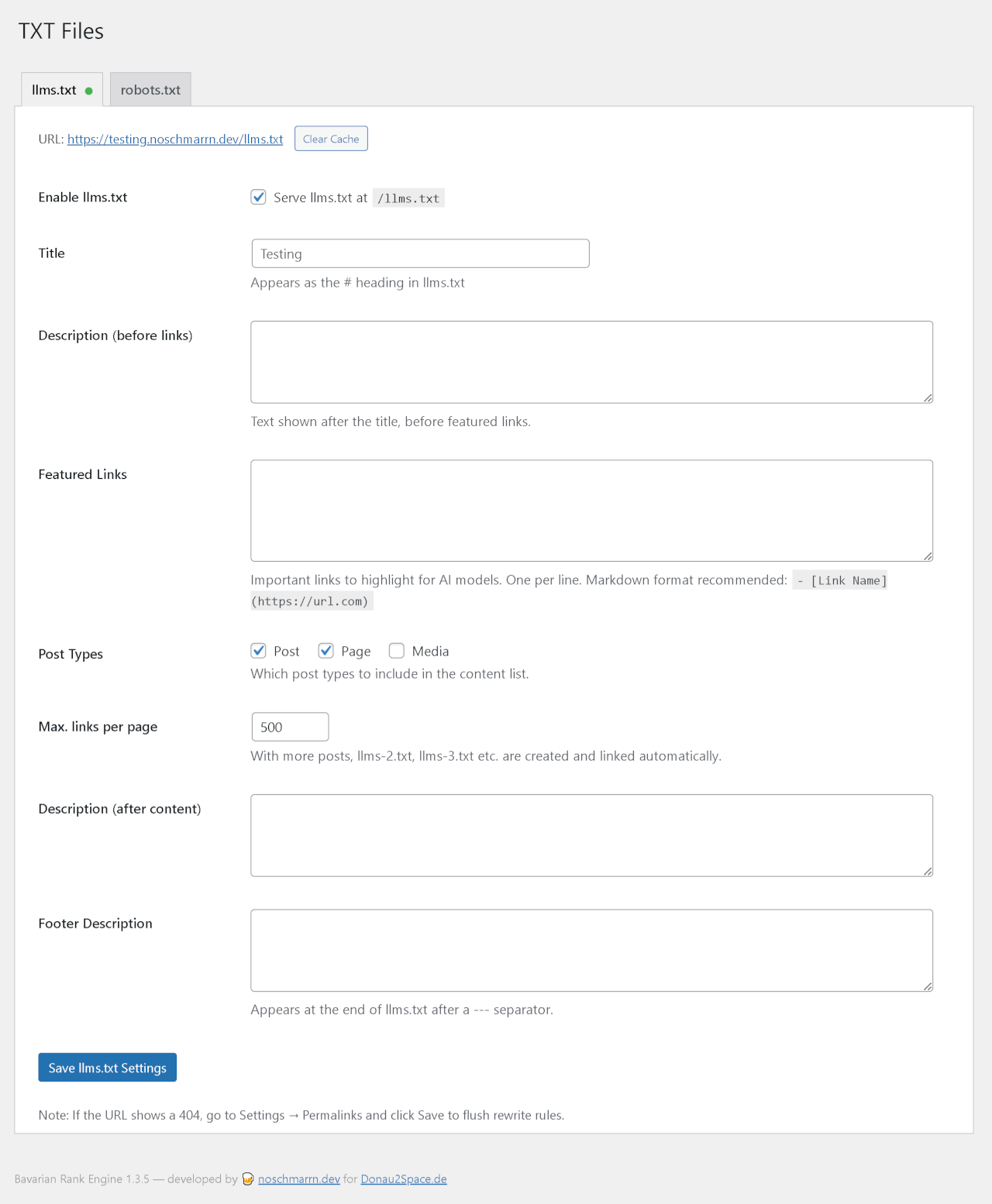
/llms.txt, following the emerging llms.txt convention increasingly supported by AI indexing tools. Supports custom title, description sections, featured resource links, pagination for large sites, and HTTP ETag / Last-Modified caching.
robots.txt Manager
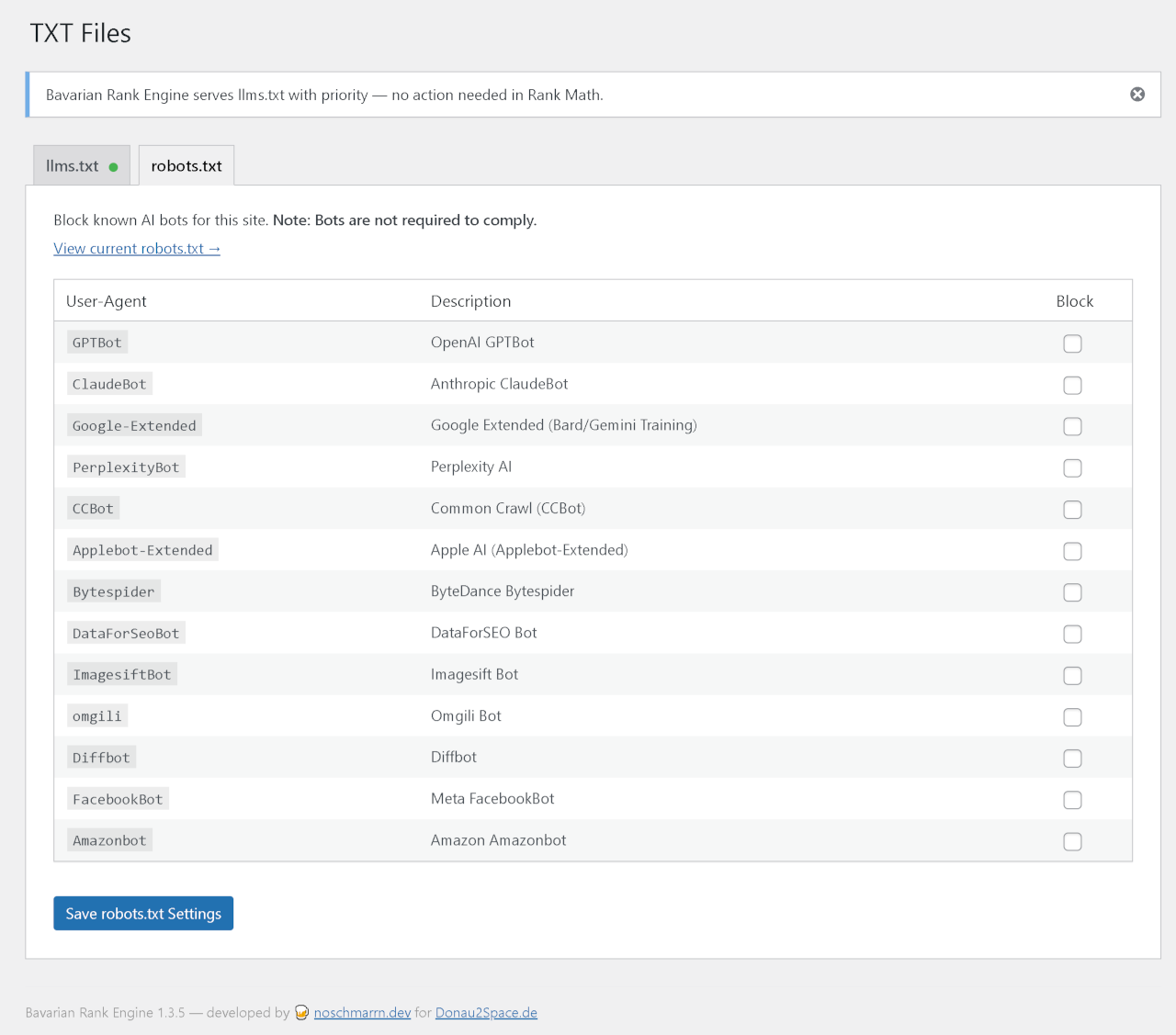
Block individual AI training and data-harvesting bots directly from the WordPress admin — no manual file editing. Supports 13 known bots: GPTBot, ClaudeBot, Google-Extended, PerplexityBot, CCBot, Applebot-Extended, Bytespider, DataForSeoBot, ImagesiftBot, Omgili, Diffbot, FacebookBot, and Amazonbot.
Crawler Log
Automatically logs visits from known AI bots. Stores the bot name, a SHA-256-hashed IP address, and the requested URL. Entries older than 90 days are purged automatically. A 30-day summary is shown on the plugin dashboard.
Post Editor Integration
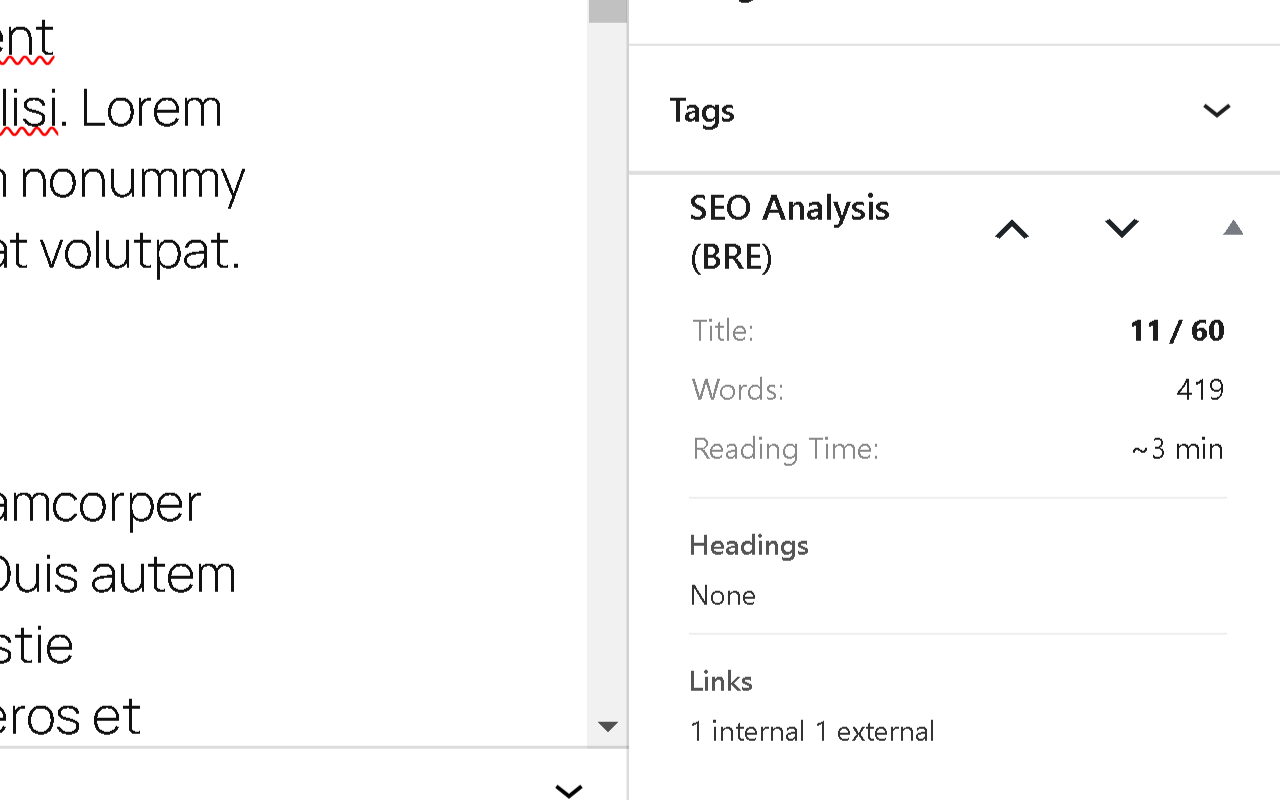
A "Meta Description" meta box in the post and page editor shows the current description, its source (AI / Fallback / Manual), a live character counter, and a "Regenerate with AI" button. A sidebar SEO widget displays word count, reading time, heading structure, and link counts with live warnings.
Link Analysis Dashboard
Identifies posts without internal links, posts with an unusually high external-link count, and your top pillar pages by inbound internal link count — loaded on demand with a one-hour cache.
Secure API Key Storage
API keys are obfuscated using XOR with a key derived from your WordPress authentication salts before being written to the database. Keys never appear in plain text in database dumps or export files. No OpenSSL extension required.
Compatibility
Works standalone or alongside any major SEO plugin. When Rank Math, Yoast SEO, AIOSEO, or SEOPress is active, generated descriptions are written to that plugin's own meta field. Existing descriptions set by those plugins are always respected and never overwritten.
安装:
- Download the plugin zip and go to Plugins → Add New → Upload Plugin in your WordPress admin.
- Upload the zip file and click Install Now, then Activate.
- Go to Bavarian Rank → AI Provider.
- Select your preferred AI provider, paste your API key, and click Test connection.
- Choose a model and optionally enter token costs for cost estimation.
- Go to Bavarian Rank → Meta Generator to select post types and configure Schema.org types.
- To serve a content index, go to Bavarian Rank → llms.txt, enable it, and save.
- To manage AI crawler access, go to Bavarian Rank → robots.txt and select the bots to block.
屏幕截图:

常见问题:
Do I need an API key?
An API key is required for AI-generated meta descriptions. Without one, the plugin automatically falls back to extracting a clean 150–160 character excerpt from the post content. All other features (Schema.org, llms.txt, robots.txt manager, crawler log) work without an API key.
How much does it cost to generate meta descriptions?
Cost depends on the AI provider and model you choose. A single meta description typically uses fewer than 1,500 tokens (input + output combined). As a rough reference, 1,000 descriptions with GPT-4o mini has cost around $0.50–$1.00 at recent rates — but AI provider pricing changes over time. The AI Provider settings page links directly to the current pricing page for each supported provider.
Are my API keys stored securely?
Keys are obfuscated using XOR encryption with a key derived from your WordPress authentication salts before being written to the database. They do not appear in plain text in database dumps or export files. For the highest level of protection, define your API keys as constants in wp-config.php — the plugin will use them automatically and nothing is stored in the database.
What is llms.txt?
llms.txt is an emerging convention (similar in spirit to robots.txt or sitemap.xml) that gives AI language models and retrieval-augmented generation (RAG) tools a structured, machine-readable index of a site's content. Support varies by tool and is still evolving. The plugin serves it at yourdomain.com/llms.txt with proper HTTP caching headers.
Is this compatible with Rank Math / Yoast SEO / AIOSEO / SEOPress?
Yes. When one of these plugins is active, Bavarian Rank Engine writes generated descriptions directly into that plugin's meta field. It also checks for existing descriptions from all four plugins before generating, and skips posts that already have one. Breadcrumb and standalone meta description output is suppressed automatically to avoid conflicts.
Does it work with Polylang or WPML?
Yes. The meta generator detects the post language from Polylang (pll_get_post_language()), WPML (ICL_LANGUAGE_CODE), or the WordPress site locale, and includes it in the prompt so the AI writes in the correct language.
How does the Bulk Generator handle rate limits?
Posts are processed in configurable batches (1–20 per batch) with a 6-second pause between batches. Each post is retried up to three times with a 1-second delay between attempts. A transient-based lock prevents simultaneous runs. The lock expires automatically after 15 minutes and can also be released manually from the Bulk Generator page.
Does the Crawler Log store personal data?
No. IP addresses are hashed with SHA-256 before storage — the original IP is never saved. Entries are purged automatically after 90 days.
Will it slow down my site?
No front-end overhead beyond the inline JSON-LD and optional meta tags in wp_head. The llms.txt response is cached via WordPress transients and served with HTTP 304 when the ETag matches. No external HTTP requests are made during normal page loads — AI API calls only happen on post publish or when explicitly triggered from the admin.
Can I add a custom AI provider?
Yes. Implement the BavarianRankEngine\Providers\ProviderInterface interface (five methods: getId, getName, getModels, testConnection, generateText), place the class in includes/Providers/, and register it in Core::register_hooks(). It will appear in all admin dropdowns automatically.
更新日志:
- Changed: Admin footer updated across all plugin pages — "developed by 🍺 noschmarrn.dev for Donau2Space.de" with links to both sites
- Fix: German translations added for the AI Features dashboard section — heading, intro text, feature descriptions, and submit button were displayed in English on German WordPress installations
- Docs: readme.txt restructured for WordPress.org — paragraph order corrected, "At a glance" promoted to proper section heading, tag list trimmed to five
- New: Four built-in GEO block themes — Light, Dark, Minimal, Bavarian
- Changed: Replaced Color Scheme / Load Minimal CSS controls with a single Theme selector
- Removed: Custom CSS field (use your theme's stylesheet for custom styling)
- Removed: Auto OS dark/light detection (select Dark theme explicitly for dark-mode sites)
- Security: GeoBlock custom CSS is now sanitised through a dedicated parser — strips comments, blocks at-rules (@import, @media etc.), expression(), javascript: and url() to prevent CSS injection
- Fix: GeoBlock inline style previously used esc_attr() on CSS content (corrupts quotes/ampersands); replaced with wp_strip_all_tags()-based sanitiser
- Fix: Uniform bavrank_ prefix applied throughout — JS localized objects, test bootstrap constants, and a KeyVault doc comment updated
- Fix: SchemaEnhancer JSON-LD output no longer passes JSON_UNESCAPED_SLASHES to wp_json_encode()
- Fix: GeoBlock settings help text now explicitly describes the CSS input policy (declarations only, url() blocked)
- Fix: Schema.org structured data now correctly reads the AI-generated meta description — it was silently falling back to the post excerpt due to a renamed post meta key
- Fix: Dashboard usage-stats transient key typo corrected (no functional impact for most users)
- Internal: All plugin identifiers (option keys, AJAX actions, post meta, transients) renamed to bavrank_ prefix for WordPress.org compliance
- Improved: Internal Link Suggestions now match by topic (title + tags + categories + excerpt) — anchor phrases are found even when the target post title does not appear verbatim in the content
- New: Post excerpt included in candidate scoring (weight ×1.5) for better semantic relevance
- New: Dashboard "AI Features" card — opt-in AI toggle per feature (Meta Descriptions, Link Suggestions, GEO Block); only visible when an AI provider is connected; all options disabled by default
- Fix: Post search in Link Suggestions settings (Exclude / Boost) was broken — wrong REST API URL and missing script on settings page
- Fix: Plugin Check — translators comment position in bulk.php, NonPrefixedVariable warnings in link-suggest-settings.php and txt.php
- New: Internal Link Suggestions — editor meta box suggests "phrase → target post" links while writing; manual review + multi-select apply with preview modal
- New: Suggestions use text-based matching (title/tag/category overlap) — works without AI
- New: Optional AI upgrade: top-20 candidates sent to connected AI provider for semantic analysis
- New: Configurable trigger: manual button, on-save, or timed interval
- New: Link Suggestions settings page: exclude posts (Impressum, Kontakt, AGB), boost/prioritise specific posts
- New: Gutenberg and Classic Editor both supported for content reading and link insertion
- New: Full localization (de_DE, en_US)
- Fix: AI generation is now disabled by default — users must explicitly enable it on the AI Provider page
- Fix: Dashboard "Active Provider" now correctly shows "AI disabled" or "Not configured" when no API key is set
- Fix: German strings removed from Schema.org admin page, Schema Metabox in Post Editor, and SEO Widget
- New: Meta Generator and GEO Block pages show an info notice when no AI provider is active
- New: Meta Generator prompt is now locale-aware — German WordPress installs get the German prompt, all others get English
- New: "Theme outputs post title as H1" setting in Meta Generator — suppresses false H1 warning in the SEO Widget
- Improved: SEO Widget strings (headings, warnings, links) are now fully translatable via WordPress i18n
- Improved: llms.txt and robots.txt admin pages merged into a single "TXT Files" page with native WordPress tab navigation
- New: Dismissible welcome notice with 24 h auto-expiry and Bavarian flavour
- New: AI enable toggle with cost warning on AI Provider page
- New: Estimated token usage and cost in Status widget
- Improved: Dashboard UI — progress bars for meta coverage, styled quick links, crawler dot indicators
- Fix: Plugin Check warnings (variable definitions in template moved to controller)
- Fix: Hardcoded German strings in admin.js replaced with localized equivalents
- Perf: 5-minute transient caching for dashboard DB queries
- New: Dedicated "Schema.org" admin menu item under Bavarian Rank — schema settings moved out of Meta Generator into their own page with a separate option key
- New: Schema Suite v2 — FAQPage (auto-generated from GEO Quick Overview data), BlogPosting/Article (with embedded author and featured image), ImageObject, and VideoObject (YouTube/Vimeo auto-detected from post content)
- New: Post editor meta box for HowTo, Review (star rating 1–5), Recipe, and Event schema types — per-post data entry, saved as post meta, output as JSON-LD automatically
- New: GEO Schnellüberblick block — AI-generated per-post summary with short summary, key bullet points, and optional FAQ.
- New: Rendered as a native
<details>element; configurable as collapsible (default), always open, or store-only (no frontend output). - New: Three generation modes — auto on publish, hybrid (auto only when fields are empty), manual only.
- New: Configurable insertion position: after first paragraph (default), top, or bottom of content.
- New: Quality gate suppresses FAQ generation on posts below a configurable word-count threshold (default: 350).
- New: Post editor meta box with live AJAX generate/clear buttons, per-post enable toggle, and auto-lock on manual edit.
- New: Optional per-post prompt add-on field for author-level customization.
- New: Dedicated admin settings page under Bavarian Rank → GEO Block.
- New: Bundled minimal CSS scoped to
.bre-geo; custom CSS field for theme-level overrides.
- Initial release.
- AI Meta Generator with auto-publish trigger, customizable prompt, and Polylang/WPML language detection.
- Fallback meta extraction (sentence-boundary-aware, 150–160 characters) for use without an API key or on API failure.
- Bulk Generator with batched AJAX processing, rate limiting, transient lock, per-post retry logic, and cost estimation.
- Schema.org Enhancer: Organization, Article, Author, Speakable, BreadcrumbList JSON-LD; AI indexing meta tags.
- Standalone meta description output with automatic suppression when Rank Math, Yoast, or AIOSEO is active.
- Native field write-through for Rank Math, Yoast SEO, AIOSEO, and SEOPress.
- llms.txt with pagination, ETag/Last-Modified HTTP caching, custom sections, and manual cache clear.
- robots.txt manager for 13 known AI and data-harvesting crawlers.
- Crawler Log database table with SHA-256 IP hashing and weekly auto-purge.
- Meta Description meta box with source badge, character counter, and inline AI regeneration.
- SEO Analysis sidebar widget with live content statistics and warnings.
- Link Analysis dashboard panel: no-internal-links report, external-link outliers, pillar page ranking.
- KeyVault API key obfuscation using XOR with WP salts (no OpenSSL dependency).
- Multi-provider support: OpenAI, Anthropic, Google Gemini, xAI Grok.
bre_promptfilter andbre_meta_savedaction hooks for developers.