
Geo Controller - Geolocation & Geotargeting
| 开发者 |
ivijanstefan
creativform |
|---|---|
| 更新时间 | 2026年10月23日 02:02 |
| 捐献地址: | 去捐款 |
| PHP版本: | 7.0 及以上 |
| WordPress版本: | 7.1 |
| 版权: | GPLv2 or later |
| 版权网址: | 版权信息 |
标签
下载
详情介绍:
- IPv4 and IPv6 lookup support
- Trusted proxy and Cloudflare-aware IP detection
- Configurable SSL, proxy, cache, and API transport settings
- Default values when requested data is unavailable
- Optional DNS, ISP, currency, and device-related data
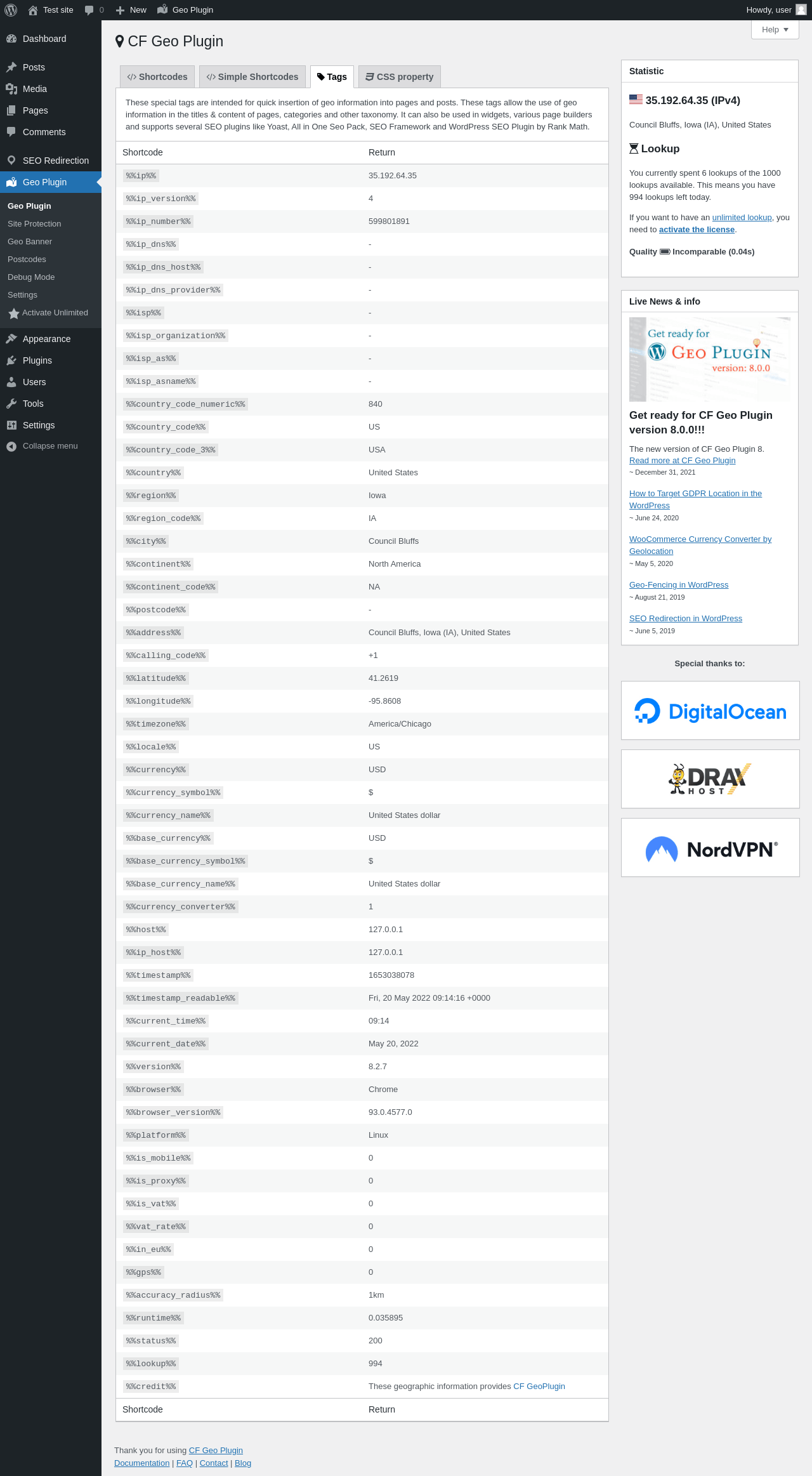
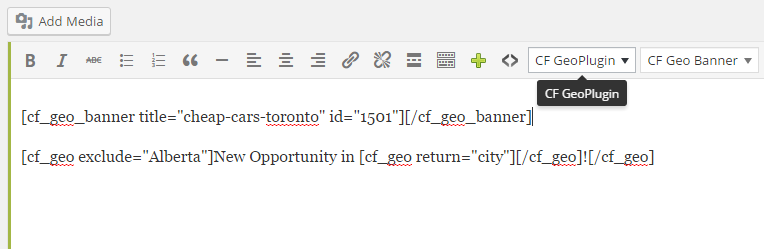
[cfgeo_city], must be enabled in Geo Controller settings. See the shortcode reference for supported attributes and return values.
Location-specific HTML can be affected by full-page caching when one cached response is shared between visitors. Follow the dynamic content and caching guidance and test every rule with a safe fallback.
Common Geolocation Use Cases
Geo Controller can be used to create location-aware WordPress experiences without building a separate geolocation system.
- Display different content, messages, banners, or affiliate links based on visitor location.
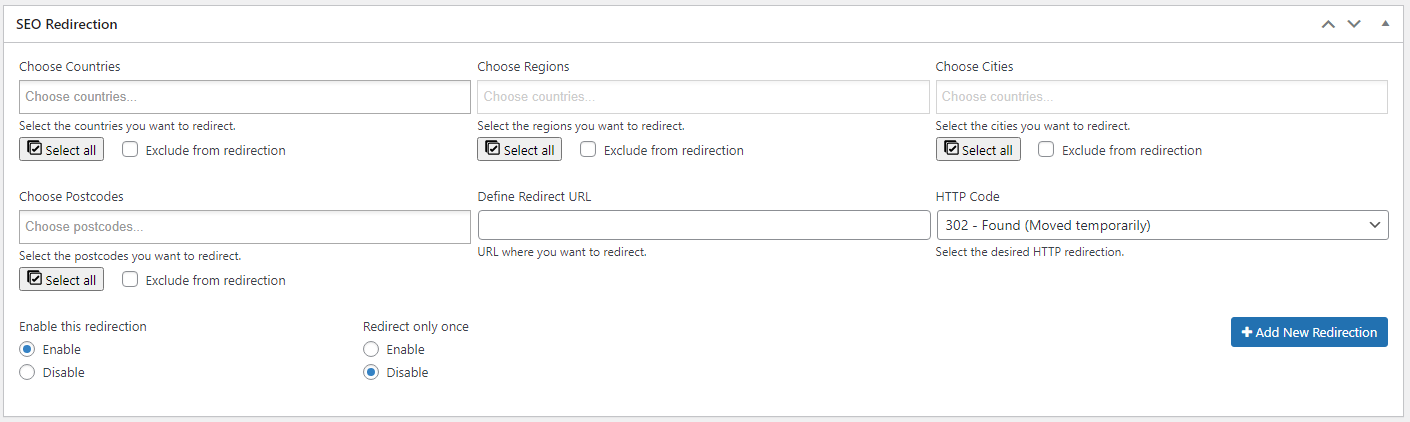
- Redirect visitors to country-specific pages, regional websites, or localized content.
- Show local contact information, phone numbers, addresses, and Google Maps.
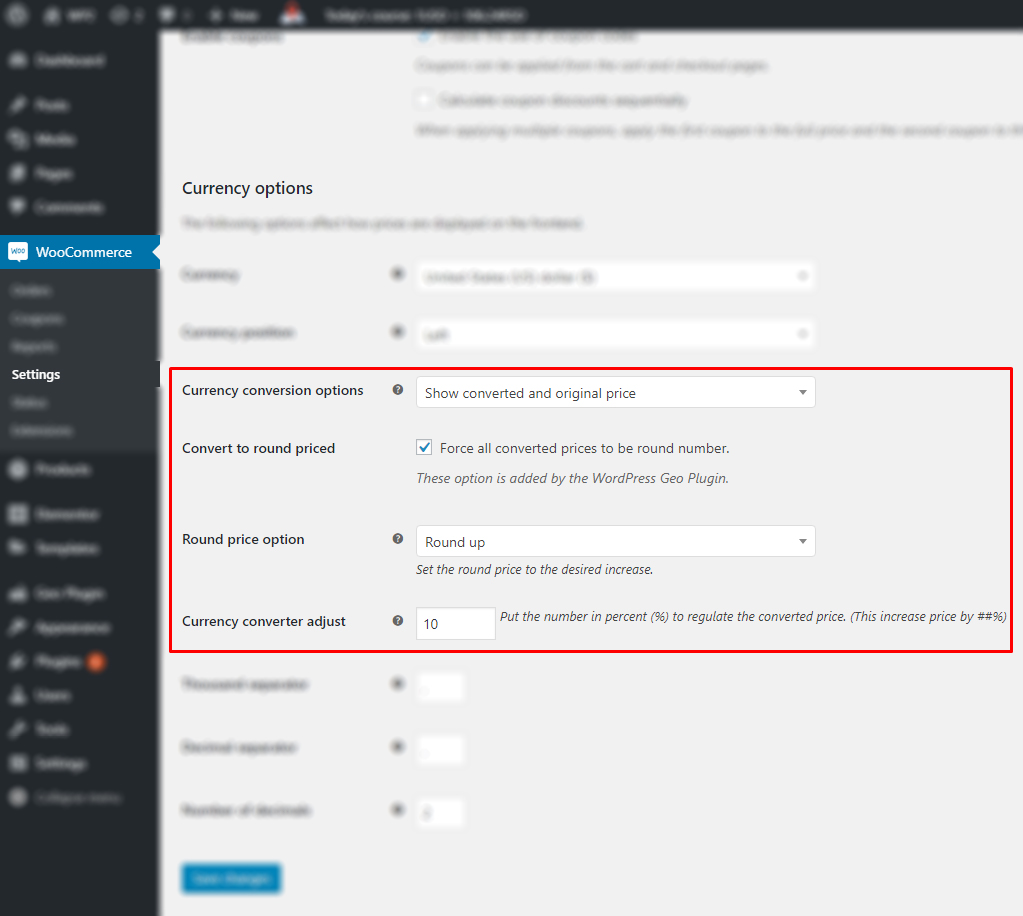
- Customize WooCommerce payment options and currency information by visitor location.
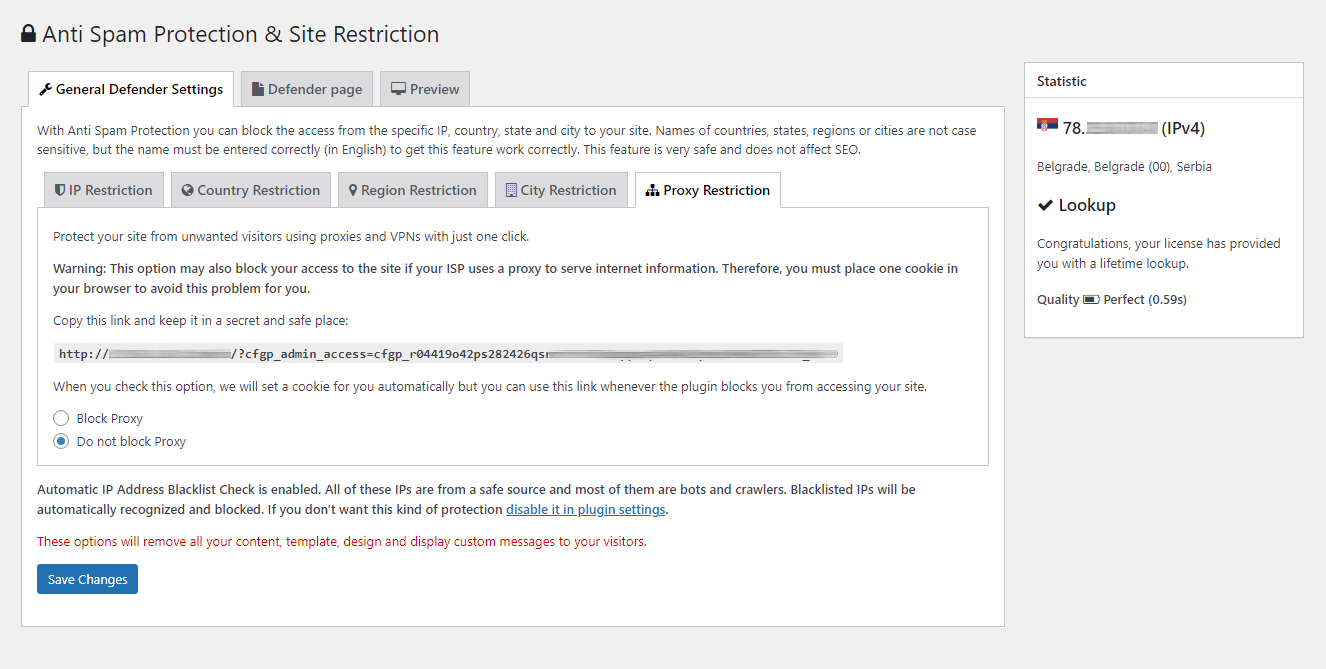
- Restrict access from selected countries, IP addresses, proxies, or TOR networks.
- Provide location-based information to custom themes, plugins, forms, and integrations.
- Customer geolocation and location data saved with orders
- Country-based payment gateway visibility
- Local currency information and currency conversion
- EU and VAT-aware content
- Classic Checkout, Checkout Blocks, Store API, and HPOS workflows
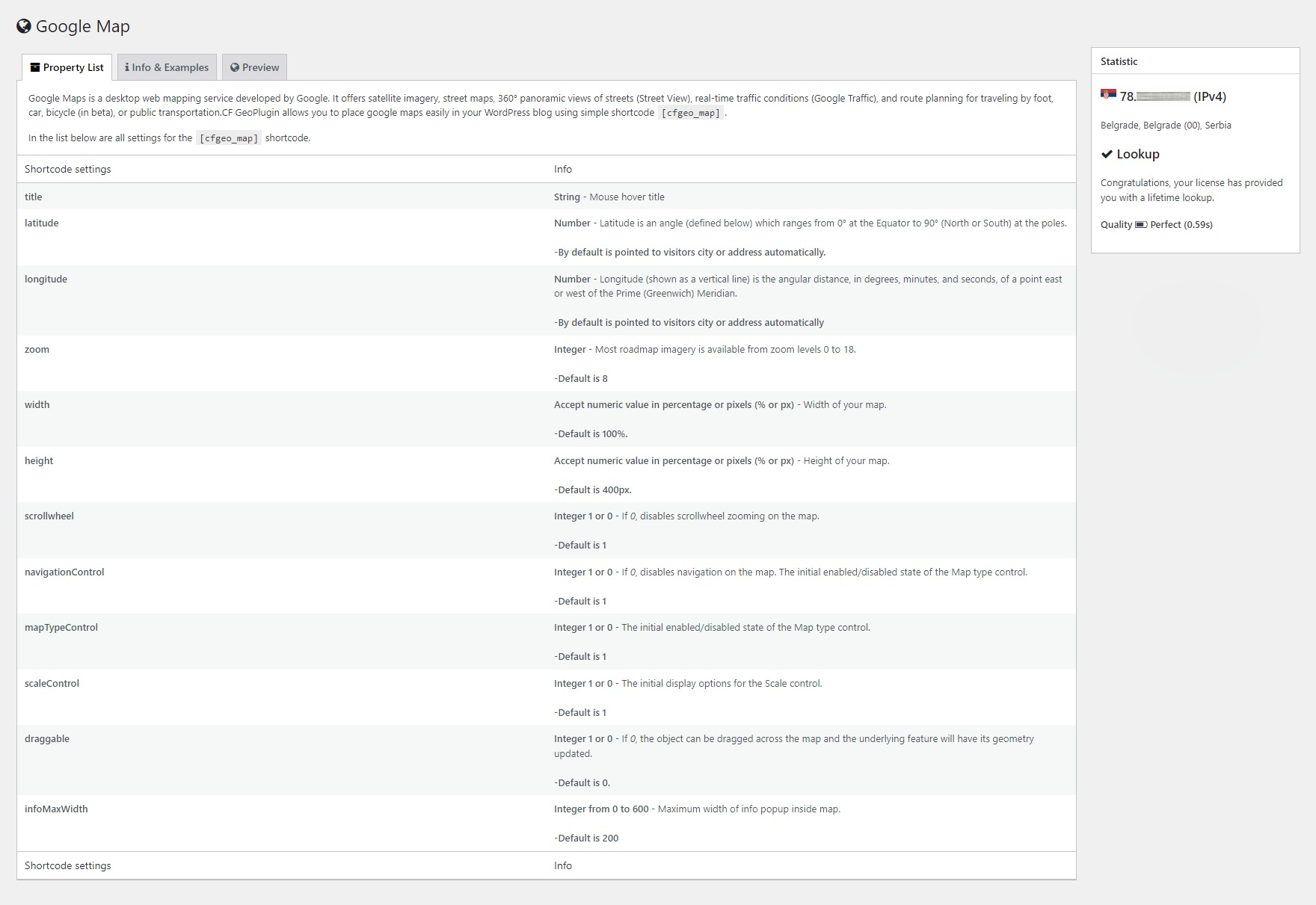
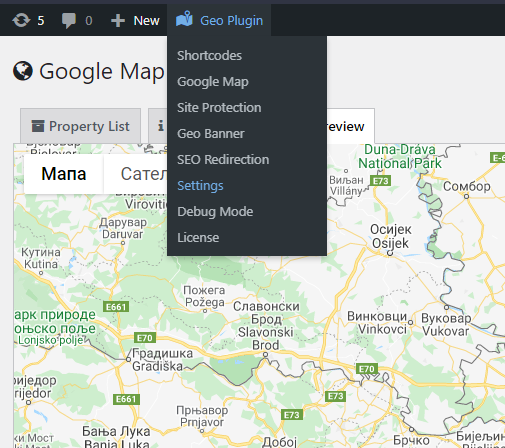
[cfgeo_map] to display a single-point Google Map for a detected or specified location. A valid Google Maps API key is required.
[cfgeo_map longitude="-74.0059" latitude="40.7128" zoom="15" title="My Company Name"]
My Company Name
No Name Street 35, New York, USA
We have what you need
[/cfgeo_map]
Geo tags can add configured geographic metadata to selected public content. Country flags are available through [cfgeo_flag], including custom country, size, class, ID, inline CSS, and include/exclude options.
Examples:
[cfgeo_flag]
[cfgeo_flag country="ca" size="32px"]
Read the Google Maps shortcode documentation before enabling map output. Google Maps is a separate external service with its own account, billing, terms, and privacy behavior.
Integrations and Developer Features
The plugin contains dedicated integration code for WooCommerce, Elementor, Contact Form 7, Gravity Forms, BuddyBoss Platform, WooPlatnica, and Yoast SEO. It also includes Cloudflare-aware IP handling and settings intended for common caching configurations. Compatibility still depends on the active theme, plugin versions, cache/CDN behavior, and site configuration.
Developers can use:
CFGP_U::api()for the current structured geodata arrayCFGP_U::api('country_code')for a single available fieldCFGP_API::lookup()for an explicit advanced lookupwindow.cfgeowhen the plugin's JavaScript output is enabled- Native WordPress
do_shortcode()in templates that intentionally render shortcode content - The optional public REST lookup feature when the required license level is active
安装:
- Install Geo Controller from the WordPress Plugins screen, or upload the plugin files to
/wp-content/plugins/cf-geoplugin/. - Activate the plugin.
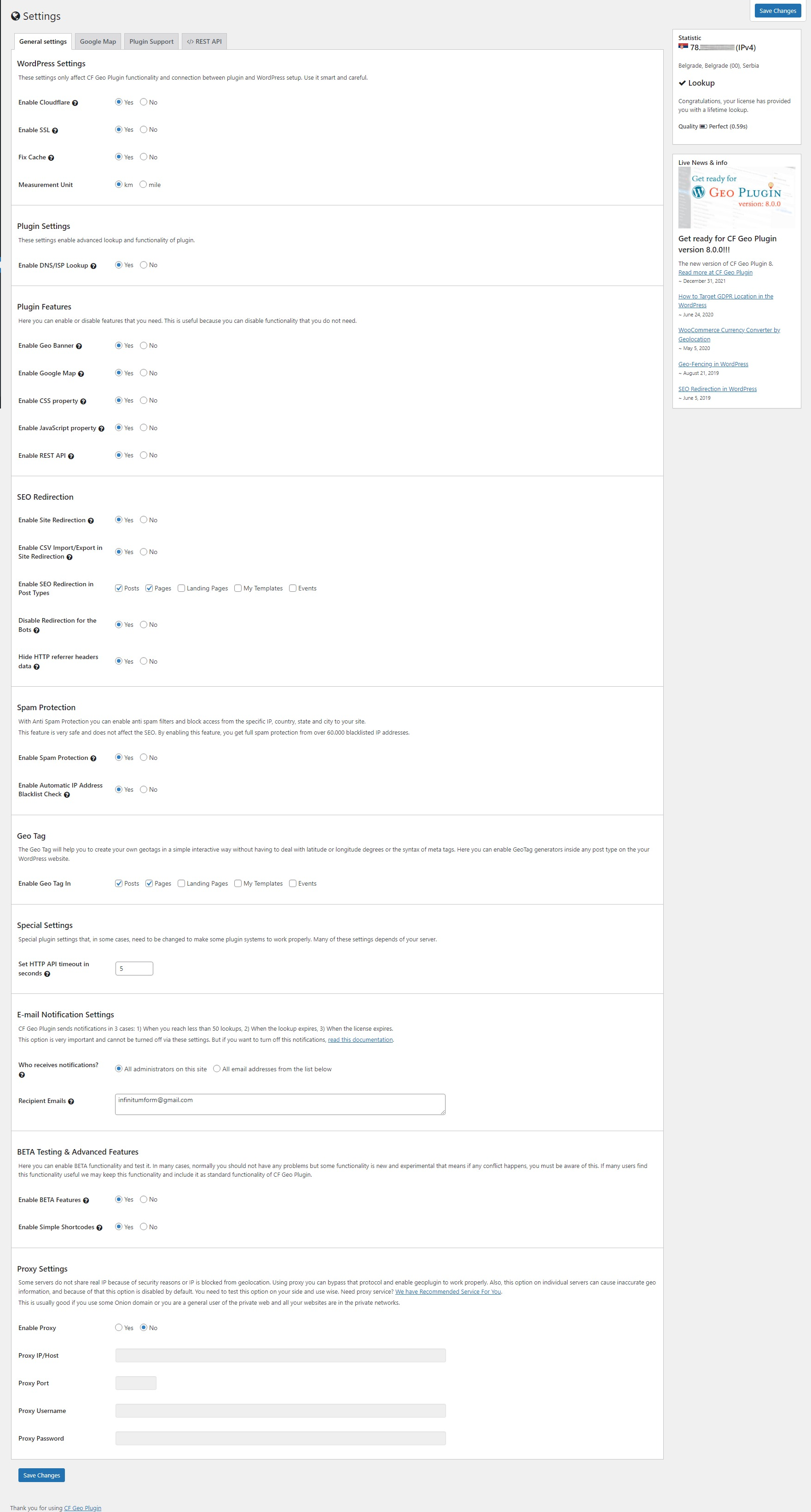
- Open Geo Controller in WordPress administration and review the general, feature, cache, and proxy settings.
- Test a basic lookup with
[cfgeo return="country" default="Unknown"]. - Configure only the modules you need, then test location rules with caching enabled exactly as it will be in production.
屏幕截图:

其他记录:
常见问题:
Is Geo Controller free?
Yes. The plugin works without a paid license with a standard allowance of up to 500 API lookups per day. Active paid licenses provide unlimited lookups during the license period and enable features associated with the applicable license level. See the current plans.
Is Geo Controller the same plugin as CF Geo Plugin?
Yes. Geo Controller was previously known as CF Geo Plugin. It is the continuation of the same WordPress plugin, with ongoing development, improved functionality, and maintained compatibility with supported existing shortcodes and integrations. Existing users do not need to install a separate plugin or migrate to a different product.
What information is sent to an external service?
IP geolocation requires communication with the Geo Controller API. An IP address and technical request data are processed to return approximate location information. Optional Google Maps output communicates with Google when enabled. Review the Privacy Policy and document these services appropriately for your site.
How accurate is IP geolocation?
IP geolocation estimates network location; it does not verify a person's physical position. Country results are generally more reliable than city or postcode results. VPNs, proxies, mobile carriers, corporate gateways, satellite connections, and incorrect trusted-proxy settings can change the detected IP or location. Provide fallback content and avoid using an IP result as the sole basis for high-impact decisions.
How can I test content for another country, region, or city?
Use a controlled connection or reputable testing service that provides an exit point in the target location, then confirm the detected IP and fields on Geo Controller's Debug page. Clear relevant page and plugin caches between tests. Do not assume that one VPN endpoint represents every visitor in that location.
Why does every visitor see the same location-based content?
A full-page cache or CDN may be serving one visitor's rendered HTML to everyone. Exclude pages that require per-visitor output, use the plugin's supported dynamic/AJAX behavior where appropriate, and purge caches after changing rules. See dynamic content and caching.
Why is a field empty or showing its default value?
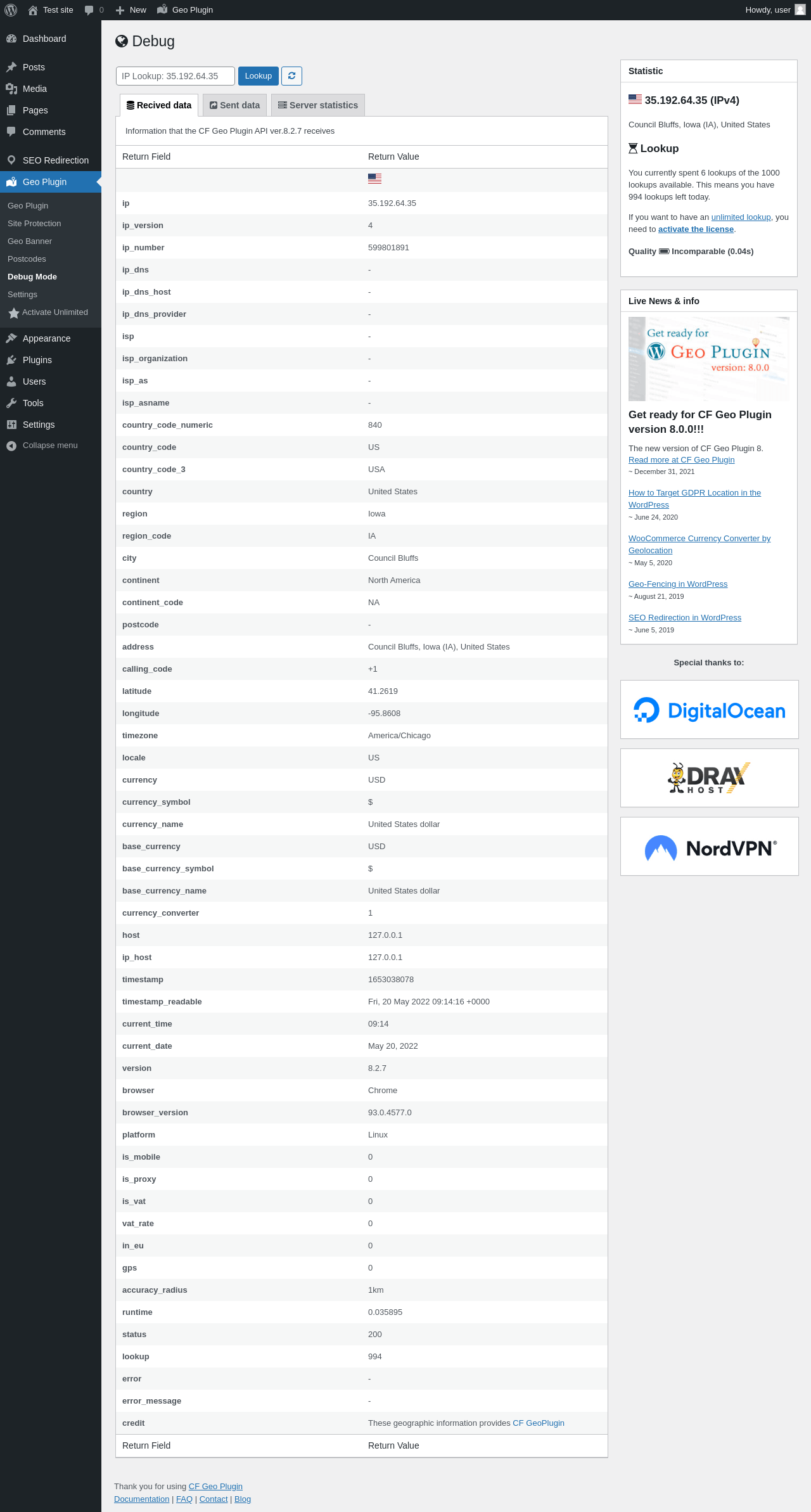
The provider may not have that field for the detected IP, the daily allowance may have been reached, the request may have failed, or proxy/CDN settings may identify the wrong address. Check the Debug page, the displayed API response and error, SSL/proxy settings, trusted forwarding headers, and server logs. Use a default shortcode value for expected gaps.
Can I use shortcodes in a custom theme or template?
Yes, when the template processes WordPress shortcodes. For example:
echo do_shortcode('[cfgeo return="country" default="Unknown"]');
Use WordPress do_shortcode() only where rendering administrator-controlled shortcode content is appropriate.
How do I access geolocation data in PHP?
Use the current helper and validate keys defensively: $data = CFGP_U::api(); $country = is_array($data) ? ($data['country'] ?? '') : ''; $country_code = CFGP_U::api('country_code'); $response = CFGP_API::lookup('8.8.8.8', ['dns' => true]); $city = is_array($response) ? ($response['city'] ?? '') : ''; See the PHP integration documentation. Historic global variables from older CF Geo Plugin releases should not be used for new integrations.
How do I access geolocation data in JavaScript?
Enable the plugin's JavaScript output, then read the generated window.cfgeo object after it is available:
if (window.cfgeo) { console.log(window.cfgeo.country); }
See the JavaScript integration documentation.
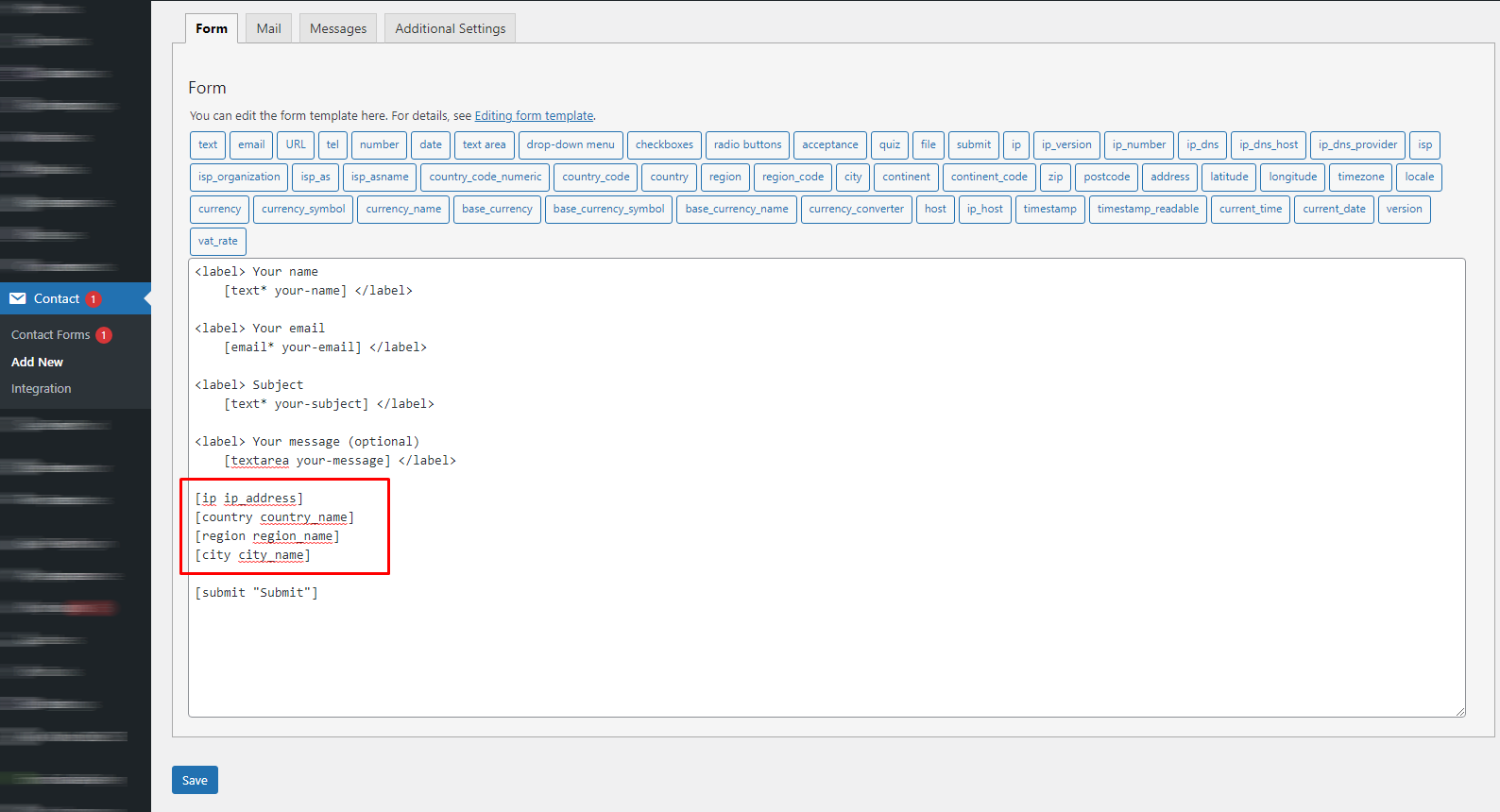
Can I populate Contact Form 7 fields?
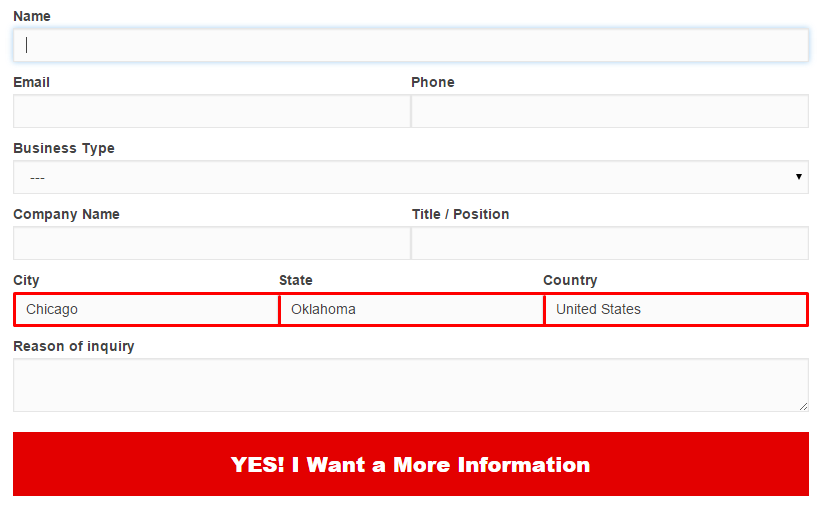
Yes, if JavaScript output is enabled. A form can contain fields such as:
[text city placeholder " City Name"]
[text country placeholder " Country Name"]
Your site script can then assign window.cfgeo.city and window.cfgeo.country after checking that the object and fields exist. Escape or validate values for the target context.
Does Geo Controller slow down a site?
Any API call and location-dependent rendering has a cost. Geo Controller caches lookup data and supports dynamic loading options, but actual impact depends on hosting, network latency, cache configuration, enabled modules, and traffic. Measure the relevant pages and avoid unnecessary repeated lookups.
Does Geo Controller make a site legally compliant?
No plugin can guarantee compliance automatically. Geo Controller provides location-aware conditions that may support a site's implementation, but the site owner remains responsible for notices, consent, access rules, data processing, taxes, and applicable law. Obtain qualified advice where needed.
Where can I get help?
Start with the documentation. If the issue remains, use Contact & Support and include the plugin version, WordPress version, relevant settings, Debug output with secrets removed, and steps to reproduce.
更新日志:
- Geo Controller Site Health updates.
- Fix crawler detection, improve Googlebot and Bingbot recognition, CIDR validation, and correct bot detection caching.
- Fixed a fatal error during WordPress initialization caused by an early user capability check. Deferred plugin integration notifications until WordPress user functions are available.
- Reworked the WordPress.org readme with clearer geolocation, geotargeting, WooCommerce, access-control, privacy, caching, and licensing guidance.
- Added accessible Copy controls for shortcode, geo tag, CSS property, and Google Maps syntax examples, with fallback and translated feedback.
- Refined the five primary admin pages with cleaner, compact tabs, tables, sections, descriptions, focus states, and responsive controls.
- Aligned Simple Shortcodes tab visibility with its standard feature setting.
- Fixed [in_eu] and [not_in_eu] shortcode registration after the Simple Shortcodes option moved from beta to standard settings.
- Security: moved dedicated Geo Controller API endpoints to HTTPS and removed the former automatic direct-IP HTTP downgrade.
- API: added centralized, backward-compatible GET/POST transport selection; GET remains the default, while POST sends API parameters in the request body.
- Added an optional Defender emergency direct-IP HTTP fallback that is disabled by default and excludes license keys, API secrets, authentication tokens, passwords, and renewal data.
- Security: validated forwarding headers against trusted proxy and Cloudflare ranges, bounded and rate-limited public location requests, and restricted integration actions to administrators.
- Security: safely JSON-encoded dynamic geolocation JavaScript property names and values so remote or cached data cannot escape the inline object.
- Compatibility: preserved geolocation, Defender, licensing, API response handling, product information, Live News, and WordPress update integrations.
- Fixed escaped shortcode examples and interactive map configuration output.
- Moved the Simple Shortcodes option to standard feature settings and kept Redis caching experimental.
- Compatibility: improved WooCommerce Classic Checkout, Checkout Blocks, Store API, and HPOS order handling.
- Fixed WooCommerce price conversion, geolocation, payment-country restrictions, and gateway settings output.
- Fixed license renewal synchronization for renewed subscription activations.
- Added automatic renewal revalidation for valid subscription activations.
- Improved expired-license renewal diagnostics and administrator guidance.
- Compatibility: maintained PHP 7.0 to PHP 8.4 support.
- Stabilized shortcode and Geo Banner caching across transient, database, and Redis modes.
- Fixed cache cleanup and prevented Geo Banner caching when disabled.
- Stabilized shortcode, GPS, Geo Banner, and Google Map attributes while preserving legacy support.
- Added optional REST API transport for public authentication and lookups; AJAX remains the default.
- Added API transport settings and endpoint documentation.
- Preserved existing API responses and access-token behavior.
- Security: protected Defender saves, previews, and bypass cookies with capability, nonce, and method checks.
- Security: limited permanent Defender bypass to administrators and removed legacy recovery and bot bypasses.
- Security: added single-use recovery links for temporary WordPress login access.
- Security: protected global and page-level SEO settings with capability, nonce, and method checks.
- Fixed postcode matching, country-city redirects, exclusion rules, empty CSV exports, and import rollbacks.
- CSS display controls now preserve flex, grid, inline, inline-block, table, and other display modes.