Changeloger - Changelog, Release Notes & User Feedback
| 开发者 |
mdjwel
spiderdevs freemius muaz404 |
|---|---|
| 更新时间 | 2026年8月11日 19:03 |
| PHP版本: | 7.4 及以上 |
| WordPress版本: | 7.0.2 |
| 版权: | GPLv2 or later |
| 版权网址: | 版权信息 |
详情介绍:
安装:
- Upload the plugin files to the
/wp-content/plugins/changelogerdirectory, or install the plugin through the WordPress plugins screen directly. - Activate the plugin through the 'Plugins' screen in WordPress.
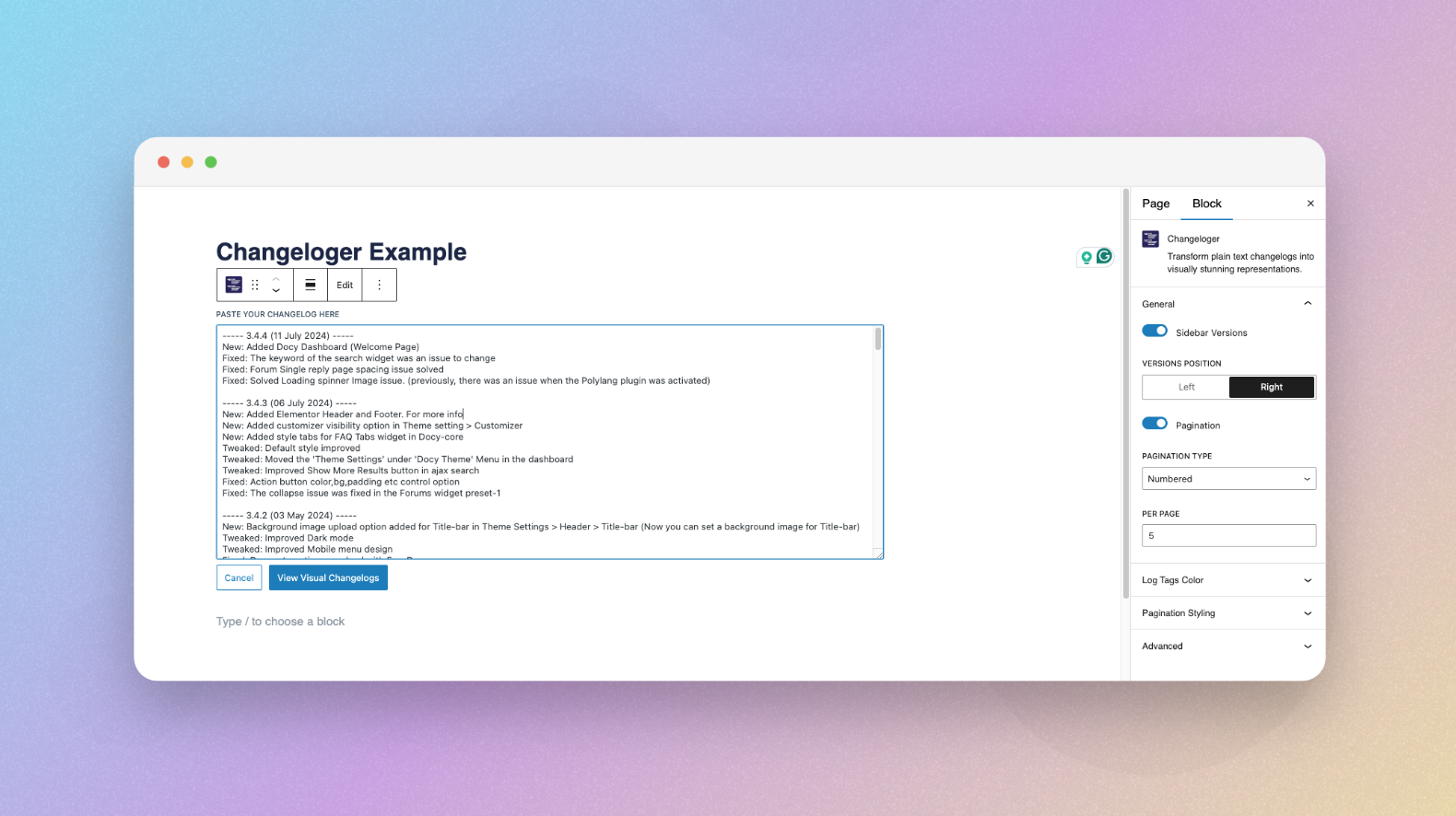
- Go to the block editor and search for "Changeloger" to add a changelog block, or navigate to Changeloger → Dashboard to use the Release Builder.
屏幕截图:





常见问题:
- What is Changeloger?
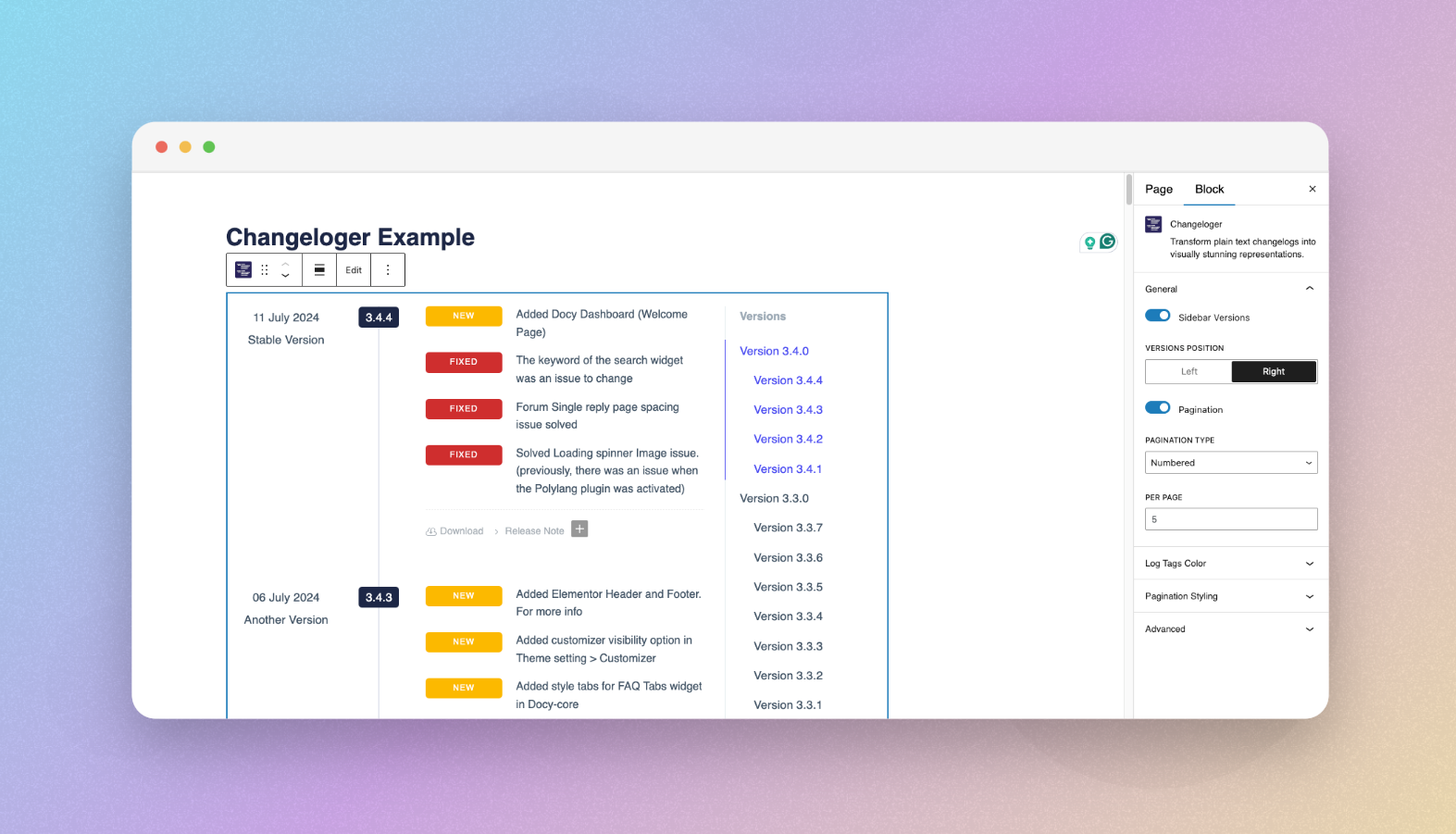
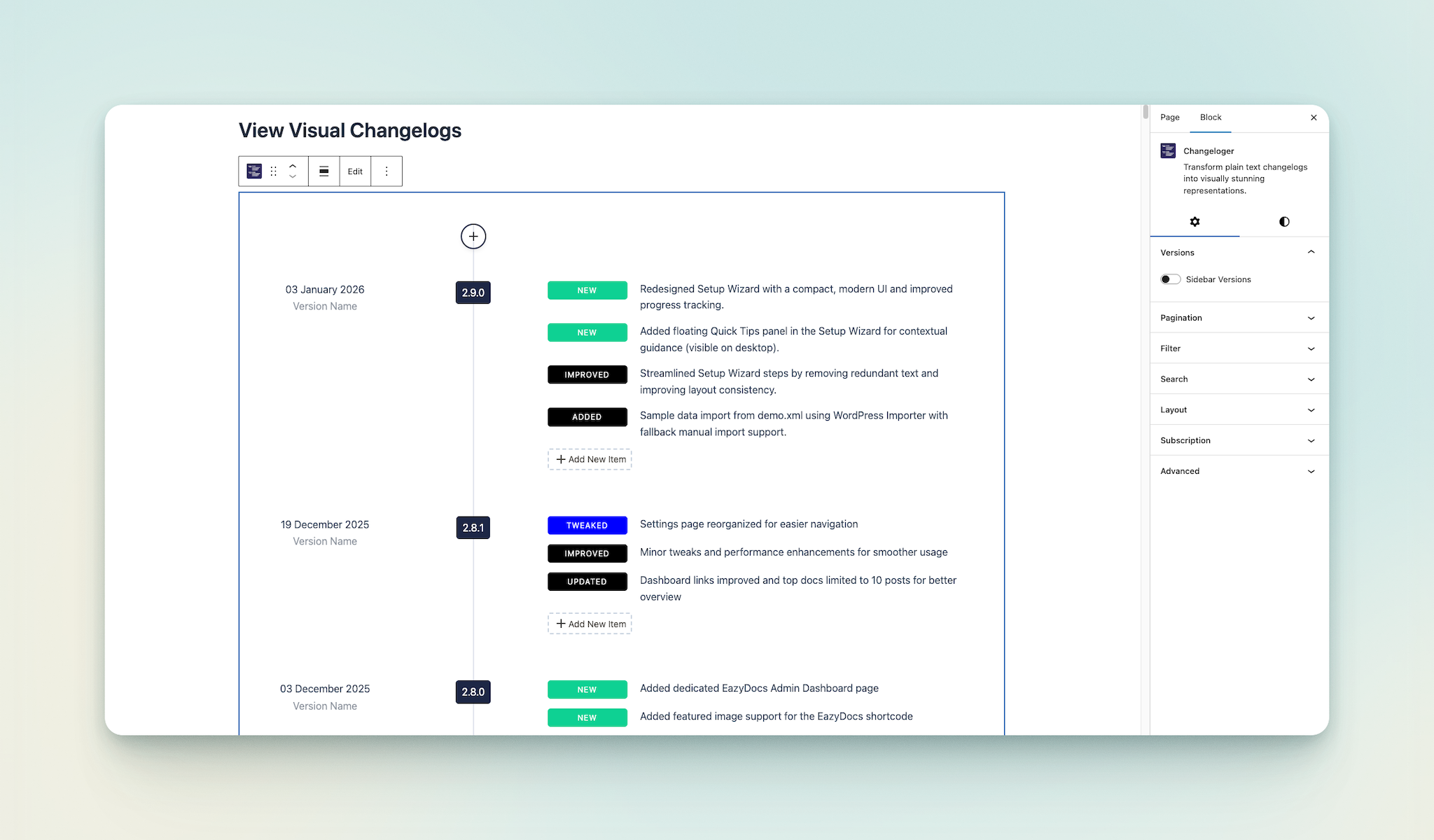
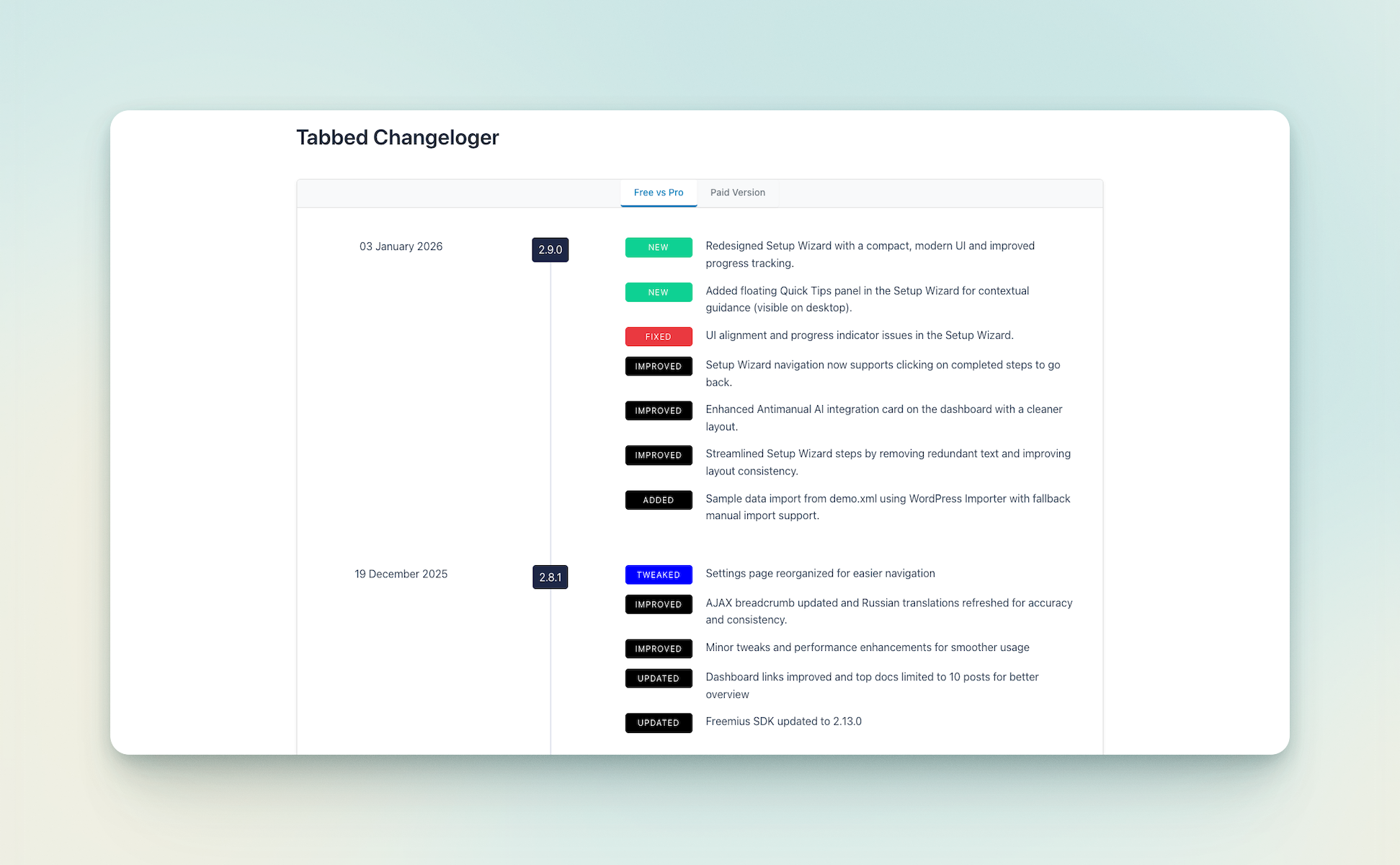
Changeloger is a powerful WordPress plugin that allows users to convert plain text changelogs into visually designed and engaging representations. It streamlines the process of presenting software or product updates in a user-friendly format within the WordPress block editor.
- How do I install Changeloger?
Installing Changeloger is easy. Simply go to your WordPress dashboard, navigate to "Plugins," click on "Add New," search for "Changeloger," and click "Install Now." Once installed, activate the plugin, and you're ready to use it.
- Can I use my existing changelog files with Changeloger?
Absolutely! Changeloger provides a convenient "Changelog Import" feature, allowing you to upload your plain text changelog files. This saves time and effort, eliminating the need for manual entry.
- Can I customize the appearance of my changelogs?
Certainly! Changeloger offers several customization options, including font styles, colors, layout formats, and more. You can personalize your changelogs to ensure they align with your website's design and aesthetic.
- Is Changeloger compatible with the WordPress block editor?
Yes, Changeloger is fully integrated with the WordPress block editor, making it seamless to create and manage visually designed changelogs directly within your content.
- How does Changeloger help with version management?
Changeloger simplifies version management by allowing you to categorize and organize changelogs based on version numbers. This ensures clarity and makes it easier for users to understand the progression of updates.
- Is Changeloger mobile responsive?
Absolutely! The changelogs created with Changeloger are optimized for mobile devices, providing a seamless user experience across all platforms.
- Can I preview changelog changes in real-time?
Yes, Changeloger offers a real-time preview feature, enabling you to see how your changelog looks as you make edits. This allows you to fine-tune the design to perfection before publishing.
- Is there any support available for Changeloger users?
Of course! Changeloger provides comprehensive customer support to assist users with any queries, technical issues, or customization needs. Reach out to our support team, and we'll be happy to help you.
- Does Changeloger work with all WordPress themes?
Yes, Changeloger is designed to work seamlessly with most WordPress themes. It ensures compatibility with the block editor and offers a consistent experience across different themes.
- Can I use Changeloger for non-software related changelogs?
Absolutely! While Changeloger is ideal for software updates, it can be used for any changelog scenario where you want to visually present changes or updates to your audience.
- Does Changeloger include a roadmap and feedback system?
Yes! Changeloger includes a user feedback board (up to 20 items in the free version). Changeloger Pro unlocks unlimited feedback, advanced features like voting and comments, and a full public roadmap builder (Kanban-style) — so you can manage your entire product loop from one plugin.
更新日志:
- New: Shortcode Support – Added the [changeloger] shortcode to display releases, feedback, roadmaps, or all views on any page or post without using the block editor.
- New: Shortcode Generator – Integrated a copy-ready shortcode generator modal directly into the Releases, Feedback, and Roadmap admin dashboard pages.
- New: Setup Wizard Layout Selection – Added a release layout picker to the Setup Wizard customization step (including Stack, Compact, and Pro-gated layouts).
- New: Release Hub Filtering – Added a "Filter By" control to toggle between Badge and Product filtering modes in the Release Hub.
- New: Change Groups – Added "New" as a default change group with automatic aliasing for imported items (Added, New, etc.).
- New: Release Management – Added sortable version and title columns to the release management board for easier navigation.
- New: Feedback Management – Integrated a visibility filter (Public/Private) and quick status filtering via clickable summary cards.
- Updated: Per-Entity Version Tracking – Version auto-check settings have moved from a global toggle to per-block and per-product controls for more granular tracking.
- Updated: Release Hub – Added a global badge filter to the release list to quickly surface specific categories of updates.
- Improved: Excerpt Overflow Detection – Improved reliability of excerpt expansion by re-calculating overflow after tab switches, AJAX updates, and pagination swaps.
- Improved: Release Management – Added unsaved changes protection to the release modal to prevent data loss when closing without saving.
- Improved: Administrative Accessibility – Added descriptive ARIA labels to all buttons, checkboxes, and filters within the admin dashboard.
- Improved: Feedback Activity – Enhanced the feedback board with comment counts and improved stat card limit indicators.
- Optimized: Sidebar Controls – Refined the block sidebar to include per-block auto-check configuration and interval settings.
- Fixed: UI Consistency – Fixed hover colors on the auto-check status pills.
- Fixed: Resolved fatal error during plugin deactivation
- New: Added Category change option for feedback and roadmap modal items
- New: Added File Url Import system and auto checker
- Fixed: Google auth endpoint 404 error and audit security
- New: Release Interactions Toggle – Control whether emoji reactions appear on releases from Settings → Releases → Interactions
- Improved: Badge Filter Speed – Badge filter responses are now cached for faster switching between badges
- Improved: AI Rewrite Modal – The bulk AI rewrite modal now opens instantly by reusing locally cached release data
- Improved: Changelog Import – Improved cross-group mapping so new categories registered during import can be used as targets for other items in the same session
- New: Feedback Board — Start collecting user feedback with a 20-item capability designed for free users, complete with a clean tracking dashboard
- New: Bulk Badge Update — Select multiple releases and reassign their badges all at once from the admin management screen
- New: Analytics Teaser Page – Added a promo page for the Analytics feature visible to free users, showcasing release activity, feedback insights, subscriber analytics, and roadmap progress metrics available in Pro
- Updated: Feature Upgrades — Added clearer prompts and visual indicators for premium features like comments, downvotes, and embeds
- Improved: Edit Speed — The release quick edit and feedback detail modals now open instantly without lag by reusing existing list data
- Improved: Badge Filter Navigation — Upgraded the frontend badge filter to use URL-based filtering for seamless and accurate navigation
- Fixed: Badge Visibility — Resolved an issue where the badge filter completely disappeared or pagination broke when no releases matched the current view
- New: Setup Wizard – Guided onboarding experience to help new users configure the plugin and create their first release
- New: Block Analytics – Dedicated analytics page in the admin dashboard showing block usage, impressions, and engagement stats
- New: Quick Add Block Action – One-click button on the Releases page to automatically insert a Changeloger block into any page
- New: Release Hub Customization – Added per-tab visibility toggles, custom tab labels, default tab selection, layout style, and releases per page options
- New: Compact Layout Style – Alternative condensed card-based layout for the Release Hub releases tab with hover effects and reduced spacing
- New: Server-Side Pagination – Numbered page navigation with prev/next arrows when releases per page limit is set in the Release Hub block
- New: Container Width Controls – Per-tab width settings (Default, Full Width, Custom) for releases, feedback, and roadmap content in the Release Hub
- New: Semantic Versioning Validation – Soft SemVer validation in the release editor with suggestions for non-standard version formats
- New: Added previous/next version navigation on single release pages.
- Improved: Redesigned the Release Hub editor layout with an inline title row, interactive tab bar, and contextual panel content replacing the static placeholder. Each tab panel displays an informational notice with a description and a direct link to the relevant admin management page
- Improved: Admin Header – Redesigned admin pages header with cleaner layout and modern styling
- Improved: Internationalization – All hardcoded JavaScript strings wrapped with i18n translation functions for full localization support
- Improved: Frontend Changelog Styles – Refined typography, spacing, and responsive design across changelog display
- Optimized: Cleaned up unused and unnecessary code across CSS and PHP files
- New: Brand Color settings for consistent product styling.
- Improved: Overall changelog quality validation logic and messaging refined.
- Improved: Minor UI and styling enhancements across all features.
- Improved: Optimized asset localization and fixed script path issues for better reliability
- Improved: admin dashboard performance with optimized stats queries
- Improved: Replaced inefficient loop-based queries with a single optimized GROUP BY query for feedback statistics
- Improved: badge system with advanced customization options
- Optimized: product count handling using wp_count_terms instead of fetching all terms
- Optimized: Release Hub page lookup with improved caching and proper cache invalidation
- Added: Badge customization settings in Changeloger → Settings → Releases → Badge
- Added: Ability to add custom badges with color controls for better visual clarity
- Fixed: Minor performance bottlenecks affecting admin dashboard load time
- Fixed: Various internal optimizations and stability improvements See full changelog and version history →