CiteKit Reference Manager with Footnotes, Citations, Bibliographies, Tooltips and Glossary
| 开发者 |
writerspress
freemius |
|---|---|
| 更新时间 | 2026年10月3日 09:55 |
| PHP版本: | 7.4 及以上 |
| WordPress版本: | 7.1 |
| 版权: | GPLv2 or later |
| 版权网址: | 版权信息 |
详情介绍:
Documentation | Live Demo | Shortcodes & Blocks Reference | Changelog | Support
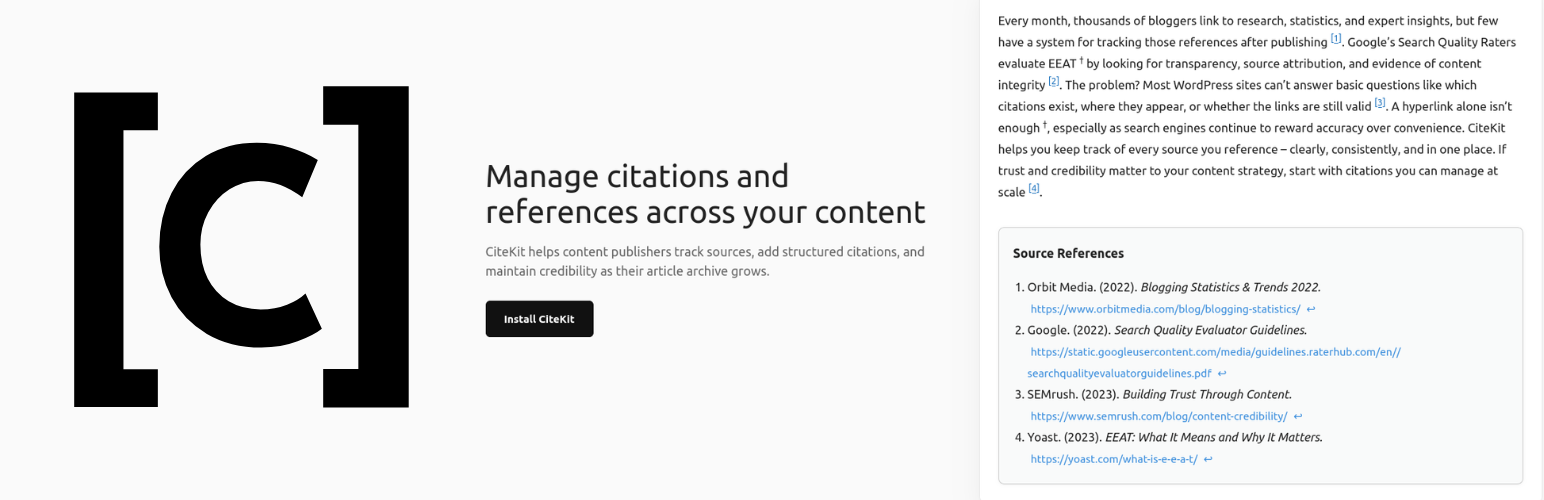
Add and maintain sources in WordPress from DOI, ISBN, PubMed, YouTube and more, then publish citations, footnotes and bibliographies from your reference library. Add tooltips and glossaries to define and connect terminology across your content.
CiteKit keeps the source information behind your published content in WordPress, so references can be checked, corrected and used to generate citations, bibliographies and citation metadata throughout the site.
🎯 Built for content that cites its sources:
- Research and academic blogs
- Health, medical, and nutrition sites citing studies and clinical guidelines
- Legal, policy, and government-focused publishers
- Finance and business analysis
- Product reviews and comparison sites
- Independent publishers and journalists
- AI-assisted content teams that need real, verifiable sources
- Agencies managing citations across many client sites
- Reference Library — keep source records in one library across your WordPress site. Search and filter references, see which posts use them, and reuse the same source without copying its metadata into every article.
- Source lookup and manual entry — create references manually or look up sources using URLs and YouTube links, DOIs, ISBNs, PubMed IDs, or title search. Retrieved metadata can be reviewed and edited before the reference is saved.
- Source types for online publishing — web pages, journal articles, books and chapters, reports, news, theses, datasets and standards, plus videos, social posts, wiki articles and code repositories. Each records what identifies the exact version cited, from a DOI to a wiki revision id to a commit.
- Reference import and export — import existing references from BibTeX, RIS, or CSL-JSON and export CiteKit references back into those formats for use in other reference-management and publishing systems.
- Multiple citation styles — publish references using APA, MLA, Chicago Author-Date, Chicago Notes-Bibliography, Harvard, IEEE, Vancouver, or AMA. Choose one style for the whole site, and set the bibliography heading site-wide or per post.
- Reference reuse — cite the same source from multiple posts while maintaining one underlying source record instead of duplicating its metadata throughout the site.
- Structured creators — record each author or editor as a person or an organization, so institutional names are published whole and personal names are inverted or initialised as the citation style requires.
- Post-level citation editor — review and edit the references used in the current post from one place.
- Citation Link Checker — check the URLs attached to references and mark them as Live, Broken, or Unchecked so publishers can identify inaccessible or deteriorating sources.
- Portable references and citations — content created outside WordPress can carry structured source data with it, allowing CiteKit to reconstruct and reuse the corresponding Reference Library records when the content is published.
- Citations — insert inline citations connected to structured references throughout WordPress content.
- Bibliographies — generate formatted, backlinked bibliographies from the references cited in a post, with configurable headings and citation styles.
- Footnotes — add numbered footnotes with hover previews and publish a complete numbered footnote list.
- Tooltips — add inline definitions, explanations, and asides using dashed or dotted terms or superscript symbols, with the explanatory content displayed on hover.
- Glossary — maintain a separate structured terminology library containing terms, definitions, aliases, concepts, related terms, examples, and URLs; import and export glossary data; promote tooltip definitions into reusable glossary terms; and publish a glossary or an index of it. Glossary terms are published with schema.org DefinedTermSet data.
- Glossary term pages — give every term its own URL under the glossary page, with a definition, aliases, related terms, examples and source links. Renamed terms redirect from their old URL, and removed terms return a proper 404.
- Glossary SEO — per-term titles, meta descriptions, canonical URLs, Open Graph tags and schema.org DefinedTerm data, with sitemap entries for every term. Works with WordPress core sitemaps, Yoast SEO and Rank Math.
- Glossary auto-linking — optional: switch it on and the first mention of a term in your content links to its glossary entry, skipping headings, existing links and code. Links are added as the page renders, so switching it off puts everything back.
- Glossary search and A–Z — filter a long glossary as you type and jump to a letter, without leaving the page.