
DevDome Malware Scanner - WordPress Malware Removal & Security Scanner
| 开发者 | devdome |
|---|---|
| 更新时间 | 2026年10月1日 20:37 |
| PHP版本: | 7.4 及以上 |
| WordPress版本: | 7.1 |
| 版权: | GPLv2 or later |
| 版权网址: | 版权信息 |
详情介绍:
- WordPress core, plugins and themes for changed, missing or unexpected files.
- PHP code for suspicious execution, hidden code and remote downloads.
- Uploads for executable files and PHP disguised as images or documents.
- Database content for injected scripts, hidden iframes, spam and hidden links.
- Administrator accounts for new users and unexpected administrative permissions.
- WordPress scheduled tasks for suspicious arguments and other warning signs.
- Must-use plugins and drop-ins that may help malware return.
- wp-config.php, .htaccess and .user.ini for suspicious code or settings.
- Severity describes potential impact: Critical, High, Medium, Low or Info.
- Confidence describes how strongly the evidence suggests malicious activity.
- Restore returns the file to its original path and verifies its hash.
- Permanent deletion is a separate action.
- Official core files and protected startup files cannot be quarantined.
- Restoring a suspicious file returns its original contents to the site.
- Remove an account's administrator rights while keeping the account.
- Remove scheduled events for a suspicious task.
- Quarantine a suspicious must-use plugin or drop-in.
- Known-malware hash checks against DevDome's database of 90,000+ signatures. These send file hashes, not file contents.
- Downloaded byte-pattern signatures for matching on your site.
- Cloud reports showing site security status in your DevDome dashboard.
安装:
- Upload the plugin and activate it.
- Open Malware Scanner in the admin menu and press Scan Now.
- The first scan verifies integrity and seeds the file baseline; later scans add the change timeline.
- Uninstalling removes the plugin's tables, settings and scheduled tasks, including the quarantine table. Restore or delete quarantined files before uninstalling if you still need them.
屏幕截图:
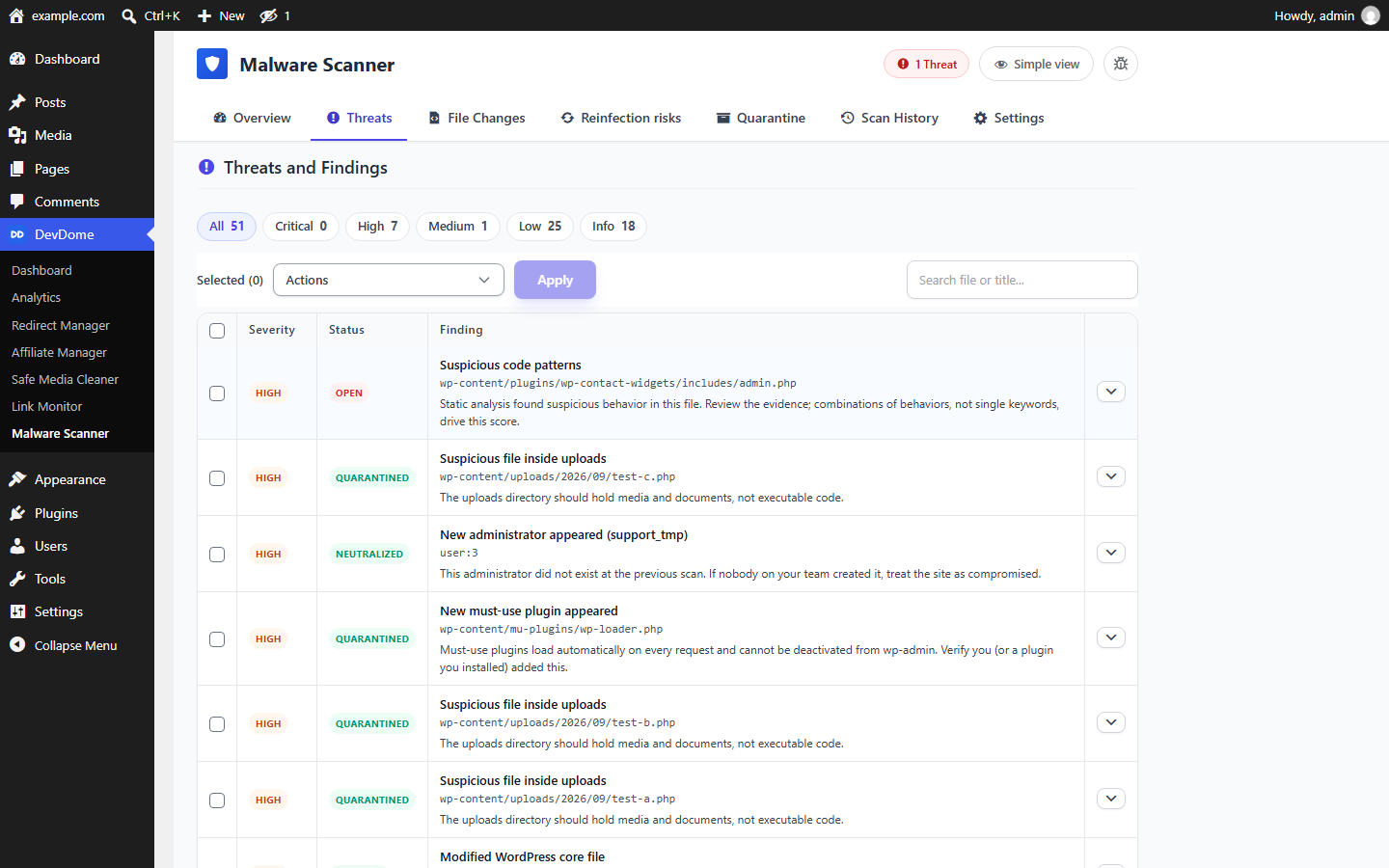
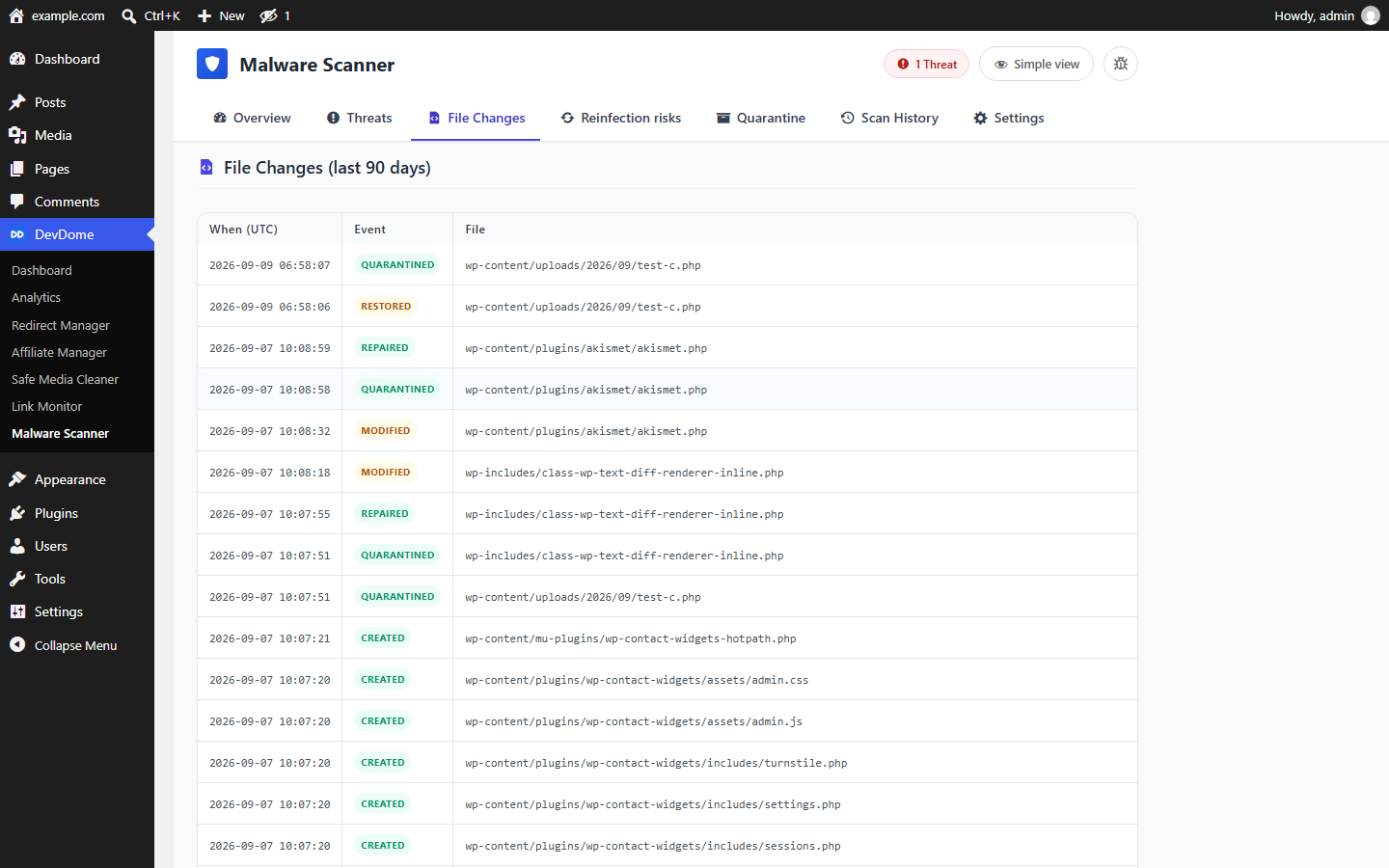
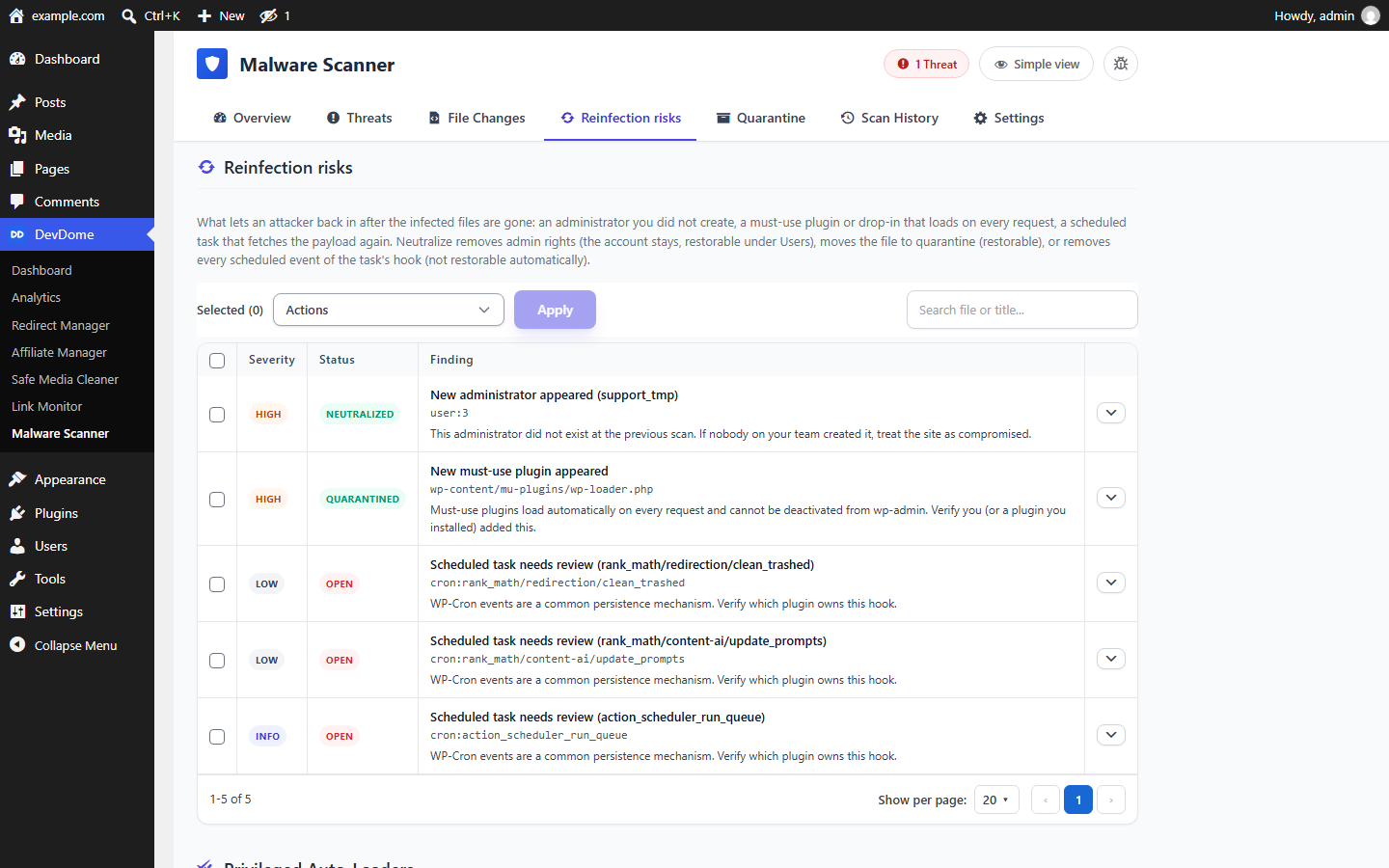
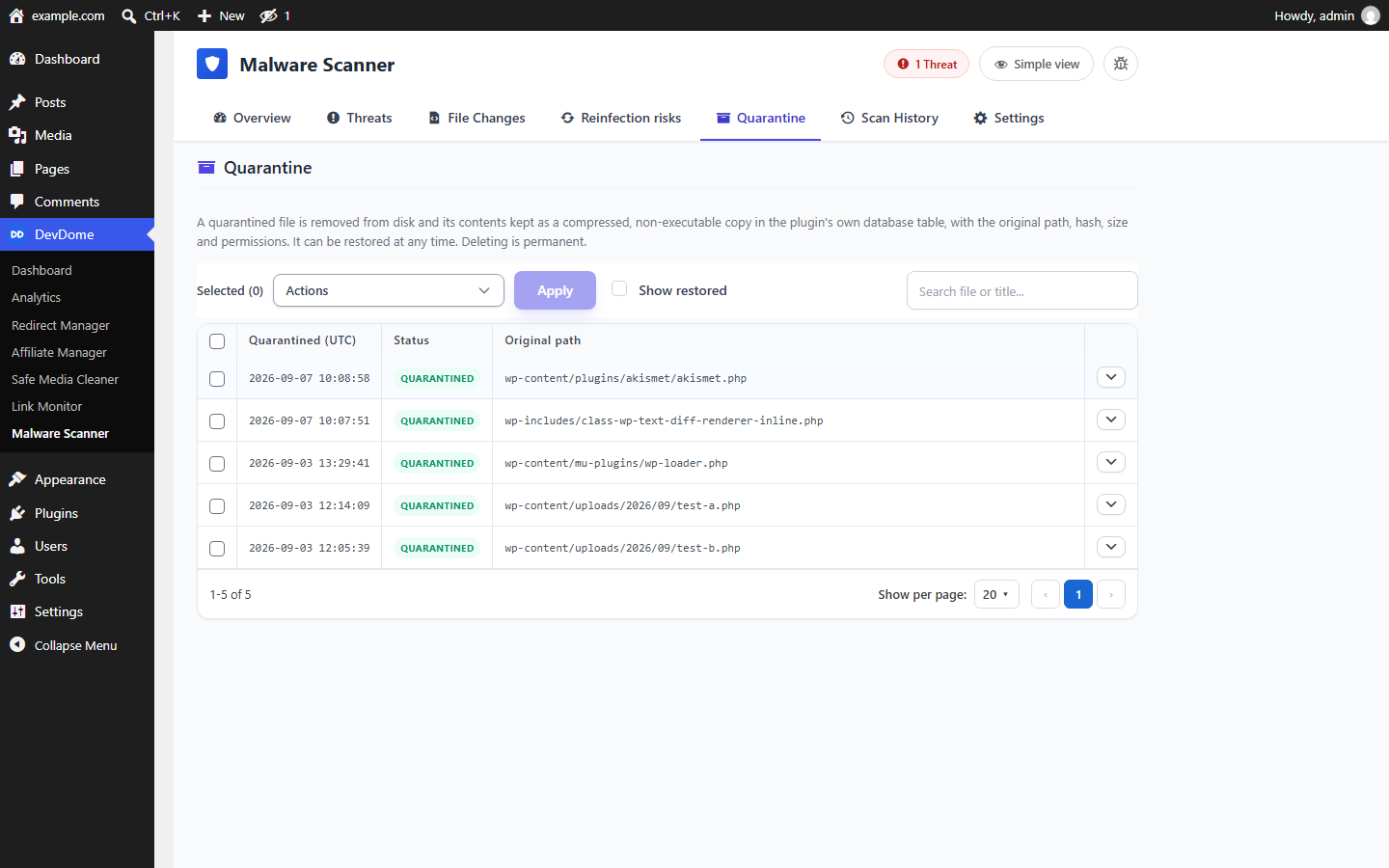
常见问题:
Does the plugin delete files?
Quarantine removes the file from disk and keeps a non-executable copy in the plugin's database table, compressed when compression is available. You can restore it from the Quarantine tab at any time. Permanent deletion requires the explicit Delete permanently button on a quarantined file. Uninstalling removes the plugin's tables, settings and scheduled tasks, including the quarantine table. Restore or delete quarantined files first if you still need them.
Do I need a DevDome account?
No. Every scanning engine runs on your own server: core, plugin and theme integrity, code analysis, uploads, configuration files, users, cron, database and persistence. Connecting a free account adds the 90,000+ known-malware signatures, the security dashboard and the alert email. Without an account, the signature set is never downloaded, so there is no known-malware signature matching. The scanner relies on its heuristics and reports that in the coverage notes. If you connect and later disconnect, byte-pattern signatures already on the site keep matching, but updates and the file hash check stop.
Can a cleanup break my site?
Cleanup has safeguards to reduce that risk. Files WordPress cannot boot without are never quarantined. A repair reinstalls the whole package, either all of WordPress core or the whole plugin, through the WordPress updater and verifies it against official checksums afterwards. The flagged file and every other file the reinstall would change are copied to quarantine first. If the reinstall fails, repair attempts to put the originals back and reports any remaining recovery work. Theme files, database content, user accounts, cron tasks and configuration files are never changed automatically, with one exception: a theme file matching a known-malware signature is quarantined. Anything quarantined can be restored with one click from the Quarantine tab.
Why does the scan list coverage gaps?
Unscanned areas cannot be called clean. The Overview lists excluded paths, files above the deep scan size limit, unreachable checksum sources, files the previous scan could not finish and stages that failed. Findings on files that could not be rechecked stay open instead of being resolved.
Does a scan slow down my site?
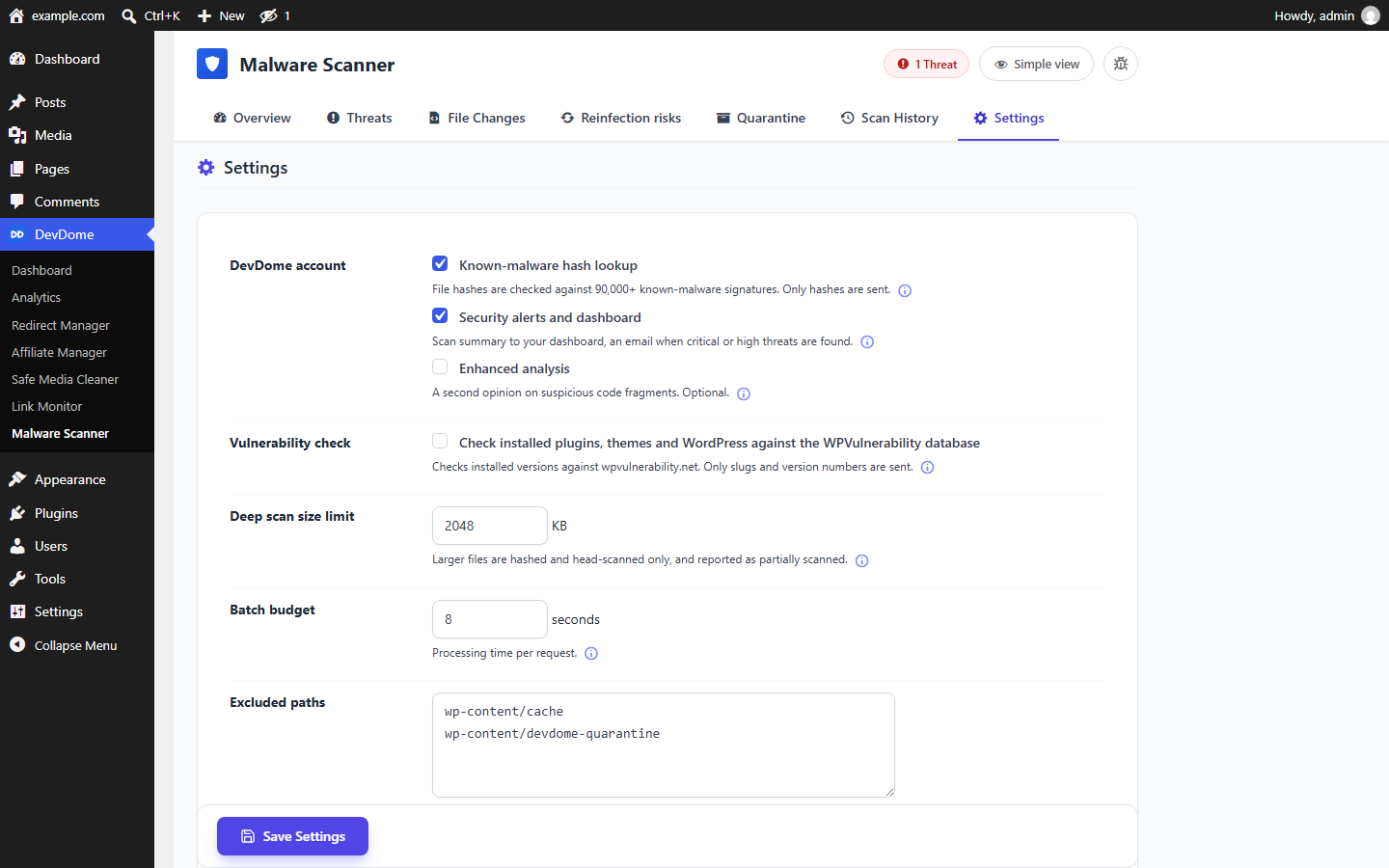
Scans run in short batches while the admin page is open and continue through WP-Cron when it is closed. The default is 8 seconds per request, adjustable from 3 to 25 in Settings. You can pause or cancel at any time. Scanning uses PHP time on your server. Lower the batch budget on very constrained shared hosting.
What is the difference between severity and confidence?
Severity is potential impact: Critical, High, Medium, Low or Info. Confidence is how likely the finding is malicious. A known-signature match has 100% confidence. A high-entropy blob alone is only a contributing signal and is never called malware by itself. Low and Info rows are notes, not threats, and never trigger an alert.
Is my website hacked?
Run a scan and review its evidence and coverage gaps. The plugin checks for changed files, suspicious PHP, database injections and unexpected administrators or scheduled tasks. A changed file or new administrator alone does not prove the site was hacked. Review eligible cleanup actions, then scan again. The Reinfection risks tab helps you investigate access or files that may remain after cleanup.
How do I run a WordPress virus scan?
Open Malware Scanner in the admin menu and press Scan Now. The virus scanner checks WordPress files and database content using integrity checks and code analysis, with known-malware matching available through the optional account. For virus removal from eligible site files, review the proposed quarantine or official repair action. This scans your WordPress installation; it does not provide continuous protection for your computer or automatically clean every finding.
Can it help with a pharma hack, Japanese keyword hack or SEO spam?
Its database checks look for injected scripts, hidden iframes, spam and hidden links in options, posts, revisions, post metadata and user metadata. These checks can help investigate a pharma hack, Japanese keyword hack or other SEO spam where the infection leaves those patterns. Suspicious database content needs your review. The plugin does not automatically rewrite affected posts or remove search engine listings.
Can it find a redirect hack or malicious redirects?
The scanner checks PHP, database content, wp-config.php, .htaccess and .user.ini for suspicious code or settings that may be involved in a redirect hack. Review the evidence to investigate malicious redirects. Configuration and database findings require a decision. These checks do not guarantee detection of every redirect mechanism.
Can I use it as an exploit scanner?
You can use it to inspect WordPress files for suspicious execution, obfuscated code, backdoor and webshell patterns, and other evidence of compromise. Its optional vulnerability check also compares installed versions with published records. Its exploit scanner role is limited to code inspection and version checks. It does not attempt attacks or provide a penetration test.
Can it detect a PHP trojan hidden in a plugin or upload?
It checks for suspicious PHP behavior, hidden code, executable uploads and PHP disguised as images or documents. These checks can identify behavior associated with a PHP trojan, but detection depends on the code and scan coverage. Official file comparisons help identify modified packages. Premium and custom code is tracked against a baseline, which records changes without proving that the original files were safe.
更新日志:
- Shared DevDome library 1.7.10: shorter Connect text on the DevDome dashboard, which now lists only real problems and no longer says Not monitored; the one-time Report a bug hint is recorded through a nonce-checked request; icons are escaped on output.
- The scanner screen is printed directly instead of being buffered, and every value is escaped where it is printed.
- Overview: a status circle coloured by the worst open finding (red, orange, amber, green) replaces the score number; the header pills are gone.
- Settings: a DevDome Account section says what connecting sends before anything is sent; the other Connect buttons open it.
- Fixed: a file with two findings left the second one open after it was quarantined ("the file is no longer there"). All findings of a quarantined file now close together and reopen together on restore; a finding whose file is already gone closes.
- Fixed: the Overview still showed findings that had just been handled on another tab.
- Fixed: a clean result on a site without a DevDome account no longer says "1 check ran with reduced coverage"; the Scan Coverage list still names the account-only check.
- False alarms from the first 1.3.8 sites: a real PDF whose compressed stream happens to hold "<?=" is no longer a disguised executable (PHP's own parser proves the grammar error, the file cannot run; a real shell inside a PDF still is); an EMPTY auto_prepend_file line (SureMails writes one to switch the attack off) is no longer reported; a scheduled task inside an active plugin's own hook namespace with no handler attached (a switched-off module) is no longer a task to review.
- Listing text updated: title, short description and introduction.
- NinjaFirewall's own rule set (the nfw_rules option) is no longer a "critical" finding: it is a list of attack patterns, which is why it looked like one. It is now a low note that names the plugin.
- A plugin that WordPress or your host updated while a scan was running was checked against the checksums of its previous version, so every changed file of the new release was reported as "modified". The version is now read again from disk before the check, and once more if a difference shows up.
- A post that embeds another WordPress post is stored by WordPress itself as a hidden, sandboxed frame; that exact markup is now recognised as the embed it is instead of a hidden iframe.
- All In One Security's firewall settings file under uploads (it starts with a stop-the-compiler statement, so nothing in it can run), Sucuri Scanner's data files under uploads (an exit statement first, then data) and comment-only PHP stubs under other extensions (.stub, .php-old) are no longer reported as executable. Checked live against 25 security and firewall plugins.
- Admin and Site Enhancements' settings (custom CSS and footer code) and Jetpack's sync error log are treated like the other settings that carry code by design: a low note, not a "script injection".
- MailPoet's compiled email templates under uploads/mailpoet/cache (one template class per file, nothing that runs on its own) are a low "compiled template cache" note instead of dozens of high "executable upload" findings.
- A must-use file that is a byte copy of an installed plugin's official file (NinjaFirewall's loader) is reported as that plugin's loader, low, instead of a high "new must-use plugin". An empty or comment-only placeholder a hardening plugin writes into wp-includes is a low note instead of a high "unknown core file".
- A hidden iframe in a script is reported only when it loads a page from a foreign address or carries inline HTML. The invisible helper frames that jQuery blockUI, elFinder and cross-site storage libraries build (UpdraftPlus, WooCommerce, WP-Optimize, All In One WP Security, Redux, YITH and others, 31 official files) are no longer "Suspicious code patterns".
- The account report and the opt-in "Help improve detection" telemetry now include low and info findings (most severe first, 50 at most) and, for each finding, the names of the checks that fired, the file's checksum and size, plus the scan's PHP version, short-tag setting and WordPress version. Still no file contents, no addresses, no server paths. This lets DevDome reproduce a false alarm from the report alone instead of waiting for a support message.
- Photos, PDFs and other uploads are no longer reported as "PHP code inside the file" because of random bytes: a file is only a finding when PHP could actually compile and run it. On a real customer site 19 of 20 ordinary photos were still flagged by 1.3.5 (PHP short tags on); all 20 are now clean, and every known way of hiding PHP inside an image is still caught.
- The same rule now covers plugin and theme images, compressed logs, archives and other data files, which were flagged as "Suspicious code patterns" for the same random bytes.
- Elementor Pro Custom Code (_elementor_code) is treated like Elementor's other data: a plain script there is a low note, not a high "script injection". A script that redirects to a foreign host, decodes and runs code or loads from an unknown host stays an injection, in every known key.
- "Report false alarms" now sends every open finding (most severe first, 50 at most) instead of refusing when only low and info findings are left; when nothing is open the message says so and what to do.
- Fewer false alarms, measured on real customer reports: ordinary images, PDFs, fonts and compressed logs are no longer reported as "PHP code inside the file" (1,060 real media files: 43 alarms before, 4 now), while PHP really hidden in an image is still caught, including code wrapped in comments or strings.
- Normal plugin code no longer raises alarms for signing the current user out or for a boolean assert() check.
- An upload folder "keep out" index.php with a closing tag (WP Migrate) is recognised. A file that only looks like one but opens a second PHP block is now reported, which the previous version missed.
- JavaScript files that are exact copies of official WordPress files (a second WordPress install inside the site folder, backup folders) are no longer scanned as suspicious code.
- A short-echo tag followed by a backtick shell command is detected in uploads.
- When a file cannot be quarantined the message now says why: the file is gone, it is a link, it is a folder, or it is outside the folders the plugin may change.
- Measured on 1,155 public PHP malware samples: detection unchanged. On 17,261 official WordPress, plugin and theme files: 177 low to high alarms before, 147 now.
- Detection rework, measured on 1,155 public PHP malware samples and 17,261 official WordPress, plugin and theme files: 89 percent to 93 percent of the samples are now caught at some level, with no new alarms on the official files.
- Files that hide PHP under an image, icon, text or translation extension are now looked at outside the uploads folder too, and a script that includes such a file is reported.
- Files over 2 MB are pattern-checked from start to end in windows instead of a 64 KB head, so a payload at the end of a large file is seen.
- A file that is byte-identical to an official WordPress core or plugin file (a backup folder such as updraft/plugins-old, a second WordPress install inside the site folder) is no longer reported as suspicious code; only its bytes are compared, a changed copy is still scanned.
- Payloads assembled from hundreds of short string pieces, the shape of the 2026 bypass shells, are recognised, also in files too large for full code analysis.
- Request input read from headers, from the raw request body, from $GLOBALS or from a superglobal spelled as a string is followed to the same sinks as $_POST and $_GET.
- More callback sinks are judged (array_udiff and friends, forward_static_call, ob_start, the error and exception handlers, register_tick_function), a function name assembled from string pieces is resolved before the call is scored, and the multibyte e-modifier replace is treated like preg_replace /e.
- A login or user elevation only counts as a backdoor when the request input is read in the same function, which removes false alarms on large official files.
- Script tags carried inside PHP strings and JavaScript uploads are judged by the JavaScript detector.
- Page cache folders are scanned for executable content instead of being skipped entirely.
- Signature hits carry the feed's severity: only critical signatures are a known malware verdict, lower ones are evidence.
- wp-includes/version.php is never repaired automatically (it names the WordPress version every repair would download): reinstall WordPress from a fresh wordpress.org package, then rescan; package reinstalls need the matching update capability and respect DISALLOW_FILE_MODS; removing administrator rights needs the promote_users capability.
- A displaced plugin folder left behind by a permission repair is denied web access where the server honours .htaccess.
- Plugin integrity: an official file that a plugin moved to a renamed folder is matched by its content instead of its path, and a folder full of files the official package does not ship (a library the plugin installed itself) is one review item, not one alarm per file. A customer site with WP phpMyAdmin received 2,386 alarms for one renamed folder.
- Updates now work when a DevDome plugin folder belongs to another system user, for example after an install from a root shell or by an AI agent. Before, the update failed with Retry update or an uploaded zip kept the old version (shared DevDome core 1.7.2).
- The old copy such an update leaves behind, a hidden folder the web server cannot delete, is recognised by the content fingerprint recorded when it was created, so it is no longer reported as a plugin folder without a plugin header. Its files are still scanned, and a copy whose files changed is reported as before.
- Scan Coverage lists only what was not scanned (excluded folders, symlinks, oversized trees), once per path. Plugins without WordPress.org checksums are scanned file by file and are no longer listed there as if they were a gap.
- The scanner now verifies its own files against the WordPress.org checksums like every other plugin. It used to skip its own folder, so its files went through the full code analysis and one shared-library file was reported as a threat on every site.
- New: a visible "Think one of these is a false alarm?" line with a "Report false alarms" button under the findings on the Overview and under the Threats list, plus "Report false alarm to DevDome" in the Actions menu of the Threats and Reinfection risks lists for selected rows. No account needed: the dialog shows the exact text before it is sent (never file contents), you can add a note and a reply address, and DevDome support uses the report to fix false alarms and improve detection.
- Overview laid out like Link Monitor: the protection ring with the Scan button under it on the left; the verdict, the One click fix button, the severity tiles (Medium is now counted in the simple view too) and the progress bar on the right; the findings in their own card below. The fix button and the false-alarm line disappear the moment a scan starts. The ring stays amber for High findings; Mediums next to a High no longer paint it red.
- Fixed two false alarms seen on real sites: a plugin's own shared-library file was reported as "request input reaches code execution" because a closure that captured a sanitised request value was treated as request-controlled code (a variable holding a closure is a function written in the file, never a name from the request), and a plugin file that is plain text without any PHP open tag (All-in-One WP Migration's "Kangaroos cannot jump here" storage/index.php) was reported as an unknown PHP file after every quarantine. An inline closure passed as a callback is now judged like a quoted function name, so values read from the database as its data no longer raise a "value read from the database is executed" note. A callback that is a plain variable or a fixed method on an object (call_user_func($renderer, $data), array_map(array($this->handler, 'run'), $rows)) is now judged by the callback itself, not by the data next to it; a callback taken from the request or the database is still reported. A PHP file inside uploads that only answers 403/404 and stops (the index.php WPForms writes into its cache folder) is no longer reported as an executable file inside uploads.
- New optional "Help improve detection" switch in Settings (off by default): after each scan a site without a DevDome account can send an anonymous finding list (severity, type, title, site-relative path, scan number, plugin and signature versions under an anonymous site id; never your site address, file contents or server paths). Connected sites already report through the account. DevDome turns files flagged on many unrelated sites into allowlist rules and shared unknown files into new signatures, delivered through the daily signature update.
- The update-settings ability accepts the new "telemetry" key; turning it on needs confirm: true like every other data-sharing switch.
- Fixed: a false "crash marker could not be saved (database error)" note at the end of every filesystem pass (an empty value read as a missing row).
- Fixed: a database write that did not land could still pass its verification when the stored value was empty.
- Secrets written with HTML entities (password="...") in database records are now redacted in stored evidence too.
- Shared library 1.7.1: a connection is never reported as "not connected" after a failed database read, the connect return leg keeps its retry handle until the connection is stored, and plugins get a devdcorev1_connected hook.
- Fewer false alarms, seen on real sites: a plugin's own empty "Silence is golden" index.php inside its storage or cache folder is no longer reported as an unknown PHP file (it came back after every quarantine); code patterns inside a Composer library a plugin ships (listed in its vendor/composer/installed.json) are LOW notes instead of MEDIUM alarms; the options of head/footer-code plugins (Head, Footer and Post Injections, Insert Headers and Footers, WPCode and similar) are LOW "review what you put there" notes, not HIGH injection alarms.
- Repair: a core file repair refuses while wp-includes/version.php itself has an open finding, so the WordPress version that chooses the package can never come from an attacker; repairs run one at a time (also across the sites of a multisite network).
- Shared core 1.7.0: Disconnect proves the connection was cleared on this site and says so when it was not; a site token removed elsewhere reads as disconnected at once; plugins without health checks show "Not monitored" on the DevDome dashboard instead of "No Issues"; overlapping bot IP ranges are merged.
- Report this error: every error banner and failed-action dialog has a button that sends the error text, the plugin and WordPress versions and the last scanner log lines (secrets redacted) to DevDome support with one click, no form. Nothing is sent unless you click it.
- Database guard: every failed database query during a scan tick, a screen action, an AI agent ability or the scanner page is now recorded as it happens. A failed read can no longer pass as an empty answer: the plugin refuses to write findings, statuses or baselines after one, actions and abilities answer a database error instead of "done", a scan stage with a failed query is marked failed (nothing auto-resolved) and the scanner page shows a warning when it was built over one.
- Shared core 1.7.0: new read-only ability devdome-tools/get-connection for AI agents (connected, account ID, plan, installed DevDome plugins); a site that moved to another domain resets its connection instead of showing the old domain's; on a subdirectory multisite every site shares the network's connection.
- Shared core 1.7.0 (account connection): a proxy error page or a short outage of the account server no longer clears a live connection (only the server's own "not linked" answer does); Disconnect reports "still listed" unless the server confirmed the unlink; the final connect confirmation requires a real success response; clearer connect error texts.
- Database scan: an oEmbed cache row (oembed postmeta) holding a visible embed from an unlisted provider is now a LOW embed note, not a critical injection. WordPress rebuilds those rows from the post on every view, so the old CRITICAL finding came back after each quarantine. Hidden iframes stay flagged. The finding text now says to remove the embed from the post instead of the row.
- Quarantine: a record whose last database write failed after the file was already removed is finished by Restore or Delete instead of staying stuck, and unfinished records are always listed (screen and agents). Secret redaction also covers heredoc and nowdoc values assigned to bracketed keys, unquoted .env / INI / YAML values, wrapped literals (base64_decode, hex2bin) and concatenated putenv() values. Hidden-frame checks decode numeric entities written without a semicolon. A record still being stored is never restored, and the backups a running repair made stay locked until it finishes. Read-only agent abilities report the account connection from the cached state without re-verifying it.
- Code analysis follows request input through one assignment (a variable that took a superglobal counts like the superglobal in include, exec and callback checks); short-echo tags followed by a quote, digit or parenthesis are recognised in uploads; an official plugin holding a file the package does not ship (a stray .htaccess, .js or .svg) is no longer skipped by the file scan. Demoted or unscheduled findings read as handled; a demote retried after a lost status write closes the finding; the Overview says when the reinfection risks could not be read; dashboard tiles use the last completed scan, not a failed later attempt; agents get a database error, not "not found", when a finding read fails.
- A restore interrupted after the file was written finishes reopening its finding on the next try. Backups made by a running repair stay locked per repair (two repairs at once never unlock each other), through the rollback. Code analysis follows request input through appended strings and through functions that return it, and judges the callback argument of array_filter, usort, array_walk, array_reduce and preg_replace_callback. Secret redaction also covers commented or parenthesised values, nested wrappers, YAML block values, hyphenated JSON keys, XML elements, HTTP Basic headers, passwords inside connection URLs and sprintf-built putenv() calls. Read-only agent abilities no longer trigger a signature or catalog download; scan history is not pruned when the keep-newest lookup fails.
- The only network super admin is never demoted; the file-changes list shows the whole 90-day window; the deep-scan size setting has an upper bound (64 MB); bulk Ignore, Mark as false positive and Remove from list ask first; an unlistable must-use plugins folder reads "unavailable"; agents get an error, not "not running", when the scan table cannot be read; a cloud switch can always be turned off without an account; signature downloads stop retrying after repeated API failures and keep the feed's own severity levels; a missing core file fails core verification; a plugin folder that is a symbolic link is never treated as verified; an empty checksum answer from WordPress.org is retried within the hour instead of being remembered for a week; short-echo PHP tags before a minus sign and PHP code inside .svg or .html uploads are recognised; $pass, $pwd and XML credential values are redacted.
- An account that still holds administrator-level capabilities through a role is never reported as demoted; a repair backup put back over the official copy reopens its finding even when the earlier attempt was interrupted; a repair refuses to start when it cannot lock its backups; credential values concatenated behind comments, parentheses or wrapper calls are redacted.
- A signature download that finishes while a scan is reading the signature table no longer leaves that scan matching against a mix of the old and the new set, and the download reads its final writes back. A scan whose saved progress record is damaged ends as failed instead of completing with nothing verified. The screens say when the scan history could not be read. Theme vulnerability findings are typed as themes. Agent output keeps file names for paths that contain spaces. A PHP short tag glued to a dangerous call (system, eval, include) counts as PHP code when short tags are on. A script tag hidden in the middle of a large image or SVG upload is found. A failed site list during network activation or deactivation is recorded.
- A findings read that fails after the counts were taken never shows the green pill or verdict; the progress poller and the finding buttons report a database error instead of "no scan" or "not found"; One click fix and the run-scan ability read the scan state back before acting. A hash lookup that answers without results keeps the known-malware findings open. A failed reinstall can always roll back its own backups, even while another repair runs, and two repairs starting at once keep both their locks. An unreadable scheduled-task list fails the cron check instead of clearing it; unreadable configuration files keep their earlier findings; a revision holding PHP is judged like its parent post; a symbolic link to an absolute path outside the site is flagged; PHP hidden in the middle of a large HTML upload is found; accounts with raw administrator capabilities join the administrator roster; a linked official plugin file or theme folder is never read through. Signature download failures are abandoned cleanly and every progress write is read back. A scan finishing in the same instant a new one starts no longer clears the new scan's pointer. A dismissed bulk confirmation re-enables Apply.
- Restoring a repair backup of a file whose threat had since been marked resolved reopens that threat; a repair whose lock could not be taken never touches the other repairs' locks.
- Every "is a scan running" check (Scan button, scheduled start, One click fix, Cancel) reports a database error instead of assuming no scan; a scan that ends never clears the pointer of a scan that started right after it; the progress poller and the background worker report an unreadable scan row; the DevDome dashboard says "unavailable" instead of "never scanned" on a failed read. A file whose current hash could not be read fails the scan stage instead of keeping a false-positive decision; configuration files larger than the read cap are recorded as partly checked; a lost core file list degrades the core check instead of skipping it; a database value used as an include path is a finding; array_filter on request data without a callback is no longer flagged; a linked folder on the way to an official plugin or theme file is never read through. Signature downloads swap the set under a marker the scan matcher honours, and a restarted download reads its state back. A cloud code-analysis answer without results is a coverage note.
- A new administrator, a new must-use plugin or drop-in, or a changed critical setting stays listed until you decide about it; earlier scans closed those findings on the next scan because the item had become part of the stored snapshot. Saving settings while the current settings cannot be read no longer replaces the schedule and the account switches with defaults. The automatic-scan schedule is only reported as applied when the scheduled-task list could be read.
- Every action that acts on a finding or a quarantine record by id (quarantine, repair, compare, restore, delete, remove from list) reports a database error instead of "not found" when the record could not be read, and the stored lists of administrators, must-use plugins and drop-ins are never rebuilt from a failed read.
- Every "is a scan running" check reports a database error when the scan pointer itself could not be read; demoting an administrator and One click fix run one at a time; a scan whose progress could not be saved ends as failed instead of restarting on stale state; no file hash or report is sent to DevDome when the settings could not be read (the defaults are never used for sharing); the repair backup lock fails closed when it cannot be read; a signature set is never matched while its version marker is unreadable; option names containing "secret" or "key" without an underscore are scanned again (an escaping mistake excluded them); an unquoted password with spaces is redacted whole; accounts that can activate plugins count as administrators; a database value used as a callback is flagged; official file lists can never point outside the plugin or theme folder; every site of a network gets its own uploads folder for quarantine; the schema version is recorded only when the tables exist.
- Reopening a trusted finding refuses when the trusted list could not be read instead of leaving the file silenced; trusting a file never rebuilds the trusted list from a failed read; a scan whose saved progress went missing after the first stage ends as failed instead of completing clean.
- Screens never show a clean or empty list when the database read failed: the Threats, Reinfection risks, File changes, Quarantine and History tabs say "unavailable" instead.
- Counts on the screens and in the agent summary are no longer taken from a capped window (header threat split, severity pills, reinfection risks, quarantine history).
- Agents: the security summary, fix plan and quarantine list refuse with an error when the findings table could not be read; the scan status names an uncounted findings table; turning any cloud switch on (hash lookup, code analysis, report) needs confirm: true; a neutralize whose demotion or unscheduling succeeded but whose status write failed says exactly that; sync-signatures reports the real start result.
- Scanners: an unreadable file in uploads, wp-config.php or a .htaccess / .user.ini is recorded as not checked instead of being scanned as an empty file; an unreadable must-use plugins folder or wp-content no longer wipes the stored snapshot; privileged config files beyond the checked set are named.
- Fix plan: a changed plugin file outside the writable roots is a decision, not a repair that would be refused.
- One-click fix: rows with a backslash in the path no longer freeze the progress loop, and a batch with failed rows is never announced as closed.
- Secret redaction also covers plain token, access_token, refresh_token, secret_key and application password assignments.
- A false-positive decision whose trust undo failed reports that the content is still trusted.
- Neutralize on a scheduled task now removes every event of the hook, including events scheduled with arguments, and verifies none remain before the finding is marked handled.
- Repair backs up everything the package reinstall may overwrite or delete (files differing from the official copy, extra files in the plugin folder) as copies in quarantine, restorable over the official copy; the scope of a repair is stated in the fix plan, the confirmation and the ability descriptions.
- A failed reinstall now puts every backed-up package file back, and restoring a backup over the reinstalled file keeps the displaced file safe if the write fails.
- Scheduled-task details show the next run for any event of the hook; agent output carries no absolute server paths; settings updates are read back before they report success and changes that lower protection need an explicit confirm.
- Abilities hardening: finding-action only accepts actions the screen offers for that finding (the screens enforce the same list); One click fix, quarantine, repair, neutralize, restore and permanent quarantine deletion require confirm: true; per-ability idempotency annotations; user email no longer included in finding details.
- The official-copy comparison now compares lines in order: a file whose code was only moved around is reported as modified, not as whitespace drift. Package repair refuses a plugin folder that contains a symbolic link (no backup is possible for it). A restore whose recorded permissions cannot be applied is rolled back and reported instead of counted as success.
- A restore whose rollback fails keeps the file it displaced as its own quarantine record (restorable over the path) and says so. Core repair backs up the files inside obsolete folders the reinstall removes. A permanent delete that lost its final database write shows as Deleting and is finished by pressing Delete again. The finding-action ability is annotated destructive (neutralize removes scheduled events for good).
- Evidence snippets are redacted before they are shortened, so a credential on a very long line never reaches stored evidence or agent output.
- Core repair refuses to run when a core file or its folder is a symbolic link (the reinstall would write outside the site with no backup) and also backs up the Genericons example.html files WordPress removes from plugins and themes. A quarantine copy from a pre-1.0.2 store is only touched inside a link-free quarantine folder, and a copy that cannot be removed stays tracked instead of being forgotten.
- Core repair also refuses when a missing core file would be created below a symbolic link, and the Genericons check reads whole files and follows links the way WordPress does, refusing any match it could not back up. Turning cloud code analysis on through the update-settings ability now needs confirm: true (it sends suspicious code fragments to DevDome).
- Core repair also backs up the legacy Requests library files WordPress removes, and its Genericons search walks every folder without a depth limit (looping links end safely). A multi-line private key in a modified file is redacted as a whole in the official-copy comparison. The account Disconnect says so when the DevDome account server could not be told.
- Every file that ships with WordPress core is now repair-only: quarantine is refused for all of them (the official checksum map decides), not just for the handful of bootstrap files. A credential whose value sits on its own line is redacted in the official-copy comparison. Pausing a scan reads the saved state back and reports when the pause did not stick.
- The secret redactor never swallows a line break, so the official-copy comparison keeps its line numbers while redacting; if a line count ever moves, every line that is part of a recognised secret is replaced whole. Resuming a scan reads the saved state back too.
- Secret values that span several lines (a define, an environment value, an assignment, a key block) are redacted whole with their line count kept. One click fix reads every active finding, not the first 500, and both it and the findings list report a failed database read instead of an empty result.
- The theme integrity check extracts the official theme copy through the plugin's own direct file access, so a host whose WordPress file method is FTP no longer ends the scan with a failed theme stage.
- WordPress Abilities API: 20 abilities covering every feature (verdict and fix plan, findings, evidence and diff, scan control, One click fix, every finding action incl. neutralize, quarantine restore and delete, logs, settings, view mode, signatures). Empty-input abilities refuse unexpected arguments cleanly.
- WordPress Abilities API support (WordPress 6.9+): seven read and scan abilities for AI agents and MCP clients: get-security-summary, get-findings, get-finding-details, get-scan-progress, run-malware-scan, get-scan-history, get-quarantine. Cleanup actions are not exposed.
- New plugin icon (shield with magnifier) in the admin header, matching the WordPress.org listing.
- Quarantine no longer keeps files on disk: the file's contents are stored compressed in the plugin's own database table and the file is removed; restore verifies the hash. Copies made by 1.0.1 are moved into the database on upgrade.
- Local file reads go through the WordPress filesystem layer; temporary files and folders are removed through it too.
- The database scanner never reads options that hold credentials (WordPress Connectors and any API key, token, secret or application password option).
- Build tooling is no longer shipped in the distribution zip.
- Quarantine store moved to uploads/devdome-malware-scanner/quarantine (resolved through wp_upload_dir(), protected by deny rules and non-executable names).
- Trusted repair now hands the write to the WordPress updater: core files are restored by reinstalling the running WordPress version, plugin files by reinstalling the same plugin version from WordPress.org. The plugin no longer writes into core or plugin folders.
- Suite dashboard: installing a sibling plugin no longer activates it; activation is a separate click.
- First public release.
- Scans WordPress core, WordPress.org plugins and themes against their official copies, and premium or custom code against a baseline with a file change timeline.
- Token-based PHP analysis for behavior chains (request input to execution, decode to execution, remote download to disk write), obfuscation detection, uploads inspection, configuration files, must-use plugins and drop-ins, administrator accounts, WP-Cron events and database injections.
- Known-malware signatures through an optional DevDome account: byte patterns matched on the site, file hashes checked on the DevDome servers, only hashes ever sent.
- One-click cleanup: quarantine (renamed, non-executable, restorable) and trusted repair through the WordPress updater (reinstall of the same version from WordPress.org), every action bound to the exact file contents the finding was made on.
- Honest verdicts: unscanned, unreadable or partially scanned areas are never assumed clean, a failed or cancelled scan never replaces the last completed result, and coverage gaps are listed.
- Reinfection risks tab: unknown administrators, must-use plugins, drop-ins and scheduled tasks that would let an attacker back in, with a Neutralize action; every finding expands to a detail panel with the facts and links that lead to the fix.
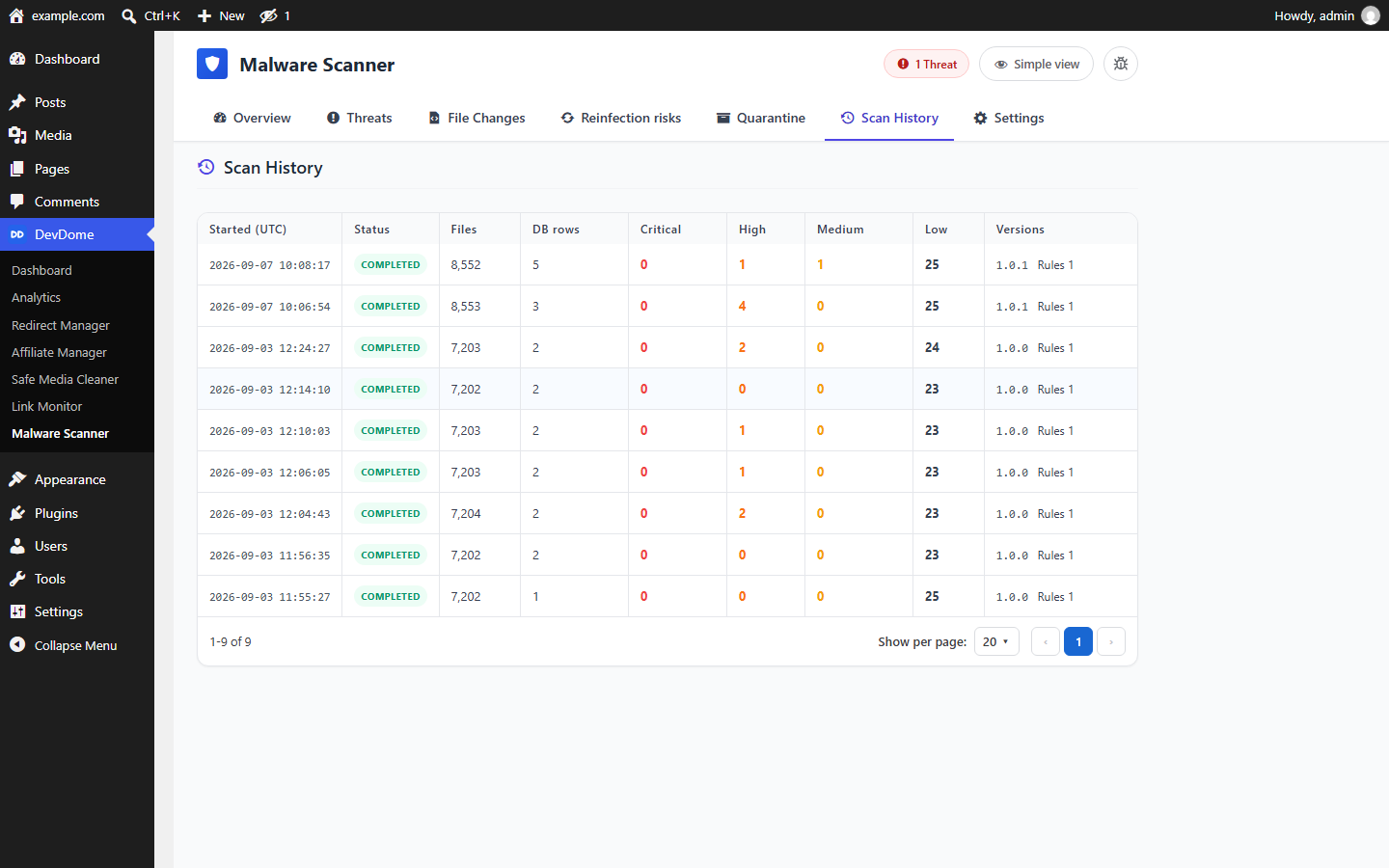
- Time-boxed batches with pause, resume and cancel, a WP-Cron fallback, scheduled daily or weekly scans, Simple and Advanced views, and multisite support.