
Easy Optimizer – PageSpeed, Cache & Core Web Vitals (Unused CSS, Delay JS, Lazy Load)
| 开发者 |
Uzair
easywpstuff uzairwp |
|---|---|
| 更新时间 | 2026年8月9日 01:49 |
| 捐献地址: | 去捐款 |
| PHP版本: | 7.4 及以上 |
| WordPress版本: | 7.0 |
| 版权: | GNU General Public License v2 or later |
| 版权网址: | 版权信息 |
详情介绍:
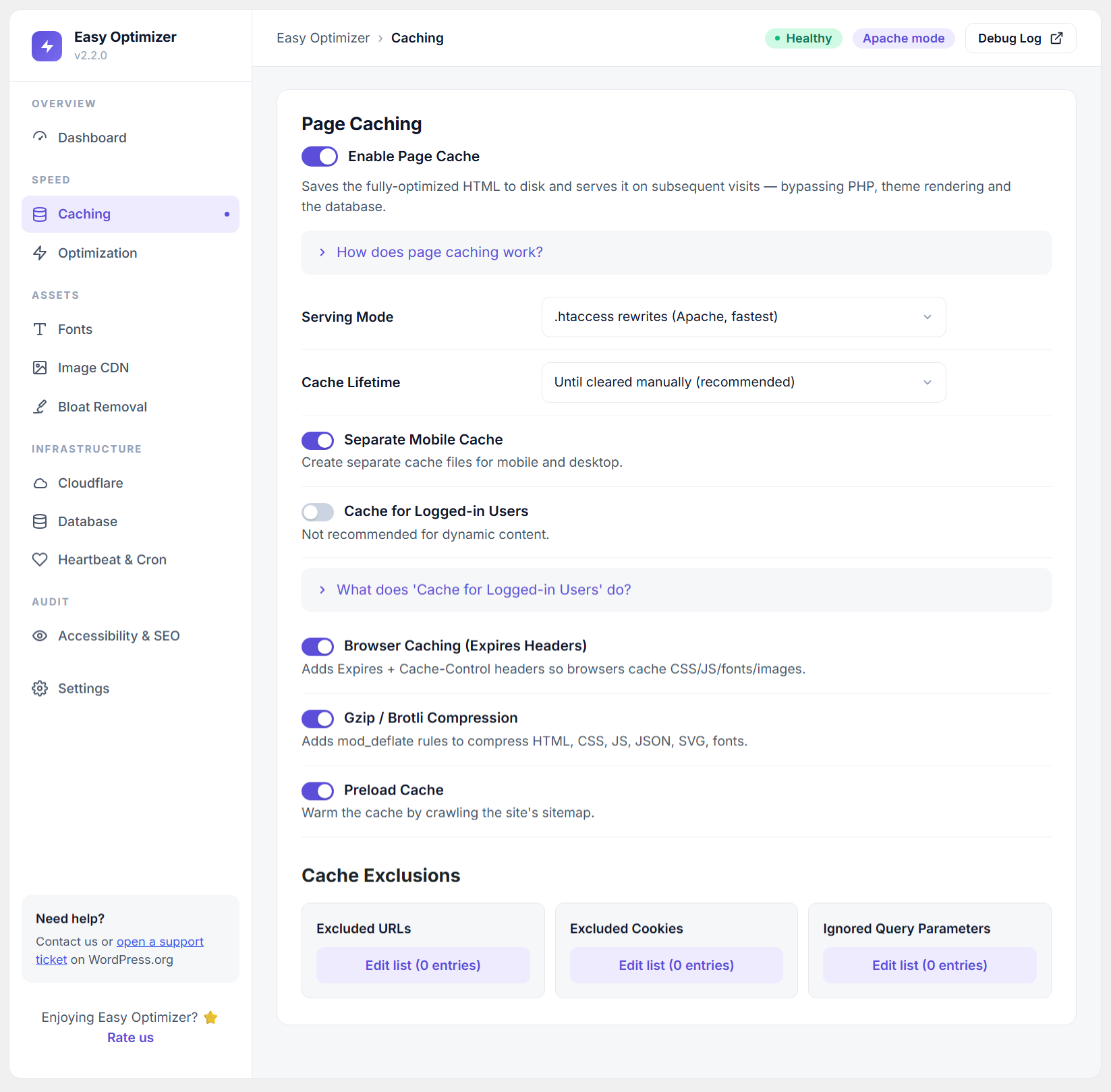
- Full Page Caching: Serve static HTML with sub-millisecond TTFB, with separate mobile and desktop caches and automatic sitemap-based preloading that warms your pages in the background.
- Compression & Browser Caching: Turn on Gzip or Brotli text compression and long-lived browser-cache (Expires) headers to shrink transfer size and stop repeat visitors re-downloading the same assets — resolving Lighthouse's "Enable text compression" and "Serve static assets with an efficient cache policy".
- Redis Object Cache: Add a persistent object cache that keeps repeated database and option lookups in Redis, cutting MySQL load on dynamic, logged-in and WooCommerce pages. Works with Relay, PhpRedis or the bundled Predis client (no PHP extension required) and reads your host's
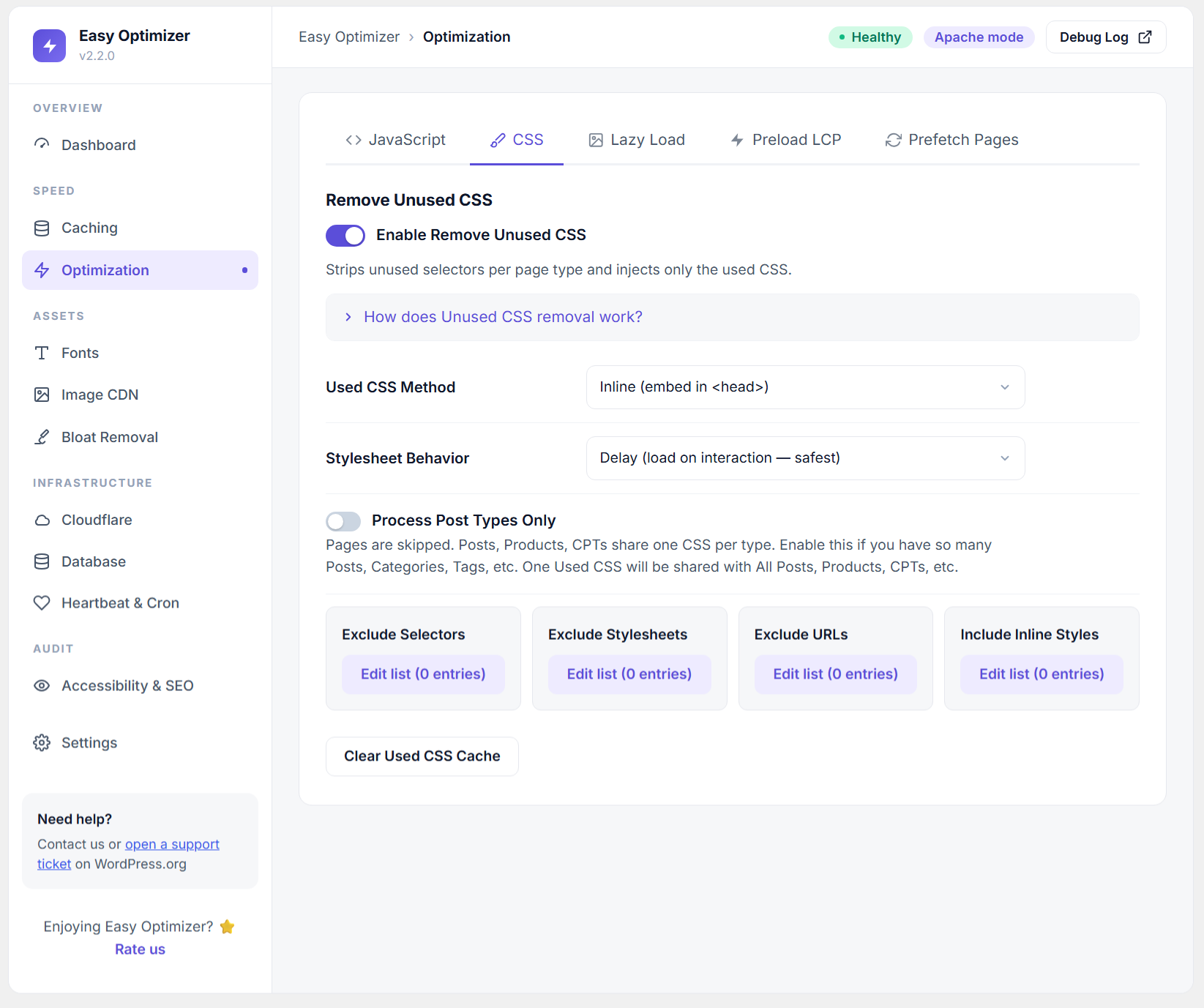
WP_REDIS_*constants automatically. It defers to any object-cache drop-in already installed instead of overwriting it, never editswp-config.php, and includes a one-click flush plus a live status panel (connection, memory, Redis version). - Remove Unused CSS: Fix Lighthouse's "Reduce unused CSS" by serving a slim, per-page-type stylesheet — eliminating render-blocking CSS and lifting your LCP. A built-in fail-safe keeps your original styles until a valid stylesheet is generated, so pages never render unstyled.
- Minify CSS & JavaScript: Strip comments and whitespace from your local CSS and JS files, caching each minified file on disk so it is processed only once. Already-minified files are skipped, and relative
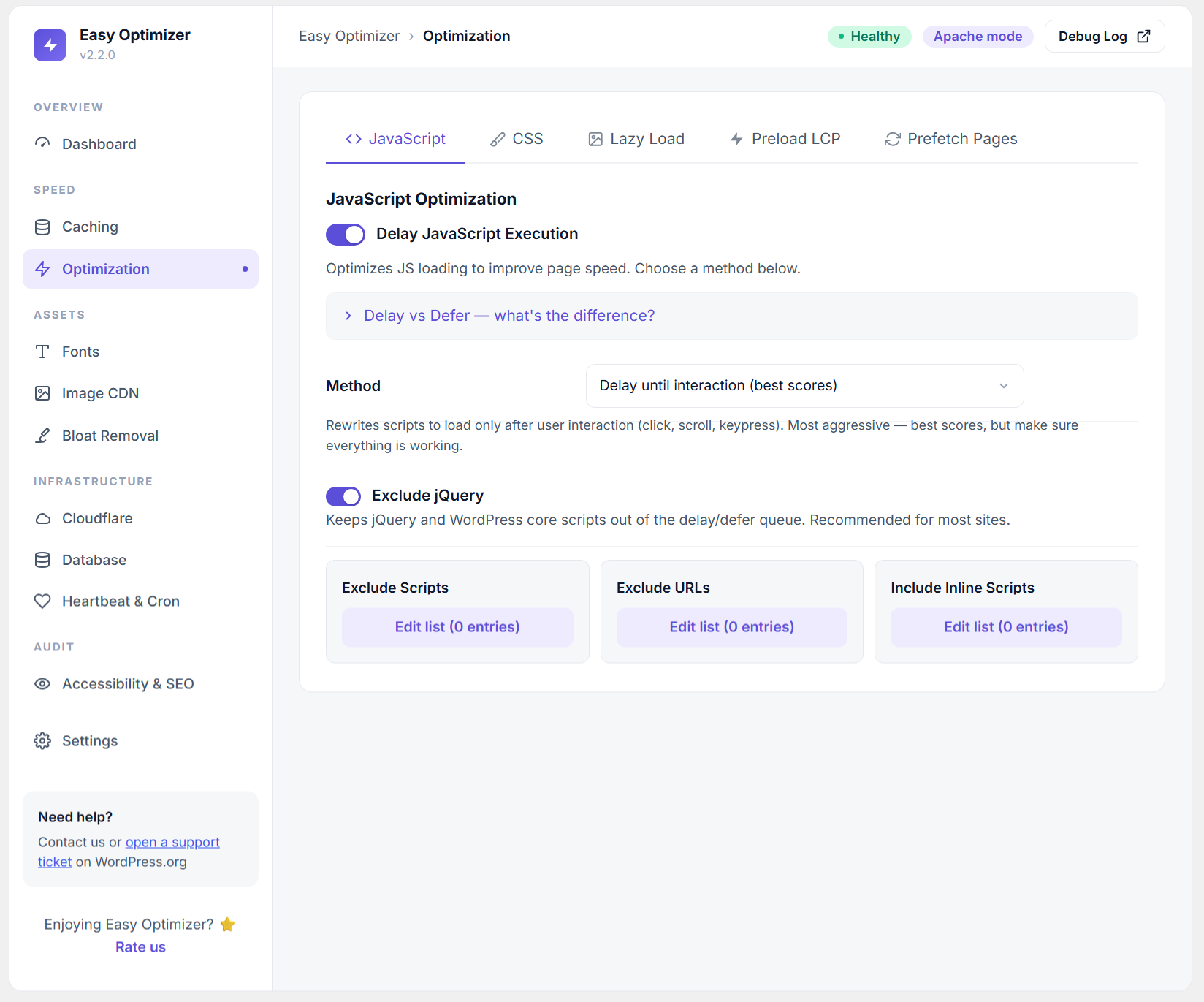
url()/@importpaths are rewritten so assets keep resolving. Works independently of Remove Unused CSS and Delay JS. - Delay & Defer JavaScript: Cut Total Blocking Time and improve INP by delaying script execution until user interaction, or by deferring scripts natively. jQuery is excluded by default, and you can exclude any script that needs to run early.
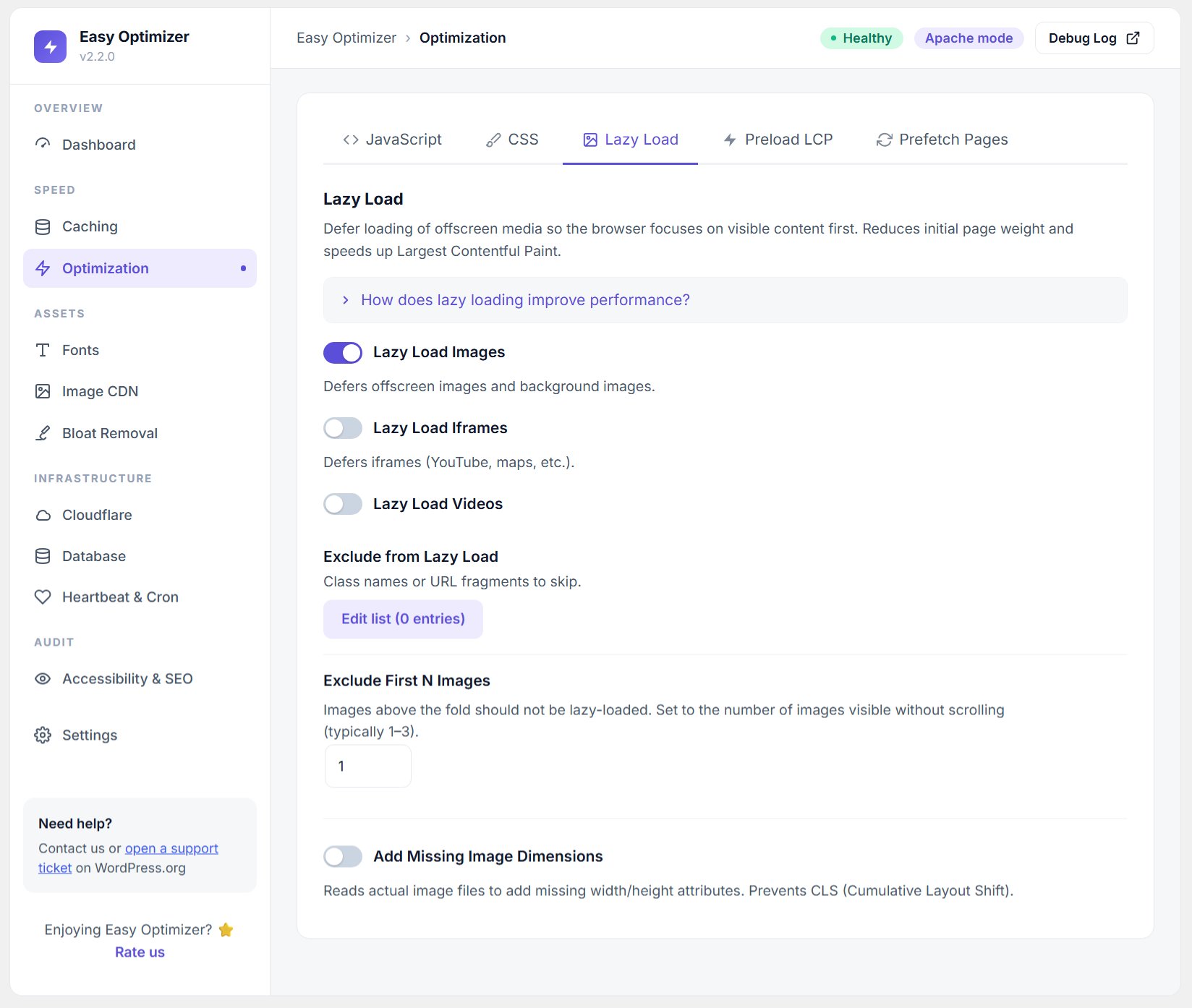
- Smart Lazy Loading: Defer offscreen images, iframes, videos and CSS background images, and add missing width/height attributes to prevent layout shift (CLS).
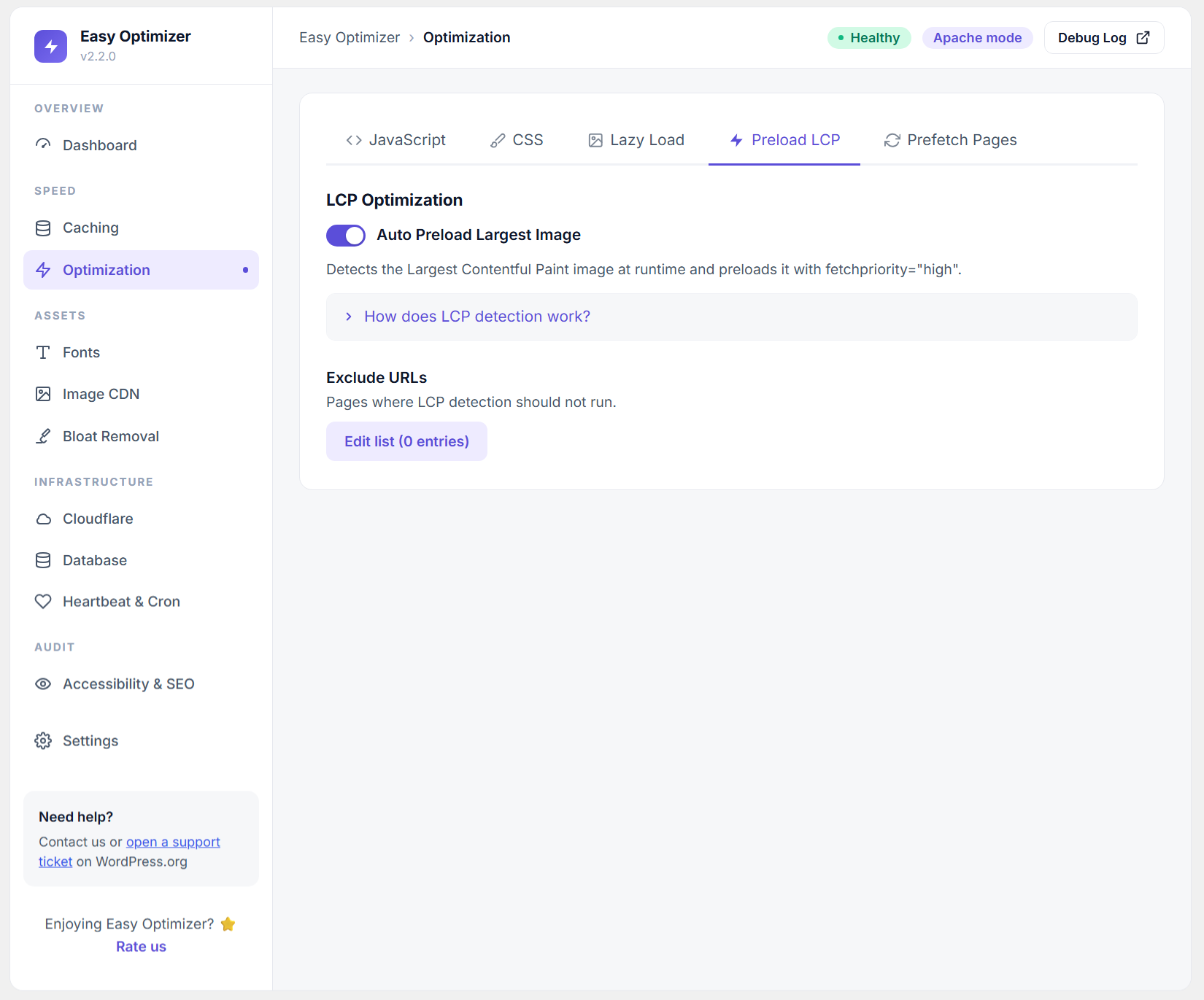
- Automatic LCP Preload: Detect each page's Largest Contentful Paint image and preload it — including responsive
srcset,<picture>and CSS background heroes — stored per URL so every page preloads its own correct hero for faster visual loading. - Image CDN (WebP & AVIF): Rewrite your image URLs to a global CDN that serves modern WebP/AVIF formats and every responsive size, addressing Lighthouse's "Serve images in next-gen formats". Optional and off until you enable it.
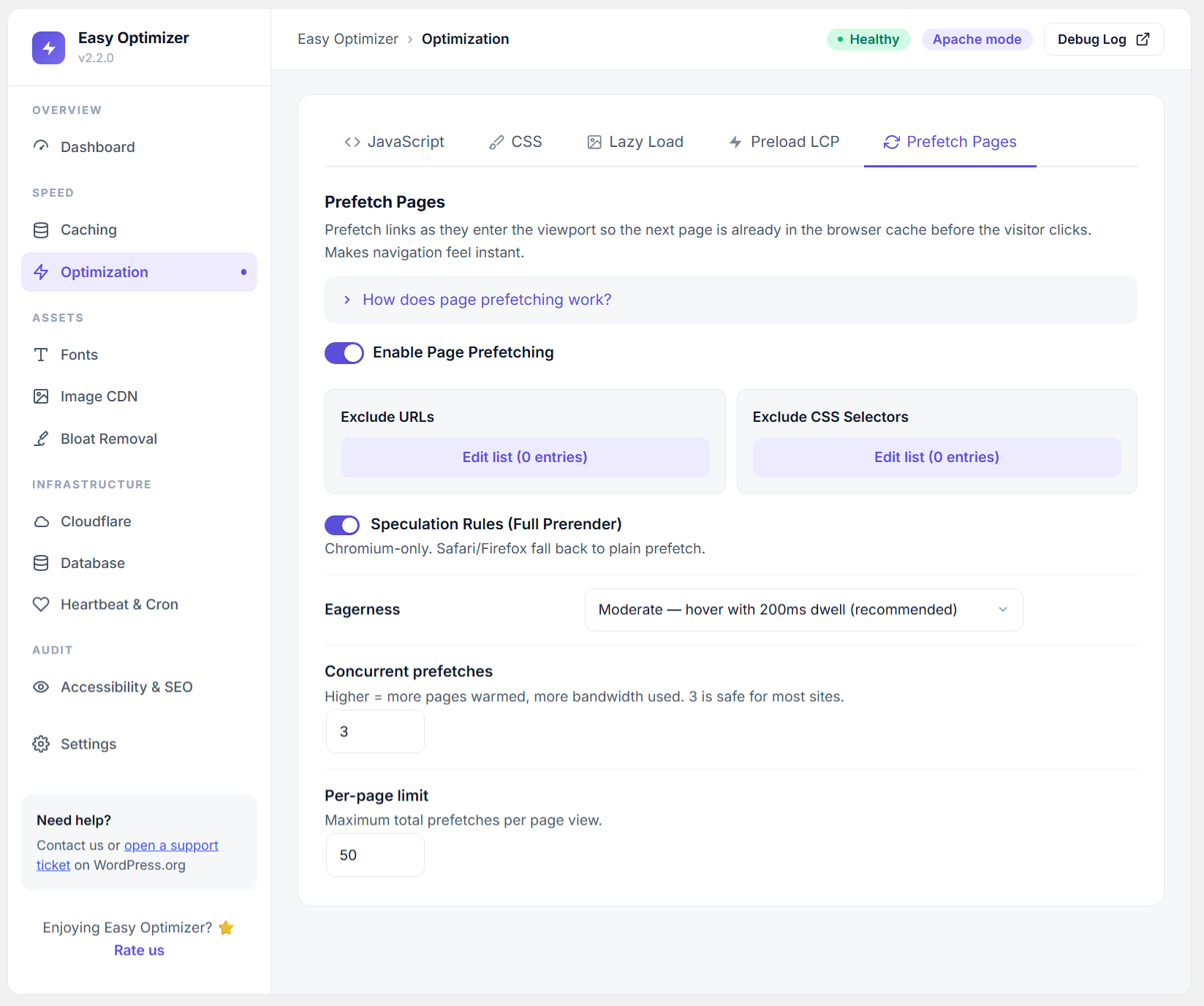
- Prefetch Pages: Pre-fetch links as visitors hover — with rate limiting and automatic back-off on a struggling server — making navigation feel like an instant single-page app.
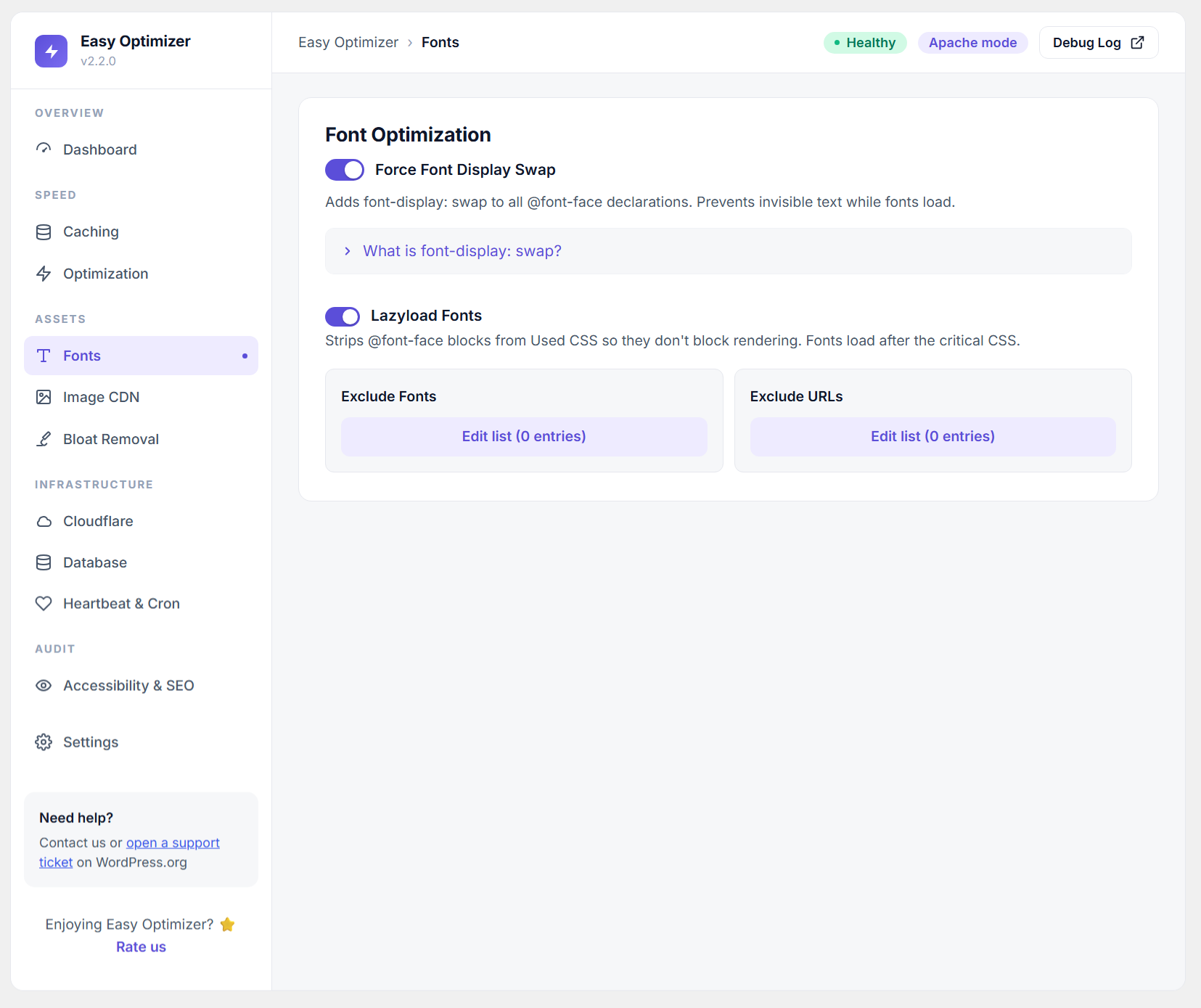
- Font Optimization: Add
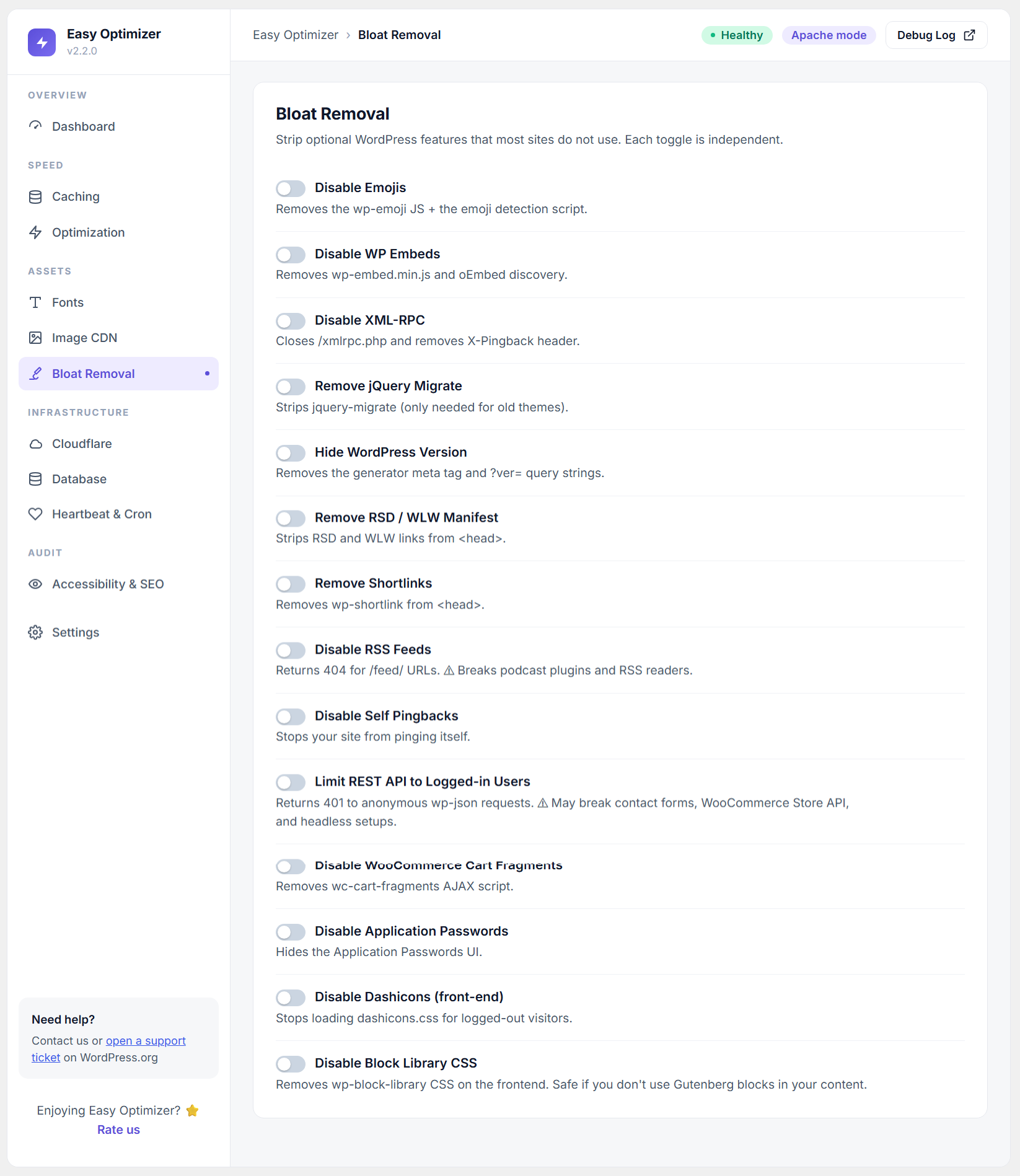
font-display: swapso text stays visible during webfont loads, with optional per-device font preloading learned from a lightweight beacon. - Bloat Removal: 15 independent toggles to safely switch off unused WordPress core scripts and features (emojis, embeds, XML-RPC, jQuery Migrate, Dashicons, Block Library CSS and more).
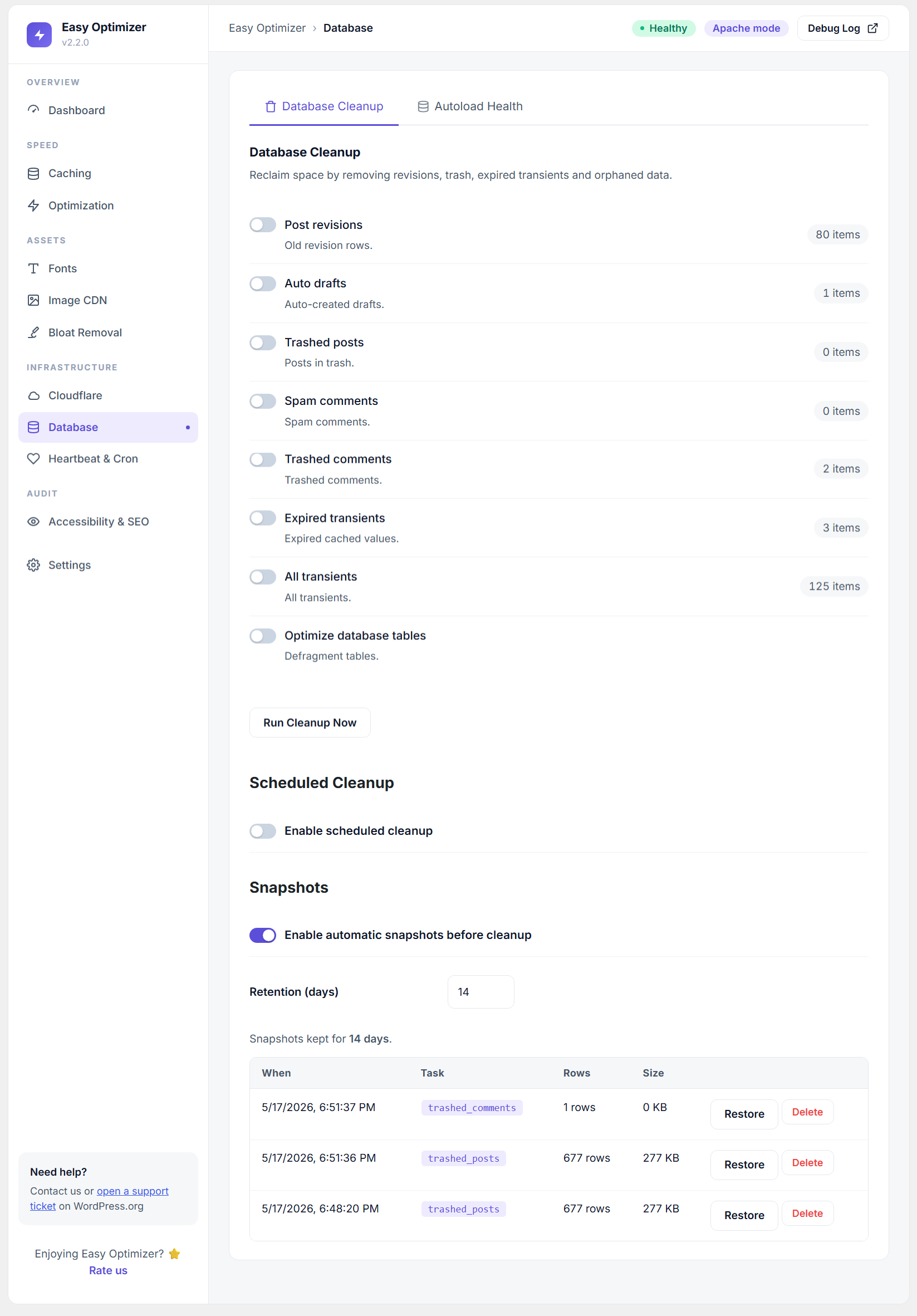
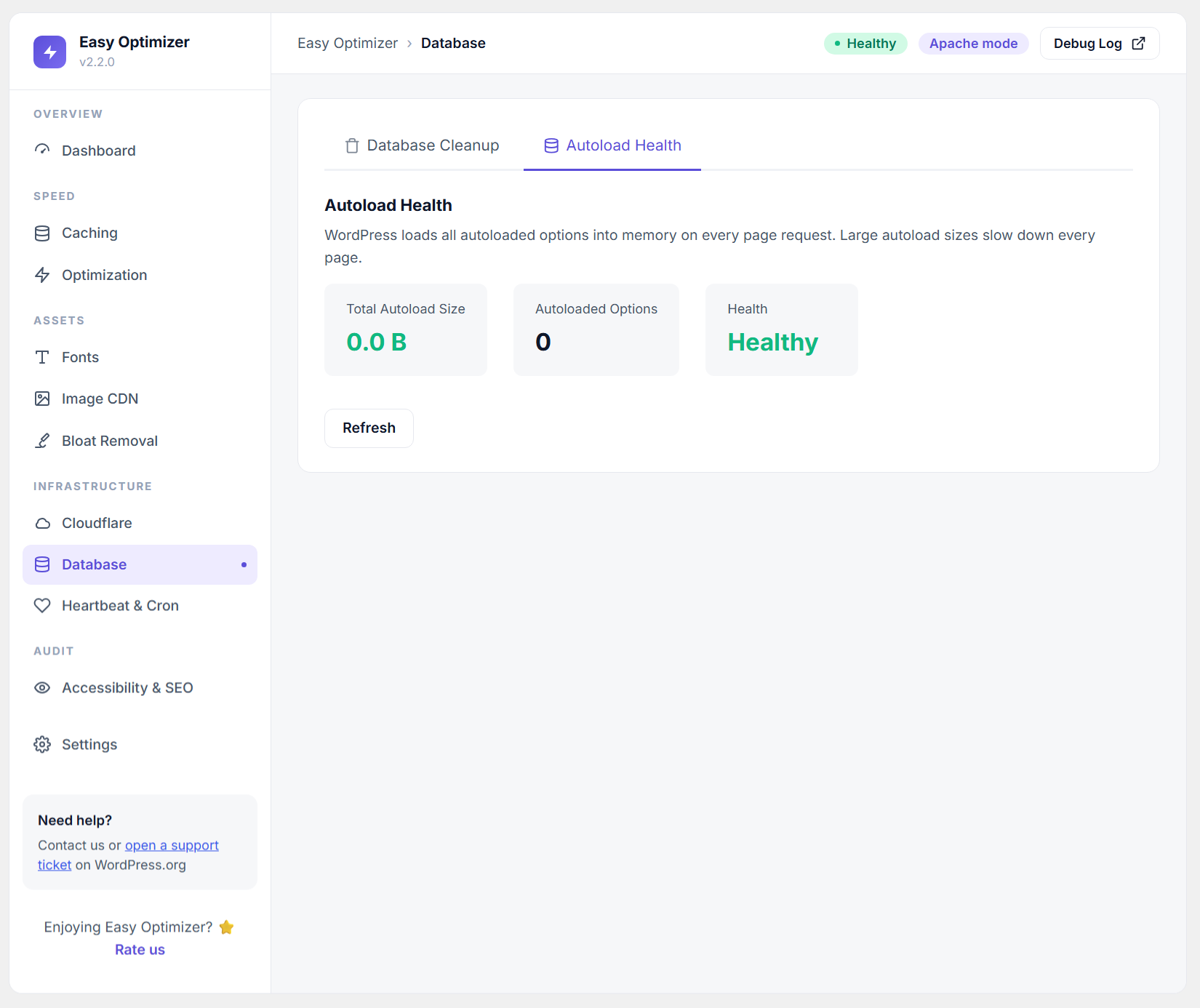
- Database Cleanup & Optimization: Schedule cleanups of revisions, auto-drafts, trashed posts, spam and transients — each with a pre-cleanup snapshot so you can restore safely. The built-in Autoload Health auditor finds the heaviest autoloaded options and lets you switch off the ones you don't need, directly resolving the Site Health warning "Autoloaded options could affect performance."
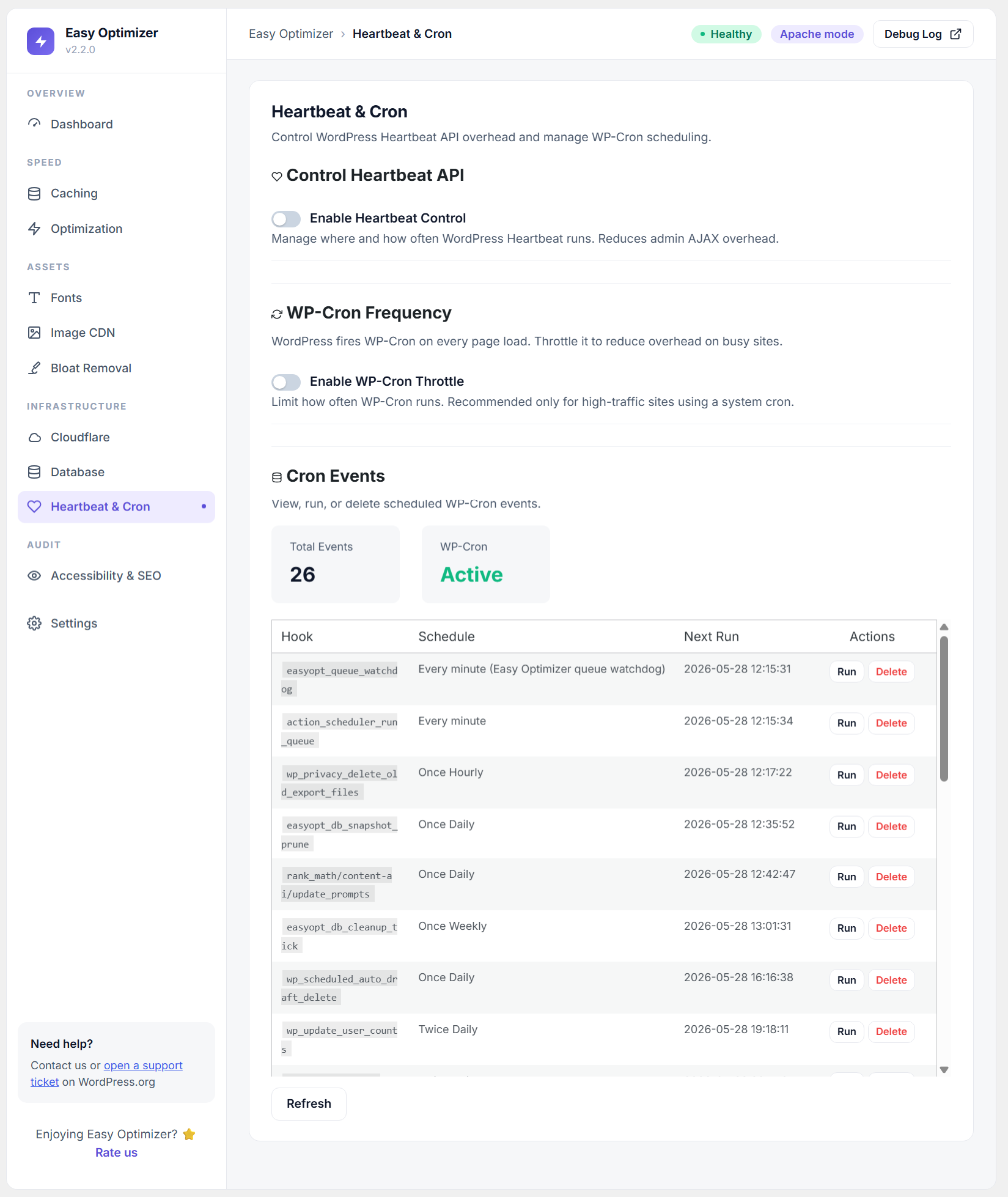
- Heartbeat & Cron Manager: Limit WordPress Heartbeat frequency and throttle WP-Cron from the dashboard (no
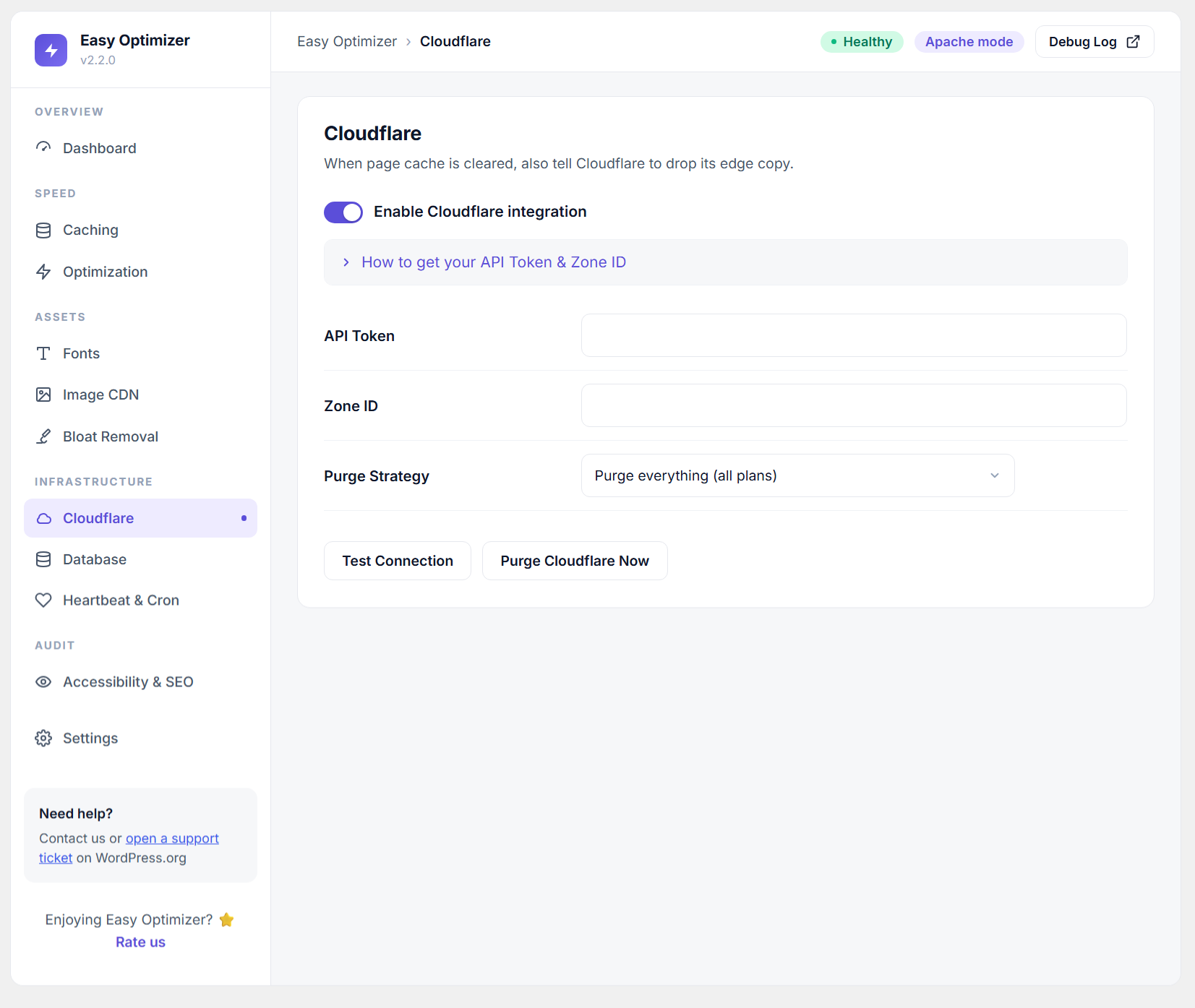
wp-config.phpedits), and view, run or delete scheduled cron events. - Cloudflare Integration: Purge your Cloudflare edge cache (tag-based or full zone) whenever the page cache clears, and test your API connection instantly without saving credentials first.
- Hosting Integrations: Detect your environment and purge server-level cache on managed hosts including Kinsta, WP Engine, SiteGround, Cloudways, GridPane, RunCloud, SpinupWP, Rocket.net and WordPress.com.
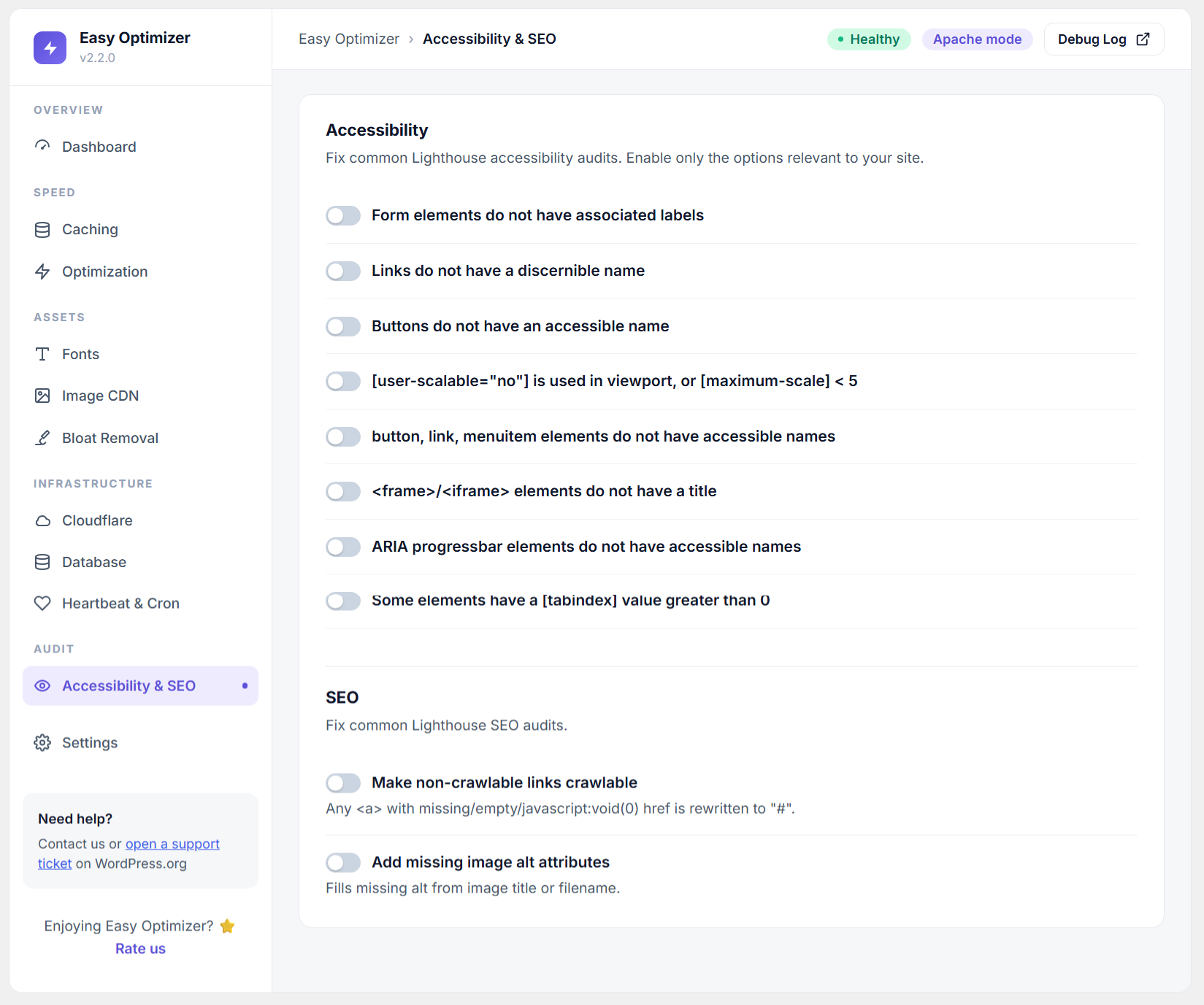
- Accessibility & SEO Fixes: Resolve common Lighthouse accessibility warnings in real time — missing form labels, ARIA names, iframe titles and un-crawlable links — without editing your theme.
- PageSpeed Speed Test: Run a Google PageSpeed test from your dashboard and compare your score with and without Easy Optimizer, for both mobile and desktop, including Core Web Vitals (LCP, CLS, INP). Works out of the box, or add your own free Google API key for unlimited tests.
- Debug Issues Panel: If a page ever looks wrong, switch individual optimizations off for a single page load and find the cause in a couple of clicks — no settings changed, no cache cleared, and no private browsing window needed. It tells you which feature caused it and takes you straight to the exclusion field that makes the fix permanent.
- Find Slow Plugins & Themes (Backend Analyzer): Profile any page or your admin area on demand to see exactly which plugins, themes and database queries take the most time — so you can pinpoint what is slowing your site down. Nothing runs for real visitors, so there is no added overhead.
- Render blocking requests (was: Eliminate render-blocking resources)
- Reduce unused CSS
- Minimize main-thread work
- Improve image delivery (was: Serve images in next-gen formats / Properly size images)
- Layout shift culprits (was: Image elements do not have explicit width and height)
- LCP request discovery (was: Preload Largest Contentful Paint image)
- Font display (was: Ensure text remains visible during webfont load)
- Use efficient cache lifetimes (was: Serve static assets with an efficient cache policy)
- Document request latency (was: Enable text compression / Reduce server response time)
- Network dependency tree (was: Preconnect to required origins)
- Form elements do not have associated labels
- Links do not have a discernible name
- Buttons do not have an accessible name
- [user-scalable="no"] in viewport or [maximum-scale] < 5
- Frame or iframe elements do not have a title
- ARIA progressbar elements do not have accessible names
- Some elements have a [tabindex] value greater than 0
- Image elements do not have [alt] attributes
- Links are not crawlable
- Image elements do not have [alt] attributes.
- WordPress & PHP: WP 6.4+ and PHP 7.4+
- Web Servers: Apache, Nginx, LiteSpeed, OpenLiteSpeed
- WooCommerce: Fully compatible. Cart, checkout, and my-account pages are automatically excluded from caching and optimization to protect the purchase flow.
- Page Builders: Elementor, Beaver Builder, Divi, Gutenberg, Bricks, Oxygen, Breakdance.
安装:
- In your WordPress admin, go to Plugins → Add New and search for "Easy Optimizer", or upload the plugin to
/wp-content/plugins/easy-optimizer/. - Activate the plugin.
- Open Easy Optimizer in the admin sidebar. On a new install the setup wizard opens automatically — nothing is enabled until you choose a preset.
- Pick a preset: Safe (best for shared hosting), Balanced (recommended for most sites) or Maximum. If you're not sure, choose Balanced.
- Save. The cache preloader starts warming your site automatically. You can fine-tune any individual feature from the tabs at any time, and the Settings tab includes a one-click Safe Mode if you ever need a known-good baseline.
屏幕截图:
常见问题:
Is Easy Optimizer compatible with WP Rocket, FlyingPress, Perfmatters, LiteSpeed Cache and other popular plugins?
Yes. Easy Optimizer is built to play nicely alongside other plugins, including WP Rocket, FlyingPress, Perfmatters, LiteSpeed Cache, W3 Total Cache, WP Super Cache, WP Fastest Cache, Autoptimize, NitroPack and the common page builders (Elementor, Divi, Beaver Builder, Oxygen) and SEO plugins (Yoast, Rank Math). It also works with WooCommerce and Cloudflare. The only rule is simple: don't run the same optimization twice. Every module is independent and only runs when you switch it on, so just turn off whatever overlaps with another plugin you're already using. Most importantly, never run two page caches at once — if another plugin is handling caching, leave Easy Optimizer's Page Cache off (or turn the other one off and let Easy Optimizer handle it). The same applies to features like unused CSS, delay JavaScript, or lazy load: pick one plugin to do each job. This means you can use Easy Optimizer as a complete all-in-one replacement, or keep your current setup and use only the parts you want — for example the Backend Analyzer, Autoload Health, database cleanup, or heartbeat and cron controls — while another plugin keeps doing the caching. Either way works.
How is Easy Optimizer different from WP Rocket, FlyingPress or Perfmatters?
Easy Optimizer is free and open, with no premium-locked core features and no upsells: caching, Remove Unused CSS, Delay/Defer JS, LCP preload, lazy load, Cloudflare and hosting-cache purging, database cleanup and the Backend Analyzer are all included. Those paid plugins are mature and excellent; Easy Optimizer aims to give you the same core speed wins for free, and to coexist cleanly if you already run one — just don't run two of the same optimization at once.
Something on my site looks broken — how do I find which feature caused it?
Use the Debug Issues button in the top bar. Pick the page that looks wrong, tick one optimization at a time, and open the generated link — that single page load runs with the feature switched off, while your settings and your cache stay exactly as they are. Answer "did that fix it?" and Easy Optimizer tells you which feature was responsible and takes you to the exclusion field that keeps the fix permanently. You do not need a private browsing window. Some optimizations are normally skipped while you are logged in, so the panel's links quietly render the page the way a visitor sees it. If the page is still wrong with everything switched off, the cause is your theme, another plugin or your server — and the panel says so rather than sending you round the loop again.
Will Easy Optimizer speed up my WooCommerce store?
Yes. Every optimization module runs on your shop, while Cart, Checkout and My Account are automatically excluded so the purchase flow is never cached or altered — including custom or translated slugs. Multi-currency stores cache a correct copy per selected currency, and you can disable WooCommerce cart fragments from the Bloat Removal tab to speed up pages that don't need them.
Does it work on Nginx, LiteSpeed and OpenLiteSpeed, or only Apache?
All of them. On Apache it can optionally write .htaccess rules (after a per-server safety probe that prevents a bad rule from ever 500-ing your site); on Nginx, LiteSpeed and OpenLiteSpeed it serves cached pages through PHP. On hosts with their own server-level cache (Varnish / LiteSpeed / nginx FastCGI), preloading and on-visit caching are handled correctly.
What's the difference between Delay JS and Defer JS — which should I use?
Defer keeps scripts in order but runs them after HTML parsing; it is the safer choice and rarely breaks anything. Delay goes further, holding scripts until the first user interaction (scroll, tap, move) for the biggest INP and blocking-time win, at a slightly higher chance of needing exclusions. Start with Defer if you're cautious, or Delay (jQuery excluded by default) for maximum speed, and add any problem script to the exclusion list.
Does Delay JavaScript break Google Analytics, the Facebook Pixel or ads?
Usually not. Delayed scripts run on the first interaction, so analytics and pixels still fire for engaged visitors. If you need a tag to load immediately — for example to measure bounces or run consent logic — add it to the Delay JS exclusion list and it will load normally.
My site looks broken after enabling Remove Unused CSS — how do I fix it?
Add the affected stylesheet or CSS selector to the exclusion fields on the CSS tab and rebuild. Remove Unused CSS also learns JavaScript-generated classes (sliders, menus, tabs) automatically so their styles aren't stripped. To confirm it really is the cause, use the Debug Issues panel. To revert quickly, use Safe Mode on the Settings tab to return to a conservative baseline.
How do I exclude a page from caching, or a script from Delay JS?
Use the exclusion fields on each tab — the Cache tab has URL and cookie exclusions for pages you never want cached, and the JavaScript tab lets you exclude scripts by name or URL from Delay/Defer. For a one-off test, the Debug Issues panel builds the right link for you; you can also append ?nocache, ?nodelayjs, ?norucss or ?nooptimize to any front-end URL by hand to disable that feature for that single request.
Does it minify and combine CSS and JavaScript?
It minifies your local CSS and JS (caching each file on disk and processing it once). It does not force-combine files into one — under HTTP/2 and HTTP/3 that usually no longer helps and can hurt caching — so Easy Optimizer focuses on minification, delay/defer and removing unused CSS instead.
Do I need a CDN to use Easy Optimizer?
No. Every core feature works without a CDN. If you want next-gen image delivery you can optionally enable the built-in Image CDN (WebP/AVIF), and you can connect Cloudflare for edge-cache purging — but neither is required.
Will it slow down my wp-admin dashboard?
No. Optimization features run on your front end, and modules you don't enable are never loaded, so your admin stays responsive. The Backend Analyzer's profiling is on-demand and never runs for real visitors.
What's the best starting configuration to improve my PageSpeed / Core Web Vitals score?
Enable Page Cache, Remove Unused CSS, Delay or Defer JavaScript, Lazy Load, LCP Preload and Font Display Swap, then turn on the accessibility and SEO toggles relevant to your site. Save and re-run the built-in speed test to compare before and after. The dashboard's "What to fix next" card then lists what is still worth changing, ranked by impact, so you don't have to guess. If you used the setup wizard, the Balanced preset already enables most of these.
Which preset and preload speed should I use for my hosting?
As a rule of thumb — shared hosting: the Safe wizard preset with the Gentle preload speed; most sites and managed hosting: Balanced; VPS or high-performance managed hosting: Maximum with the Turbo (or Balanced) preload speed. Preload also auto-tunes to your server's real capacity and backs off automatically if it detects errors or rate-limiting, so you can't overload your host.
Do I need Redis, and does it work without the PHP extension?
The Object Cache module needs a running Redis server (many shared hosts ship the PhpRedis extension but no server — if the status panel shows "not connected", leave Object Cache off). You do not need a Redis PHP extension, though: the pure-PHP Predis client is bundled, so the object cache works without PhpRedis or Relay. Enter your host, port and password in the settings, or define WP_REDIS_* constants in wp-config.php and they'll be used automatically. Easy Optimizer never edits wp-config.php, and if another object-cache plugin is active it defers to it rather than overwriting its drop-in.
What do "Pages cached" and "URLs in waiting" actually count?
Both count unique URLs, not files. With Separate Mobile Cache on, one page can have a desktop copy and a mobile copy on disk, but it is still one page in both figures. The two numbers are not meant to converge: a page whose desktop copy is cached while its mobile copy is still queued is legitimately counted in each at the same time.
Can I use this with Cloudflare?
Yes. Add your API token and Zone ID in the Cloudflare tab. Cache purges sync automatically.
Does it support multisite?
Works on individual sites within a multisite network.
How do I migrate settings between sites?
Export settings as JSON from the Settings tab, then import on the destination site. Credentials (Cloudflare token, Redis password, CDN key) are deliberately left out of the export, so re-enter those on the destination site.
What happens to my cache when I edit a post or product?
Editing content clears only the affected URLs — the post or product itself plus its archives, author, date and taxonomy pages (with pagination) — instead of wiping the whole cache, and changing a slug also clears the old URL. Comment and term edits trigger the same targeted, lightweight clears.
Does Easy Optimizer collect any data? Is it privacy-friendly?
The usage analytics are opt-in and off by default. When enabled they send only technical, non-personal data (plugin/WordPress/PHP versions, theme, locale, host flags and your site URL) — never your email, visitor IPs, user data or page content. With analytics left off, nothing is sent anywhere. See the Privacy and External Services sections for the full list.
How do I completely uninstall Easy Optimizer and remove all of its data?
On the Settings tab, turn on "Delete all plugin data on uninstall" before deleting the plugin. With it on, removing the plugin cleans up its options, cache files, drop-ins and snapshots; with it off, your settings are preserved in case you reinstall.
Is there a developer API for clearing the cache?
Yes. You can trigger purges from your own code with these action hooks:
do_action( 'easyopt_purge_all' ); — clear the entire page cache.
do_action( 'easyopt_purge_url', 'https://example.com/some-page/' ); — clear one URL.
do_action( 'easyopt_purge_url_type', 'home' ); — clear a key page type (home, front or posts page).
The plugin also fires events you can listen to: easyopt_cache_cleared_all, easyopt_cache_cleared_url (passes the URL) and easyopt_page_cached. For Cloudflare, EasyOpt_Cloudflare::purge_url( $url ) and EasyOpt_Cloudflare::purge_all() are available when the integration is connected.
External Services
Easy Optimizer can connect to the external services below. Each is optional and used only for the feature noted.
- FluxPress Adaptive Images (paid, optional) — when Smart Images is connected with a license key, your public image URLs are rewritten to your personal CDN endpoint (CDN + an image-processing service) for AVIF/WebP conversion, resizing and delivery. URLs are cryptographically signed; only public image URLs are requested by visitors' browsers; your original files are never modified or uploaded. During connect, and roughly hourly afterwards, the plugin contacts fluxpress.io (endpoints: /provision on connect, /usage for the bandwidth meter and license check, /preflight during connect, /deprovision on disconnect, /purge after settings changes), sending only your license key and site URL. Terms & Privacy
- SureCart (licensing for Adaptive Images) — validating and activating/deactivating your license contacts api.surecart.com with your license key and site URL. Only used when you connect, disconnect, or the license is re-validated. Terms · Privacy
- Cloudflare API — when Cloudflare is connected, your edge cache is purged (by URL or full zone) as the page cache clears. Only the URLs to purge and your zone ID are sent. Terms · Privacy
- Google PageSpeed Insights — when you run a speed test with your own API key, your site's public home URL is sent to Google. Terms · Privacy
- FluxPress PageSpeed proxy — the default speed-test path; your site registers once, then its public home URL is tested via Google so no API key is needed. Terms & Privacy
- FluxPress usage analytics — opt-in, off by default; sends technical, non-personal data (plugin/WordPress/PHP versions, theme, locale, host, multisite/WooCommerce flags, and your site URL). It never sends your email, visitor IPs, user data, or page content. Terms & Privacy
更新日志:
- Cache Query String — a new box in Caching, next to Ignored Query Parameters. Ignoring a parameter makes every value share one cache file, which is what keeps campaign links fast. That is wrong for the minority of sites where the server renders the value into the page — a form that writes UTM values into hidden fields, or a plugin that varies content by
?ref=. List those parameters here and each value gets its own cache file instead. Empty by default, so nothing changes unless you use it. Per-click identifiers (gclid,fbclid,msclkid,_ga…) are refused: their values are unique per visitor, so keying on one would create a cache file per visit. -
Three more parameters ignored by default for parity with other cache plugins:
gadid,fbadid,_ke. Fixed -
The
easyopt_cache_strip_query_paramsfilter was applied by the plugin but not when generating theadvanced-cache.phpdrop-in — and the drop-in is what serves the page. Filtering a parameter out of the ignore list therefore did nothing at all, with no error to explain it; filtering one in cost a full WordPress boot on every matching URL. Both serve paths now build the list identically. - Installing a cookie-based multilingual plugin (Polylang, WPML) on a site that was already caching could serve the pre-existing single-language page to every visitor, in every language, indefinitely — the drop-in's copy of the cache-key settings was only refreshed when an Easy Optimizer setting was saved. It is now refreshed, and the cache purged, whenever any plugin is activated or deactivated.
- Nginx snippet no longer emits the mobile rule when Separate Mobile Cache is off — mobile visitors were being routed to a file that is never written and losing the fast path.
- Apache rules now skip requests carrying a non-standard port.
%{HTTP_HOST}keeps the port but the cache writer strips it, so the rule silently never matched; those requests are served by PHP instead, which is correct. -
Cache directories are no longer created from an unrecognised
Hostheader, which could be rotated to fill the cache folder with junk directories. Security - CDN credentials (signing key, salt, account token, licence key) moved out of the main settings row into their own storage that is not loaded on every request. They were previously included in the settings payload sent to the admin screen and in Settings Export files.
- Image URLs containing
\or@in the hostname are no longer signed. The CDN edge and the image server resolved such a hostname differently, so a crafted URL could be authorised as your domain while fetching from somewhere else.
- Debug Issues panel — find which optimization is breaking a page in a couple of clicks, without changing settings, clearing the cache or opening a private window.
- "What to fix next" dashboard card — your PageSpeed findings as a ranked to-do list, each mapped to the setting that fixes it. Replaces the old read-only feature-status list.
- Setup wizard now checks your site first and leaves off any feature another plugin or your host already handles, with the reason shown.
- GoDaddy Managed WordPress: Varnish and CDN cache are now cleared per page as content changes.
-
define( 'EASYOPT_PROFILE_BUFFER', true );logs per-page optimization time and memory use. Security -
Fixed: cache preload requests are now cryptographically signed.
?eopreload=1was unauthenticated, so anyone could force a full uncached render — the most expensive request a site can serve — with no rate limit. - Fixed: the Core Web Vitals beacon token is now tied to the page it was issued for.
- Fixed: Easy Optimizer no longer replaces the
advanced-cache.phpdrop-in of another active caching plugin, which previously disabled that plugin's caching silently. - Fixed: cached pages now declare what they vary on, so a CDN can no longer serve one visitor's variant (device, role, currency) to everyone.
- Fixed: exported settings no longer contain your Cloudflare token, Redis credentials or CDN key. Fixed
- Page cache was never served on hosts where the drop-in cannot be installed (Pantheon, read-only filesystems) — those sites paid the cost of caching with none of the benefit.
- Cache file paths are now built by one shared routine, ending permanent cache misses for URLs the drop-in and the plugin disagreed about.
- "Pages cached" now counts unique URLs accurately. It could previously drift in both directions — a page first cached on mobile never counted, role- and currency-keyed copies over-counted, and editing a post subtracted from the total even when nothing was on disk.
- Preload status could stay on "running" forever on sites that never ran a manual preload.
- Preload no longer re-warms the whole site on every run when Gzip is off or on OpenLiteSpeed.
- Remove Unused CSS could crash a page on hosts that lock
memory_limit; it now checks before raising it. - Remove Unused CSS builds no longer queue ahead of the preload crawl and interrupt it.
- The Gzip toggle now really stops compressed copies being created and served; pre-compressed files are no longer served on OpenLiteSpeed, which compresses natively.
- Delay JavaScript no longer delays
<script type="module">, which broke Interactivity API blocks until the first click. - Safe Mode can now switch minification off.
- Debug switches (
?nooptimizeand friends) can no longer be silently disabled by adding them to the strip-query-parameters list. - Activating the plugin during a bulk activation no longer leaves it switched off with no route back to the wizard. Improved
- Conflict notices now name the other plugin, link to your Plugins screen, and offer "keep both". The two-page-caches warning is a notice, not an error.
- Conflict detection extended to 20+ further plugins, and to fonts (OMGF, Perfmatters) for the first time.
- Preload no longer starves small servers, backs off much sooner under strain, and works without Redis on far more hosts.
- Disabled modules are no longer loaded on front-end page views (~300KB of PHP per request). For developers
-
Added:
EasyOpt_Preflight::scan(), REST routeeasyopt/v1/wizard/preflight, filtereasyopt_preflight_scan. - Added: filters
easyopt_defer_used_css_generation,easyopt_font_conflicts,easyopt_lazyload_conflicts,easyopt_preload_latency_ceiling_ms,easyopt_beacon_accept_legacy_token,easyopt_preset_map,easyopt_secret_setting_keys,easyopt_used_css_memory_multiplier,easyopt_reconcile_pages_throttle. - Added:
EasyOpt\Cache\path_segment()/path_segments()— the shared cache-path builder. - Added:
EasyOpt_Cache::get_reserved_query_params();EasyOpt_Cache::current_request_url()is now public. - Note: beacon tokens issued by 2.5.x are accepted for this release only. Filter
easyopt_beacon_accept_legacy_tokento__return_falseto enforce the new binding immediately.
- Fixed: Smart Lazyload Fonts and Smart Preload Fonts had no effect on mobile. The above-the-fold font data was collected and saved correctly, but the mobile page render looked for it under the wrong name, so every font was kept. Desktop was unaffected.
- Fixed: robots.txt, llms.txt and other plain-text files inherited a 30-day browser-cache lifetime, which could keep a regenerated llms.txt hidden from search engines and AI crawlers for weeks. They now use a 5-minute lifetime.
- Fixed: automatic preconnect no longer opens a connection to gmpg.org and other domains that are only referenced in metadata links (rel="profile", rel="me", rel="alternate"). Those handshakes were wasted and used up hint slots that real font and CDN origins needed.
- Changed: preconnect hints no longer emit a duplicate dns-prefetch tag for the same origin — every current browser honours preconnect, which already includes the DNS lookup.
- Fixed: on OpenLiteSpeed, cached pages could download instead of display. Cached pages are now written in a format every server can serve.
- Fixed: preload no longer pauses with a false "server busy" message on shared hosting. It now paces itself using your site's own response times.
- Fixed: firewall-blocked requests (Sucuri and similar) are retried with backoff instead of being marked failed, and the speed test no longer hangs when a firewall blocks WordPress cron.
- Fixed: cached Used CSS files are no longer re-checked with the server on every page view.
- Fixed: cookie-based multilingual sites (Polylang / WPML) no longer serve a cached page in the wrong language.
- Fixed: images inside could stay blank when a slider or Ajax filter duplicated them.
- Fixed: sitemaps and feeds no longer enter the preload queue, and "Log Warnings" now takes effect immediately.
- New: Browser-native lazy load (on by default) — images use the browser's built-in lazy loading, so they start downloading sooner and most pages ship no lazy-load script. Iframes keep the JavaScript method to hold back heavy embeds. Turn it off if your theme styles the .lazyload classes.
- New: Preconnect to External Origins (on by default) — connects early to Google Fonts, CDNs and similar so their files start loading sooner.
- New: optional Nginx server rules, shown under Advanced in the Caching tab for servers without .htaccess.
- Improved: WooCommerce shoppers now keep getting cached pages after adding to cart. Previously the whole session browsed uncached. Pages carrying a WooCommerce notice are still never cached.
- Improved: many more tracking parameters (Klaviyo, Marketo, ConvertKit, MailerLite, Omnisend, LinkedIn, Reddit, Snapchat, HubSpot Ads and others) no longer bust the cache, so email and ad campaign landing pages are served from cache.
- Improved: video posters now paint immediately instead of waiting for JavaScript, and muted autoplay videos start reliably.
- Improved: "Exclude First N Images" now defaults to 1. Diagnostics (still strictly opt-in):
- Privacy: diagnostics no longer send your theme name, site language, or multisite flag. Data sent is limited to: site URL, an anonymous site identifier, plugin/WordPress/PHP versions, server type, hosting provider, enabled features, and anonymous error codes.
- New: optional one-click feedback when deactivating the plugin. If diagnostics are off, submitting sends a single message (your reason, plugin version, and site URL — nothing else); skipping sends nothing.
- New: Smart Images connection health reporting so delivery problems (SSL, host firewall, quota) can be diagnosed and fixed faster.
- Improved: feature usage flags now distinguish settings you chose from shipped defaults.
- Improved: version updates report immediately instead of at the next weekly check.
- Fixed: re-activating the plugin no longer stopped the weekly diagnostics schedule; saving settings repeatedly no longer re-sends activation diagnostics.
- Page cache: content-change purges (post saves, comments, terms, WooCommerce stock updates) are now deduplicated and run after the response is sent — checkout and editor requests no longer wait on purge I/O.
- Page cache: anonymous visitors skip user resolution on the serve path; exclusion lists parse once per request; cache-file gzip level is now filterable (easyopt_cache_gzip_level, default 4).
- Minify: cache keys derive from file size+mtime instead of re-hashing every source file on every render.
- Remove Unused CSS: the font- and CDN-transformed critical CSS is cached per context (used.final.css) instead of re-transforming on every render; safelist matching is precompiled (large builds up to 5x faster).
- FluxCDN: image URL signing is memoized per request; license/maintenance checks moved off admin page loads into background cron.
- Lazy Load: image dimensions persist across requests (no repeated disk reads); WooCommerce product-gallery images are excluded so gallery zoom always initializes correctly.
- Preload: warm tasks carry their post ID (no reverse URL lookups); permalink collection primes caches in batches; the speed governor reads shared state far less often; Turbo/Auto modes ramp faster on healthy servers.
- Queue: the per-minute watchdog exits after one option read when the queue is idle.
- Object cache drop-in: wp_cache_get_multiple uses one Redis MGET round-trip; add() uses atomic SET NX; batch set/delete are pipelined.
- Database cleanup: bulk deletions no longer trigger per-row cache purges; transient wipes stay coherent with Redis; chunked runs skip redundant count queries.
- Cloudflare: Free/Pro/Business zones no longer pay a doomed tag-purge API call before every full purge.
- Debug log: log lines buffer per request and flush once at shutdown.
- Many further micro-optimizations across schema checks, option reads, and cron scheduling.
- New: Image Optimization — FluxPress CDN, a built-in image CDN that converts your images to next-gen formats (AVIF/WebP) on the fly, resizes them per device, compresses them, and serves them from a global edge network. Nothing is uploaded and your original files are never modified.
- New: Smart quality — automatically picks the best quality per browser and format (AVIF/WebP/JPEG), or set a fixed quality manually.
- New: Real-time delivery for , srcset, / (including existing WebP files), inline and shorthand CSS backgrounds, Used CSS backgrounds, and Elementor background images.
- Improved: automatic fallback to the original image if a delivered image can't load, so images never appear broken.
- Improved: graceful degradation everywhere — no license, an invalid license, or an unreachable CDN simply serves your original images.
- New: cache for logged-in users now works — pages are cached per user role (per-user via the
easyopt_cache_logged_in_per_userfilter; restrict roles viaeasyopt_cache_logged_in_roles). - New: Cron Events tool shows times in your site's timezone, marks overdue events, and Run now executes AND reschedules the event; a heartbeat line shows when background jobs last ran.
- Fixed: Object Cache drop-in installation on PHP-FPM hosts (e.g. xCloud) — syntax validation now runs in-process, and installs are atomic so a failed check never removes a working drop-in.
- Fixed: Redis ACL credentials in the xCloud format (
WP_REDIS_PASSWORDas[username, password]) are now supported in the connection tester and the drop-in. - Improved: the WP-Cron warning recognizes real system crons (constant, filter, permanent dismissal, and automatic detection when background jobs run).
- Improved: admin notices now have a real "Don't show again" that persists — and returns only if the situation changes.
- Improved: the Image tab is now "Smart Images" with clearer connection status, including SSL-provisioning state.
- Fix: Remove Unused CSS: Fixed missing styles when using shared Used CSS across different template variants of the same post type. Shared CSS now updates automatically as new layouts are encountered.
- Fix: LCP Optimization: Correctly de-lazifies the detected LCP image when lazysizes-style lazy loading is used, improving LCP.
- Fix: Prevented blank pages on very large pages by improving PCRE handling and adding safeguards against incomplete HTML output.
- Fix: Lazy Load: Reduced unnecessary resize events triggered by lazysizes, preventing layout flickering in some themes and plugins.
- Change: Lazy-loaded iframes without dimensions now reserve a 16:9 placeholder to reduce layout shifts.
- Internal: Bumped the CSS logic version so existing Used CSS files regenerate once with the updated logic.
- Fix: Remove Unused CSS — Elementor entrance and hover animations (e.g. zoomInUp) no longer break. Animation names declared only in Elementor's data-settings JSON (added to elements by JavaScript on scroll) are now detected server-side and their CSS rules kept, per page. Pages that declare no animations keep nothing extra. Also safelisted the animated-slow, animated-fast and elementor-invisible helper classes so animated elements can never be left stuck invisible.
- New: Object Cache — Username field for Redis 6+ ACL hosts (e.g. Cloudways). Works with ACL, password-only, and no-auth servers.
- New: Object Cache — reads host-provisioned WP_REDIS_CONFIG arrays (Object Cache Pro format used by Cloudways and other managed hosts), so connection details including the assigned database number are picked up automatically.
- New: Object Cache — TLS (rediss://) support for managed Redis providers, and unix socket support (enter the socket path in the Host field).
- New: Object Cache — settings page shows which connection values are managed by wp-config.php constants or WP_REDIS_CONFIG.
- Improved: Object Cache — connection errors are now diagnosed precisely: authentication required, wrong credentials, missing ACL permission, invalid database number, server starting up, and no-server-running each get their own actionable guidance instead of a generic "no Redis server" message.
- Improved: Object Cache — Test Connection also works with the bundled Predis client when no PHP Redis extension is installed, and reports the same precise diagnostics.
- Improved: Object Cache — changing the database or key prefix flushes the old location so no orphaned keys are left behind (flushes remain prefix-scoped; FLUSHDB is never issued).
- New: Object Cache module (Performance → Object Cache) — one-click persistent Redis cache (Relay/PhpRedis/Predis, Predis bundled) that speeds up database-heavy, logged-in and WooCommerce pages. Status panel with flush/test buttons; never touches another plugin's drop-in and falls back safely if Redis is unreachable.
- New: Adaptive preload speed — warm-up auto-tunes its crawl rate to your server's capacity (honouring Retry-After) with Gentle / Balanced / Turbo envelopes, and warms pages in priority order: homepage, menu links, posts/pages/products, then archives.
- New: Preload Fonts preloads the above-the-fold fonts each page actually uses (stored per device), and Remove Unused CSS now keeps JavaScript-generated classes (sliders, tabs, AJAX content) instead of stripping them.
- Improved: LCP preload is now per-URL and covers background-image, and CSS image-set heroes with responsive sources, plus a fallback for older browsers; decorative videos are no longer preloaded as the LCP image.
- Improved: Image CDN now rewrites responsive srcset so every image size is served from the CDN; link prefetch adds a real per-second rate cap, an automatic slow-down on a struggling server, and skips download/external/nofollow and nonce-bearing links.
- Improved: Warm-up transfers far less data per request and uses a real browser identity so host bot/security rules don't block it; Delay/Defer/Minify now protect literal markup inside <textarea>, <pre>, <code>, <svg> and <noscript>.
- Fix: Preloading now works on hosts with a server-level cache (WPX, Varnish/LiteSpeed/nginx FastCGI) — previously the counter advanced but no pages were written.
- Fix: Redirected URLs are never cached under their original address, while harmless same-page redirects (trailing slash, HTTP→HTTPS, www) are still warmed correctly; pages that opt out of caching, password-protected posts, and search/preview pages are always served fresh.
- Fix: On-visit caching no longer disables itself on server-cache hosts and keeps optimization running when the page cache is off; WooCommerce variable/grouped/external products clear their Used CSS correctly.
- Fix: URLs merely containing "sitemap", "cart", "checkout" or "my-account" (e.g. /our-sitemap-guide/) are no longer wrongly excluded from caching.
- Fixed: PHP open_basedir warnings on restricted hosts (CloudLinux, GridPane, RunCloud, Cloudways) — hosting-detection no longer probes paths outside the allowed directories.
- Improved: Conflict notices are now feature-aware. Easy Optimizer only warns about another page-cache plugin when its own Page Cache is enabled, and only warns about an overlapping feature (delay JS, CSS/JS, lazy load, prefetch) when you actually have that feature on — so you can run it alongside other plugins for the tools you want without being told to deactivate anything.
- Fixed: Perfmatters was not being detected for feature-overlap notices (wrong plugin path).
- New: Backend Analyzer now measures each plugin and theme's own code precisely (per-callback timing) and groups results by plugin/theme — one row per plugin showing the total time it added, click to see its steps. No more blaming the theme for other plugins' or WordPress's work.
- New: Time spent inside WordPress itself (templates, options, database) is shown as its own "Page render / WordPress core" row instead of being mislabelled.
- Improved: Each test now shows the average of its runs and replaces the previous result, so re-testing a page no longer inflates the numbers.
- Improved: Profiling falls back automatically to your browser when a host blocks the server's background request, and waits for the feature to finish saving before testing (fixes an occasional "couldn't start profiling").
- New: Developer hooks for clearing the cache from your own code — easyopt_purge_all, easyopt_purge_url and easyopt_purge_url_type (see FAQ).
- Improved: Clearer guidance on using Easy Optimizer alongside other performance plugins (WP Rocket, FlyingPress, Perfmatters, LiteSpeed Cache and more).
- Added: Donation link for those who'd like to support development.
- New: Dashboard speed test — Google PageSpeed score before vs after, mobile and desktop, with Core Web Vitals.
- New: Backend Analyzer — find slow plugins, themes and database queries by profiling any page or admin URL.
- Fix: admin toolbar menu missing in wp-admin (Clear All Cache / Used CSS / LCP) — restored.
- Fix: blank admin panel when another plugin loads React ("Identifier 'React' has already been declared").
- Fix: autoload options disabled on WordPress 6.6+ now show correctly with a working Enable button.
- New: optional Cloudways hosting recommendation when a slow score is detected on non-Cloudways sites.
- Fix: cookie-keyed cache variants (currency/language switchers) could be served the wrong variant in .htaccess mode — rewrite serving now auto-falls back to drop-in/PHP when variant cookies are registered
- Fix: page-builder template and reusable-block saves no longer trigger repeated full cache purges — purges are debounced and coalesced (max one per minute, nothing skipped)
- Fix: settings import now runs through the full save pipeline (drop-in, .htaccess and cache are refreshed immediately)
- Fix: permalinks containing ".xml"/".txt" in the slug were wrongly excluded from drop-in cache serving
- Fix: HEAD requests are now served from cache in PHP mode (headers only) instead of booting WordPress
- Fix: cached page counter self-seeds and falls back to a real scan on fresh installs
- Fix: theme-switch now also clears remote-CSS fetch transients
- Fix: uninstall cleans up site transients and no longer deletes data by default on installs that never saved settings
- New: per-site drop-in configuration on multisite — every network site is served with its own settings
- New: unused-asset garbage collection — minified/inline/used-CSS files not referenced by any render in 30 days are removed daily
- New: Cloudflare per-URL purges are batched, deduplicated and capped per request (large bursts escalate to one zone purge)
- Improved: database autoload toggle uses the WordPress 6.4+ core API and recognises WP 6.6+ autoload values
- Improved: cache engine split into focused modules with shared serve logic between runtime and drop-in; classmap autoloader added
- Multisite: .htaccess rewrite mode safely disabled (shared root file); full-clear site scan is now cached
- Fixed: Astra: .ast-header-break-point styles are now excluded from desktop Used CSS (kept on mobile; skipped when Separate Mobile Cache is off).
- Fixed: Queue table bloat on large sites — failed and orphaned rows are now auto-cleaned and disk space reclaimed, preventing unbounded growth.
- Improved: Added a daily queue cleanup, a cleanup index, and a one-time table optimization on upgrade.
- Improved: Cache invalidation overhaul. Editing a post now clears just the affected URLs (the post, its archives, author, date and taxonomy pages, with pagination) instead of needing a full flush, and a changed slug also clears the old URL.
- Improved: Comment actions (new comment, approve, spam, edit) now clear only that post's page instead of the whole cache.
- Improved: Taxonomy term, author profile and media edits now trigger targeted, lightweight cache clears.
- Improved: Multisite: clearing the cache now affects only the current site, never the rest of the network.
- Improved: WooCommerce: cart, checkout and account pages are reliably kept out of the cache, including custom or translated page slugs.
- Improved: WooCommerce: multi-currency stores (CURCY, WPML/WCML, Aelia, WOOCS) now cache a correct copy per selected currency.
- Improved: Simplified the admin-bar menu to three focused actions: Clear Page Cache, Clear Used CSS and Clear LCP Images for the current page.
- Improved: Minified the link-prefetch and LCP beacon scripts for a smaller front-end footprint.
- New: Added a "noojs" body class (removed automatically once JavaScript runs) so themes can style the pre-JS / delayed-JS state. Hardened against themes and plugins with duplicate or malformed output.
- Fixed: HEAD requests no longer return the page body on a cache hit.
- Fixed: Removed unused/dead code in the WooCommerce and caching layers.
- Added: first-run setup wizard. On a new install, nothing is enabled until you choose one of three presets — Safe (cache, browser caching, gzip, font-display swap, LCP preload, lazy load, cache preload, moderate prefetch), Balanced (adds Remove Unused CSS in Async mode, Delay JS with jQuery excluded, and add-missing-image-dimensions), or Maximum (Used CSS in Delay mode, Delay JS including jQuery, lazy-load fonts). Existing sites keep their settings and are not shown the wizard.
- Added: Minify CSS and Minify JavaScript. Each minifies local files only, caches the result on disk, and processes a given file just once, so the per-request cost stays minimal. Already-minified files are skipped, relative url()/@import paths inside CSS are rewritten so assets keep resolving, and the Delay-JS loader and lazy-load runtime are never touched. Minify reuses the existing Exclude Stylesheets / Exclude Scripts fields and works independently of Remove Unused CSS and Delay JS.
- Added: Safe Mode button (Settings tab) that instantly reverts to the conservative Safe preset and turns off the riskier features — a one-click known-good baseline for troubleshooting.
- Added: query-string debug switches. Append ?nooptimize, ?nocache, ?nodelayjs, or ?norucss to any front-end URL to disable that feature for a single request without changing settings (the switched request is never cached, so you always see fresh output). Instructions are shown on the Settings tab.
- Fixed: Remove Unused CSS now has a fail-safe — original stylesheets are only delayed/async'd/removed after a valid Used CSS file has been generated and passes a confidence check (minimum size, real rule blocks, at least one stylesheet processed). If generation comes up empty or low-confidence, the page is served with its original styling untouched and is not cached, preventing rare unstyled-page output.
- Changed: the diagnostics opt-in is now requested in the setup wizard (and remains toggleable later), so the separate opt-in admin notice has been removed.
- Fixed: cached page count could repeatedly drop back to near-zero while the preload queue stayed at hundreds/thousands of URLs. Recording a page's LCP element no longer wipes the entire cache and restarts the whole preload crawl — it now refreshes only the affected page. This removes a self-perpetuating clear → re-preload loop that prevented the cache from ever filling on some sites.
- Fixed: lazily-expired cached pages now adjust the page counter correctly, so the dashboard count no longer drifts upward after TTL expiry.
- Improved: cached files are written atomically (temporary file + rename) so a concurrent visitor can never receive a half-written page under load.
- Improved: Apache-served cache files always send a single
Vary: Accept-Encoding. - Added: Debug Log now records excessive cache purges, stalled or looping preload queues, the origin of every full cache clear, and cache-write failures — making invalidation loops easy to spot.
- Added: Settings → Debug Logging lets you enable/disable error and warning logging independently. Error logging is on by default.
- Fixed: the Debug Log is no longer deleted when you clear the cache. It now lives in wp-content/cache/easyopt-logs/ (outside the cache directory); any existing log is migrated automatically on update.
- Improved: preload and serving warnings are far less noisy — the preload "queue growing" and "stalled" warnings now only fire on a genuine problem (e.g. a real invalidation loop, or an actively-running queue that isn't progressing), not during a normal preload start or behind a CDN.
- Performance: no feature changes; the loop fix substantially lowers CPU and disk usage on busy and low-resource/shared hosting.
- Fixed: HTTP 500 on some Apache/LiteSpeed servers after writing .htaccess. Removed the obsolete Internet Explorer / Netscape 4
BrowserMatchgzip directives, which are rejected by the LiteSpeed/OpenLiteSpeed config parser. Gzip and Brotli compression are unchanged — the exact same content types are still compressed. - Fixed:
AddOutputFilterByType(Gzip/Brotli) is now wrapped in<IfModule mod_filter.c>, the correct module on Apache 2.4, instead ofmod_deflate.c. - Fixed: Cache-directory responses no longer send
Content-Encoding: gzipon uncompressed files — the gzip headers are now scoped to the.html_gzipcache files only, preventing rare decode errors for clients that don't accept gzip. - New: Per-server safety probe. Before writing to the live .htaccess, risky rule classes (Gzip directives and
Options -Indexes) are now tested in an isolated throwaway directory. Any rule the server can't parse is skipped automatically so it can never 500 the site — the page-cache rewrite, Expires headers and everything else still apply. - New:
Options -Indexesis only emitted after passing its sandbox probe (it 500s where AllowOverride forbids it). A blank index.html is written to the cache directory as a universal directory-listing safeguard. - New: OpenLiteSpeed is now detected and the Gzip block is skipped on it (the server compresses natively), matching how other top performance plugins behave.
- Improved: The loopback validation no longer treats a blocked loopback as success. If it can't confirm the write, an admin notice is shown instead of silently continuing.
- New filters:
easyopt_htaccess_gzipblock output andeasyopt_probe_unverified_default/easyopt_probe_unverified_okfor hosts that block loopback HTTP.
- New: Auto-detect and purge server-level caches across major hosting providers (Cloudways, Kinsta, WP Engine, SiteGround, Pantheon, Flywheel, Pressable, and more).
- New: Dashboard card showing detected server cache layers.
- New: Direct Varnish HTTP PURGE fallback for Cloudways when Breeze is not installed.
- Improved: Server cache purge is rate-limited to once per request and uses non-blocking HTTP.
- Improved: Full server purge only on explicit cache clear — post saves only purge the changed URL.
- Improved: Apache htaccess creation.
- Added support for Pantheon, Flywheel, Pressable, Closte, and Convesio hosting environments.
- New: Optimization tab split into 5 sub-tabs — JavaScript, CSS, Lazy Load, Preload LCP and Prefetch Pages
- New: Database tab split into 2 sub-tabs — Database Cleanup and Autoload Health
- New: Heartbeat & Cron tab — consolidates Heartbeat API control, WP-Cron throttle and Cron Event Manager
- New: Settings tab with Import/Export and "Delete all plugin data on uninstall" toggle
- New: Collapsible help sections throughout all panels
- New: Dependency check on Lazyload Fonts when Remove Unused CSS is not enabled
- New: Disable Block Library CSS toggle in Bloat Removal
- New: Rewrite Elementor Background Images toggle in Image CDN panel
- New: Stylesheet Behavior "Remove" option with inline breakage warning
- Improved: "Instant Load" renamed to "Prefetch Pages" for clarity
- Improved: Cache exclusion fields displayed in compact 3-column grid
- Improved: Preload Cache enabled by default with auto-restart on cache clear
- Improved: Admin toolbar "Clear All Cache" triggers preload restart when preload is enabled
- Performance: pre_option shim uses prefix-based early exit
- Performance: Database cleanup counts moved to async REST API call
- New: Heartbeat API control with location and frequency settings
- New: WP-Cron frequency throttle using transient-based lock
- New: Cron Event Manager with manual run and delete
- New: Defer JavaScript method as alternative to delay
- New: Separate mobile/desktop Used CSS generation
- New: Autoload Health auditor
- New: Expanded mobile safelist for Used CSS
- Fixed: Cloudflare test connection no longer requires pre-save
- Improved: Dashboard module rows fully clickable
- Improved: Database snapshot restore
- Improved: Performance optimizations for conditional module loading
- Initial release with lazy load and Image CDN.