
Feather – Elementor Performance Optimizer | Asset Cleanup, Page Speed & Database Cleanup
| 开发者 | featherr |
|---|---|
| 更新时间 | 2026年9月30日 20:07 |
| PHP版本: | 7.4 及以上 |
| WordPress版本: | 7.1.2 |
| 版权: | GPLv2 or later |
| 版权网址: | 版权信息 |
详情介绍:
Feather is an optimizer for WordPress sites built with Elementor. It reads each page's saved Elementor data, knows which widgets and assets are actually in use, and trims the rest from your frontend.
What it does
- Per-page asset awareness. Inspects your saved Elementor data to build a map of which widgets each page uses. Asset-stripping optimizations only activate when the scan confirms zero usages site-wide.
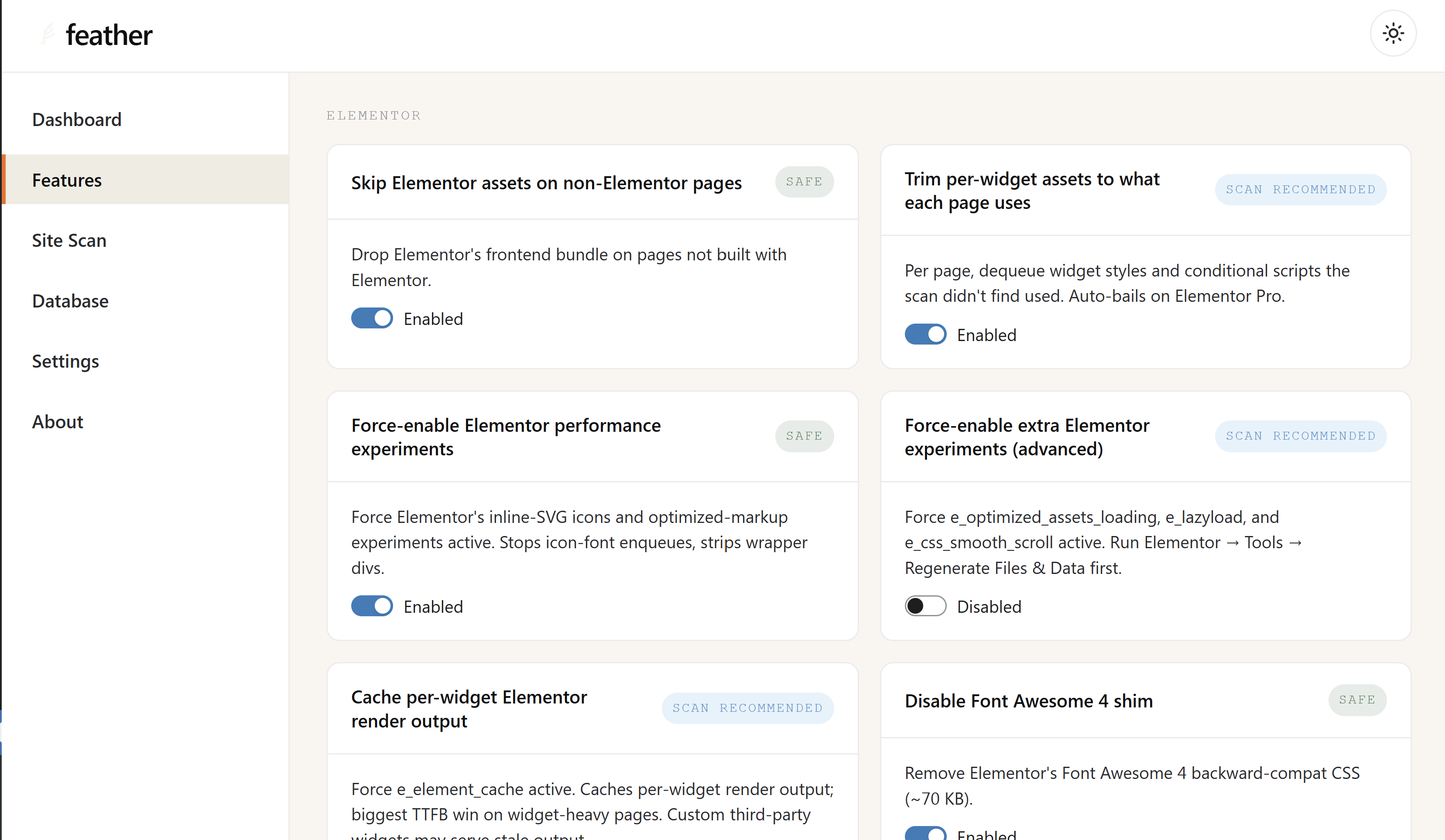
- Safe defaults. Universally-safe optimizations are active on first activation: skip Elementor's frontend bundle on non-Elementor pages, defer JavaScript, block Elementor telemetry, throttle the admin heartbeat, disable WP emojis and embeds, and more.
- Measured impact. Take page-weight snapshots from the dashboard and track the trend across bytes, asset count, and HTTP request count, all measured against your real frontend.
- Database tooling. One-click cleanup for expired transients, orphaned Elementor revisions, and oEmbed cache rows. Autoload audit flags any large always-loaded options.
- Privacy by default. No telemetry. Scans run on your server. Page-weight measurements hit your own URLs. Nothing leaves your site without explicit opt-in.
- Elementor frontend assets: Font Awesome 4 shim, eicons, Google Fonts, JS defer, asset gating on non-Elementor pages, atomic (v4) JS and CSS gating on legacy pages
- WordPress hygiene: emojis, embeds, jquery-migrate, heartbeat throttle, head cleanup, version disclosure, hover-prerender for faster navigation
- Lazy loading & media: iframe lazy attributes, image-dimension auto-fix, content-visibility for off-screen sections
- Database: transient cleanup, Elementor revision pruning, oEmbed cache flush, autoload audit
- Reporting: page-weight history, site-scan results, database health score
e- element family (Grid, Form, Tabs, Accordion, Background Video, Components and the rest). Elementor 4.1 and newer require WordPress 6.8; Feather itself runs on WordPress 6.0 and up.
Feather detects WP Rocket, LiteSpeed Cache, SiteGround Optimizer, W3 Total Cache, Imagify, Smush, and most other performance / image-optimizer plugins and lists them on the Settings screen, so you can leave overlapping toggles off where another plugin already does the work.
安装:
- Upload the
featherfolder to the/wp-content/plugins/directory, or install the plugin through the WordPress Plugins screen. - Activate Feather through the Plugins menu in WordPress.
- Visit Feather in the admin sidebar. Run the welcome scan and apply a recommended preset.
屏幕截图:


常见问题:
Will Feather break my site?
Feather's defaults are conservative. Aggressive optimizations require a recent site scan and an explicit confirmation. Every change is reversible from the dashboard.
Does Feather work alongside WP Rocket / LiteSpeed Cache?
Yes. Feather detects them and shows which are active. Most Feather optimizations are Elementor-specific and don't overlap; where one does (JS defer, lazy-loading), leave it to whichever plugin you prefer.
Does Feather send any data to a remote server?
No. Scans, metrics, and configuration all live on your server. The Lighthouse-on-demand feature uses your own Google PageSpeed Insights API key to call Google directly. Feather never proxies this through a third party.
Does Feather work on multisite?
Yes, in compatible mode (per-site configuration). Network-level controls are planned for a later release.
更新日志:
0.4.0
- Compatibility: Tested with Elementor 4.3.3 and WordPress 7.1.2. Handles, hooks and options every optimizer relies on were re-checked against the 4.3.3 source.
- Fixed: "Defer Elementor JavaScript" could break Elementor Pro and add-on scripts. It forced
deferontoelementor-frontend-modulesandelementor-frontendeven when a non-deferred script depended on them, so those scripts ran beforeelementorModulesexisted. It now uses WordPress's loading-strategy API, which only defers a script when everything depending on it can wait. The atomic (v4) and Interactions scripts are covered too. - Fixed: The scanner now looks inside Elementor Components. Widgets placed in a component were invisible to the page that embeds it, so "Trim per-widget assets" could drop their styles on that page. Rescan after updating.
- Fixed: "Lazy-load iframes" no longer overrides WordPress's choice to keep the first on-screen embed eager (it was adding
loading="lazy"to exactly those, delaying hero videos and maps). It now only covers what core doesn't: comments, and Elementor templates and popups rendered outside the main content. It also respects thewp_lazy_loading_enabledfilter. - Fixed: "Disable Font Awesome 4 shim" no longer removes icon fonts that are still in use. It had also been dropping the Font Awesome 5 icon stylesheets and the unmigrated FA4 font, which broke icons whenever Inline Font Icons was off.
- Fixed: Elementor's promotional admin notices were never actually removed (the removal targeted the wrong hook priority). They are now.
- Fixed: "Remove Edit with Elementor from the admin bar" now removes the item from Elementor's admin-bar config. Elementor builds that menu in JavaScript, so the old node removal never matched and only the CSS fallback hid it.
- Fixed: Elementor's tracker listener removal ran before Elementor registered the listener, so it removed nothing. It now runs right after.
- Fixed: "Drop Elementor's wp-admin Google Fonts" (formerly "Disable Elementor admin top bar") targeted the 3.x top bar, which Elementor 4.x never loads. It now removes the Roboto request Elementor 4.x makes on every wp-admin screen.
- Fixed: Self-closing
<img … />tags no longer come out as<img … / width=… height=…>after "Auto-fix image dimensions". - New: Elementor 4.3 atomic elements. Background Video is mapped to its handler, and "Skip atomic widget JS on legacy-widget pages" also drops the new handlers plus the atomic
base-*/default-*stylesheets that load on every Elementor page. - New: "Block Elementor telemetry" covers Elementor 4.3's server-side Mixpanel pipeline. It forces the
editor_eventsexperiment off, unregisters the/elementor/v1/events/…proxy routes, and refuses any request Elementor's events code sends. - New: "Disable Elementor MCP / AI agent abilities" (opt-in). Elementor 4.3 loads its MCP module whenever WordPress has the Abilities API (6.9+): 27 abilities, a REST proxy, heartbeat hooks and a menu item.
- New: "Prerender pages on hover" (opt-in). Switches WordPress 6.8+ speculative loading from click-prefetch to hover-prerender for logged-out visitors, with WooCommerce cart, checkout and account pages excluded. Constants a site owner sets win.
- New: "Hide Elementor admin bloat" also removes the Elementor One dashboard widget, the Go Pro conversion banner, the V4 editor promotions (and their remote fetch) and the Angie "Custom Widget" upsell.
- Improved: The network firewall also covers
elementor.red, where Elementor 4.x hosts its cloud template library. - Improved: Emoji and head cleanup also remove core's 6.4+ emoji style enqueue, the /embed/ template's emoji script, and the shortlink HTTP header.
- Removed: "Remove Elementor DOM artifacts". It stripped
?ver=from Elementor asset URLs. That query string is Elementor's only cache-buster, so visitors kept stale CSS after every edit and, after an Elementor update, could get old JavaScript alongside the new. Elementor 4.3 rewrotefrontend.min.jsunder the same URL. - Removed: "Hide Elementor loading overlay". The element it hid only exists inside the Elementor editor, so it did nothing on visitor pages.
- Stored settings for the two removed features are cleaned up automatically on upgrade.
- Fixed: Pages built with Elementor 4.2's Grid, Form, or Collection Loop elements could lose their atomic-widget JavaScript. The scanner recognised only a hardcoded list of atomic types, so a page made of newer ones scanned as "no atomic widgets" and the gated optimizer dropped a bundle that page needed. Atomic detection now matches Elementor's own rule (any
e-element or widget type), so future atomic elements are covered without a Feather update. - Fixed: The atomic-widget asset gate targeted
elementor-v2-widgets-frontend, a handle Elementor no longer registers, while missingelementor-v2-action-link-handlersandelementor-v2-form-handlers. Both new handler bundles are now included, along with the tabs preview handler. - Fixed: "Skip Elementor assets on non-Elementor pages" now drops the per-page stylesheet. Elementor names it
elementor-post-{id}, not theelementor-post-cssthe gate looked for, so that CSS shipped on every non-Elementor request. The Kit stylesheet is deliberately left in place because themes inherit its global typography and colors. - Fixed: "Disable Elementor Google Fonts" now dequeues the per-font stylesheets Elementor actually enqueues (
elementor-gf-*,elementor-gf-local-*) instead of two handles that no longer exist. - Fixed: "Disable Elementor AI module" reads Elementor's current AI switch. The old
elementor/ai/is_ai_enabledfilter is gone from Elementor 4.x, so the feature relied on its dequeue fallback alone; it now answers theelementor_enable_aiuser option at read time and covers all seven current AI bundles. - Fixed: The Font Awesome feature also removes the shim's script half and the FA4 / FA5 bundles Elementor enqueues for legacy icon content.
- Removed: Three optimizations that Elementor deleted upstream and that could not do anything on Elementor 4.x — the
e_optimized_assets_loading/e_lazyload/e_css_smooth_scrollsub-toggle, thee_element_cachesub-toggle, and "Trim Elementor frontend config payload" (the filter it hooked no longer exists). Their stored settings are cleaned up automatically on upgrade. The experiments card still forces Inline Font Icons and Optimized Markup, which are real. - Removed: Dead handles and hooks from the remaining optimizers (
elementor-frontend-legacy,elementor-waypoints,elementor-animations,lottie-js,elementor/admin/menu/promotions, the Google Fonts preconnect detach). They matched nothing in Elementor 4.x and made the optimizations look broader than they were. - Changed: Tested against Elementor 4.2.1. Note Elementor 4.1 and newer require WordPress 6.8; Feather itself still supports WordPress 6.0.
- Fixed: "Remove Edit with Elementor from the admin bar" optimizer now actually removes the node. Elementor 4.0.x registers the node late in the
admin_bar_menulifecycle, so the previous priority-999 hook fired before the node was added and removed nothing. Switched towp_before_admin_bar_render(which fires after all menu callbacks complete) and added a CSS belt-and-braces hide that guarantees the item never renders even if a third party re-adds the node after our removal. - Fixed: The three Elementor telemetry component features (telemetry, phone-home, AI module) no longer appear as duplicate cards on the Features page. They're surfaced through the Dashboard "Block Elementor telemetry" composite toggle; the underlying optimizers still apply at runtime.
- Fixed: Site Scan results now appear as soon as the scan completes instead of requiring a page refresh. The polling tick now refreshes aggregate + results progressively (every 1.5 s) so the UI converges in real time even when object caches briefly desync the scan state.
- New: WordPress 7.0 and Elementor 4.0.9 compatibility. Tested up to WordPress 7.0; scanner recognises Elementor 4.0.x atomic Self-Hosted Video and standalone Video elements.
- New: Dashboard "Block Elementor telemetry" toggle. A single switch bundles Elementor's tracker flags, my.elementor.com phone-home (banners, what's-new feed, update prompts, upsells), and the AI editor bundle.
- New: Optimizer that removes the "Edit with Elementor" item from the WordPress admin bar at the top of the site. Post-edit screen buttons still open the editor as usual.
- New: Background auto-rescan on post save. When an Elementor page is saved, Feather refreshes that post's scan row so gated optimizations stay accurate without a manual rescan. Throttled to one rescan per 60 seconds per post.
- New: Per-page feature overrides. A sidebar meta box on the post edit screen lets you disable specific Feather features on a single page without touching the sitewide setting. Wired into JS defer, frontend asset gate, per-page asset trim, iframe lazy-load, image dimensions, and below-fold rendering.
- New: Settings export / import. Download your Feather configuration as JSON and re-import on another site. Scan history and metrics history are not included.
- New: Core Web Vitals signals on the Dashboard. The page-weight probe now records response time, a TTFB estimate, and the hero-image byte size (HEAD-probed for same-origin images).
- New: Elementor 4.0.x Global Classes detection in the site scan. Gated optimizers can now factor in Global Class usage when deciding whether a handle is safe to strip.
- New: Database cleanup adds Spam Comments and Auto-Draft Posts tools. Batched in groups of 200 per click.
- Changed: Pause-all card copy clarified — the toggle is now explicitly labeled "Pause all optimizations for editing", with a Resume optimizations button in the paused state.
- Changed: The three Elementor experiment-forcing toggles (
force_experiments,force_extra_experiments,element_cache) are now one feature card, "Force-enable Elementor performance experiments". Existing installs keep their behavior — sub-toggles for the extra experiments and element cache live underadvanced.experiments. - Changed: Heartbeat throttler now tunes the block editor and other admin pages separately, with the public-frontend disable still default-on.
- Fixed: Brand mark in the topbar briefly rendered the wrong variant (cream on a light page or vice versa) when the OS color preference disagreed with the saved Feather theme. The theme is now applied synchronously and passed down to the mark.
- Fixed: Several pre-existing lint warnings (nested ternaries, unused catch bindings) cleaned up across the admin UI.
- Fixed: Optimizations briefly showed as "not applied" after toggling them, on sites using persistent object caches (Redis, Memcached, LiteSpeed). The settings option now busts the WordPress options cache explicitly after every save so follow-up requests see the canonical database value immediately.
- Fixed: Site Scan results and "Take measurement" output sometimes appeared stale until a page reload on sites with page caches (LiteSpeed Cache, WP Rocket, Cloudflare). The feather/v1 REST namespace now returns strict no-store, no-cache headers so page caches stop holding onto authenticated responses.
- Changed: In-WordPress plugin name shortened to "Feather" so the Plugins list and Updates screen show a clean brand name. The longer descriptive title remains on the WordPress.org listing for search visibility.
- Fixed: "Settings" link in the Plugins list now points to the correct admin page slug. Previously it linked to
admin.php?page=feather, which produced a "Sorry, you are not allowed to access this page" error. - Fixed: Site Scan now refreshes results in the UI as soon as the scan finishes, instead of requiring a full page reload. The old code only refreshed when the scan state landed exactly on
complete, missing edge cases where the cached state briefly read asidleafter the cron tick. - Fixed: Dashboard "Take measurement" now re-reads the latest snapshot from the server after capturing, so the "Last measured" tile and homepage-weight value update immediately instead of after a page reload.
- New: Footer link on every Feather admin page that opens the WordPress.org review form in a new tab.
- Changed: Plugin display title rewritten to describe what it does in search results and on the plugin page.
- Changed: Replaced em dashes throughout the readme and plugin header with regular punctuation.
- Changed: Inline CSS now emitted via
wp_register_style()+wp_add_inline_style()instead of direct<style>echoes. Follows WordPress.org enqueue guidelines. - Removed: Placeholder feature toggles that had no implementation. Every shipped feature is now fully functional out of the box.
- Removed:
load_plugin_textdomain()call. WordPress.org auto-loads translations for hosted plugins since WP 4.6.
- New: Elementor 4.0.x support. Scanner detects atomic widgets (e-heading, e-button, e-image, e-paragraph, e-divider, e-svg, e-self-hosted-video, e-youtube, e-component) and atomic element types (e-flexbox, e-div-block, e-tabs, etc.) in saved page data.
- New: "Skip atomic widget JS on legacy-widget pages" optimizer (gated). Drops the v4 atomic widget handler bundle, including Alpine.js, on pages built entirely with legacy widgets. Auto-bails on Elementor Pro.
- New: "Pause all optimizations" master toggle on the Dashboard. Temporarily disable every Feather optimization while editing in Elementor, without uninstalling.
- New: "Block all Elementor outbound HTTP except user-initiated" optimizer (gated). Refuses every background request to elementor.com and subdomains. Template Library, Connect login, and Pro flows still work because they run as AJAX/REST.
- New: PerPageAssetTrimmer now drops
elementor-tabs-handlerandelementor-youtube-handleron pages that don't use those atomic elements. - New: UnusedWidgetBundleStripper deregisters the entire v4 JS chain when no scanned post on the site uses atomic widgets.
- Changed: Default theme switched from "system" to "light" on fresh installs. Existing users keep their preference.
- Fixed: Third-party widget packs (Rivax, etc.) that throw inside
get_style_depends()no longer leak error strings into Feather's asset map. - Fixed: Elementor's
Widget_WordPressclass incorrectly declares Swiper as a dependency for everywp-widget-*type. Feather now strips that incorrect claim so sidebar widgets don't falsely require Swiper. - Fixed: Dashboard "Last measured" tile no longer shows "Never" immediately after running a measurement.
- Fixed: Dashboard "Pause all optimizations" card now renders with proper spacing between label and description.
- Initial pre-release scaffold.