
GAinWP Google Analytics Integration for WP
| 开发者 | tomdude |
|---|---|
| 更新时间 | 2026年10月30日 05:28 |
| PHP版本: | 7.4 及以上 |
| WordPress版本: | 7.1 |
| 版权: | GPLv2 or later |
| 版权网址: | 版权信息 |
详情介绍:
- Form leads: an event for every successful submission in Gravity Forms, Contact Form 7 and WPForms, whether the form uses AJAX, reloads the page or redirects to a thank-you page. Failed validation and spam don't count. Set the forms that bring you business to Lead and they send GA4's
generate_lead; a sign-up form can sendsign_up. Other forms sendform_complete, so a newsletter or search form never counts as a lead. Field values are never sent. - Goals with values: mark the results that matter as goals and say what each is worth, for example $100 for a lead. Goals send their value to GA4 and, through it, Google Ads; per-form values override the default.
- WordPress events: logins and registrations as GA4's
loginandsign_up, and comments ascomment_submit. - Engagement events that GA4 enhanced measurement doesn't cover: email and phone link clicks, affiliate link clicks (including
rel="sponsored"links), same-page anchor clicks, and scroll depth at 25, 50 and 75%.
- Paste your Measurement ID (G-XXXXXXXXXX), or your Tag Manager container ID.
- In Tag Manager mode, page attributes go to the data layer (under their GA4 names and GAinWP 5.x's
gainwp*names) and events are pushed as{ event, intelligence: { ... } }. - Cross-domain measurement, cookie domain and cookie lifetime settings, and an optional AMP container for AMP plugin Reader mode pages.
- Google Consent Mode v2 defaults: leave them to your consent banner, deny in the EEA, UK and Switzerland only, or deny everywhere.
- Optionally skip tracking for visitors who send Do Not Track or Global Privacy Control.
- Visitor opt-out link or button with the
[gainwp_useroptout]shortcode. A visitor's opt-out is honored even if the site later turns the shortcode off. - No personal data in events: email addresses and phone numbers are removed from link text and URLs, and authors are sent by display name only.
- Exclude logged-in user roles (and network super admins) from tracking. Post previews and the Customizer are never tracked.
Bug reports and feature requests: GAinWP on GitHub.
安装:
- Install and activate GAinWP from Plugins → Add New.
- Go to Settings → Google Analytics.
- Choose Google Analytics 4 and enter your Measurement ID, or choose Google Tag Manager and enter your container ID.
- Save. Open your site in a private browser window and check Reports → Realtime in Google Analytics.
屏幕截图:
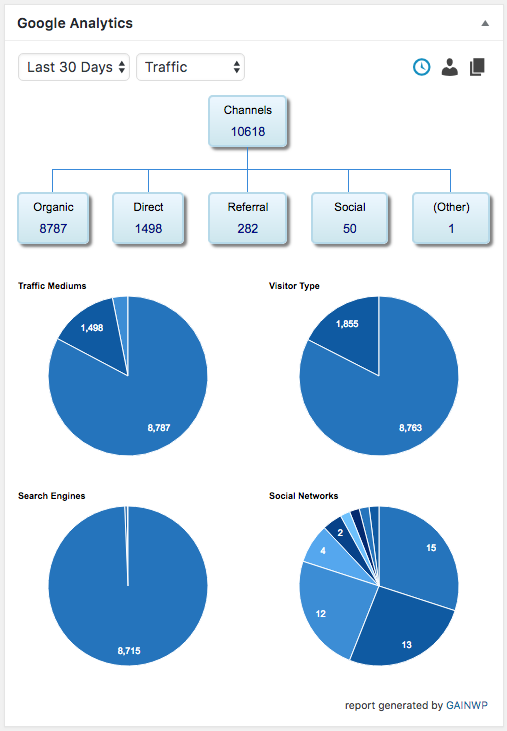
常见问题:
Where do I find my Measurement ID?
In Google Analytics, go to Admin → Data streams and open your web stream. The Measurement ID starts with G-.
Why don't page attributes or form names show up in my reports?
GA4 only reports custom parameters you register. The GA4 setup tab under Settings → Google Analytics lists the ones your settings send, such as content_author, content_category and component_name. In Google Analytics, go to Admin → Data display → Custom definitions and create an event-scoped custom dimension for each. Content type, content ID and content group are built into GA4.
How do I count form submissions as conversions?
Under Settings → Google Analytics → Forms, set the forms that bring you business to Lead (every form sends form_complete until you do). In Google Analytics, mark generate_lead (and sign_up, if you use it) as a key event. Mark generate_lead, not GA4's own form_submit, which counts every submit attempt. Give leads a value under Goals to see the value they bring in GA4 and Google Ads.
Which form plugins are supported?
Gravity Forms, Contact Form 7 and WPForms (Lite and Pro). Contact Form 7 counts a submission once its email has been sent, which is when it reports success. Other plugins and themes can send their own events with gainwp.track() or the PHP recorder (see below).
Does it work with cookie consent banners?
Yes. Most banner plugins set Google Consent Mode themselves, so leave "Consent mode default" set to "Not set". Choose a denied option only if your banner sends consent updates but doesn't set defaults.
How do I check that it's working?
View the source of any page while logged out and look for the GAinWP comment followed by the Google tag. Settings → Google Analytics also shows what is being sent. Logged-in users in excluded roles are not tracked, so test from a private browser window.
Can I use it alongside Site Kit or another analytics plugin?
Use only one plugin to add the Google tag, or page views are counted twice. Site Kit can show reports without adding the tag if you turn off its "Place Google Analytics code" setting. If Site Kit's plugin conversion tracking is on, also turn it off when GAinWP tracks your forms, or leads count twice. GAinWP warns you when it sees either overlap.
How can I customize the output?
Developers can use these hooks:
gainwp_gtag_config(filter): parameters of thegtag('config')command.gainwp_page_data(filter): page attributes before they are sent, keyed by parameter name (content_author, ...). Keys from 6.0 (author, ...) are still mapped.gainwp_exclude_tracking(filter): return true to skip tracking for the current request. For page output it runs after the query is parsed, so conditional tags such asis_page()work; it also runs when an event is recorded on the server, such as a login or form submission, with a second argument'event'(page output passes'page').gainwp_event(filter): change an event recorded on the server, or return null to drop it.gainwp_event_recorded(action): runs when an event recorded on the server is queued, for example to react to a lead.gainwp_integrations(filter): add or remove integrations (classes implementingGAinWP\Integrations\Integration, orFormSourcefor form plugins). An integration'sajax_events()names the browser events, such as a form plugin's success event, after which events recorded during an AJAX request are sent.gainwp_consent_regions(filter): regions where consent defaults to denied.gainwp_scroll_thresholds(filter): scroll depth percentages.gainwp_gtag_script_path(filter): gtag.js URL, for example to use a proxy.gainwp_tagmanager_datalayer(action): change data layer variables with the tracker'sget()andset()methods.
gainwp_gtag_commands still runs but is deprecated in favor of gainwp_gtag_config.
To send your own events from JavaScript, call gainwp.track( 'event_name', { parameter: 'value' } ); it works in both tracking modes and honors opt-outs. From PHP, call \GAinWP\Plugin::instance()->recorder()->record( 'event_name', array( 'parameter' => 'value' ) ); the event is sent from the visitor's browser on their next page view, or right away after an AJAX submission in a supported form plugin.
更新日志:
- New: form tracking for Gravity Forms, Contact Form 7 and WPForms, on by default. Successful submissions send
form_complete, orgenerate_leadorsign_upfor forms you set to Lead or Sign-up, with the form's ID and name, including AJAX forms and forms that redirect. - New: goals with values. Mark results as goals, give them a value and a currency, and set per-form values.
- New: GA4's
loginandsign_upevents for WordPress logins and registrations, andcomment_submitfor comments. - New: GA4 setup tab listing the custom dimensions, key events and GA4 settings your configuration needs, with warnings when Site Kit adds the same tag or events.
- New: page attributes for content type and ID, content group, and the primary category from Yoast SEO or Rank Math.
- New:
gainwp.track()in JavaScript and a PHP recorder for sending your own events;gainwp_event,gainwp_event_recordedandgainwp_integrationshooks. - Changed: page attribute parameters renamed to GA4-style names (
content_author,content_category,content_tags,content_publish_month,user_status);publish_yearremoved. See "Upgrading from 6.0". - Changed: page attributes are sent with
gtag('config')instead ofgtag('set'), so they reliably apply to every event. - Changed: engagement events now work in Tag Manager mode, and links marked
rel="sponsored"count as affiliate links. - Changed: scroll depth stops at 75%; GA4's enhanced measurement covers 90%.
- Changed: authors are always sent by display name; the username option was removed.
- Fixed: a visitor's opt-out is honored even after the site turns the opt-out shortcode off.
- Fixed: link click events no longer send the Universal Analytics
transport_typeparameter.
- Rewritten for Google Analytics 4 and modern WordPress (PHP 7.4+, WordPress 6.0+).
- New: Google Consent Mode v2 defaults, Global Privacy Control support, scroll depth for GA4, opt-out for Tag Manager sites.
- Settings move to Settings → Google Analytics, with a status summary.
- Settings from 5.x are migrated automatically. See "Upgrading from 5.x".
- Removed Universal Analytics, dashboard reports and real-time stats, Google sign-in, and features Google has discontinued.
- Last Universal Analytics release.