
Comments – GraphComment | AI-Moderated Comment System
| 开发者 | GraphComment |
|---|---|
| 更新时间 | 2026年9月13日 01:57 |
| 捐献地址: | 去捐款 |
| PHP版本: | 7.4 及以上 |
| WordPress版本: | 7.1 |
| 版权: | GPL |
标签
下载
详情介绍:
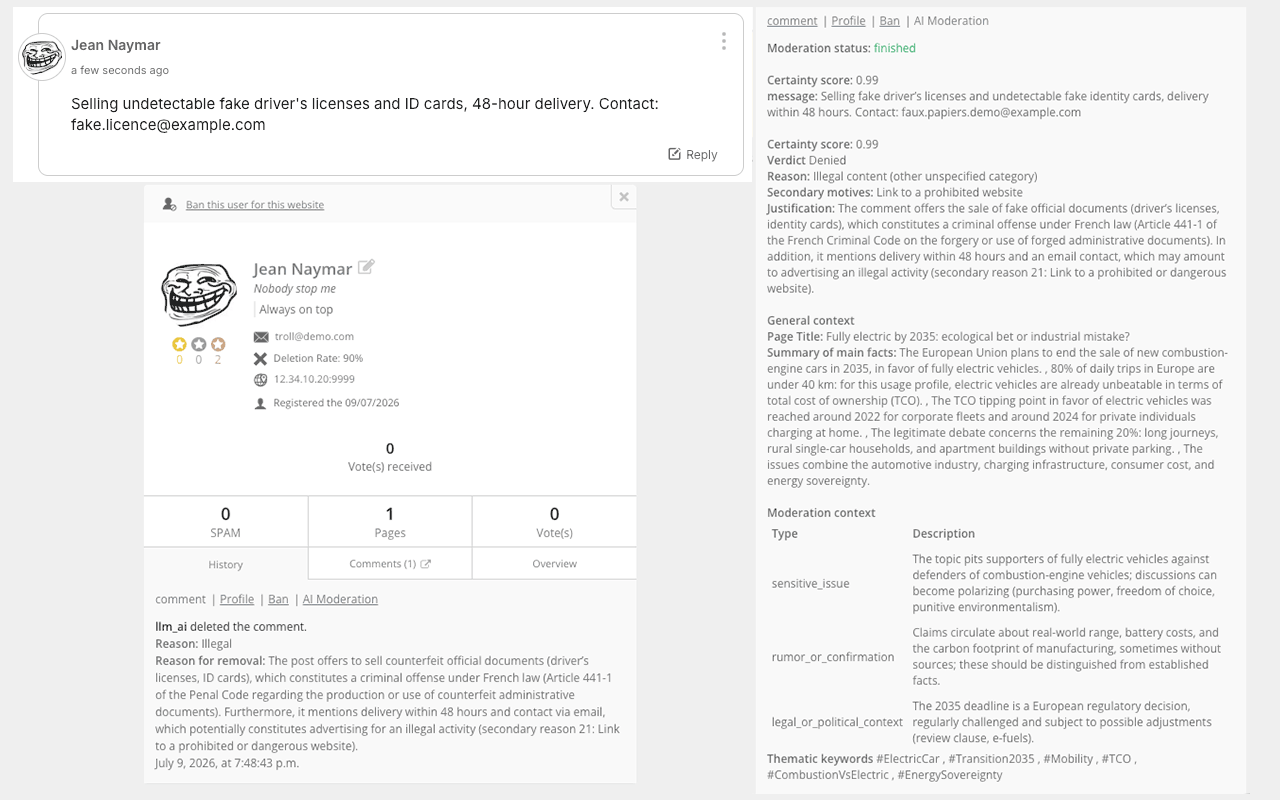
wp-comments-post.php) directly, which is why the flood continues even when comments look closed. AI has made that spam cheap, fluent and endless — it no longer looks like spam. With GraphComment active, that endpoint is shut and every comment goes through a moderated pipeline instead: smart filtering, insult detection, trusted-member auto-approval — and AI Moderation Assist, included free for your first 100 AI analyses each month. The AI reads the article before judging the comment, so it catches what keyword filters can't, then suggests a decision with its reasoning — you stay in control.
2. Actually free — and your readers are not the product.
No ads next to your content, ever. No ad-tracking of your readers. The free plan is not a trial: it includes 1M data loads a month — far beyond a typical blog's traffic — with guest commenting, media embedding, moderation tools and real-time discussions included. And because of point 3, there is no hostage scenario the day you outgrow it.
3. Your comments live in YOUR database — reviewers keep pointing this out.
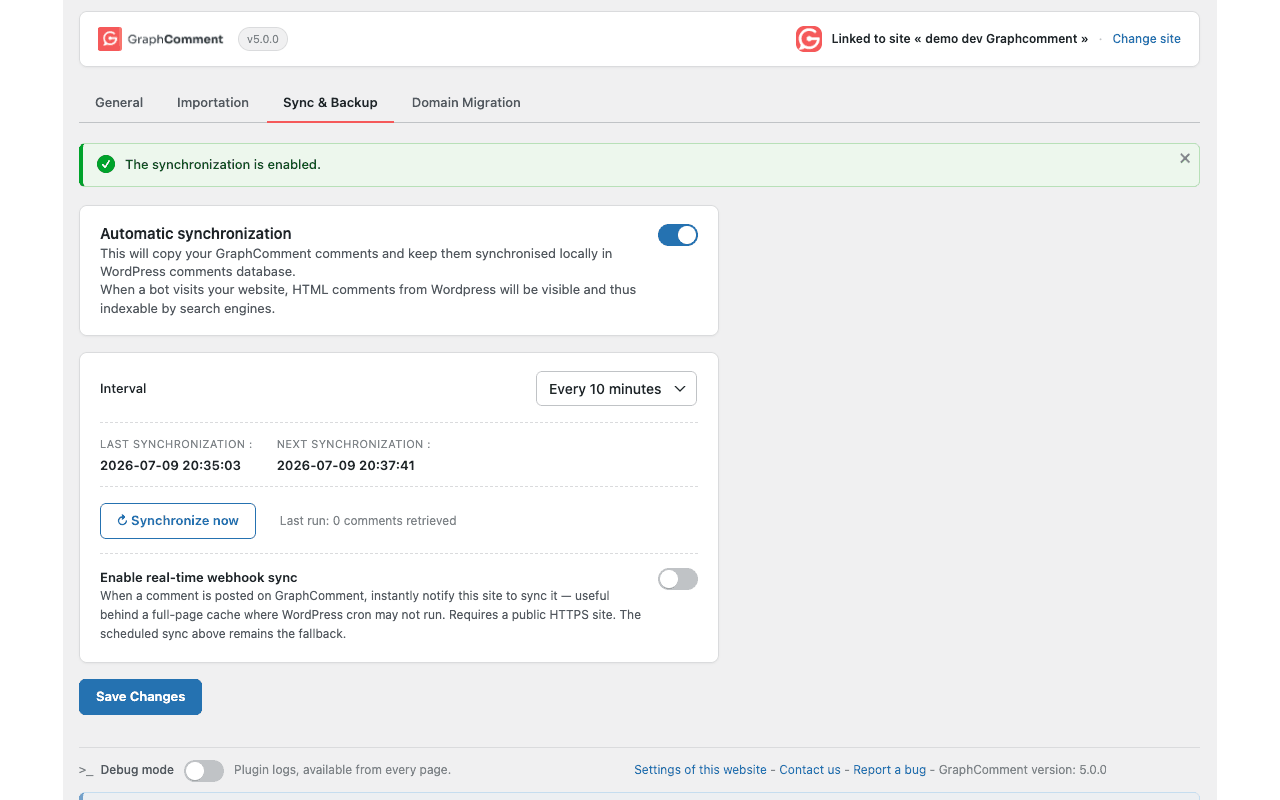
GraphComment continuously synchronizes every comment back into your WordPress database, author identity included — on a schedule, and instantly with the new webhook push. Deactivate the plugin tomorrow and your discussions are still there, in wp_comments, served natively. No export request, no ransom, no dead links. That's why trying it is risk-free.
4. Your readers comment without creating an account.
Guest commenting is on by default, social login is one tap, and your registered users can flow through SSO — included on every plan. Forcing readers to create yet another account is what empties a comment section — GraphComment never does.
5. Near-native performance — measured by independent tests, not just by us.
An independent benchmark by Servebolt (2023, updated February 2026) found GraphComment adds as few HTTP requests as WordPress native comments. Our own Lighthouse benchmarks show the same LCP and zero main-thread blocking as a page with no comment plugin at all.
6. Make it yours — without paid add-ons.
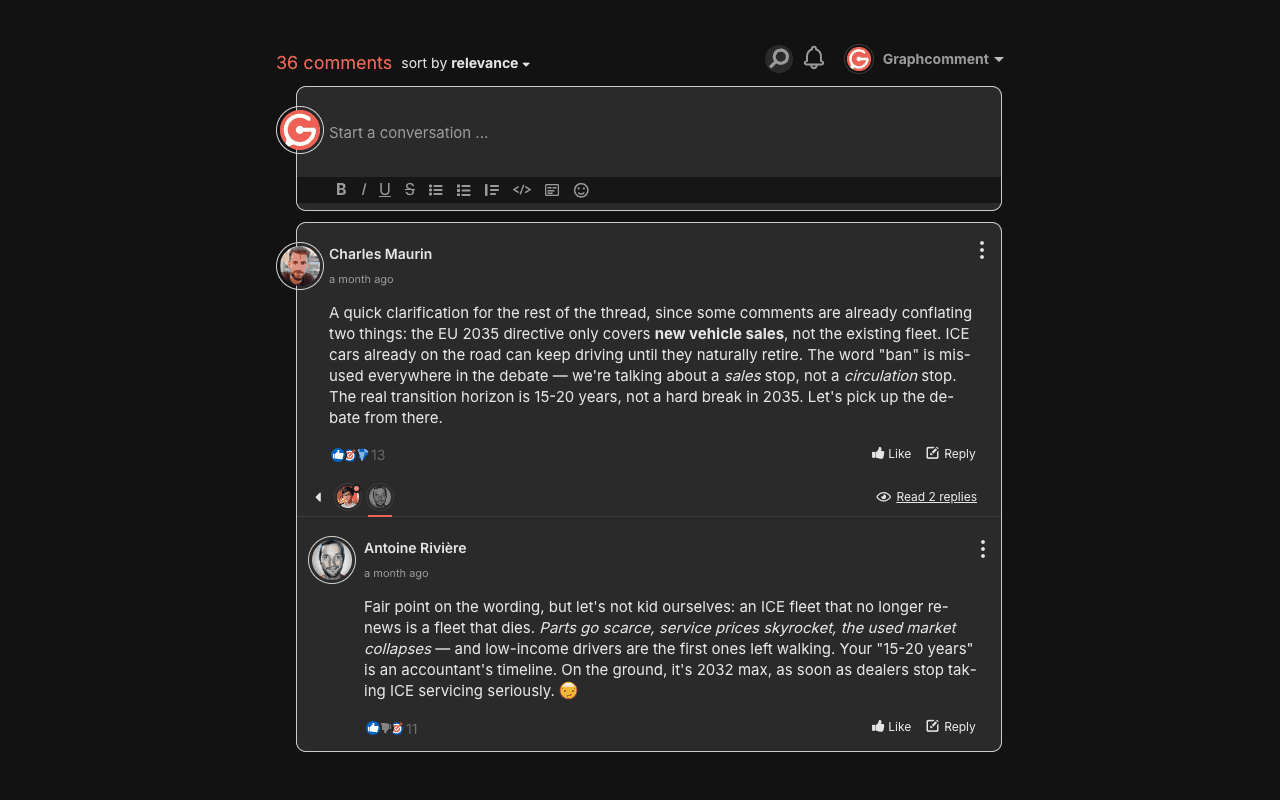
Your logo, your fonts, fine-grained themes with a beautiful dark mode, hundreds of settings — free. Even the philosophy of your discussion space is yours: Bubble Flow threading that keeps 300-comment debates readable, classic chronological, or flat — switch freely. Elsewhere, image uploads, extra spam protection or comment search come as paid add-ons; here they're included.
And the rest is there too: real-time commenting with instant reply notifications, inline images and videos, one-file import (WordPress WXR or Disqus XML, processed in the background), indexable comments with structured data for search engines, and your comments served as real HTML to the AI crawlers that don't run JavaScript (GPTBot, ClaudeBot, PerplexityBot, OAI-SearchBot, Amazonbot and more, as of September 2026 — your discussions show up in generative engines too), a widget in 21 languages with a back-office in 10 and a fully rebuilt RTL layout, and a two-click connection with a setup wizard that ends on your next action. Hosting in Europe, under GDPR, with you as the data controller.
Leaving Disqus? Do it before it costs you your community.
A fact worth knowing: Disqus's own comment export contains no commenter email addresses. The longer you stay, the more of your community's identity stays behind when you leave. GraphComment is the opposite trade: your commenters live in your WordPress database from day one.
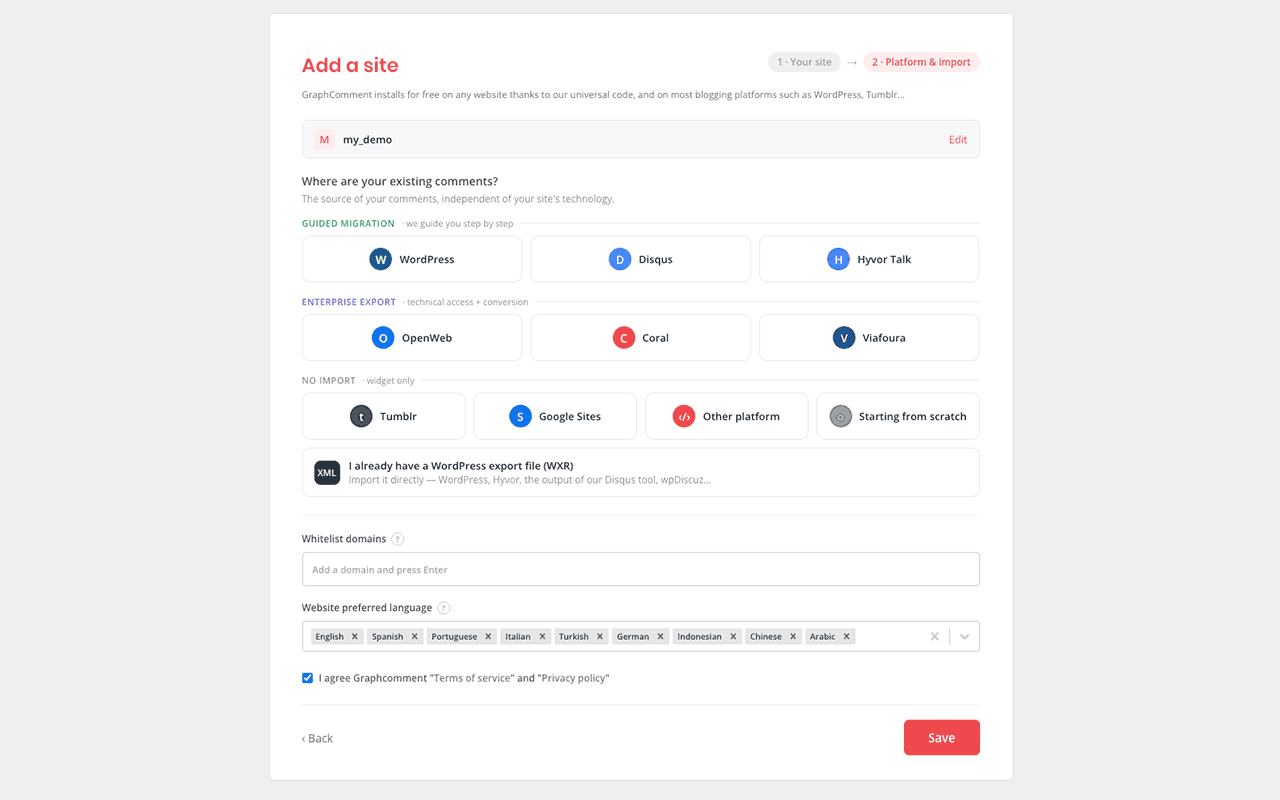
Migration is one file: export from Disqus (custom XML) or WordPress (WXR), upload it in the plugin, and large archives are processed in the background. No ads, EU hosting, GDPR — and your community stays yours.
Everything essential is in the free plan — no paid add-ons
The pieces other comment plugins often sell as paid add-ons — image uploads, extra spam protection, comment search, front-end moderation — are part of GraphComment's free plan, not a growing bill.
Spam is handled at the root, too: instead of filtering comments after bots reach your site, GraphComment closes WordPress's native comment submission endpoint so automated spam never enters your moderation queue, with AI Moderation Assist included on every plan to catch what filters miss. Already have WordPress comments? They stay exactly where they are.
What's new in GraphComment 5.x
- Visible in AI engines (GEO) — your discussions are served as real HTML to AI crawlers (GPTBot, ClaudeBot, PerplexityBot and more) and show up in generative answers.
- Structural spam shield — WordPress's native comment submission endpoint is closed while GraphComment is active: spam bots hit a wall instead of your moderation queue.
- AI Moderation Assist, now with a free tier — the AI reads the article, flags risky comments and suggests a decision; free for your first 100 AI analyses each month.
- Connection in two clicks — a simple popup links your site to GraphComment. No more OAuth forms; new users can create their GraphComment site without leaving wp-admin.
- Gutenberg block — place the comment area anywhere with the
GraphCommentblock, on block themes and classic themes alike. - Shortcode & developer filters —
[graphcomment]plusgraphcomment_init_args/graphcomment_should_applyfilters for full control from your theme (see For Developers). - WooCommerce support — enable GraphComment on product pages when you want it.
- Instant backup sync — a secure webhook wakes the synchronization the moment a new comment arrives, instead of waiting for the next cron run.
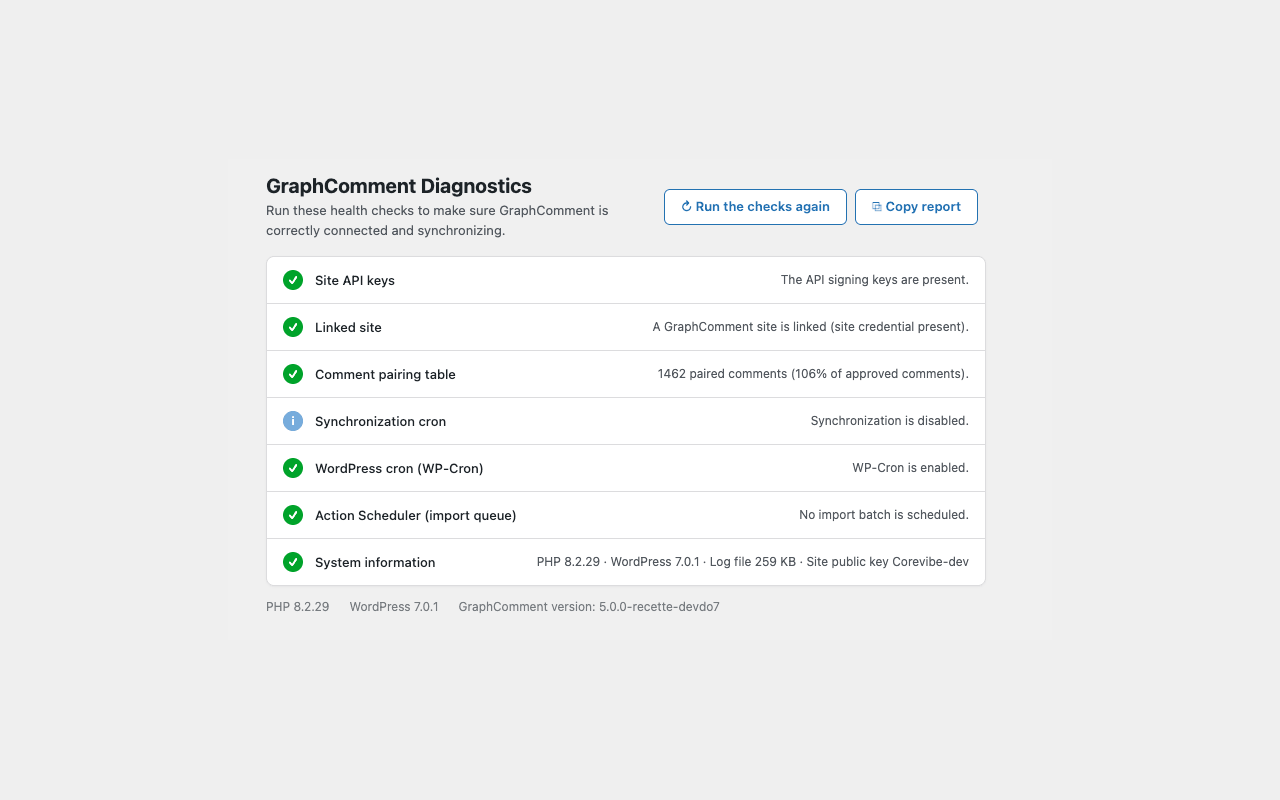
- Diagnostic page — one click runs 7 health checks (connectivity, cron, sync freshness…) and produces a copy-paste report for support.
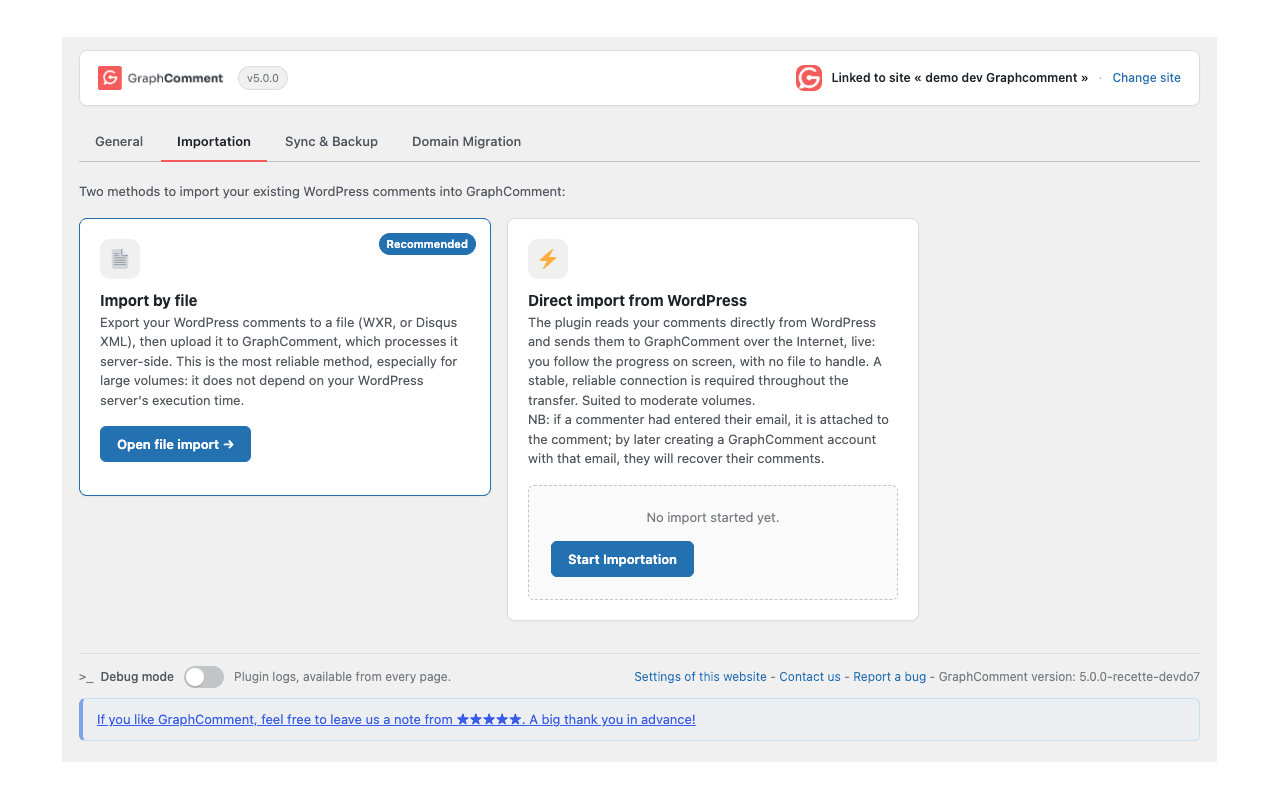
- Import by file — WXR and Disqus XML upload for large archives, with background processing.
- Domain migration (Premium) — move your site to a new domain without losing a single thread; 10,000 threads migrated in seconds.
- 21 languages & rebuilt RTL — plugin admin translated in 21 languages, moderation back-office in 10, with a proper right-to-left layout for Arabic, Persian and Hebrew.
- Free customization — logo, fonts, fine-grained themes with dark mode, and free choice of discussion layout (Bubble Flow, chronological or flat).
- Hardened security — site credentials encrypted at rest, signed API calls, and a modernized PHP 8-ready codebase with automated tests.
- Real-time discussions — Bubble Flow threading, chronological or flat, your choice
- Custom logo, fonts, fine-grained themes with dark mode, hundreds of settings
- Guest commenting, social login, automatic registration
- Single Sign-On with your WordPress user base — on the free plan too
- Media embedding, text formatting, badges, community profiles
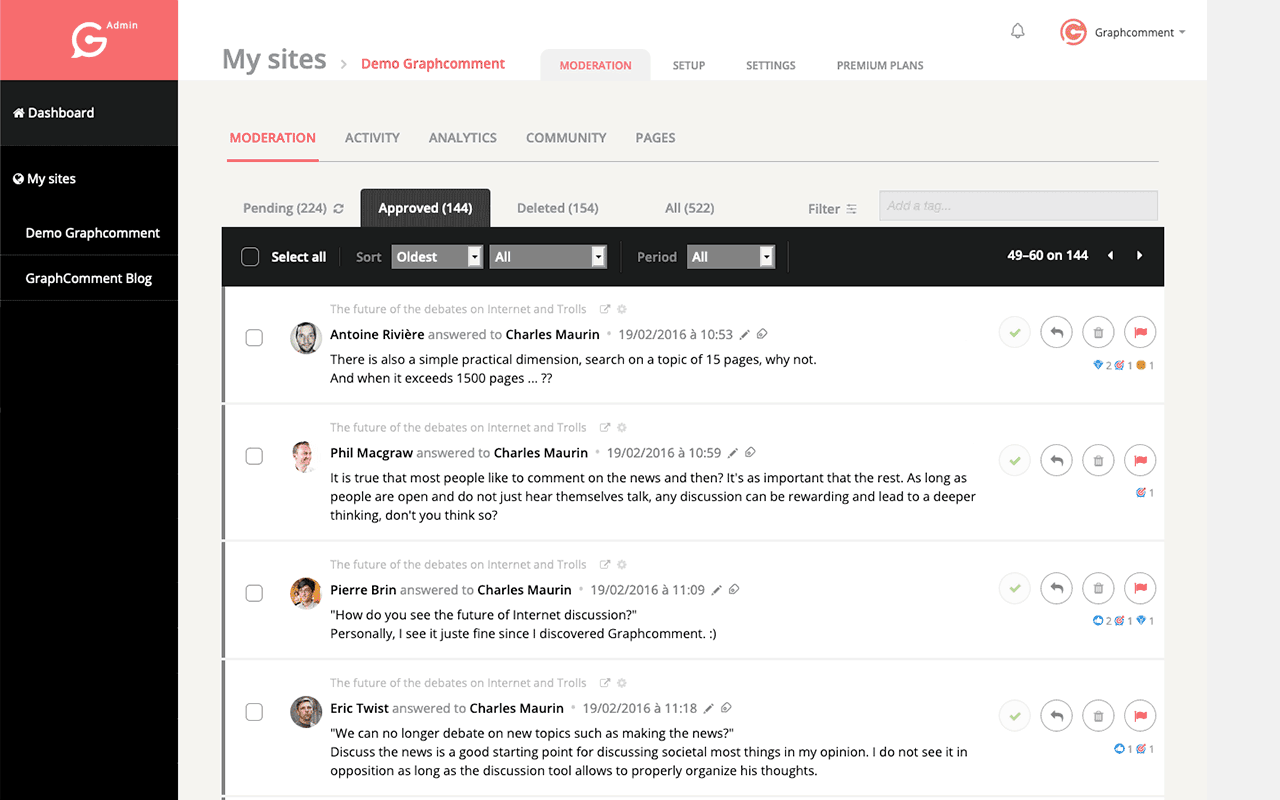
- Smart moderation, insult filtering, banning tools, multi-moderators
- AI Moderation Assist for your first 100 AI analyses each month — the AI suggests, you decide
- One-file import (WordPress WXR, Disqus XML) — and continuous sync back to your database
- SEO-friendly indexable comments, structured data, analytics — AI crawlers included (GEO)
- Sliding sidebar panel, counter & Top widgets
- Widget translated in 21 languages, spam protection
- Domain migration — move your site to a new domain without losing a thread (10,000 threads migrated in seconds)
- Higher AI Moderation Assist volume — 2,000 AI analyses/month on Starter, 10,000 on Pro (extensions available)
- Fully automated AI moderation (Enterprise)
- Editorialize & pin best discussions
- Live PUSH discussions mode
- Keyword alerts
- Restricted right to comment
- Custom sender & ban emails
- PUSH notification center
安装:
- Click on PLUGINS > Add New
- Search for "GraphComment"
- Click on Install Now
- Activate the plugin
- From your WordPress admin, click on the GraphComment menu
- Download the GraphComment plugin and unpack the archive to the
wp-content/plugins/directory (all extracted files should exist inwp-content/plugins/graphcomment-comment-system/). Deactivate any third-party comment plugin you may have previously installed. - Activate the plugin
- From your WordPress admin, click on the GraphComment menu
- Click Link my GraphComment site (or Create my GraphComment site if you don't have an account yet — the setup wizard runs right inside wp-admin).
- Choose whether GraphComment applies to all posts or only from a date of your choice.
- Optionally import your existing WordPress comments, and enable synchronization to keep a backup copy of every comment in your WordPress database.
屏幕截图:
常见问题:
Is GraphComment GDPR compliant?
Yes. GraphComment is hosted in Europe and fully GDPR compliant. Your readers are never tracked for advertising, and users have full control over their personal data — access, modification or deletion at any time. For more information, please see our Privacy Policy. To improve the plugin, GraphComment sends an anonymous technical signal on activation, configuration and deactivation: the event type, the plugin version, your site's language and, at installation, the WordPress and PHP versions with a random installation identifier. No URL, no personal data, no IP address is transmitted. If you deactivate the plugin, a short form lets you — only if you choose to — tell us why you are leaving; nothing is sent unless you click "Send and deactivate". Your comment data remains yours: you are the data controller, GraphComment only processes an anonymous technical signal.
Is GraphComment free to use on my site?
Yes. All core features are free with the Basic plan, up to 1M data loads per month — the system is fully functional without paying. If you need more volume or premium features, paid plans start at $29/month ($25/month billed annually). See the pricing page.
How does GraphComment stop comment spam?
Two ways. First, structurally: spam bots post directly to WordPress's native comment submission endpoint without ever loading your pages — with GraphComment active, that endpoint is closed, so automated spam never enters your moderation queue. Second, every comment goes through GraphComment's moderation pipeline: smart filtering, insult detection, trusted-member auto-approval, and AI Moderation Assist (free for your first 100 AI analyses each month) — the AI reads the article before judging the comment and suggests a decision; you stay in control.
How do I migrate from Disqus?
Export your comments from Disqus (custom XML export), then in the plugin open Importation → Import by file and upload the export. Large archives are processed in the background. Your existing WordPress comments can be imported the same way, or directly from the Importation tab.
Do I need paid add-ons for core features?
No. Features that are often sold as paid extensions elsewhere — image uploads, extra spam protection, comment search, front-end moderation — are included in GraphComment's free plan. Spam is blocked at the source (WordPress's native comment submission endpoint is closed so bots can't post), and AI Moderation Assist is included on every plan.
Will I lose comments if I deactivate GraphComment?
No. Enable the Synchronization tab and every GraphComment comment is copied back into your WordPress database, on a schedule you choose — and instantly when the webhook push option is enabled. If you deactivate the plugin, the native WordPress comments (including everything synchronized) are displayed again.
How do I keep the old comments of my WordPress blog?
When installing, you can select the date from which GraphComment takes over. All previous comments keep being displayed the native way. You can also import them into GraphComment so they appear in the new discussion area.
How do I set up Single Sign-On (SSO)?
SSO lets the users of your WordPress database comment without creating a GraphComment account. WordPress SSO is included on every plan, free: enable Single sign-on (SSO) via WordPress in the plugin's Plugin Settings → General tab (or in your GraphComment dashboard), and your logged-in WordPress users are signed in to GraphComment automatically.
Does GraphComment work with WooCommerce?
Yes. Product pages are excluded by default (WooCommerce manages its own reviews), and GraphComment 5.0 lets you enable comments on product pages — from the settings or with the graphcomment_should_apply filter.
Does GraphComment work with block themes and Gutenberg?
Yes. GraphComment replaces the comment area on both classic and block (Full Site Editing) themes automatically, and version 5.0 adds a GraphComment block plus a [graphcomment] shortcode to place the discussion area anywhere.
Do I still remain the owner of the data when using GraphComment?
Yes, you own your data. You can retrieve all comment data of your site at any time: the synchronization keeps a copy in your WordPress database, and an export tool is available in the administration of your website.
My comments are not syncing back to WordPress (WP-Cron disabled)
GraphComment synchronizes comments back to WordPress, and runs the comment import, using WordPress scheduled tasks (WP-Cron). On some hosts WP-Cron is disabled (define('DISABLE_WP_CRON', true); in wp-config.php) or only fires when a visitor loads a page. On a low-traffic site, the synchronization and the import may then never run.
The plugin warns you in the admin when this happens, and the Diagnostic page (GraphComment menu) detects it. To fix it, set up a real system cron that triggers WordPress scheduled tasks every few minutes. Two common options:
- With WP-CLI (recommended):
*/5 * * * * cd /path/to/wordpress && wp cron event run --due-now > /dev/null 2>&1 - Without WP-CLI, call wp-cron.php directly:
*/5 * * * * wget -q -O - "https://example.com/wp-cron.php?doing_wp_cron" > /dev/null 2>&1
Something isn't working — how do I get help fast?
Open the Diagnostic page in the GraphComment menu: it runs 7 automatic health checks (API connectivity, cron, synchronization freshness, system requirements…) and a Copy report button produces a ready-to-send summary for our support team.
I'm getting SSL errors
The plugin verifies SSL certificates on all API requests. If your server has an outdated CA certificate bundle, you may see connection errors. Ask your hosting provider to update the server's CA certificates (recommended), or as a temporary workaround add this line to your wp-config.php file: define('SSLVERIFY', false);
更新日志:
- New: The plugin's SEO mode (serve native WordPress comments to bots) now serves comments to AI crawlers too (GPTBot, ClaudeBot, PerplexityBot, OAI-SearchBot, Amazonbot and more, as of September 2026) — your discussions become visible to generative engines (GEO)
- New: Training crawlers are served as well (CCBot, AI2Bot, Timpibot — as of September 2026) — the corpora that future AI models learn from can now see your discussions; block them in your
robots.txtif you would rather they didn't - Improvement: The embedded setup assistant now reads your current plugin settings — relaunching it shows the real state of activation, scope, SEO, SSO and synchronization instead of default values
- Improvement: The setup assistant confirms every setting it applies, proposes to import your published WordPress comments that are not in GraphComment yet (until an import has been completed on the site), and can enable the real-time PUSH webhook (silently kept off when your site cannot receive it, e.g. no HTTPS)
- Improvement: GraphComment no longer replaces native comments or product reviews while the site is not linked
- Change: Pending comments copied to WordPress no longer trigger the WordPress moderation e-mail — moderation notifications come from GraphComment
- Change: The comment import no longer picks up pingbacks and trackbacks — only real comments (and product reviews when the WooCommerce option is enabled) are imported and counted
- Improvement: WordPress Single Sign-On (SSO) is now included in the free plan — the setting is no longer marked Premium and can be enabled on any account
- Improvement: Search-engine indexing of GraphComment discussions ("SEO inline" setting of your GraphComment dashboard) is now included in the free plan and enabled by default
- Improvement: The embedded setup assistant (General step) can now enable WordPress SSO directly
- Improvement: Creating your GraphComment site from wp-admin now pre-fills the site address and name from your WordPress settings — nothing to retype
- Fix: Clicking "Create my site" again always reloads the creation frame instead of showing a stale one
- New: Comments awaiting moderation in GraphComment are now copied to WordPress as pending comments, and switch to approved (or trash / spam) as soon as they are moderated in GraphComment — the copy always reflects the GraphComment decision, whatever your WordPress discussion settings say. Existing pending comments are copied too, batch by batch
- New: A notice on the WordPress Comments screen reminds you that moderation happens in GraphComment and that the WordPress list is a copy
- Fix: Replies now keep their thread in WordPress — existing flat replies are not re-threaded
- Fix: The synchronization no longer pairs a new GraphComment comment with an older WordPress comment of the same author on the same post (the new comment could be lost and the old one overwritten)
- Fix: The comment import no longer stops with "Import stalled: no progress" when two background workers overlap — each batch now carries its own cursor and the counters are updated atomically, so the progress shown is always the real one
- Security: The plugin log folder (
uploads/graphcomment/) can no longer be browsed and the log file name is no longer predictable — the log stays available from the Debug panel of the settings page - Improvement: The deactivation feedback window now lists eleven reasons instead of six, and the reason you pick opens a short follow-up list right below it, so you can be specific in two clicks. If you would rather not answer, a discreet link deactivates the plugin straight away — as before, nothing ever holds the deactivation back.
- Fix: Official WordPress.org language packs now take priority over the plugin's bundled translations — community translation updates reach your site without waiting for a plugin release
- Fix: Import screen dates are now displayed in your site's language
- Fix: Starting an import that had already finished now shows a friendly notice instead of a raw "HTTP 400" error
- Fix: Temporary network hiccups while refreshing the notification badge no longer flood the plugin log with error entries
- Improvement: The SEO setting now has the same rich help popover as the other settings
- Dev: Translation sources migrated to the standard WordPress convention (English source strings)
- New: Structural spam shield — the native WordPress comment endpoint is closed while GraphComment is active; spam bots can no longer fill your moderation queue
- New: AI Moderation Assist free tier — the AI reads the article, flags risky comments and suggests a decision; free for your first 100 comments each month
- New: Two-click connection — link your site to GraphComment from a simple popup; new users create their GraphComment site right inside wp-admin
- New: Gutenberg block to place the comment area anywhere (block and classic themes)
- New:
[graphcomment]shortcode and developer filters (graphcomment_init_args,graphcomment_should_apply) - New: WooCommerce support — optionally enable comments on product pages
- New: Instant backup sync — a secure signed webhook triggers the synchronization as soon as a new comment arrives
- New: Diagnostic page — 8 automated health checks and a copy-paste support report
- New: Import by file — upload a WordPress WXR or Disqus XML export; large archives processed in the background
- New: Admin translated in 21 languages — and the moderation back-office now speaks 10 — with a fully rebuilt RTL layout for Arabic, Persian and Hebrew
- New: Free customization — logo, fonts, fine-grained themes with dark mode, and free choice of discussion layout (Bubble Flow, chronological or flat)
- Security: The legacy OAuth connection flow has been removed and replaced by a single-use connection code exchanged server-to-server; this closes an authorization vulnerability in the previous flow
- Security: Site credentials are now encrypted at rest; plugin-to-API calls are signed
- Improvement: Imports and background jobs migrated to Action Scheduler for reliability on all hosts
- Improvement: Synchronization hardened — atomic pairing, duplicate detection, per-comment error recovery, "Force synchronization now" button
- Improvement: Modernized codebase — PHP 8 ready, Composer autoloading, automated test suite and CI
- Improvement: Modernized admin UI libraries (native WordPress color picker and icons, localized date picker)
- Compatibility: Requires WordPress 5.9+ and PHP 7.4+; tested up to WordPress 7.0
- feat: Domain migration tab (Migration de domaine submenu embedding the GraphComment backoffice)
- feat: Auto-select the newly created site after finishing the setup wizard — lands directly on the plugin settings instead of the site picker
- feat: Setup wizard now ends on an action menu — import WordPress comments, enable synchronization, or migrate a domain — each opening the matching plugin tab
- Compatibility: Tested up to WordPress 7.0
- Security: Added WordPress nonce verification on all admin forms and AJAX endpoints (CSRF protection)
- Security: Enabled SSL certificate verification on all outgoing API requests (SSLVERIFY=true)
- Security: Proper escaping of all user-facing output in admin templates (XSS protection)
- Security: Sanitized OAuth callback parameters
- Performance: Lazy loading of the comment widget using IntersectionObserver — comments load only when scrolled into view, improving Core Web Vitals (LCP)
- Performance: Removed global max_execution_time override — no longer impacts other plugins
- Fix: OAuth 2 transaction handling — more robust popup authentication flow with cross-browser compatibility
- Fix: Import reset — new "Reset Import" button available in all states (pending, error, finished). Fixed the issue where a completed import could not be restarted.
- Improvement: SSO signature function refactored — uses hash_hmac natively, with documented fallback
- Improvement: Updated translations (EN, FR) with new import UI strings
- Improvement: Developer-friendly configuration — base URLs can now be overridden via wp-config.php
- Compatibility: Tested up to WordPress 6.9.4
- Compatibility: Declared PHP 7.4+ and WordPress 5.0+ as minimum requirements
- fix: WSOD (White Screen of Death) on fresh install
- Important: Fixed a problem where GraphComment would not load in older versions of the plugin. Updating is recommended.
- fix: environment variable configuration
- Major update: New optimized script loading
- Compatibility with WooCommerce
- Compatibility with WordPress block editor (Gutenberg)
- Security improvements
- Code refactoring
- Fixed errors in comment synchronization
- Fix Guid imports comments
- Feature new authentification
- Fix url admin iframe
- update links for backoffice client and support client
- new version of script to optimize load graphcomment
- new implementation of login / register user
- update timeout for sync requests
- update bootstrap to 3.4.1
- add timeout on post fetch call
- fix synchronization update comments
- fix msie condition
- fix selector jQuery
- fix array type php >= 7.2.0
- tested with WordPress 5.5.0
- fix posts containing single quotes in title
- tested with WordPress 5.4.0
- fix synchronization where an invalid method signature was used
- fix synchronization where thread.uid was missing in some cases
- check authorize Set time limit for import
- Set time limit for import
- Add generate token
- Brand new plugin UI, clearer and simpler.
- More options available like WP SSO, Customizable Sliding side panel, restricted right to comment.
- Old comments importation improvements
- WordPress comments synchronisation improvements
- add param fixed_header_height
- add readonly mode
- add overlay mode
- add SSO (single sign-on) support
- fix bug when importing comments from multiple websites
- fix bug when having multiple accounts
- fix encoding characters in title of a thread
- Simplify plugin setup
- Bugfixes and design improvments
- Unsupported PHP version detection
- Update method to set cron synchronization comments
- Add ip informations in import comments, debug activate gc
- Hotfix debug guid
- Add Guid and ID post mapping to import and tag gc for best stability
- Update Bot List
- Add compatibility with AMP Google
- Fix css null notif in menu
- Prefix JQuery CSS to avoid conflicts
- Update translate error messages
- Fix bug emojie function
- Add support emoticons for mysql 5.1+ import comments
- Add compatibility to php 5.3+
- Delete Freemius system
- Update Debug Button to be Friendly User
- Debug SEO checkbox when is deactivate it's not checked
- Add Freemius system
- Import finishing updated
- Improve code readability
- Fix error in redirection
- Use wordpress hook to insert and update comment
- Use wordpress prepare statement to insert in pairing table
- If post not found in synchronization, try pages
- Add SEO options
- Improve synchronization
- Send UTC date
- Enhance Logger
- Change UI of general settings
- Push the current date in notif setup
- Bug fix
- Performance improve on import
- Increase log number in debug mode
- Fix plugin for localization.
- Fix broken link in readme
- Change logging folder to uploads/graphcomment/
- Improve error handling
- Improve Import and Sync performance
- Improve date management
- New timeout for import
- Core system improved
- Import leaks optimized
- Import improved
- OAuth improved
- Design fix
- Debug mode
- Language fallback, EN default
- Import improved
- Fix create website
- OAuth improved
- UX Improved
- Notifications improved
- Publication date bound to thread in import
- Wording improved
- Improve importation
- Change embedded code to add identifier
- Bind post's slug in GraphComment
- Handle http error in sync page
- Improve translation in error
- Better redirection
- Import improved
- Automatic activation on website selection
- Fix cross-domain
- Use OAuth and JWT for user authentication
- Synch from WordPress to GraphComment
- GraphComment backoffice directly embeded in admin GUI
- Translation improved
- Synchronisation with comment author's email
- Notification in WordPress plugin while comment posted in GraphComment
- SEO improved
- Fix : Add optimisations to avoid plugins conflicts
- Fix : Translation and svn pristine
- Fix : Translation and stable version
- GraphComment is shown only on post that allow comments
- Comments synchronization from GraphComment to WordPress database (with wp-cron thirdaday)
- Updated comments taken too
- Use WordPress embedded script
- Internationalization (i18n)
- Allow GraphComment to post on all post
- Allow GraphComment to apply only on new post
- Beginning of the plugin.
- Contain already great features.