GTM Kit - Google Tag Manager & GA4 integration
| 开发者 |
tlamedia
torbenlundsgaard gtmkit |
|---|---|
| 更新时间 | 2026年10月6日 15:58 |
| 捐献地址: | 去捐款 |
| PHP版本: | 6.9 及以上 |
| WordPress版本: | 7.1 |
| 版权: | GPLv3 |
| 版权网址: | 版权信息 |
标签
下载
1.14.2
2.20.2
2.3.1
2.21.0
2.2.1
2.0
1.22.1
1.22.4
1.23.1
1.6.1
1.5.2
1.5.3
1.8
1.4.2
1.4.5
1.3.2
1.4.1.1
1.10
1.12.1
1.13.1
1.3.1
1.14.1
1.2
1.22.3
1.23.3
1.4.3
1.6.2
1.7
2.16.0
2.3.0
1.0
1.12.2
1.13.2
1.3
1.15
1.16
1.16.1
1.7.1
1.12
1.17.1
1.2.1
2.2.2
1.17
1.19
1.20
1.21
1.22
1.6
1.9
2.0.1
1.1
1.4
1.18
2.4.2
2.5.1
2.6.0
1.18.1
2.3.2
2.8.0
1.19.1
2.10.0
2.4.4
2.7.0
2.12.0
2.2.0
2.5.0
2.8.2
2.8.3
1.11
1.11.1
1.13
1.23
1.4.4
2.1.0
2.13.1
2.14.0
2.4.0
2.4.3
1.5
1.1.1
1.16.2
1.23.2
2.13.0
2.14.1
2.15.0
1.17.2
1.3.3
1.4.1
2.16.3
2.16.4
2.17.0
2.18.0
2.18.1
2.4.1
2.8.1
2.8.4
1.5.1
2.11.0
2.16.1
2.19.0
2.20.0
2.9.0
1.14
2.20.1
详情介绍:
GTM Kit puts the Google Tag Manager container code on your website so that you don't need to touch any code. It also pushes data from WooCommerce, Easy Digital Downloads (EDD) and Contact Form 7 to the data layer for use with for Google Analytics 4, Facebook and other GTM tags.
The goal of GTM Kit is to provide a flexible tool for generating the data layer for Google Tag Manager. It is easy to use and doesn't require any coding, but it allows developers to customize the plugin as needed.
The settings are organised around what you are trying to do (Setup, Events & data layer, Commerce, Consent & privacy, and Tools), so related options live together and the setting you need is quick to find.
Know when your tracking breaks
Tracking fails quietly. A caching plugin strips the container out of the page, a second plugin loads it a second time, a staging copy reports into your live property, and nothing on the settings screen says so.
GTM Kit checks one of your own pages once a day, the way a visitor receives it, and tells you when nothing on your site is loading your container, or when your pages load tracking twice. Where it recognises the plugin or tool adding the second copy, it names it.
WordPress's own Site Health screen reports on GTM Kit directly: whether your container is set up and reaching your pages, whether consent is configured, whether GTM Kit's settings can be saved at all, and, if you serve the Google tag from your own domain, whether that is still working. A GTM Kit section on the Info tab lists your whole configuration on one screen and copies it into a support request with one click.
On sites WordPress reports as staging, development or local, GTM Kit leaves the container out, so test traffic never reaches your live analytics. The data layer is still built there, and a setting loads the container anyway when you are measuring a test site on purpose.
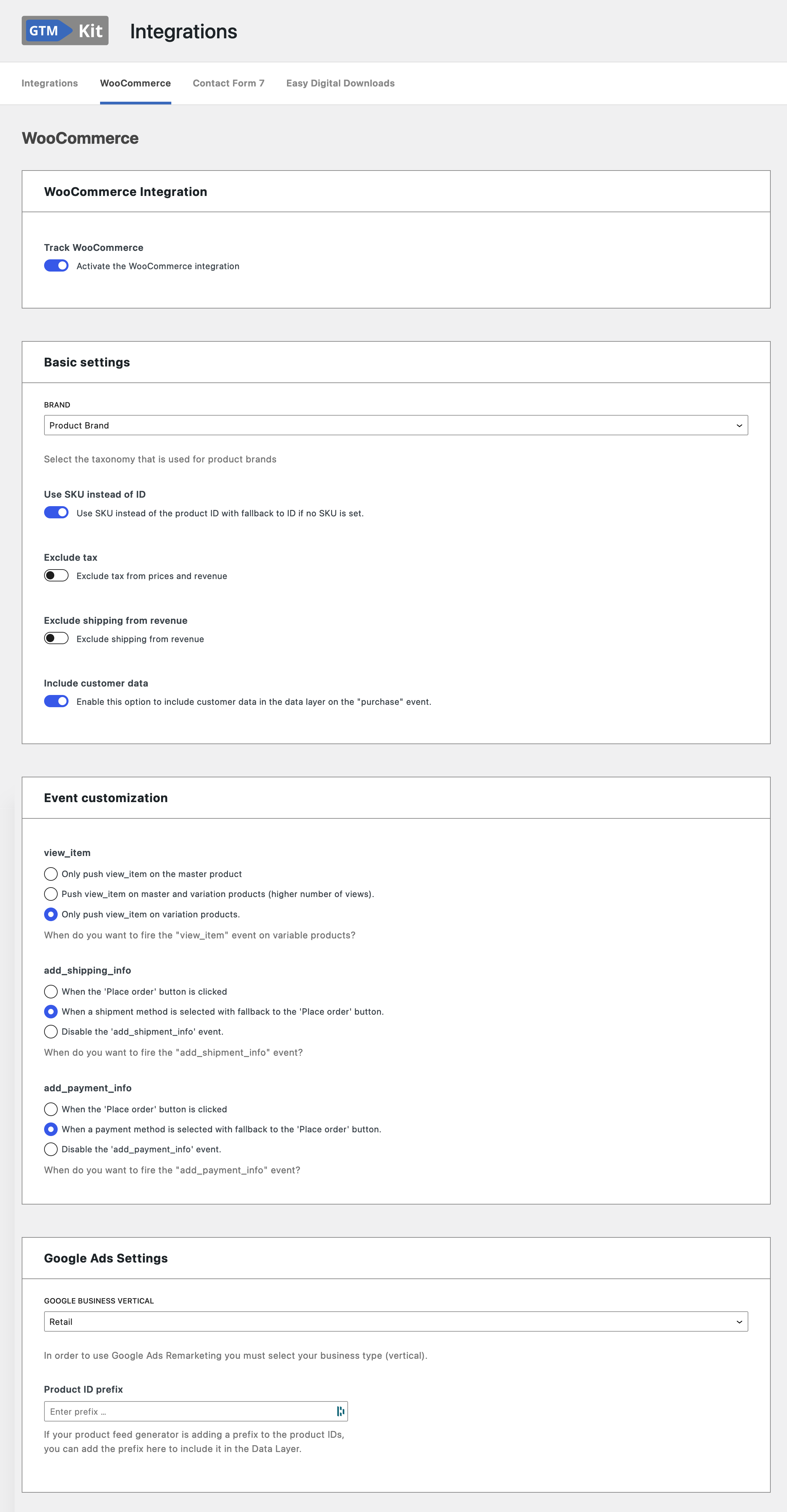
eCommerce events tracked with Google Analytics 4
The following GA4 events are automatically included in the dataLayer:
WooCommerce
- view_item_list
- select_item
- view_item
- add_to_wishlist [Premium]
- add_to_cart
- view_cart
- remove_from_cart
- begin_checkout
- add_shipping_info
- add_payment_info
- purchase
- refund [Premium]
- order_paid [Premium]
- order_processing [Premium]
- order_completed [Premium]
- order_refunded [Premium]
- subscription_started [Premium] Unlock all features with GTM Kit Premium.
- view_item
- add_to_cart
- begin_checkout
- purchase
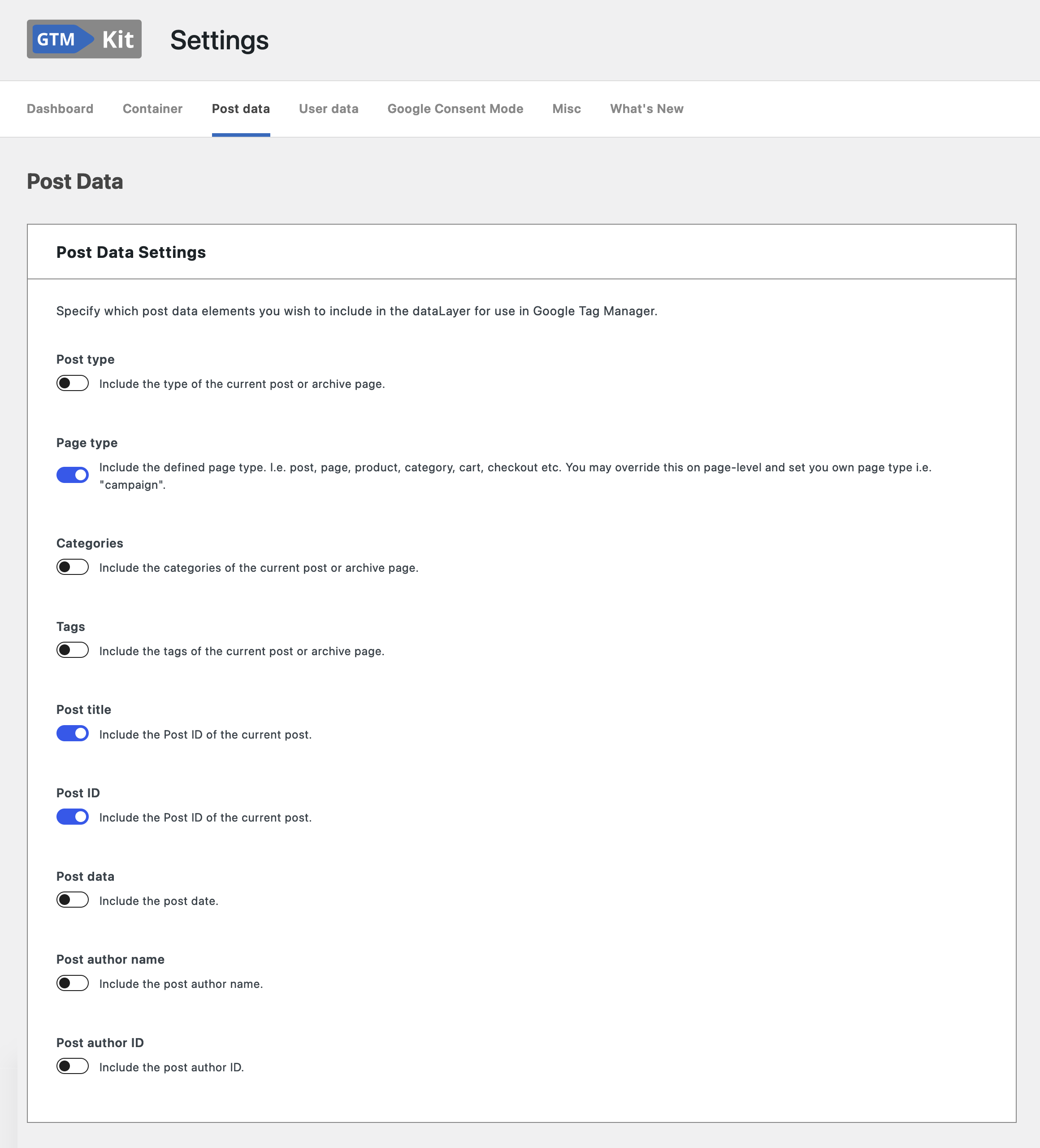
- Post type: include the type of the current post or archive page.
- Page type: include a defined page type. I.e. post, page, product, category, cart, checkout etc.
- Categories: include the categories of the current post or archive page.
- Tags: include the tags of the current post or archive page.
- Post title: include the post title of the current post.
- Post ID: include the Post ID of the current post.
- Post date: include the post date.
- Post author name: include the post author name.
- Post author ID: include the post author ID.
安装:
- Install GTM Kit either via the WordPress.org plugin repository or by uploading the files to your server.
- Activate the plugin through the 'Plugins' menu in WordPress
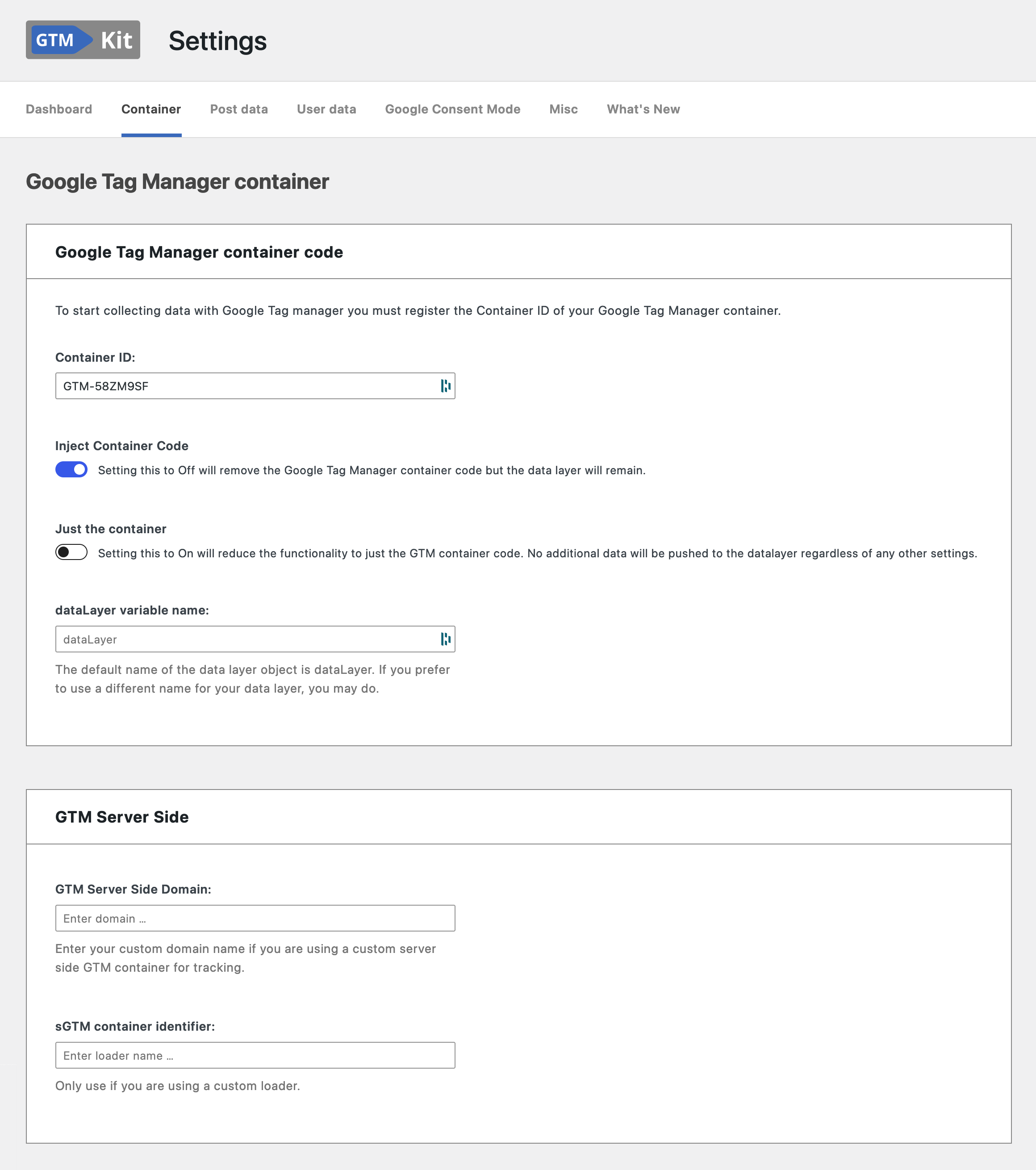
- Enter your GTM Container ID and click 'Save changes'.
屏幕截图:


常见问题:
Where do I get a GTM Container ID?
Create an account and container in Google Tag Manager and get it there.
Is Google Analytics 4 (GA4) supported?
Yes! We strive to support the full feature set of Google Analytics 4 and will implement any future features of Analytics 4.
Is this plugin cache friendly?
Yes! Pagespeed is one of our main focus points, and we strive to make the plugin compatible with full page caching.
How can I report security bugs?
You can report security bugs through the Patchstack Vulnerability Disclosure Program. The Patchstack team help validate, triage and handle any security vulnerabilities. Report a security vulnerability.
更新日志:
2.21.0
Release date: 2026-10-06
Find out about what's new in our our release post.
New:
- AI assistants connected to your site through the WordPress Abilities API can now read how GTM Kit is set up, which consent defaults apply, and whether tracking is healthy. Only administrators can use them, nothing can be changed through them, and they send nothing off your site.
- If you use the loader Stape issues but GTM Kit has none stored for your site, the GTM Kit dashboard now tells you that your pages use the standard loader and how to get Stape's loader back with Refresh.
- If the Google tag gateway is switched on while a custom server-side tagging domain is set, the GTM Kit dashboard now says the two cannot be used together and how to choose between them, instead of reporting that the gateway is not working. The settings screen explains why one of the two is unavailable only while it is.
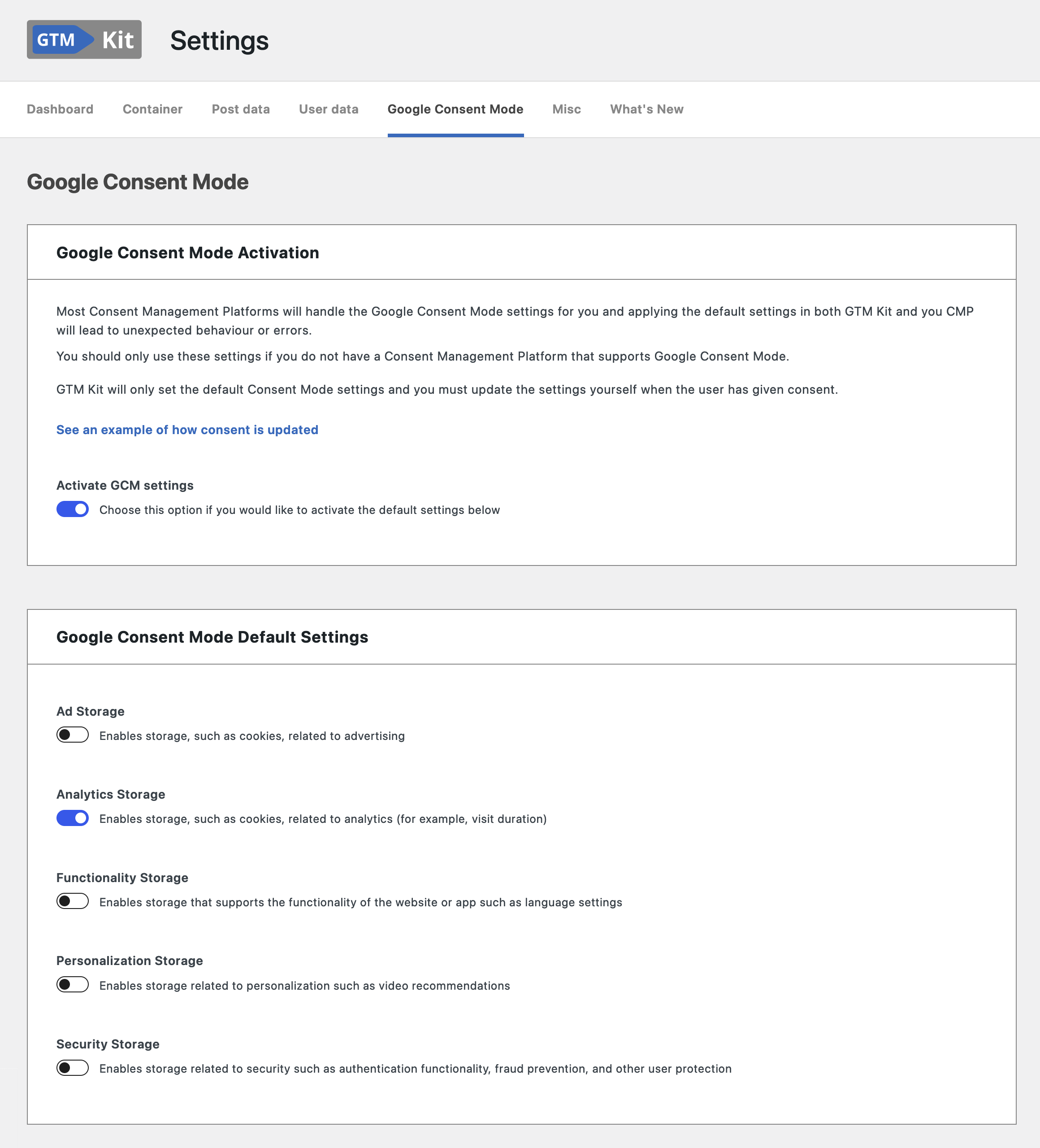
- Site Health no longer reports that consent is configured when the Consent Mode defaults deny analytics and no consent platform was found to grant it, a setup where every visitor is measured without cookies. It now recommends adding a consent platform or changing the defaults, and the Consent settings page shows the same warning.
- Site Health no longer says consent is not configured when the Consent Mode defaults are off because a consent integration, such as one using the WP Consent API, sets and updates the visitor's consent.
- Importing settings from GTM4WP no longer sets a server-side tagging domain when GTM4WP loads the container from a custom path, which produced a loader address that did not serve your container. The import now says the domain was skipped.
- On stores with a classic theme, shop, product and category pages without WooCommerce blocks no longer load GTM Kit's block tracking script, so those pages load less JavaScript. Pages that show a WooCommerce block anywhere, including a Mini Cart in a widget area, still load it, and block themes are unchanged.
- If you send customer details with the purchase event and use Consent Mode, GTM Kit now adds the email, phone, name and address, hashed or not, only once the visitor has granted both advertising storage and advertising user data consent. If consent is denied, or a denying default has not been lifted within three seconds, the purchase is still sent, without those details. GTM Kit reads consent from its own data layer, from
dataLayerif that is a different one, and from the consent state Google Tag Manager holds, so consent a consent platform sets through its Google Tag Manager template counts too. A denial in any of them withholds the details. If GTM Kit finds no consent state at all within three seconds, it sends the details, as it did before, and a developer can make GTM Kit withhold them in that case with a filter.
- If you use the loader Stape issues, GTM Kit no longer uses a loader stored by an earlier version, because it cannot tell whether that loader was checked against your data layer name. Your pages use the standard loader until you click Refresh under Server-side Tagging, which gets a checked loader from Stape.
- If refreshing or pasting your Stape loader fails, the settings screen now names the loader your pages keep using, instead of claiming they fell back to the standard loader. A request that fails before reaching Stape, for example because your login has expired, now says so instead of reporting that Stape could not be reached.
- If saving your settings fails because the connection to your site dropped, the settings screen now says there is a network problem instead of reporting a server error.
- If activating your licence fails because the request itself failed, for example because the connection dropped, the licence screen now says so instead of telling you to check your licence key. If deactivating fails, the button no longer keeps spinning: the screen shows what went wrong and lets you try again.
- If a Stape loader is made for a different data layer name than GTM Kit uses, whether you paste it or GTM Kit gets it from Stape, the settings screen now refuses it and says why, instead of using a loader that listens to the wrong data layer.
- If your server-side container is hosted on Stape, GTM Kit can now use the loader Stape issues for it, which ad blockers find harder to recognise. Switch it on under Server-side Tagging. GTM Kit asks Stape for the loader only when you save or refresh it, and you can paste the code from Stape instead.
- With Cookie Keeper enabled, Safari visitors now load your Stape custom loader when its identifier is longer than eight characters, as every identifier Stape issues today is. Safari previously asked Stape for a loader address it rejects, so those visitors were not tracked.
- On sites with a persistent object cache such as Redis, GTM Kit no longer re-runs its update routine on every admin page load when the cache still holds the previous version number. The update routine also no longer logs a notice from Action Scheduler on its first run.
- The description of serving the Google tag from your own domain now says what the setting does and does not do: it changes where the tag loads from, while the measurement it sends still goes to Google unless Google's tag gateway is provided by your CDN or host.
- When Google for WooCommerce adds a Google tag beside your container, GTM Kit now names it as the source instead of saying it could not tell.
- Site Health now checks that GTM Kit's settings can be saved, and shows the error it got back when they cannot.
- When sending your system data from the Support screen cannot get through, the screen now says so instead of claiming your ticket was not found. With GTM Kit Premium you can then copy the data or download it to email instead.
- You can now serve the Google tag from your own domain, so ad blockers and browser tracking restrictions interfere less with loading it. If it stops working, GTM Kit falls back to the standard loader and tells you. It is off by default, and an alternative to your own sGTM container domain. (Corrected after publication: this entry originally said restrictions would interfere less with your measurement. The setting changes where the tag loads from. The measurement the tag sends still goes to Google unless your CDN or host provides Google's tag gateway, which this setting cannot switch on.)
- GTM Kit now points out setups that leave data unmeasured, such as a WooCommerce store with its ecommerce events switched off. At most one such notice appears at a time, and dismissing it keeps it away for 90 days.
- A Google tag loading beside your container is no longer reported as duplicate tracking in the dashboard. It is now a notice, since the tag is only counted twice when it also fires inside your container. Two containers, or the same container loaded twice, are still reported as problems.
- When settings will not save, the settings screen now tells you why instead of quietly showing your old values again. It names any rejected setting, and on a site with a persistent object cache it names the cache as the likely cause.
- Password managers no longer fill in GTM Kit's settings fields. A filled-in value could previously be saved without you typing it, and came back after you removed it.
- Event names such as purchase and add_to_cart can no longer be renamed by translations in the settings screens, where they disagreed with the events GTM Kit actually sends.
- The order confirmation page now sends purchase data only to visitors WooCommerce or Easy Digital Downloads would show the order to. Anyone opening a shared or guessed link previously received the order contents, its value and the shopper's details. The buyer's own visit still reports the purchase.
- New
gtmkit_active_cmpandgtmkit_cmp_display_namefilters let a site declare a consent platform GTM Kit cannot detect, such as one loaded by the theme or a code snippet, so Site Health stops reporting consent as unconfigured. - The customer details sent with a purchase now come from the order itself, so they describe the buyer rather than whoever opened the confirmation page.
WooCommerce::include_customer_data()now takes the order as its second argument, before the order value, and reads every customer field from it. Code that calls this method directly must pass the order.