
Latchbot - AI Crawler Control
| 开发者 | maksymkotenko |
|---|---|
| 更新时间 | 2026年11月14日 19:50 |
| PHP版本: | 7.4 及以上 |
| WordPress版本: | 7.1 |
| 版权: | GPLv2 or later |
| 版权网址: | 版权信息 |
详情介绍:
- One rule per crawler - allow or block GPTBot, ClaudeBot, Google-Extended, PerplexityBot, CCBot, Applebot-Extended, Bytespider, Meta-ExternalAgent and about 20 more, each labelled with its operator and purpose (AI training, AI search or fetches for a user).
- Presets - "Block AI training, allow AI search", "Block all AI crawlers" or "Allow all" in one click, then fine-tune.
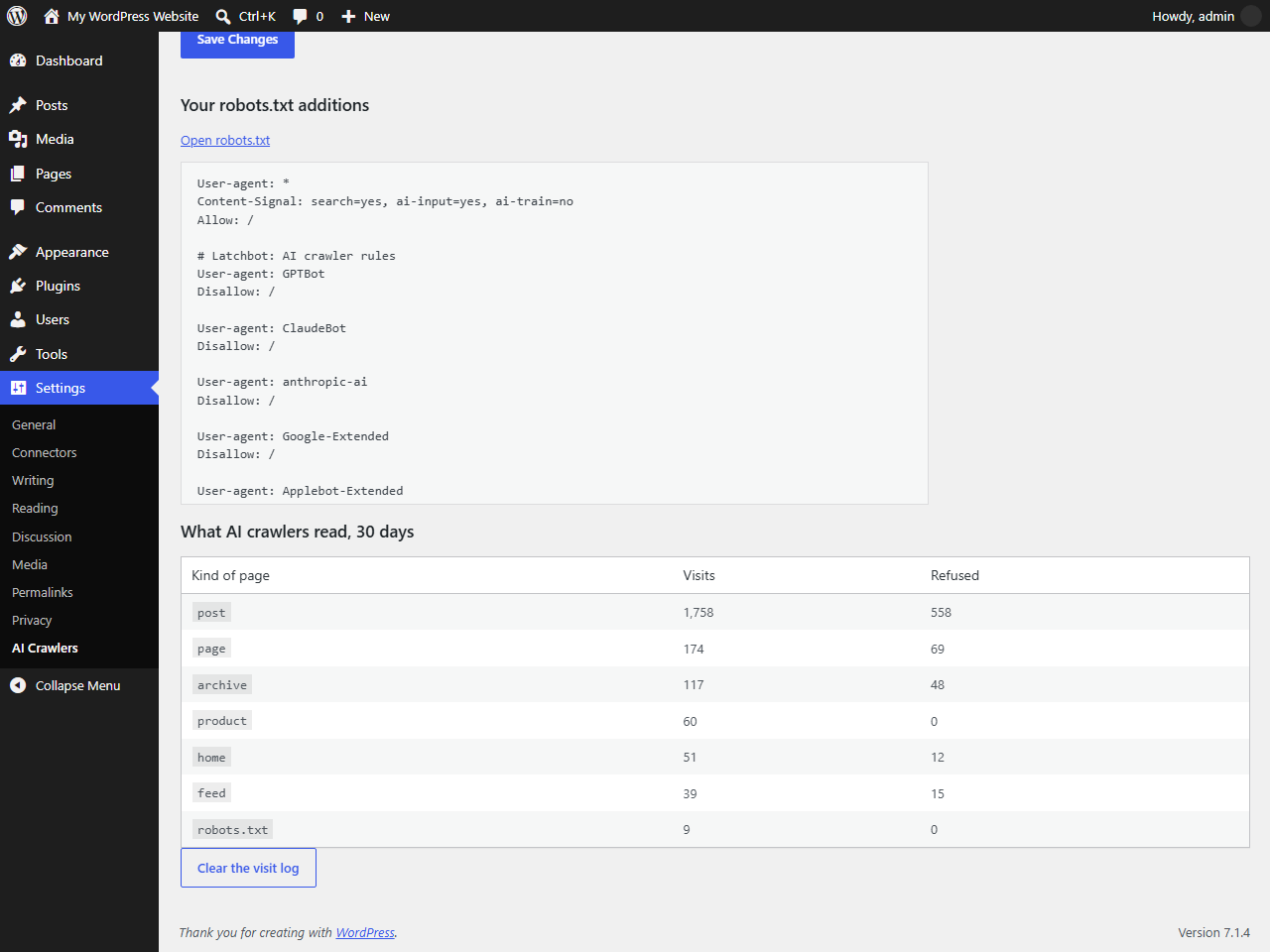
- robots.txt rules - added to the robots.txt WordPress generates, one group per blocked crawler, with a preview on the settings screen.
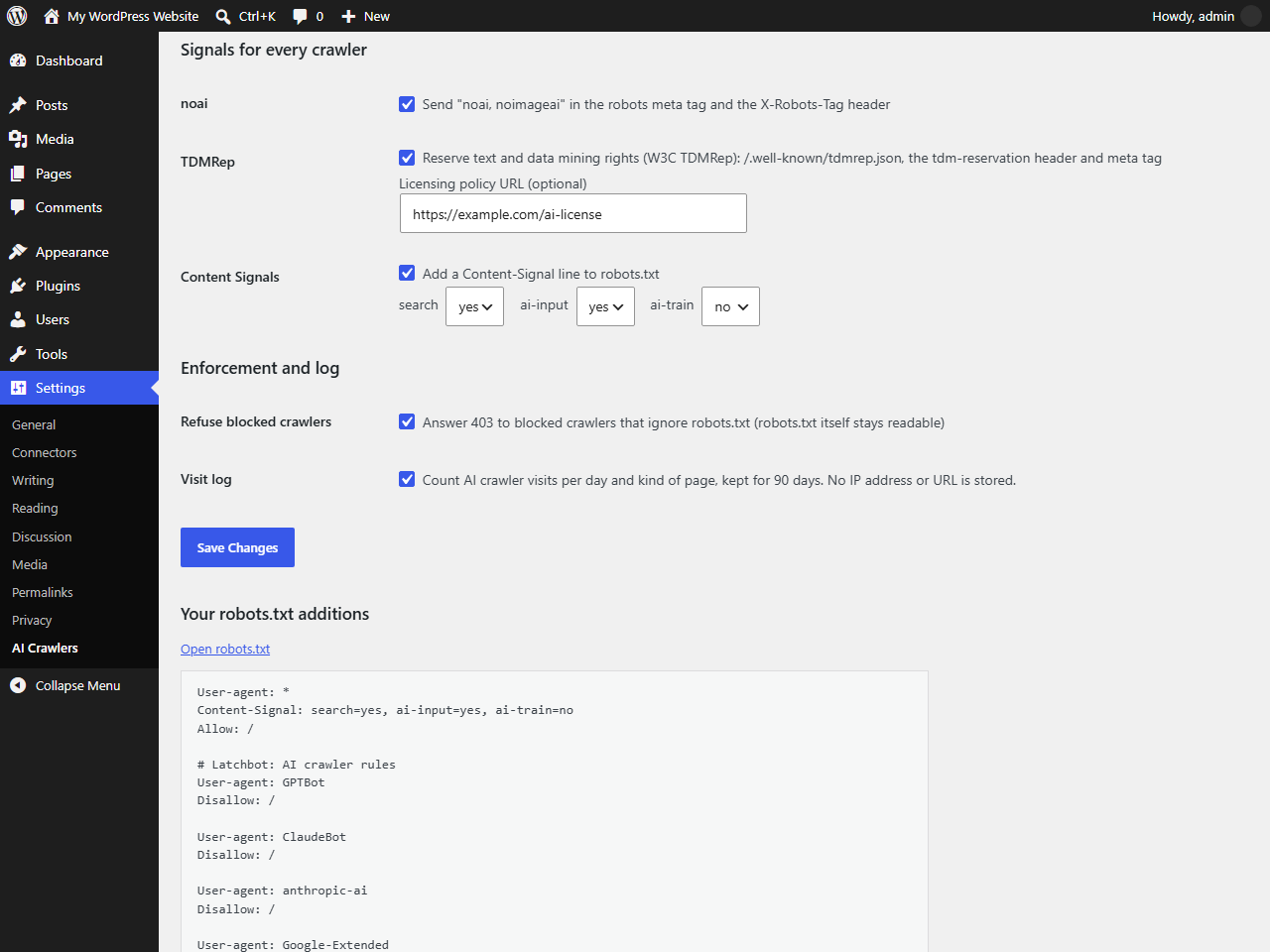
- Refuse crawlers that ignore robots.txt - optionally answer 403 to blocked crawlers; robots.txt itself always stays readable.
- TDMRep - reserve text and data mining rights under the W3C TDMRep protocol:
/.well-known/tdmrep.json, thetdm-reservationheader and meta tag, with an optional licensing policy URL. - Content Signals - add a
Content-Signal: search=yes, ai-input=yes, ai-train=noline to robots.txt, with each value your choice. - noai and noimageai - in the robots meta tag and the
X-Robots-Tagheader. - Visit log - how often each AI crawler came in the last 30 days, when it was last seen, and which kinds of pages it read (posts, pages, products, feeds and so on).
- New crawlers - updates add newly announced crawlers; a setting blocks the new training crawlers automatically.
- robots.txt is a request, not a lock: well-behaved crawlers follow it. Turn on "Refuse blocked crawlers" for those that do not.
- If your site root has a physical robots.txt file, the web server sends that file and WordPress rules do not apply. Latchbot warns about it and shows the lines to copy.
- Page caches and CDNs answer many requests without running WordPress. Those visits are not counted and not refused by the plugin; block crawlers at the CDN too if it offers that.
- Google-Extended and Applebot-Extended are robots.txt tokens only: Google and Apple crawl with their normal search bots and read the token to decide whether pages may be used for AI. They never show up in the visit log.
latchbot_botsfilter - add, change or remove crawlers; the list is built once per request, so add the filter from a plugin or your theme's functions.php. Each entry hastoken,name,operator,purpose(training,searchoruser) andua(the User-Agent substring; empty for robots.txt-only tokens).latchbot_refusefilter - decide whether a request from a known crawler gets a 403. Arguments: the decision, the crawler id and the kind of page.latchbot_visitaction - runs after a crawler visit is counted, with the crawler id, the kind of page and whether it was refused.
安装:
- Install and activate Latchbot from Plugins > Add New.
- Open Settings > AI Crawlers, pick a preset or set each crawler, and save.
- Open your robots.txt from the link on the settings screen to check the result.
屏幕截图:
常见问题:
Does blocking GPTBot or Google-Extended hurt my Google ranking?
No. Google-Extended only controls whether Google may use your pages for its AI models; Google Search keeps crawling with Googlebot, which Latchbot never touches. The same goes for Applebot-Extended and Applebot.
What is the difference between training, search and user fetches?
Training crawlers collect pages to train AI models. AI search crawlers build the index that AI answers cite and link to. User fetches happen when someone asks an assistant about your page. Many sites block training and allow the other two, which is the first preset.
Does it work with a caching plugin?
The robots.txt rules, the TDMRep file and the meta tags are part of the page, so cached copies keep them. The X-Robots-Tag and tdm-reservation headers, the visit counts and the 403 answers need WordPress to run, so they cover only requests your cache passes through; some caches store headers too.
My site is in a subdirectory.
Crawlers read robots.txt and /.well-known/tdmrep.json only at the root of the domain. Latchbot shows a warning; copy the rules from the preview into the files at the root.
更新日志:
- First release: per-crawler rules for 28 AI crawlers, presets, robots.txt rules, optional 403, TDMRep, Content Signals, noai, and a visit log without IP addresses.