
mee-table
| 开发者 | breedartstudios |
|---|---|
| 更新时间 | 2026年10月15日 03:25 |
| PHP版本: | 7.4 及以上 |
| WordPress版本: | 7.1 |
| 版权: | GPLv3 or later |
| 版权网址: | 版权信息 |
详情介绍:
api.mee-table.com, so there is no server for you to maintain.
Every installation starts with a 14-day trial of the full version. When the trial ends the plugin does not switch off: it carries on at the free level, and your venues and bookings stay where they are.
What it costs, and what we take. The plugin is free. A mee-table account is from EUR 24 per month billed yearly (EUR 29 monthly), and there are higher plans for larger venues and groups.
We never take a commission on table reservations. Ever, on any plan, including the free one. A guest booking a table costs you nothing.
A percentage applies only where a ticket is sold and paid online: Dating Aperitivo tickets, Cooking Class tickets and gift cards. It is deducted at the moment of payment, and the rest goes straight to your own Mollie, Stripe or PayPal account. Mollie only opens accounts for businesses based in the European Economic Area, Switzerland and the United Kingdom (list of countries); venues elsewhere, for example in the US, connect Stripe:
- Free (or after the trial ends): 20% on Dating Aperitivo, 12% on Cooking Class, 10% on gift cards
- Bronze: 15% on Dating Aperitivo, 5% on Cooking Class, 5% on gift cards
- Silver: 12% on Dating Aperitivo, 3% on Cooking Class, 5% on gift cards
- Gold: 10% on Dating Aperitivo, 2% on Cooking Class, 5% on gift cards
- Platinum: agreed with you
- Table reservations with availability, opening hours, rules on the number of guests, a weekly closing day and a quick-block calendar for one-off closures.
- Guests manage their booking on YOUR site. The link in every email and message opens your own booking widget, on your own pages, in edit mode: the guest moves the date, the time or the number of guests, or cancels, inside the limits you set. A per-venue cap says how many people one booking may bring (the venue capacity is a separate number), and an optional notice window closes online changes some hours before the table, after which the guest is asked to call you.
- Move a booking instead of losing it. The guest can change the day, the time or the number of people from the link in their confirmation email, without calling: the free tables are re-checked live, and you decide how many times they may do it before they are asked to phone you. Your own staff can move any booking from the Waiter Dashboard, with no limit, the phone rings there.
- Your own time zone, so opening hours and reminders are right even when the venue and the server are in different countries.
- Prepayment by time band. An "Aperitivo" rate from 19:00 to 20:00 and a different one for dinner, each with its own days of the week and minimum number of guests. The guest is only ever offered the rate that covers the time they picked, and when a rate covers it the prepayment replaces the no-show card guarantee: nobody is asked to pay twice for the same evening.
- Sittings that change by day. For example 20:00, 21:45 and 23:00 from Friday to Sunday, and other times from Tuesday to Thursday. You type the start time you want, even 20:05. A sitting with no amount (for example Aperitivo 18:00-20:00, Dinner 20:00-22:00, After-dinner 22:00-24:00) only decides which times guests can book, and works on every plan, Free included and without a licence, because it is saved in your WordPress site. Prepayment amounts start from the Gold plan (or the 14-day trial).
- Gift cards paid with Mollie or Stripe Connect, with a "Coming soon" preview per venue, a venue picker, one page per language with WPML or Polylang, and gifting to another person by email or WhatsApp.
- Choose which emails reach you. Everything that happens to a booking sends you an email by default, confirmed, declined, cancelled or moved, including what your own staff did from the dashboard. Untick the ones you do not want; your guests keep receiving theirs either way.
- No-show guarantee: the guest's card is authorised, not charged. Nothing is taken unless they fail to turn up, and staff release or charge it from the Waiter Dashboard.
- You decide what your staff can do. For each action on the phone dashboard (confirm, cancel, mark a no-show, refund a payment, waive a no-show charge) you choose all staff or the manager only. Until you change it, everything works as before.
- Set menus at a fixed price, that guests book like a ticket: the whole thing happens on YOUR website, from the list of menus to the booking form, and only the payment page itself opens the payment provider's own window, because they refuse to be shown inside a frame. You can ask for full prepayment, cap the seats per day or per service, and write each menu in as many languages as you like. The kitchen sees how many portions per service in the Waiter Dashboard.
- Cooking classes, custom events and Dating Aperitivo, each with its own page on your site, its own photo, its own ticket and its own flyer to print.
安装:
- Upload the plugin folder to
/wp-content/plugins/or install via the WordPress plugin directory. - Activate the plugin through the 'Plugins' menu. 3. Go to mee-table -> Settings, paste your licence key (from your mee-table.com dashboard), and click Activate licence.
- Set up your location(s), opening hours and payment methods on the Locations and Settings pages. 5. Optional: to switch the guest assistant on, open mee-table -> Guest assistant and paste a Groq key. Until you do, nothing is sent anywhere and the chat does not appear.
屏幕截图:


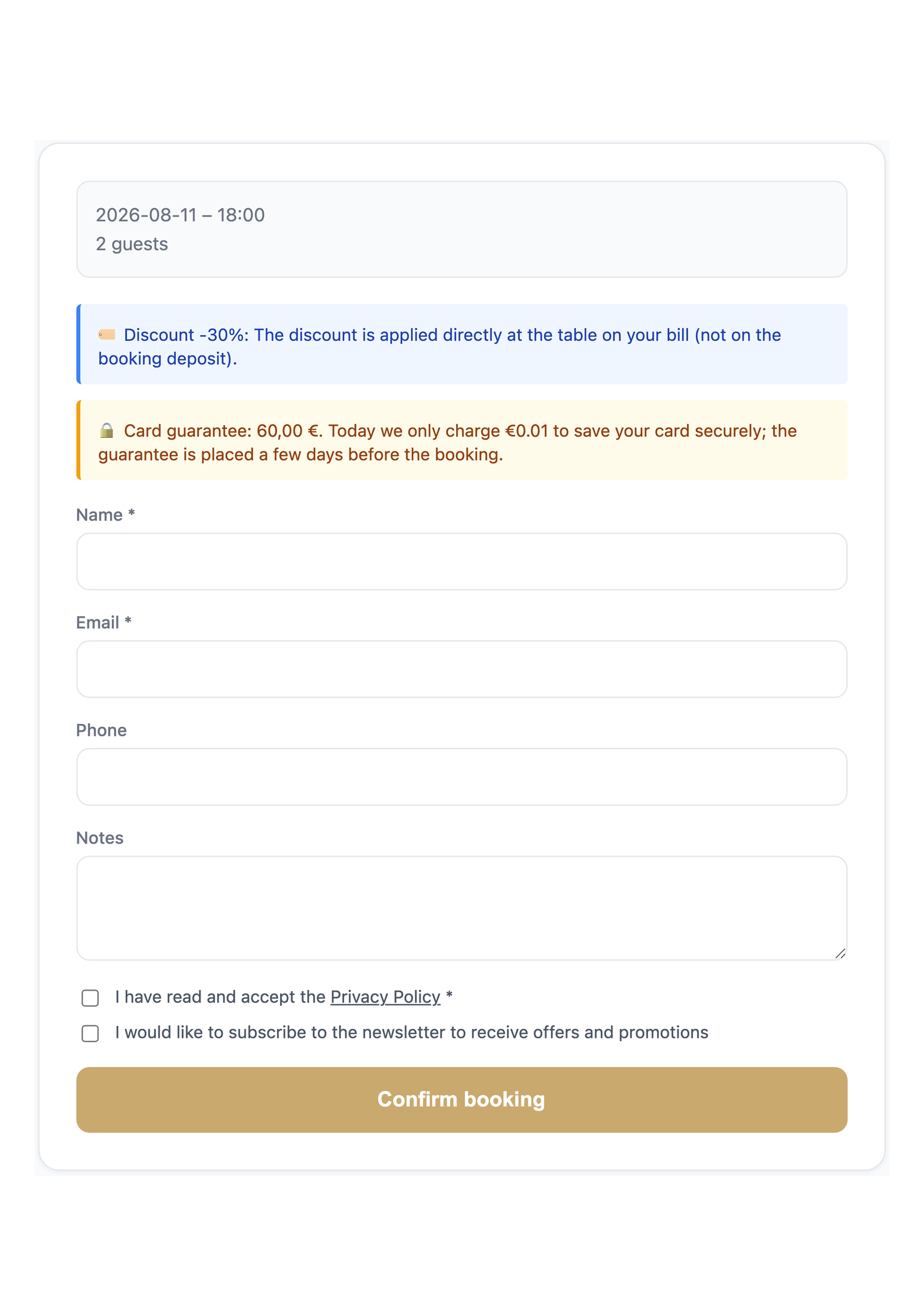
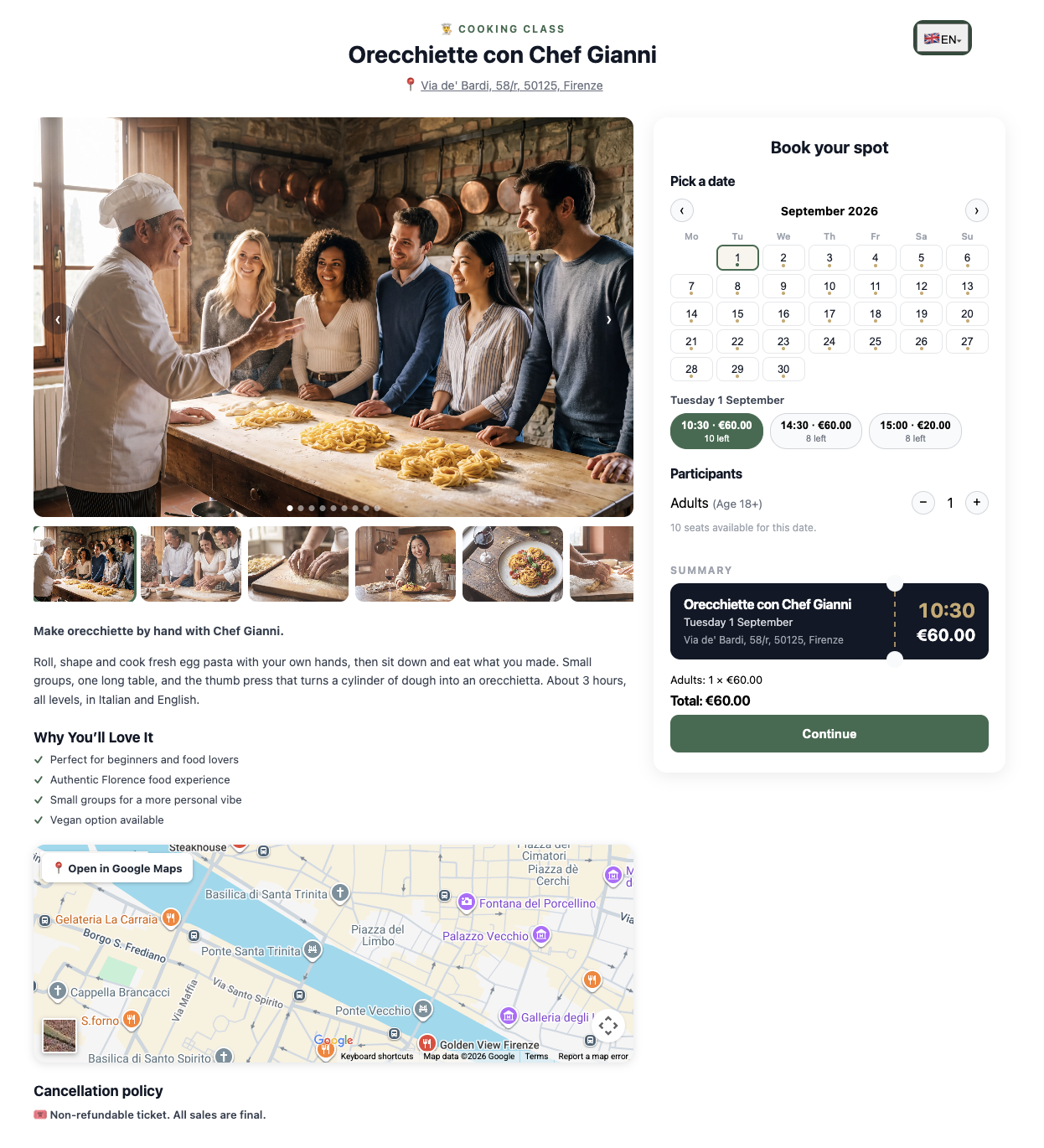


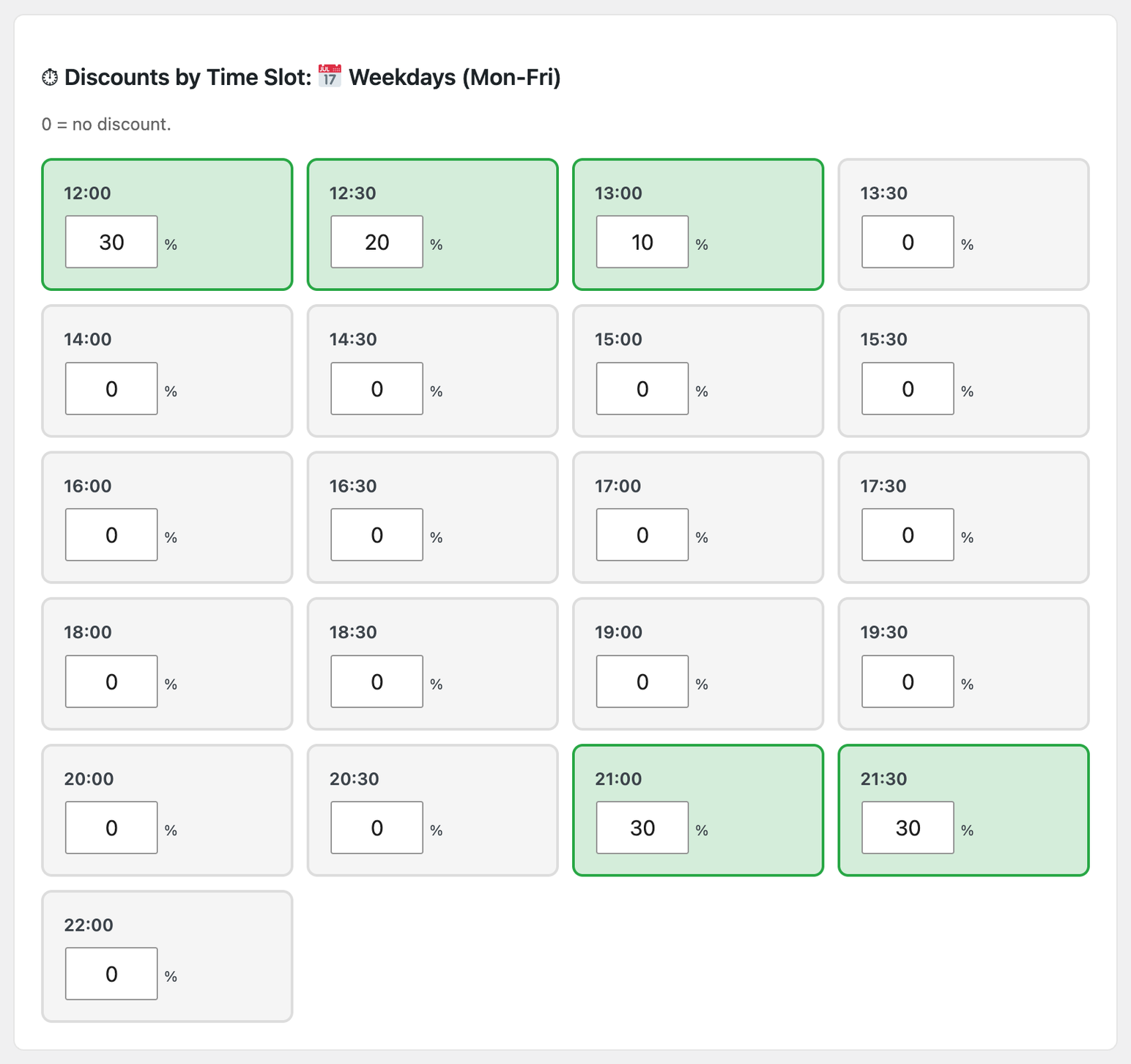
常见问题:
Where should my Google Business Profile booking link point?
To your dedicated booking page, not to your homepage, even if the widget is on the homepage too. A link always opens at the top of a page: on a long homepage the guest lands on the header and has to scroll to find the widget, on the booking page they land right on it. The plugin creates that page for you (see mee-table -> Settings) and the floating booking pill brings guests there from every other page of your site.
Does mee-table store guest data on my WordPress server?
On the free Lite plan, reservations stay in the restaurant owner's WordPress database. On plans with an active mee-table licence, booking data is stored on the mee-table server (api.mee-table.com).
Does the AI guest assistant cost anything, and is it on by default?
It is off until you paste a Groq API key in mee-table -> Guest assistant, and while that field is empty the plugin contacts no AI service at all and the chat is not even loaded on your pages. The key is free to create at https://console.groq.com/keys and the account is yours, so the free allowance is yours alone and the plugin never resells anything.
What does the assistant tell guests about allergens?
If you have ticked your menu page and the answer is written there, it repeats what you wrote and says it read it from you. What it never does is promise a guest that a dish is safe for their own allergy: a question like "I am allergic to hazelnuts, can I eat this?" always goes to your phone, whatever your menu says. Cross-contamination is decided in your kitchen, not on a menu, and only you know how you work.
And about prices?
The same rule. If your menu with prices is on a page you ticked, it can repeat a figure you wrote. If it is not published, it tells the guest to ask you. It never invents a figure, and it never says a percentage: on time-slot discounts it tells the guest which times are discounted and that they are marked on the list, so the number is read from your own page and cannot be misquoted.
The admin panel is in the wrong language. Where do I change it?
By default the panel follows Settings -> General -> Site Language. If you want it pinned to one language regardless, set it in mee-table -> Settings -> Panel language.
Do you take a commission on my bookings?
No. Table reservations never carry a commission, on any plan, including the free one. A percentage applies only to tickets sold and paid online: Dating Aperitivo is 20% free, 15% Bronze, 12% Silver, 10% Gold; Cooking Class tickets go 12% free, 5% Bronze, 3% Silver, 2% Gold; gift cards are 10% free, 5% on every paid plan. It is taken at the moment of payment; the rest reaches your own Mollie, Stripe or PayPal account directly. Sell no tickets and you pay no percentage.
What happens to my data if I delete the plugin?
It stays. Deleting the plugin from the Plugins page keeps your reservations, your customers, your venues, your time slots, your discounts and your hourly capacity: install it again and they are all still there. Only what the plugin generated by itself is cleaned up, such as caches and counters. If you really do want everything gone, there is a switch in mee-table -> Settings, off to begin with, that has to be turned on first. With it on the deletion is immediate and there is no undo, so only a backup of your site would bring anything back.
Where can I manage my licence or upgrade?
Log into your dashboard at https://mee-table.com/dashboard. There you can manage your location(s), billing, and staff accounts.
Why does the plugin need to connect to api.mee-table.com?
The connection is required for the booking widget, payment processing, and no-show protection to work. Without it, Mee-Table cannot retrieve availability, process payments, or update reservations.
What is the difference between the no-show guarantee and the prepayment tiers?
They are two different things, each with its own refund setting. The no-show guarantee only authorises the card: no money is taken, so there is nothing to refund. Its setting is a deadline, up to when the guest may cancel without a penalty. The prepayment tiers take real money at booking time, for a fixed-price menu you have already shopped for: that setting decides whether it is refundable at all, and defaults to non-refundable. A venue can run a flexible guarantee alongside a non-refundable tasting menu, which a single shared setting made impossible.
I set up an SMS provider. How do I know the credentials are right?
Use the "Send test SMS" button under the credentials. It sends one real message, using what is typed in the form even if you have not saved yet, and it costs one credit of your plan. Missing fields are reported before anything is dispatched, and the button locks for ten seconds after each attempt so a double click cannot burn credits. Note that the test leaves from your own site while real reminders leave from the mee-table servers: if your provider filters by IP address, the test can succeed where real sending fails.
What photo should I use for a cooking class?
A horizontal one, and as large as you can. The picture sits in a wide band on the flyer and in the email, so a portrait shot only shows a central strip of itself. When you pick the file the plugin crops it to 3:2, tells you which print sizes that photo can actually carry (A3 needs about 2200 px of width, A4 about 1550) and compresses it below 600 KB before it leaves your computer, so the 15 MB a modern phone produces is never uploaded. No compression invents pixels that were never there: a small photo stays small.
Which paper size should I print the flyer on?
A3 for a poster read from a distance, A4 for a window or a wall, A5 for a table stand, portrait or landscape. Each size is laid out separately rather than being a scaled copy, because what makes text readable is the distance it is read from, not the size of the sheet. The flyer always shows the next scheduled event: if nothing is scheduled it says so instead of printing a date that has passed.
Can a guest give a gift card to someone else? Does it arrive on WhatsApp?
Yes. The buyer can add the recipient's name, email and phone. If they add the email, mee-table emails the gift card to the recipient right after payment. The buyer can also choose the day the email goes out ("Send on"), from tomorrow up to a year ahead, for example for a birthday: it is sent that morning at 9:00. If they leave the email empty, the gift card reaches only the buyer, who then has to send it separately. After payment a window opens with a green "Share on WhatsApp" button: WhatsApp opens with the message ready (amount, venue, code and link) and the buyer taps send. The WhatsApp message is not sent automatically and cannot be scheduled. If the buyer typed the recipient's phone it is already filled in; if not, the number can be typed in that window. They can also add a personal message of up to 200 characters, which the recipient reads in the email. Gift cards are paid with Mollie or Stripe Connect, whichever the venue has connected.
Can I have different sittings on different days?
Yes. In mee-table → Location, edit the location and open the first tab, Venue, hours & booking confirmation: right after the opening hours you find Rates by time slot / custom shifts (the ? next to the title opens the guide). Add one row per sitting with + Add tier, then Save the rates only, tick its days and set its time. Example: three rows at 20:00, 21:45 and 23:00 ticked Fri, Sat and Sun, and other rows for Tue, Wed and Thu. Type any start time you like, for example 20:05 or 21:45: the sitting times do not depend on the time interval, which only sets the grid of the normal times for the whole location (every 30 or every 15 minutes). Tick "One time for the sitting" to show a single button per sitting, or choose "Show only the times of the tiers" to hide the normal grid. A row with an empty amount or 0 has no prepayment; the no-show guarantee (from Silver), if you keep it on, still applies. Sittings without an amount work on every plan, Free included; prepayment amounts are part of the Gold plan, and below Gold the amount field is switched off with a note.
Can I close at different times during the week, for example earlier on weekdays than on weekends?
Yes, with the same sittings, and it holds for good until you change it. In mee-table → Location, edit the location, first tab, Rates by time slot / custom shifts. Switch on Show only the times of the tiers below and add one row for each group of days with different hours. Set From to the first bookable time and To to the last bookable time, leave the amount empty, and leave One time for the sitting unticked. Example: Mon to Thu from 12:00 to 22:00 (last bookable time 22:00) and Fri to Sun from 12:00 to 22:30 (last bookable time 22:30). Tick the days for each row, then Save the rates only. Guests see the times from From through To, including To, at the interval set for the location (every 30 or 15 minutes). A day with no row keeps the location's normal opening hours and closing time; you do not need to add a row for every day. Discounts and hourly capacity stay tied to the times actually offered on each day. The quick blocks in the calendar (Hourly Capacity) are for single dates or a period, such as holidays, not for fixed weekly hours. With Show all normal times, the rows do not change the schedule: only the location's normal opening hours and closing time count.
How do I enable the WhatsApp contact button?
Go to mee-table → Location, edit the location, and fill in the "WhatsApp (digits only)" field with the number in international format, digits only (e.g. an Italian number +39 333 123 4567 becomes 393331234567). Once saved, a WhatsApp chat button appears automatically under the booking widget on your site, linking to a direct chat with that number. This uses the free wa.me link: no paid service, no extra setup, available on every plan tier.
更新日志:
- Fixed: on a phone the last bookings of the staff dashboard could not be reached. The window now scrolls as a whole and is sized on the visible part of the screen, without the browser bars.
- Gift cards now have their own page in the panel: the full register of every card issued (buyer, recipient, value, remaining balance and the commission mee-table received), with free search and month and year filters, fifty rows at a time. It used to sit inside the Venues page, where it grew longer every month.
- One CSV for your accountant: gift card sales and redemptions together, in date order, with the commission and, for every sale, buyer, recipient, remaining balance, status and expiry. It replaces the two separate exports.
- New: fixed menus have their own refund choice on the Fixed menus page: non-refundable (the default) or refundable up to the number of hours before that you choose. It applies only to prepaid menus.
- New: the link in the fixed menu emails opens the booking on your own menus page, not on mee-table.com. From there the guest can cancel, add or remove a menu (if not paid online) or change menu.
- New: changing fixed menu. The guest books the new menu from your page and the old booking is cancelled only when the new one is confirmed or paid. If they had paid online, they pay only the difference for a more expensive menu, or get the difference back for a cheaper one when the menu is refundable and still within your hours; otherwise they are asked to call you.
- Changed: gift card validity guidance in the panel: 18 months recommended (the usual period in most European countries), 24 months in the Netherlands; ask your accountant which validity to apply. New venues start at 18 months.
- Fixed: the gift card fee note now says that the EUR 10 cap applies to paid plans and the trial, while the free plan is 10% with no cap.
- Fixed: the "+ Add amount" button of the gift card amounts was translated as cropping an image in German, French, Spanish, Dutch and Portuguese.
- Fixed: when mee-table.com cannot be reached, the course languages and the fixed menus try again after 5 minutes instead of on every page view, so your pages no longer wait for it each time.
- The commission is read from the server, never estimated in the plugin: cards issued before 9 October 2026 have no commission recorded and are shown blank, not as a zero.
- Fixed: on a site in Chinese (Traditional) or Korean the booking widget showed its own labels in English (Number of guests, Guests, Date, Time, Contact, and the payment terms), because those two languages had no dictionary in the plugin. They now have one, with the whole widget translated, including the payment terms and the card window.
- The booking page, the Gift Card page and the Staff login page are now created in every language of the site when WPML or Polylang is active. Pages that already existed before this update are covered too: the translations are created the first time you open the panel after updating, so you do not have to save anything again.
- Fixed: on a WPML or Polylang site the widget now follows the language of the page the guest is looking at, so the widget labels, the language switcher and the payment terms all agree.
- New: each venue can switch its Gift Cards off. The button disappears from the booking widget and the purchase page, and the amounts you had saved stay there: switch it back on and everything is as before. It used to be all or nothing, and deleting the amounts was the only way to stop selling.
- New: the custom Stripe and PayPal credentials of a venue can now be removed. Ticking the box and saving erases them from that venue, which goes back to the global keys; until now the fields could only be emptied, and the key stayed saved and in use.
- New: staff can move a booking from the Floor Dashboard on the phone (button Move: pick the day, see the free times with the seats left, confirm). Each venue decides who can do it, all staff or managers only, in Locations > Staff; out of the box all staff can do it, like cancelling, and you can restrict it to managers. The guest receives the new time by email.
- New: Stripe and PayPal with your own keys now work as a bridge for prepaid bookings. They are offered only until Mollie (verified) or Stripe Connect is active for the venue: from then on they switch off by themselves. Each one has its own on/off switch for the whole site (Settings) and for each venue (Locations > Payments); switching off never deletes your keys. Keep the keys until the prepaid bookings have taken place: they are needed to refund from the plugin.
- The Global Mollie box was removed from Settings: every venue connects its own Mollie account, as it always had to.
- Fixed: the Stripe and PayPal webhooks now acknowledge events that belong to other activities on the same account (a shop, a POS, other apps) instead of answering with an error. Before, Stripe could report the webhook as failing and switch it off after a few days.
- New: a separate switch "Also on the courses page" (Settings, next to "Buttons in capitals, like my theme"). The courses page shows only mee-table buttons and keeps its own look by default; switch it on if you place it among other capital-letter buttons of your site.
- Changed: the "Next Cooking Class" button of the booking widget now appears only when your site has a courses page (the page with the [mee-cooking] shortcode) and always opens it. It no longer sends guests to mee-table.com. The Dating button still opens the match page on mee-table.com.
- New: the courses page ([mee-cooking]) is now created on your site by itself as soon as you have an active class, and only then (no classes, no page). The option "Create a page on my site for the classes" is on by default and you can switch it off. The plugin never deletes a page and does not recreate one you have removed.
- Fixed: with a licence the menu showed both Bookings and the staff page. Bookings now appears only in the free Lite version, where it is the place to see reservations; with a licence you use the Floor Dashboard.
- The staff page now has a gender-neutral name in every language (Floor Dashboard, Cruscotto sala, Panel de sala, Tableau de bord de salle, Service-Übersicht, Painel de sala).
- Gift cards: each amount can now have an optional name (for example Bronze 100, Silver 150).
- A short note next to the Stripe and PayPal credentials explains that PayPal is meant for the first days only, while Mollie or Stripe verify your account.
- The no-show guarantee can now also use Stripe Connect, as an alternative to Mollie: each venue chooses. Mollie works exactly as before.
- Gift cards: the buyer now chooses how the gift reaches the other person: by email, right away or on a chosen day (it arrives that morning at 9:00, in the venue's own time zone), and on WhatsApp from their own phone. They can add a personal message of up to 200 characters and see a live preview of what will arrive. After payment the page says exactly what was sent and when.
- Gift cards can now also be sold with Stripe Connect, as an alternative to Mollie: each venue chooses, and the Gift Card button appears as soon as one of the two is connected. Mollie works exactly as before.
- The staff role is now gender-neutral in every language, and the labels in the staff box now say so.
- The Cooking class button in the booking widget now opens your own cooking class page (the one with the [mee-cooking] shortcode) when your site has one, instead of the mee-table.com page.
- Fixed: the Bookings entry was missing from the mee-table menu, so clicking mee-table opened Locations and the list of reservations could not be reached. Bookings is back as the first entry.
- Sittings without an amount (time slots that only decide which times guests can book) are now available on every plan. Prepayment amounts stay from the Gold plan, and when a plan does not include something the panel now says which plan does.
- The "Rates by time slot / custom shifts" section has a clearer name and a short example, in all 9 languages.
- Sittings without an amount now work in the free Lite version too, without a licence: they are saved in your WordPress site.
- The "Rates by time slot / custom shifts" section has moved to the first tab of the location ("Venue, hours & booking confirmation"), right after the opening hours, with a ? link to the guide. The payments tab keeps a note that points there.
- Dutch: the waiter dashboard is now the neutral "Bedieningsdashboard".
- Cooking class pages with WPML and Polylang: existing translated pages are linked instead of duplicated.
- Class Presentation offers the site languages and "+ Add language", same list as the set menus.
- Class prices: adults from 10 EUR, children from 5 EUR.
- Table deposits with Stripe: charged in the currency of your Stripe account, refund button works with Stripe too.
- New "Test payment" button: a real 0.10 EUR payment to check bookings, emails and payouts.
- New: sittings that change by day, each with its own start time, days, dates and optional prepayment, plus a time interval of 15 or 30 minutes for the whole venue.
- New: gift cards on one page with a venue picker, gifting by email (on a day you choose, up to a year ahead) and a "Share on WhatsApp" button, and a "Coming soon" page while Mollie is not connected.
- New: the widget follows your site: colours, the heading font of your theme and the month name of the calendar. Reading texts are dark for better contrast.
- Changed: the booking page and the Gift Card page are created in every language of the site with WPML or Polylang.
- Fixed: the confirm button no longer turns gold when the mouse goes over it.
- New: you choose what your staff can do from the phone dashboard. For each venue, five switches decide who may confirm a booking, cancel it, mark a no-show, refund a payment and waive a no-show fee: all staff, or the manager only. Out of the box confirm, cancel and no-show are open to all staff, while refunds and waived fees stay with the manager. The buttons a person may not use are hidden, and the server refuses them too.
- Fixed: the staff dashboard on the phone and the Waiter Dashboard in the panel are now the same dashboard, and show the same bookings. The phone one did not show set menus.
- Fixed: set menus show their real name and price everywhere, in every language, instead of a generic "Special Menu" label in Italian.
- Changed: the dashboards list tables and set menus only. Cooking class and event tickets have their own ticket list and the QR check at the door.
- Fixed: time slots with a discount showed the time broken in two ("17:0" and "0") when the booking form sits in a narrow column. The discount badge stays next to the time and is readable, and the time is never split: when there is not enough room for three columns the form switches to two, like on a phone, and to one in very narrow boxes. Time grids without discounts look exactly as before.
- Fixed: in a very narrow column (about 280 to 320 pixels) the calendar and the third column of times went past the right edge of the form. They now stay inside.
- Fixed: the set menu booking window went 17 pixels past the edge of the menu card in narrow columns on some themes.
- Fixed: a free trial started from your mee-table.com account is now recognised by the plugin, so every feature is unlocked during the trial as promised.
- Fixed: on the free plan the booking form ignored your opening hours and always offered 12:00 to 22:00. A restaurant that opens at 17:00 was taking bookings at lunchtime. It now follows the opening and closing time you saved, your lunch and dinner service windows and your weekly closing day, exactly like the paid plans already did. The last table offered is 30 minutes before closing.
- Fixed: when the booking form sits inside a narrow column of a wide page, the step names (Guests, Date, Time, Contact) broke in the middle of the word. In a narrow box the form now shows the step numbers and the name of the current step only, and never splits a word. In a normal-size box it looks exactly as before.
- New: deleting the plugin no longer deletes what you wrote. Your reservations, customers, venues, time slots, discounts and hourly capacity stay, and come back if you install it again. A switch in Settings, off to begin with, is there for anyone who really does want everything gone.
- New: set menu booking now stays on your own website. The booking form opens inside the page, like the cooking class one already did, instead of sending the guest to mee-table.com: guests were calling the restaurant to ask whether the other website was genuine. Only the payment page itself still takes the whole window, because payment providers refuse to be shown inside a frame.
- New: the waiter dashboard shows which set menu each guest bought, and a box at the top counts the portions per menu per service (day and time), which is how a kitchen actually prepares them.
- New: a Mollie Test mode switch next to the Mollie option, so you can try a booking with a payment without moving real money. With Mollie connected there is no test key to paste anywhere, so until now there was no way to try one.
- Fixed: with SMS or WhatsApp reminders on and the phone rule left on Automatic, the phone was not required in the booking form, although that option says it should be. Your explicit choice still wins in both directions, and the venue page now tells you which way it is right now, and why.
- New: the little "?" that opens the guide is now next to every section, not only next to the page title. Forty-one of them across the panel, each one landing on the paragraph that explains that section.
- Fixed: the "?" links and the new Guide entry open the guide in the language of your panel. They always opened the Italian one, whatever language you were working in.
- New: a "Guide" entry in the mee-table menu, opening the guide in the language of your panel. The little "?" next to each setting already jumped to the right paragraph; this is for when you just want to read how it works.
- Fixed: the label next to the price ("per person", "per cover") stayed in Italian on every language of your site. You can now write it per language, next to the name and the description; leave it empty and it is written for you in the language of the page instead of always in Italian.
- New: the set menu booking form is no longer English only. It follows the language of the page it opens in, in all nine languages the set menus already spoke: Italian, English, Dutch, French, German, Spanish, Portuguese, Traditional Chinese and Korean. An Italian guest of an Italian restaurant was filling in "Name", "Guests" and "Book Now".
- Fixed: "Back to all menus", inside the booking form, showed a broken grey box instead of going back. It now closes the form and puts you back on the list, which is right there on the page.
- Fixed: the day separator row in the waiter dashboard stopped one column short when a payment column was showing.
- Fixed: on a multilingual site (WPML or Polylang) renaming your set menus page could rename one of the translations instead of the page you were looking at, leaving the others untouched. The plugin now always works on the page in the language you are in.
- New: "Buttons in capitals, like my theme", next to the theme font option, for themes that write every button in capitals. And if you already asked mee-table to follow your theme's font, it now follows the theme's capitals too, without switching anything on.
- Changed: the panel entry is now called "Set Menus", not "Special Menus". In English this has always been a set menu, the fixed-price lunch, and the page, the button and this readme already said so: only the menu entry did not. Nothing you wrote is affected, and any page already created keeps working.
- New: rename your set menus page and everything follows. Type the new name in Settings and the page on your site is renamed too, and the button under the booking widget says it as well. Your own wording wins: a page you named yourself is never renamed behind your back.
- The waiter dashboard breaks the list by day, with the day written once and the guest count next to it, and today's rows stand out. Each row carries a colour stripe for its status, and the whole table fits on the screen again. Refunding moved in with the other buttons, where it belongs, and only shows up when there is something to refund.
- The payment column shows the amount actually received and nothing else. What is left to pay belongs to the bill, where the drinks and the covers are: a reservation list cannot know it.
- Fixed: the logo you choose for your booking emails is now copied to mee-table's own storage instead of being linked from your site. Linked from your site it broke on its own, with no mistake from anyone: a theme change, a moved file, a new firewall or a staging site was enough, and from then on every confirmation email went out with an empty box where your logo should be.
- Fixed: a set menu booking with no payment due was shown as paid in the waiter dashboard, with a warning about refunding a deposit that never existed.
- Fixed: the set menu confirmation email gave the day but not the time.
- Fixed: lines written one under the other at the end of a set menu description ran together into a single block on your website. They now break where you wrote them.
- Fixed: set menus are listed in the same order in your panel and on your website, so the second one on your screen is the second one your guests see.
- New: choose the logo that goes at the top of your booking emails, from your own media library. Your guests see your restaurant instead of ours. Settings, next to the widget colours. Available on the paid plans: on the free plan the mee-table logo stays.
- New: the plugin can create the set menus page on your own site, with the name you choose, and add it to your site menu if you want. Settings, next to the pages for the classes and the special event. Nothing is ever duplicated or renamed.
- Fixed: the special menus page now shows the list directly on your own site instead of a frame from mee-table.com, so it always loads even on domains that were never registered with us.
- New: an "Optional phone number" switch on each location's Table rules tab. The phone number is still required by default when SMS or WhatsApp reminders are on, but you can now make it optional anyway.
- The English text of a special menu is clearly optional now: the language buttons only appear on the public page when there is something really translated to show.
- The plugin is now called simply "mee-table" everywhere: in your dashboard, on the plugin directory and in the readme. What it does is described right under the name, where it belongs.
- New: Special Menus now really save (a booking backend gap could leave every translation unsaved). Fixed for good.
- New: Special Menus translations panel, "+ Add language" picker: pick from over 30 languages without a plugin update, instead of a fixed set of sections.
- New: rich text (bold, lists) for every Special Menus translation, not just Italian.
- New: a price label next to the price ("per person", "per cover"...), written by you, never auto-translated.
- Fixed: text colour and price colour in the Special Menus card and widget, for better contrast.
- Fixed: the floating booking pill and the "Discover more" button now follow the page's real language on WPML/Polylang sites, for languages without a WordPress translation file (e.g. Chinese, Korean), instead of always showing English.
- Fixed: Special Menus are now listed by price when no date range is set, instead of in a random order.
- Fixed: the anti-spam check (Turnstile) could reject a real booking with a stale or reused token when the guest took a while to fill the form. The token is now requested fresh right before sending, on both the table and the special menus widget.
- Fixed: the phone number was still required even with SMS and WhatsApp reminders both switched off; now only your own explicit choice on the location's Table rules tab decides it.
- Removed: the "Also send the confirmation on WhatsApp" checkbox from the special menus booking form, never requested and confusing when WhatsApp reminders are off.
- Changed: picking a date or a time slot now moves straight to the next step in the special menus booking form, instead of requiring an extra tap on "Next".
- Fixed: the booking calendar could render too wide on desktop, and a long month name (e.g. "September 2026") could wrap to two lines and throw the arrows out of line.
- Fixed: the widget's main colour is now read fresh on every page load instead of possibly showing a colour your hosting had cached from before your last change.
- Fixed: the "Discover our Set Menus" and "Next Cooking Class" buttons now match the width of the booking widget above them and use your widget's own colour, instead of a fixed width and three unrelated colours.
- Fixed: on some layouts the booking widget could show a different amount of empty space on its left than on its right.
- Changed: the Settings page now has nine distinct "Save" buttons (one per section) instead of nine identical ones, so it is always clear which part of the form was saved.
- Fixed: after saving some admin screens the booking widget could render as an empty box for up to five minutes, because the cached venue list was cleared while its freshness stamp was left in place. The widget then believed the site had no venues.
- Fixed: the new "show the Book button" checkbox could never be switched off, because the saved value was read too strictly. Found in review.
- The two heading checkboxes are now written only when the form actually sends them, so no other form can silently switch them off.
- New: each special menu can now hide its own "Book" button, to show the menu without taking bookings for it.
- New: two checkboxes in Settings, next to the widget colour, to hide the restaurant name and the "Book your table" line above the booking form. Both on by default, so nothing changes unless you turn them off.
- Fixed: on the Discounts screen the "Add a day group" button did nothing at all, silently, so you could not give Saturday and Sunday different percentages from the rest of the week.
- Fixed: the same fault also killed the warning that tells you a day is in two groups at once.
- New: you can now hide the restaurant name and the "Book your table" line above the booking form, from the venue settings. On by default, so nothing changes unless you turn it off.
- New: shortcode [mee-menu-speciali], to show your special menus on your own site instead of sending guests to mee-table.com.
- The steps of the booking form (Guests, Date, Time, Contact) are slightly bigger and easier to read.
- Fixed: the booking pill (the floating "Book" button) could load inside a theme's live visual page builder (BeTheme, Elementor, Divi, Beaver Builder, WPBakery, and others), sitting on top of the builder's own controls in the corner of the screen.
- Fixed: the same issue affected the guest chat assistant when it loaded from the shortcode directly, and the Customizer's live preview was not covered by either fix.
- Fixed: opening a page in a visual builder's preview could record the wrong page as "where the booking widget is", which then went into the "edit your booking" link in confirmation emails.
- If another floating button (e.g. WhatsApp) is already in the same corner, the booking pill now moves to the opposite side instead of overlapping it, and shows a one-time note to administrators. This can be turned off in Settings.
- Fixed: the WhatsApp button under the booking widget used a generic speech-bubble emoji instead of the real WhatsApp icon, which looks different (or missing) depending on the phone or OS.
- Fixed: time-slot discounts could only be set between 12:00 and 22:00, a fixed list that did not match every restaurant's real opening hours.
- Added a short, optional survey when you deactivate the plugin, so we know why. It never delays or blocks deactivation.
- Fixed: time-slot discounts could only be split into Weekdays and Weekend, so Saturday and Sunday shared the same values and could not be edited or removed separately.
- Fixed: the location's closing time is now treated as the last bookable time.
- Added Special Menus: offer fixed-price set menus on specific dates that guests book as tickets, like an event, from a new page linked from a button under the booking widget.
- The WhatsApp, staff login and event-teaser buttons under the booking widget are now bigger and easier to read.
- Fixed: "Connect WhatsApp in one click" opened the general mee-table dashboard instead of the page that actually starts the Facebook connection for that venue.
- Special Menu Sessions can now require full prepayment before a booking holds a seat, using the same secure Mollie checkout already used elsewhere in the plugin.
- Special Menu Sessions descriptions now support bold, italic and lists.
- Added: the cooking class confirmation email, to the guest and to the venue, can now be rewritten from the Emails page, the same as the table reservation emails, photos included.
- Class times: you now write the end time, not a number of minutes. Type 10:30-13:00 in the times field and the class shows as 10:30 - 13:00 everywhere: on your page, on the flyer and on the ticket.
- Your lesson now shows its end time wherever the start time was shown before, as soon as an end time is set.
- Age bands: you decide what counts as a child and what counts as an adult, next to the prices in the Classes screen. They used to be fixed and could not be changed.
- The showcase on the mee-table.com city page now starts switched off, and the readme says so.
- Documentation: the readme now states what the plugin costs and where a commission applies. Table reservations never carry one, on any plan; a percentage applies only to tickets sold and paid online (events, cooking classes, gift cards).
- The Gold plan commission on tickets is now 5%.
- Cooking class photos: you can now pick several photos at once from the WordPress library, and drag them with the mouse to change their order. The first photo is the one used on the flyer. Before, each new photo replaced the previous one.
- Cooking class tickets: the list of who bought can now be filtered by this week, this month or all, shows where each buyer came from, and can be exported to CSV.
- On a page that shows one of your experiences, the floating button now offers the experience first, with Book a table underneath: a guest reading about a class was being sent to the table booking instead.
- The page the plugin creates can also be added to your site menu, if you tick the box: it is off by default, because many restaurants already have their own Book now entry pointing somewhere else.
- You can now choose whether your class appears on the mee-table.com page for your city, the one people find searching for a cooking class in their town. The tick was already in mee-class and was missing here.
- Your classes and your special event can now live on your own site: switch on the page in Settings and the plugin creates it, or paste the shortcode [mee-cooking] or [mee-custom] into any page you like. The box resizes itself and never blocks scrolling.
- You can now name the ticketed experience yourself: wine tasting, piano lesson, Valentine dinner. The old fixed list of six categories is gone, and what you type is the line printed above the title on the public page and on the flyer.
- Dating Aperitivo: the panel now shows who bought a ticket, not only how many tickets were sold, with the same filters, the same "Came from" column and the same CSV export.
- Fixed: the public Gift Card page stayed on "Loading..." on block themes (Twenty Twenty-Four, Twenty Twenty-Five). Scripts are now registered on init.
- Fixed: the booking form loaded no scripts or styles when the shortcode came from a page builder such as Elementor or Divi.
- Fixed: a double click on the confirm button could create two bookings when a prepayment tier was selected.
- Fixed: when a licence expired or was suspended, the booking form showed no time slots at all instead of falling back to the free mode.
- Fixed: on the free plan the restaurant received no email when a guest booked a table.
- Fixed: with more than one venue, the second venue could not be reached by the panel.
- Fixed: every page load could call the server again when the venue cache was empty, slowing the whole site down when the server was unreachable.
- Fixed: payment confirmations arriving after a trial ended were refused, so a guest could be charged without the booking being confirmed.
- Fixed: schema updates never reached the venues table on sites installed before this release.
- Fixed: on the free plan, editing a venue showed a success message without saving anything.
- Fixed: the "Give a Gift Card" button appeared on the free plan and led to an empty page.
- Fixed: the Quick Blocks routes ran even on plans where the feature is not included.
- Fixed: the Events page was empty for free sites that had opted in to selling tickets.
- Changed: gift card amounts no longer ask for a name. An amount of 25 is called 25.
- Added: a link from Settings to where the gift card amounts are set.
- Fixed: the disabled-fields styling in the email settings screen is now delivered as a stylesheet instead of being written into the page.
- Free version: bookings, calendar and confirmation email, with no account.
- 14-day trial on activation, then the plugin drops to the free level.
- Events and ticket sales work on the free level too.
- The free confirmation email uses the same wording as the paid one.
- The floor log now lives on the mee-table service, not in the site database.
- Events page: four PHP notices fixed.
- The author name in the plugin list links to mee-table.com. Le versioni precedenti stanno in changelog.txt, dentro la cartella del plugin. Older releases are listed in changelog.txt, in the plugin folder.