Nahnu Code & API Block
| 开发者 | ja1me4 |
|---|---|
| 更新时间 | 2026年10月14日 06:11 |
| PHP版本: | 7.4 及以上 |
| WordPress版本: | 7.1 |
| 版权: | GPLv2 or later |
| 版权网址: | 版权信息 |
详情介绍:
- Syntax highlighting for 20+ languages, powered by Prism.js and bundled with the plugin (no external CDN requests).
- Automatic light/dark mode: follows the visitor's OS preference, and can also follow a dark-mode class or attribute your theme or another plugin already sets on
<html>or<body>(filterable). - An optional per-block toggle button so visitors can flip a single code block between light and dark themes manually.
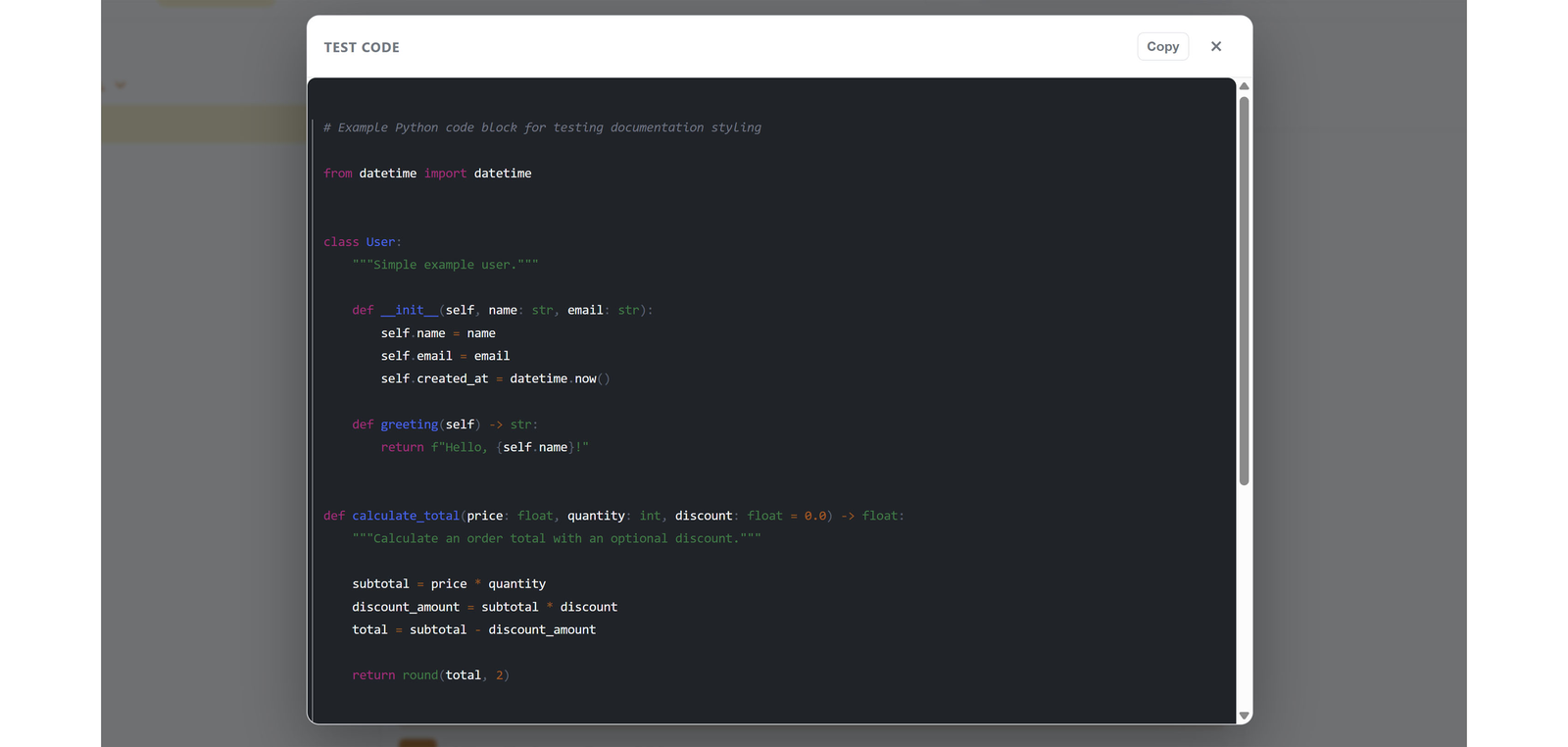
- Long snippets collapse to a configurable preview height with a "View all code" button that opens the complete snippet in a modal.
- One-click Copy button, optional line numbers.
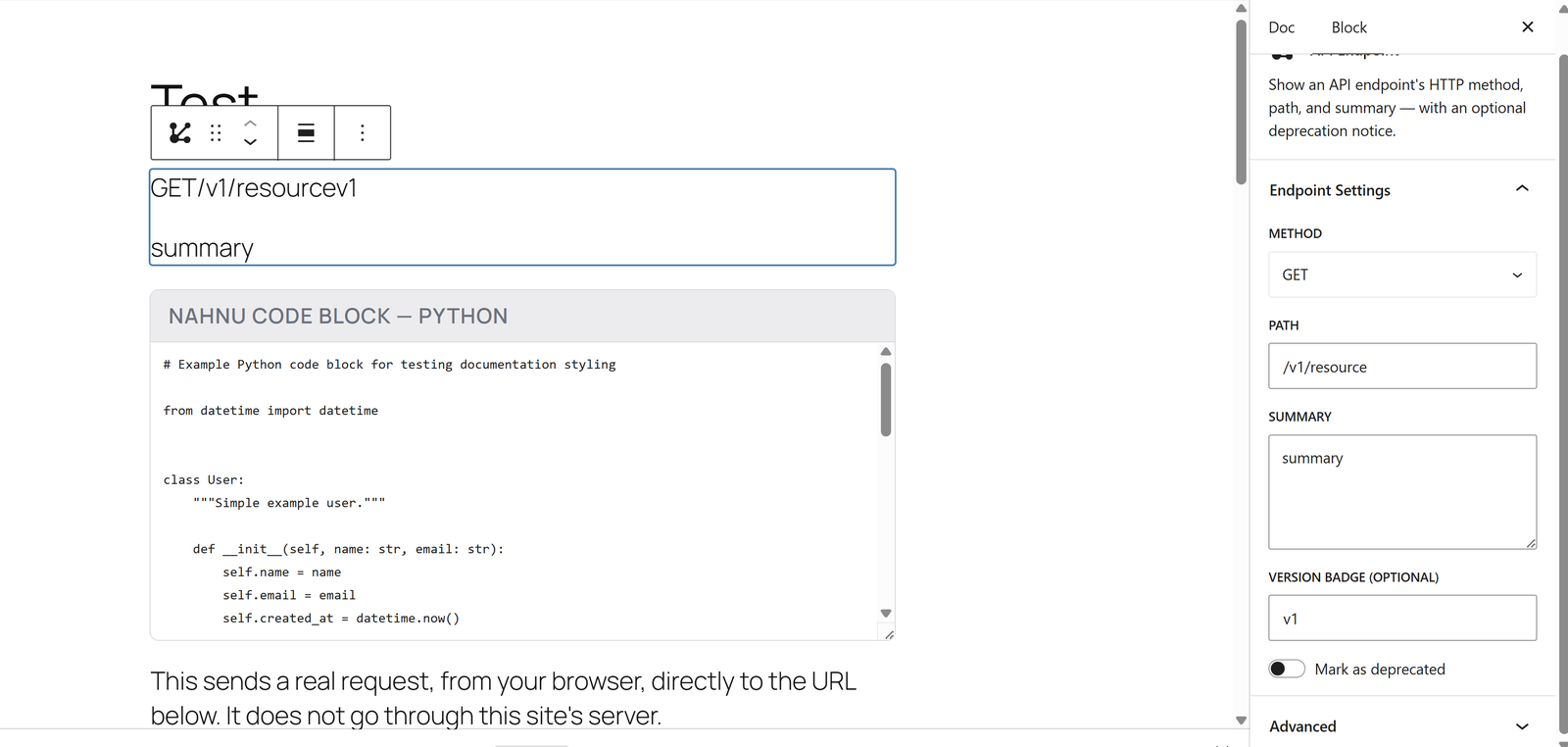
- Endpoint — HTTP method badge, path, a short summary plus an optional longer description, version badge, an optional deprecation notice, an "Auth Required" indicator, an "Operation ID" for a stable deep-link anchor, a "See also" list of related endpoints, and a copy-link icon for deep-linking directly to this endpoint.
- Parameters — a name / type / location (query, path, header, cookie, body) / format / default value / example value / allowed values / validation range and pattern / nullable / read-only or write-only / required-optional / deprecated / description table, with support for nested object parameters (e.g. an
addressparameter with its ownline1,city, etc.), linkable type references (e.g. "array of ProgramResponseDto" linking to another Parameters block set up as that named schema), and a copy-link icon on each row for deep-linking to a specific parameter. - Request / Response — tabbed code examples per language (cURL, JavaScript, Python, PHP, and more), each with Request and Response sub-tabs. Language selection is synced and remembered across every Request/Response block on the same page.
- Response Body — a "Returns" description, optional response headers shown as a persistent table, and one or more real response bodies grouped by status code, shown as an expandable accordion with syntax highlighting and its own copy button per response. An optional "Show Schema" toggle switches a response between its real example and a lightweight type-shape table. Complements the Status Codes block: Status Codes is the quick-scan summary table, Response Body is the rich single-response view.
- Status Codes — a table of the HTTP status codes your API returns, color-coded by class (2xx/3xx/4xx/5xx), with an optional collapsible example response body.
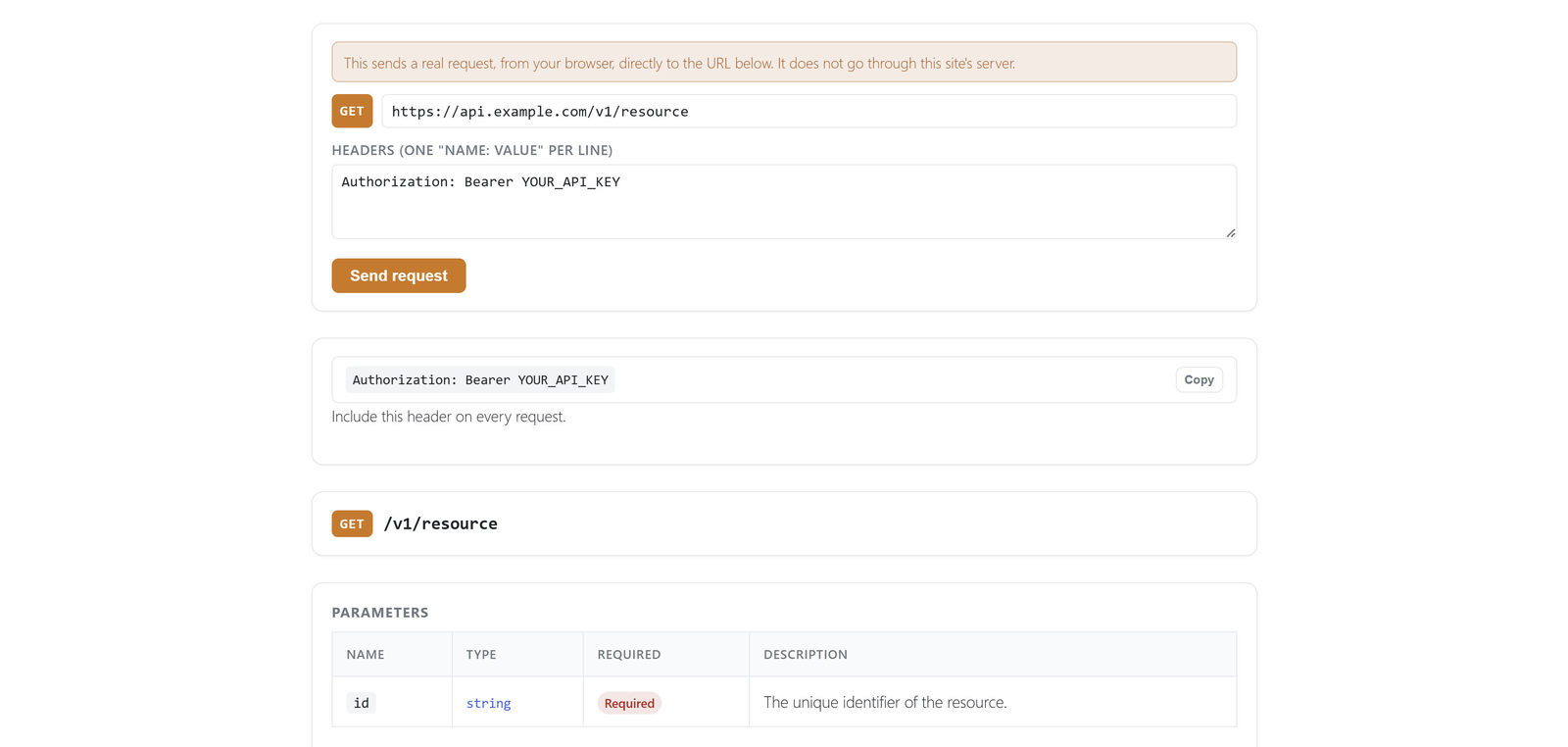
- Authentication — shows the exact header a client needs to send (Bearer token, API key, Basic auth, or OAuth 2.0), with a copy button.
- Try It Console — a live request form visitors can edit (URL, headers, body) and send directly from their own browser to see a real response. This performs a genuine client-side request; it never proxies or issues the call from your WordPress server.
- Error Codes — document your API's error types and codes (e.g.
invalid_request_error/parameter_missing), distinct from HTTP status codes, each with an optional expandable example error body. - Events — list the webhook/event names a resource can emit (e.g.
customer.created), each with a description, an optional expandable example payload, and a copy-link icon. - API Navigation — auto-generates a jump-list of every Endpoint block on the current page. No manual list to keep in sync as you add or reorder endpoints; scans this page only, never your whole site.
- Servers — list an API's base URLs (production, sandbox, regional) each with a label and a copy button. Maps onto OpenAPI's
serversarray, including server variable templating like{region}.
[nahnu_code_block block="..."] shortcode (for widgets, page builders, or classic-editor content) or directly from PHP via nahnu_code_block_render() (for theme templates) — see INTEGRATION.md. Both support the same per-instance color overrides as the settings page.
External services and data
Nahnu Code & API Block does not connect to any external service, API, or CDN at runtime, and does not collect, transmit, or store any personal data. The Prism.js syntax-highlighting library is bundled with the plugin files (MIT licensed) rather than loaded from a third-party server. The Try It Console block is the one exception worth being explicit about: when a site visitor clicks "Send request" on that block, their own browser makes a direct HTTP request to whatever URL is shown in that block (which the page author configured, and the visitor can edit). That request comes from the visitor's browser, not from your WordPress server, and nothing about it is seen by this plugin's author or by Nahnu.
安装:
- Upload the
nahnu-code-blockfolder to/wp-content/plugins/, or install the plugin through the Plugins → Add New screen in your WordPress admin. - Activate the plugin through the Plugins screen.
- Edit any post or page, add a new block, and search for "Nahnu" to see the full set of code and API blocks.
- Configure each block from its sidebar settings.
屏幕截图:
常见问题:
Does this send my code anywhere?
No. Everything is rendered on your own server and in the visitor's browser. The plugin makes no external network requests, with the one exception noted above for the Try It Console, which is a request the visitor themselves chooses to send.
Will this conflict with my theme's or another plugin's dark mode switcher?
It's designed to cooperate rather than compete. By default it follows the visitor's OS-level light/dark preference. You can also use the nahnu_code_block_dark_mode_selectors filter to tell it which CSS selector your existing dark-mode plugin toggles (for example body.dark-mode), so the code block switches along with the rest of your site.
Can I integrate my own dark-mode toggle with this plugin?
Yes. If your theme or plugin already sets a class or attribute for dark mode (like body.dark-mode), add it via the nahnu_code_block_dark_mode_selectors PHP filter and it works automatically, with no JavaScript required. If your toggle is JavaScript-driven, call window.NahnuCodeBlock.setTheme('dark' | 'light' | 'auto') from your own click handler. Full details, including how to rebrand the actual colors, are in HOOKS.md in the plugin folder.
Can it take over WordPress's built-in Code block?
Yes. Under Settings → Nahnu Code Block → Standard Code block, choose Colors only (keeps the core Code block and your theme's styling, just adds syntax colors) or Replace (every core Code block is shown as a full Nahnu Code Block, with copy button, collapse, line numbers and the light/dark toggle). Both only affect the front end; your saved posts are never changed, so switching back to Off restores everything. Each core Code block gets a "Syntax highlighting" panel in its sidebar to pick a language, with a site-wide default (HTML/XML out of the box) for blocks that don't pick one. To permanently convert individual blocks in the editor instead, use the block toolbar's Transform menu — Code ↔ Nahnu Code Block works in both directions.
Can I change the syntax highlighting or table colors?
Yes. All colors are exposed as CSS custom properties scoped to .nahnu-code-block (for example --nahnu-code-block-token-string), so they can be overridden from your theme's stylesheet without touching plugin files.
Is the Try It Console safe to use?
It only ever performs a request from the visitor's own browser to a URL you configure (and the visitor can see and edit before sending). It does not run on, or route through, your WordPress server, so it can't be used to make your server call arbitrary internal or external URLs.
Does it work with the Classic Editor?
No, not by adding a block through the Classic Editor's UI. You can still
place any block on a Classic Editor page (or anywhere else outside the
block editor) using the [nahnu_code_block block="..."] shortcode, or by
calling nahnu_code_block_render() from a template if you're a
developer — see "Can I render a block from PHP or a theme template?"
below.
Can I render a block from PHP or a theme template?
Yes. Since version 1.0.2, nahnu_code_block_render( 'endpoint', array( 'method' => 'GET', 'path' => '/v1/users' ) )
(and its echoing counterpart nahnu_code_block_the()) renders any of this
plugin's blocks straight to HTML from a theme template, a widget, or a
page-builder module — no post content or block editor required. The same
thing is available as a [nahnu_code_block block="..."] shortcode for
places that only accept shortcodes. Full details, including how to pass
each block's attributes, are in INTEGRATION.md.
Can I customize the colors without writing code?
Yes. Settings → Nahnu Code Block has a color picker for each core
color (accent, text, background, header/footer background, muted text,
border) in both light and dark mode — every block on your site picks
these up automatically, however it was added to the page, including
blocks placed with the [nahnu_code_block] shortcode. A single block or
shortcode instance can also override just its own colors (e.g. one
partner-branded endpoint) without changing the site-wide palette — see
HOOKS.md for the shortcode attributes and the equivalent PHP filter.
更新日志:
- Added a way to take over WordPress's standard Code block (core/code), under Settings → Nahnu Code Block: Colors only keeps the core block and your theme's styling and just adds the same light/dark-aware syntax colors as this plugin's code block; Replace shows every core Code block as a full Nahnu Code Block (copy button, collapse, line numbers, light/dark toggle). Front end only — saved posts are never modified. Each core Code block gets a "Syntax highlighting" language panel in its sidebar, with a site-wide default (HTML/XML out of the box).
- Added block transforms between WordPress's Code block and the Nahnu Code Block (block toolbar → Transform), in both directions, keeping the code and its language.
- Added a WordPress Shortcode language option to the code block, for displaying example
[nahnu_code_block ...]shortcode syntax (or any other plugin's shortcode syntax) as a properly highlighted, copy-pasteable code sample. - Fixed: an example shortcode shown inside a code block could get picked up and actually executed by WordPress's own
do_shortcode(), which runs over the entire rendered page after every block (including this one) has already produced its output — square brackets pass throughesc_html()untouched, so a literal[nahnu_code_block ...]example was never actually inert. The code block's displayed brackets are now encoded as HTML entities at the character level, which a browser still renders as ordinary[/]and which the Copy button (reading the browser's own decoded text) still copies as real, directly usable brackets — but which WordPress's shortcode parser can no longer misread as a real invocation. This fixes example shortcodes silently vanishing (or, worse, swallowing surrounding page content) when shown this way; no double-bracket escaping needed. - Added an optional "Show a live rendered preview" toggle for the WordPress Shortcode language: runs the code sample for real and shows its actual output in a separate, clearly labeled panel below the (still inert) code sample — useful for demonstrating what a shortcode produces. This runs in isolation on just that one code sample, never on the surrounding page, so it can't affect anything outside its own preview panel.
- Added
nahnu_code_block_render()(andnahnu_code_block_the(), its echoing counterpart) so a theme or plugin developer can render any of this plugin's blocks directly from PHP — in a template file, a widget, or a page-builder module — without needing the block to live in a post's content or pass through the block editor. - Added a
[nahnu_code_block block="..."]shortcode wrapping the same rendering path, for widgets, classic-editor content, and page builders that only accept shortcodes. - Fixed: any block whose main attribute is a JSON array or list (Parameters, Response Body, Status Codes, Error Codes, Events, Servers, Request/Response, Endpoint's related operations) — as well as the code-block block's
codeattribute — now reads that value from the shortcode's enclosed content instead of a quoted attribute. A quoted attribute can never safely hold a JSON array (WordPress's own shortcode parser treats any]character inside the tag, even deep inside a quoted attribute's value, as the end of that shortcode — corrupting it the moment the array isn't empty), and can't hold real code containing a quote character either. - Fixed a much bigger issue affecting every
[nahnu_code_block]attribute on every block, not just the ones above: the shortcode handler was normalizing attributes throughshortcode_atts()against a list that only ever containedblockand the seven color-override names, which meant every other attribute a block actually needed —code,method,path,language, all of it — was being silently discarded before the block ever rendered, on every single shortcode call. On top of that, WordPress always lowercases shortcode attribute names before a callback sees them, which broke every camelCase attribute (operationId,authRequired,relatedOperations,showLineNumbers, and others) independently of the first bug. Both are fixed: every attribute now reaches its block correctly, under its real declared name, regardless of the case it was written in. - Added a Settings → Nahnu Code Block admin page: a color picker for each core theme color, in both light and dark mode, with no code required. Applies site-wide, to every block however it was placed (block editor, PHP rendering, or the shortcode).
- Added per-instance color overrides —
accentColor,accentTextColor,bgColor,chromeBgColor,textColor,borderColor,mutedColorshortcode attributes, or a third argument tonahnu_code_block_render()/nahnu_code_block_the()— so a single shortcode or PHP-rendered block can carry its own branding without changing the site-wide palette. - Fixed: a block rendered this new way after
wp_head()has already printed (the common case for a template file, since it usually runs afterget_header()) now still gets its stylesheet, instead of silently rendering unstyled. - Documented the new PHP rendering API, shortcode, settings page, and per-instance branding in
INTEGRATION.mdandHOOKS.md. - Mobile responsiveness pass across all 12 blocks: the Parameters, Error Codes, Status Codes, Events, and Response Body blocks' tables now scroll horizontally within their own container instead of squeezing columns unreadably or breaking the page's layout on narrow screens. The Try It console's method/URL row, the Request/Response language sub-tabs, the Authentication header line, and the Response Body toolbar now wrap onto multiple lines on narrow screens instead of overflowing. The code block's copy/theme-toggle toolbar and the deep-link anchor icons — both previously shown only on
:hover— are now always visible on touch devices, since touchscreens don't reliably trigger hover states.
- Added six new blocks: Response Body (status-code accordion with real response JSON), Error Codes (API-level error taxonomy, distinct from HTTP status codes), Events (webhook/event names), API Navigation (auto-generated jump-list of Endpoint blocks on the page), and Servers (base URLs, maps onto OpenAPI's
serversarray). - Parameters block: added Format and Default value badges, support for nested object parameters (e.g. an
addressparameter with its ownline1/cityfields), parameter location (query/path/header/cookie/body, matching OpenAPI'sinfield), a per-parameter Deprecated flag, and an Allowed-values (enum) field. - Added deep-linkable anchors: a copy-link icon on Parameters rows, Endpoint blocks, Error Codes, and Events, each generating a stable, page-unique URL you can share directly to that specific item.
- Added
nahnu_code_block_build_block_markup()— lets another plugin (e.g. a docs platform importing an OpenAPI spec) generate any of this plugin's blocks programmatically, with correct WordPress block markup and sensible attribute defaults. Documented in the newINTEGRATION.md. - Added the
nahnu_code_block_pre_attributesfilter, for third-party plugins that scan the page and inject their own UI into<pre>elements (with a real example for WP Super Docs, which was colliding with this plugin's own copy button and language label). - Security: filter-derived theme CSS is now stripped of characters that could break out of the
<style>element it's printed inside, following a WordPress.org review finding. - Fixed the Copy button not correctly scoping to the clicked item when a block has multiple independent code panels open at once (surfaced by the new Response Body block's accordion).
- Fixed two buttons (Auth and Request/Response) left referencing a CSS class removed during an earlier redesign, which meant they rendered with no styling at all.
- Fixed table titles on the Parameters and Status Codes blocks losing their styling after the same redesign.
- Corrected the Plugin URI in the plugin header, which pointed at a URL that didn't resolve.
- First public WP.org version.