
HTML Forms & Contact Form for WordPress: Narrative Forms
| 开发者 | narrativecode |
|---|---|
| 更新时间 | 2026年8月6日 17:08 |
| PHP版本: | 7.2 及以上 |
| WordPress版本: | 7.0 |
| 版权: | GPLv2 or later |
| 版权网址: | 版权信息 |
详情介绍:
- Fast AJAX form submissions. Forms submit without a page reload, and there is a graceful fallback when JavaScript is turned off, so the form never breaks for a visitor. AJAX form submissions also keep your pages cache friendly, because the page can stay static while the form posts in the background.
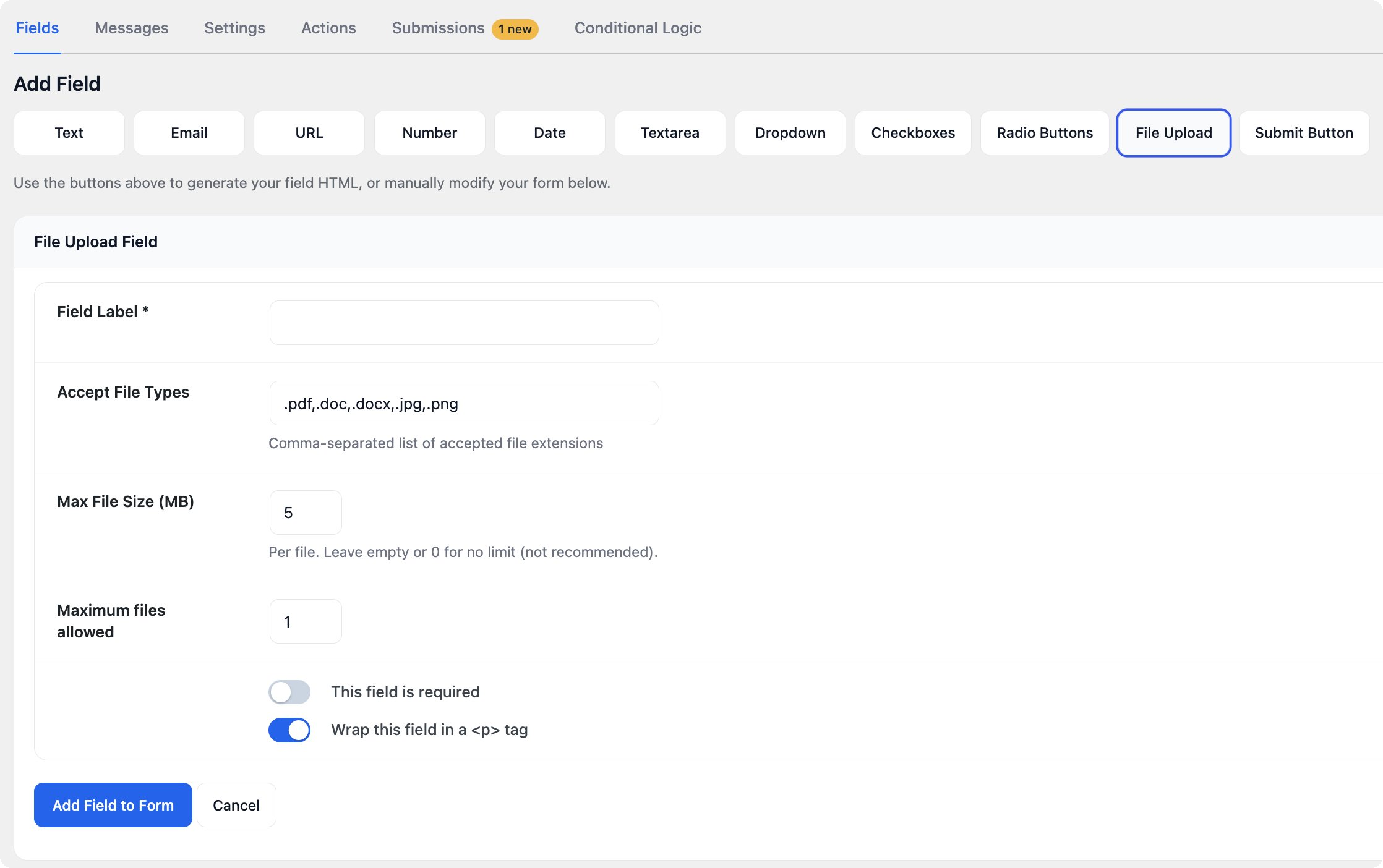
- A built in HTML editor. One click field buttons generate the markup for common fields, and a live preview shows the form as you type. Write the HTML by hand, scaffold it quickly with the buttons, or paste a form an AI wrote for you. The editor never hides your markup behind a visual builder, so what you see is what ships.
- A built in AI form builder. Describe the form you want and let AI write the HTML for you inside WordPress, then keep refining it by chatting. You bring your own API key for an OpenAI compatible provider (DeepSeek, OpenAI, OpenRouter, or a custom endpoint), so you control the model and the cost. Your key is stored for administrators only and is never exposed to visitors.
- Conditional logic. Show or hide any field based on what the visitor enters, using simple match rules. A hidden required field is dropped from validation automatically, so a conditional logic rule never blocks a submission.
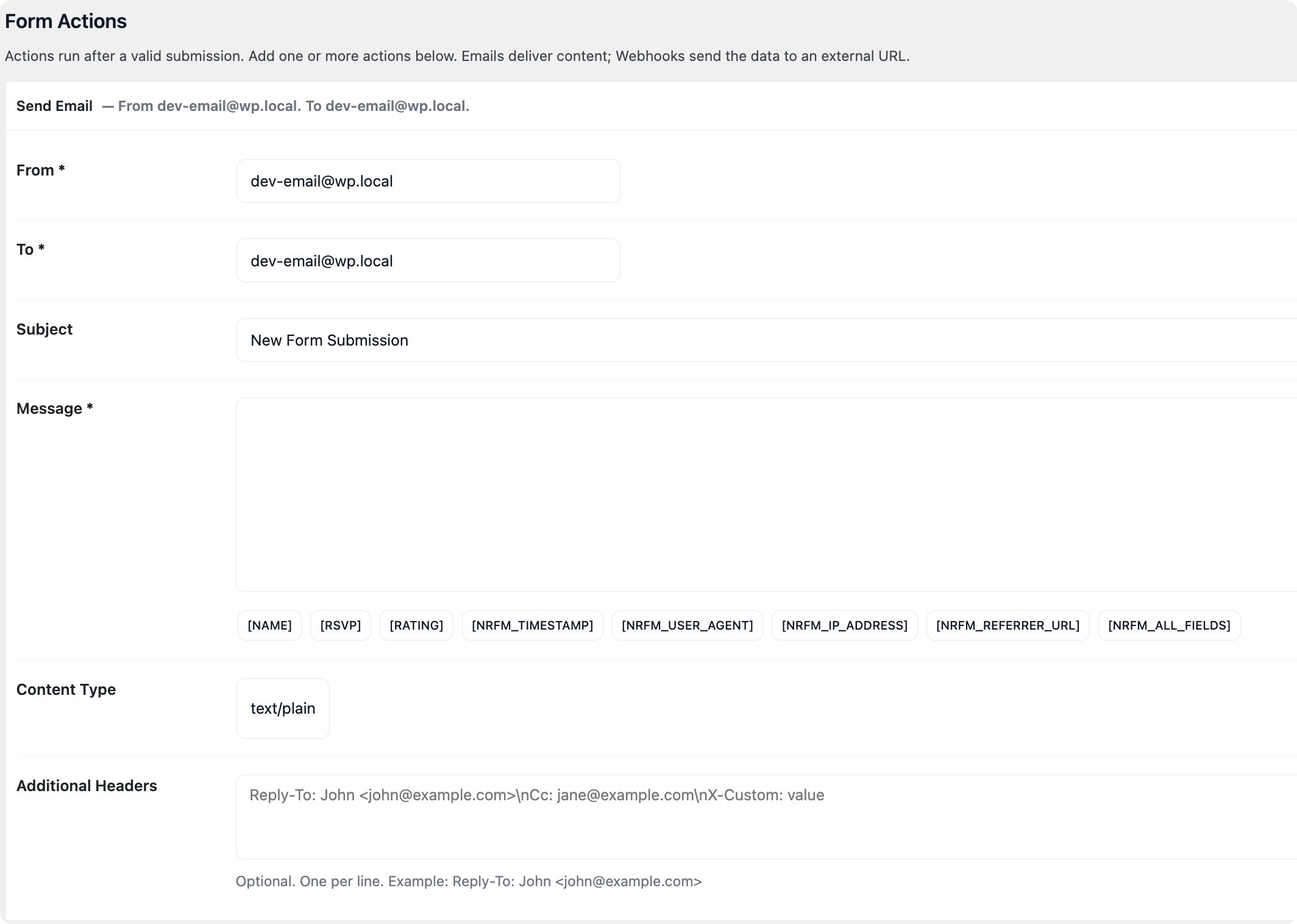
- Email notifications. Send a clean, readable email for every form submission, to yourself or any address, in plain text or HTML. Each field is formatted tidily, and you can route different forms to different inboxes with separate email actions.
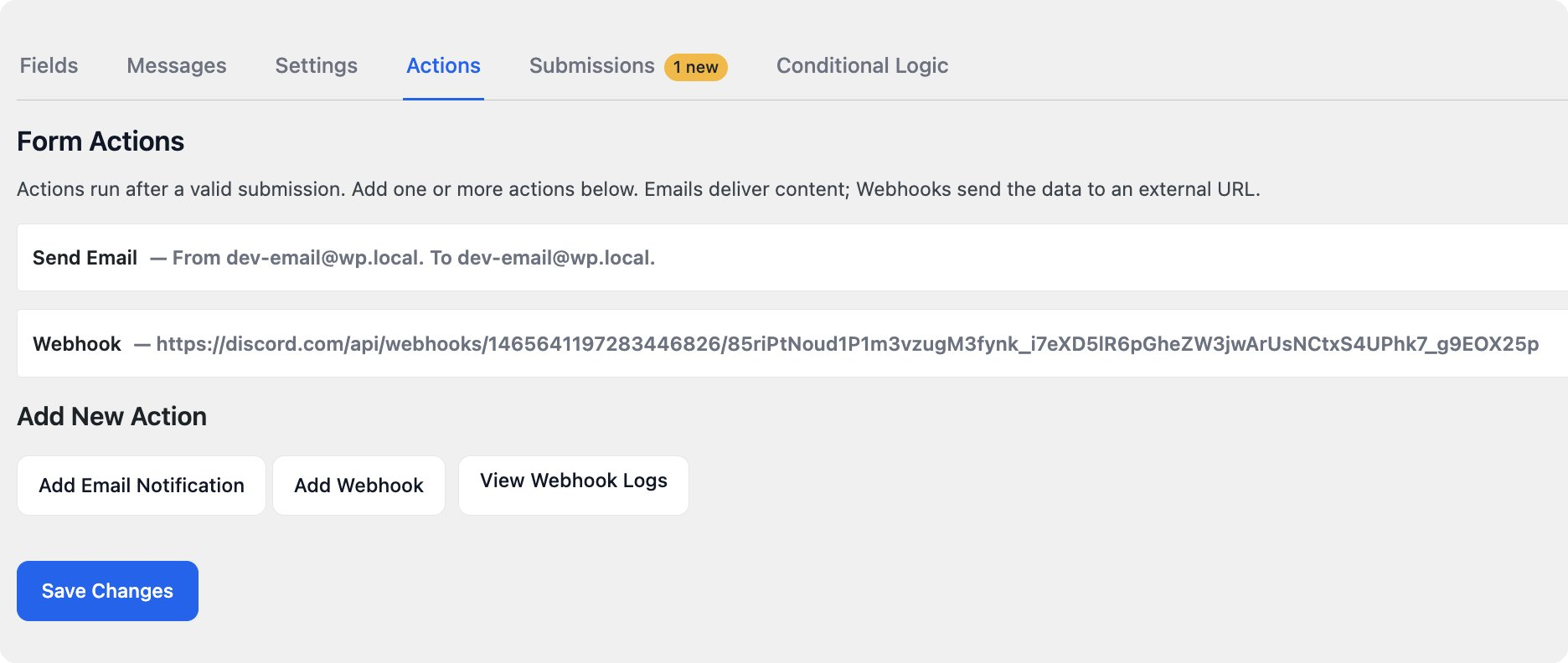
- Webhook actions with delivery logs, retries, and templates. Send form data to any URL when the form is submitted, with no code, and add more than one webhook per form so one submission can fan out to several services. Every webhook call is recorded in a delivery log, failed calls retry automatically with backoff, and reusable webhook templates ship with one click Discord, Slack, and Microsoft Teams presets plus custom JSON payloads and request headers.
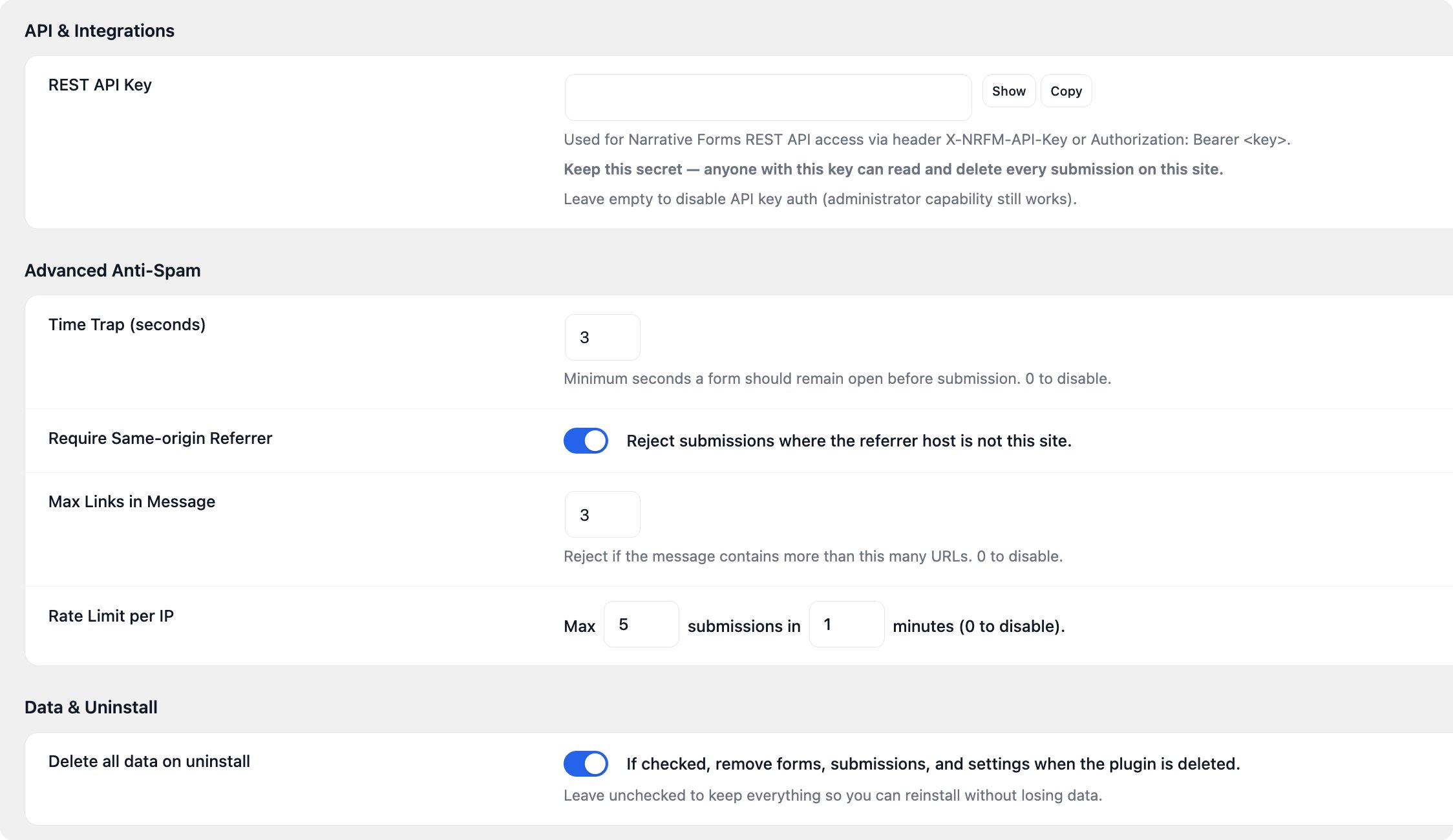
- REST API. Read and manage your form submissions programmatically through a REST API (namespace nrfm/v1), authenticated by a capability check or an API key you generate. Connect your forms to another app, a dashboard, or your own tooling.
- File upload form fields. Accept a file upload field with a maximum file size and a maximum number of files per field. Uploaded files are stored safely in the WordPress media folder and recorded with the submission, so building a file upload form is one paste of HTML away.
- Stored form submissions and CSV export. Optionally keep every submission in a fast, indexed database table that you browse in the admin. Run a CSV export of your form submissions at any time; the export streams in batches, so it works even with very large numbers of submissions and never times out.
- Save and resume. Let visitors save a long form as a draft and continue later from a private resume link. Drafts expire automatically and are cleared once the form is submitted.
- Submission notifications. An unread badge on the Forms menu and the submissions list flags new entries, so a fresh form submission never slips by.
- Require login. Restrict any form to logged in users only, with your own message and login link for signed out visitors.
- Schedule windows. Open and close a form automatically on the dates and times you set, with separate messages for before it opens and after it closes.
- Direct share links. Give any form its own hosted URL, so you can share a working form without adding it to a page or copying a shortcode.
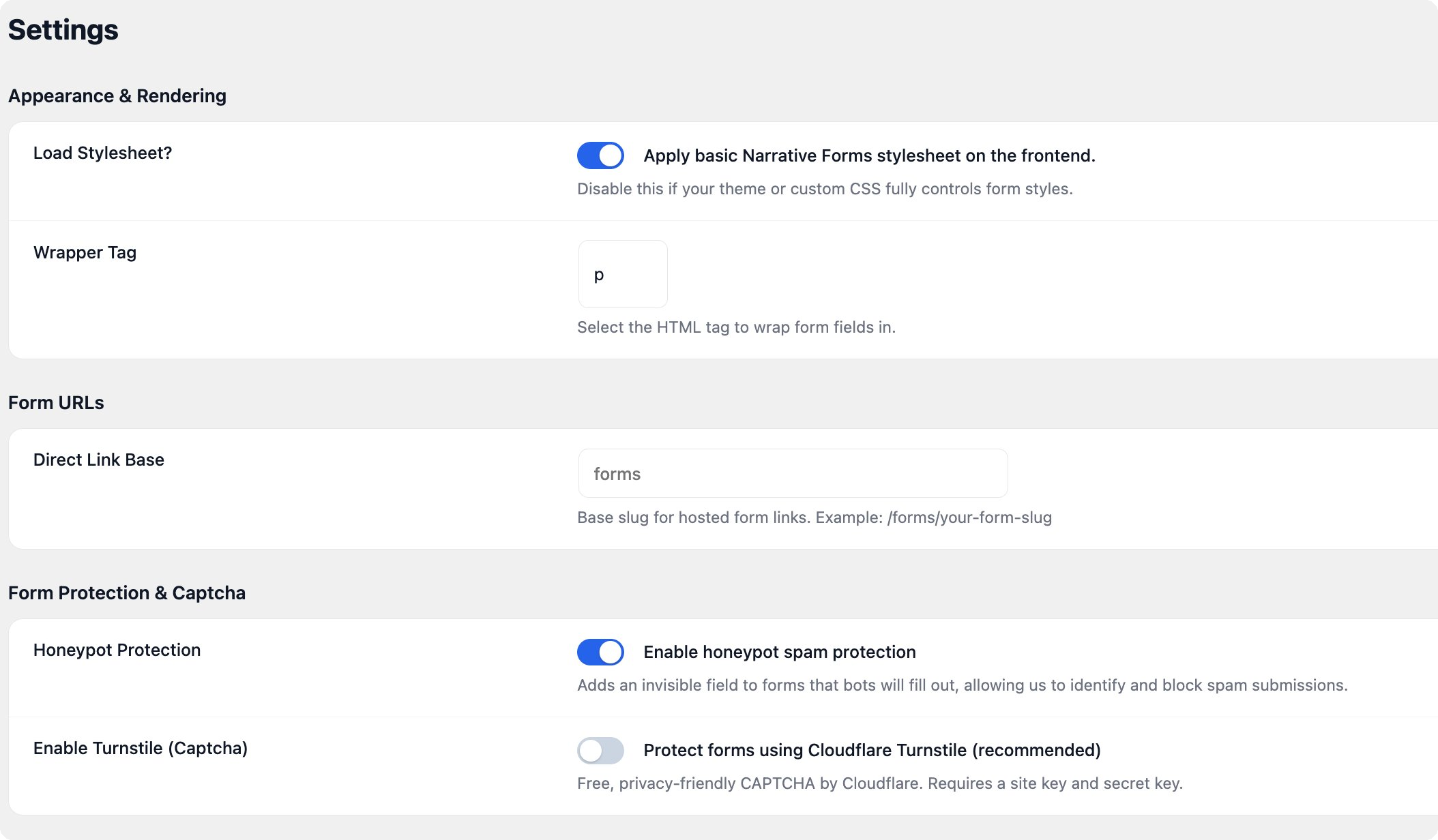
- Layered spam protection. Stop bots with a honeypot, a time trap that rejects instant submissions, a same origin referrer check, a limit on the number of links in a message, and an optional rate limit per IP. You can also switch on Cloudflare Turnstile for a privacy respecting CAPTCHA. This spam protection adds no third party tracking to your site.
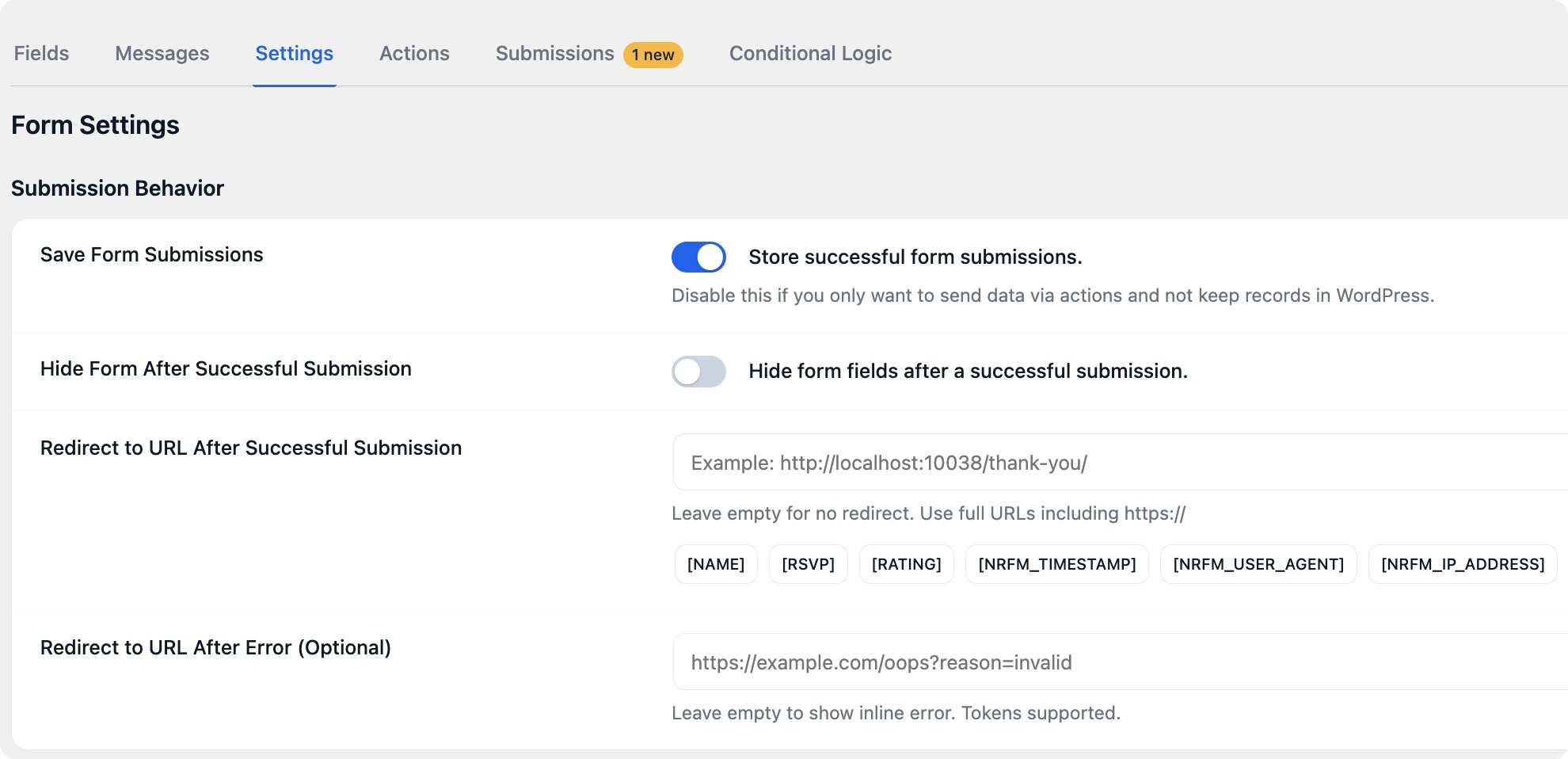
- Custom messages and redirects. Set your own success and error messages, redirect to any URL after a successful submit, and use template tags so the form behaves exactly how you want.
- Clean, optional styling. A calm, minimal stylesheet ships with the plugin and is on by default, and you can switch it off in one click if your theme or custom CSS should own the look. Semantic wrapper classes keep your theme in charge of how your HTML form appears.
nrfm-submit, nrfm-submitted, nrfm-success, nrfm-error) let you push conversions to Google Tag Manager or your dataLayer, show a toast, or run any custom logic with a tiny nrfm.on() helper. Filters and actions sit at every decision point, including the form HTML, validation, and webhook request arguments, and a REST API is available for reading and managing form submissions, so you can extend this HTML form plugin without forking it.
Built to scale to millions of form submissions
Narrative Forms is engineered for sites that collect a lot of data. Form submissions live in a dedicated, indexed database table rather than bloated post meta, so lookups stay fast as the table grows. Repeated reads are cached, queries are paginated and bounded, CSV export streams in batches, and heavy work can run in the background so the front end stays quick. Whether you collect ten form submissions a month or millions over time, this lightweight form plugin is designed to stay responsive. Scaling to millions describes the architecture, indexed storage, caching, and bounded queries, rather than a benchmarked guarantee.
Who this HTML forms plugin is for
- Developers and agencies who want a contact form or custom HTML form they fully control, without a heavy builder.
- Anyone who uses an AI assistant: generate the HTML with the built in AI form builder or paste it from ChatGPT, and you are done.
- Site owners who need reliable form submissions, email notifications, webhooks, file upload forms, and CSV export without the bloat.
- Teams that want conditional logic, require login, scheduled forms, and a REST API without paying for a premium tier.
- Teams that have outgrown a drag and drop form builder and want a faster, lighter way to build forms.
屏幕截图:
常见问题:
What is the best HTML form plugin for WordPress?
If you want full control of your markup, Narrative Forms is built to be the simplest HTML form plugin for WordPress. You write or paste plain HTML, or generate it with an AI, and any input with a name attribute becomes a saved field. There is no drag and drop builder and no field type registry to limit you, so the form is exactly what you build, from a basic contact form to a complex custom form with conditional logic and file uploads.
How do I create an HTML contact form without a builder?
Go to Narrative Forms, then Add New, and write or paste your contact form HTML, or use the one click field buttons to scaffold it. Give every input, select, and textarea a name attribute so its value is saved. Copy the generated shortcode into any post, page, or block, and your HTML contact form is live with fast AJAX form submissions and optional stored data.
Does Narrative Forms have a built in AI form builder?
Yes. The built in AI form builder writes the form HTML for you inside WordPress: click Generate with AI, describe the form you want, and keep refining it by chatting. You bring your own API key for an OpenAI compatible provider such as DeepSeek, OpenAI, or OpenRouter, so you control the model and the cost. You can also paste a form from ChatGPT, Claude, or Gemini, because Narrative Forms saves any named HTML field.
How do I show or hide fields with conditional logic?
Open the form's Conditional Logic tab and add a rule such as show or hide a field when another field equals, contains, is greater than, or is empty. Conditional logic runs in the browser for an instant response and is enforced again on the server, and any required field hidden by a rule is dropped from validation so it never blocks a submission.
How do I send form data to a webhook such as Discord, Slack, or Zapier?
Open the form's Actions tab and add a webhook action with your endpoint URL. On each submission the field data is sent to that webhook URL, so you can connect Narrative Forms to Zapier, Make, a CRM, or your own service without writing code. Webhook templates include one click Discord, Slack, and Teams presets, every call is recorded in a delivery log, and failed webhooks retry automatically. You can add more than one webhook per form.
Where are form submissions stored, and can I export them to CSV?
You can optionally store every submission in a dedicated, indexed database table that you view in the admin. Run a CSV export of your form submissions at any time; the export streams in batches, so it works even with very large numbers of submissions. You can also forward form submissions by email or webhook, or read them through the REST API, instead of or in addition to storing them.
Is there a REST API for form submissions?
Yes. Narrative Forms exposes a REST API under the nrfm/v1 namespace so another application can read and manage your form submissions. Requests are authenticated by a capability check or by an API key you generate in Settings, so access stays under your control. It is handy for dashboards, integrations, and your own tooling.
Can I display form submissions on the front end?
Yes, with the Narrative Forms Frontend Submissions add on, which publishes your form submissions as public Views such as directories, testimonials, galleries, and listings, with instant search, single pages, per field privacy, and approval moderation. Frontend submission display is the one paid add on; the free HTML form plugin focuses on collecting, storing, and routing your form submissions.
更新日志:
- Fixed: forms placed in a page through a theme template (rather than in the page content) now load their script and styles correctly, so they submit without a page reload and show a properly styled confirmation message.
- New: edit submissions. Update any entry from the Edit action on the submissions list, and optionally include a secure, expiring edit link in a confirmation email or redirect so people can update their own submission.
- Fixed: fields whose name contains "token" (for example a price token) are no longer dropped as spam. Re-enter any affected values.
- Fixed: direct share links now work right after you change the Direct Link Base, with no need to visit Settings then Permalinks to refresh.
- Fixed: on the form Settings tab, the direct link field and Copy button no longer occasionally stay hidden until a page refresh.
- New: webhook delivery logs and automatic retries. See every webhook call and its response, and failed calls retry automatically with backoff.
- New: webhook templates with Discord, Slack, and Microsoft Teams presets, plus custom JSON payloads and request headers.
- New: REST API for form submissions (namespace nrfm/v1), authenticated by a capability check or an API key.
- New: require login. Restrict any form to logged in users, with your own message and login link.
- New: schedule windows. Open and close a form automatically on the dates and times you set.
- New: direct share links. Give any form its own hosted URL, with no page or shortcode required.
- New: built in AI form builder. Describe a form and let AI write the HTML for you inside WordPress, then keep refining it by chatting. Bring your own API key for an OpenAI compatible provider (DeepSeek, OpenAI, OpenRouter, or a custom endpoint). See the External services and Privacy sections.
- New: conditional logic. Show or hide any field based on what the visitor enters.
- New: save and resume. Visitors can save a long form as a draft and finish later from a private resume link.
- New: submission notifications. An unread badge flags new form submissions in the admin.
- Added a developer hook for add-ons: nrfm_field_buttons_after (after the editor toolbar).
- Fixed a Security check failed error that could appear when dismissing the usage analytics notice on the form edit screen.
- Deleting submissions now shows a confirmation message, and bulk deletes ask before removing.
- Fixed the form preview being clipped at its edges.
- Internal cleanup: removed unused code, including a dead admin action handler and an unused plugin constant.
- New installs now include a ready to use Contact Form with a dropdown, so you do not start from a blank screen.
- The basic Narrative Forms stylesheet is now enabled by default on new installs.
- Simplified the field setup panel by removing a nested box.
- Removed the redirect after error option. Form errors now always show inline, the same way in AJAX and non JavaScript submissions.
- Forms whose template includes its own form tag now render and submit correctly; the plugin always provides the form wrapper.
- Added optional usage analytics through the Appsero SDK. Nothing is collected unless you allow it in the admin notice. See the Privacy section.
- Readme updated.
- Initial release of Narrative Forms, the HTML form plugin built on plain HTML.
- Build contact forms and custom forms by writing or pasting any semantic HTML.
- Built in editor with one click field buttons and a live preview.
- Fast AJAX form submissions with a fallback when JavaScript is off.
- Stored form submissions in a dedicated, indexed table with batched CSV export.
- Email notifications and webhook actions for every submission.
- File upload form fields with a size limit and a file count limit for every field.
- Layered spam protection: honeypot, time trap, referrer check, link limit, rate limit per IP, and optional Cloudflare Turnstile.
- Template variables for prefilling fields, public JavaScript events, and developer hooks.
- Customisable success and error messages, redirects, and template tags.