
RankBotAI – AI SEO Optimizer for RankMath & Yoast
| 开发者 | ksanyok |
|---|---|
| 更新时间 | 2026年8月16日 18:29 |
| PHP版本: | 7.4 及以上 |
| WordPress版本: | 7.1 |
| 版权: | GPLv2 or later |
| 版权网址: | 版权信息 |
详情介绍:
- Connect your site (free account, free monthly credits — no credit card).
- Open Bulk Optimization, filter to "posts with no focus keyword".
- Press start. Background processing does the rest — roughly 700 items/hour.
- Check the History log. Don't like something? Restore that one item, that one content type, or the whole site.
- It scales the part that does not scale. A WooCommerce catalog with 3,000 products is a month of freelancer work. Here it is an afternoon of background cron.
- It never leaves you stuck. Snapshots are taken before every change, and Restore works per item, per content type, or site-wide.
- It respects your SEO plugin. Values are written into Rank Math / Yoast / AIOSEO fields — no lock-in, no shadow database, nothing breaks if you deactivate RankBotAI.
- It writes in your language. The AI detects the source language of each post or product and answers in it — Ukrainian content stays Ukrainian.
- It does not hallucinate your catalog. Strict anti-hallucination rules: no invented prices, no competitor brands, no
[placeholder]text, facts from your content only.
- Optimize 1 product page — SEO specialist: 15–30 min vs. RankBotAI: ~10 sec
- Research & set focus keywords (100 pages) — SEO specialist: 2–3 days vs. RankBotAI: ~20 min
- Write meta titles & descriptions (100 pages) — SEO specialist: 1–2 days vs. RankBotAI: ~15 min
- Full SEO audit + optimization (500 pages) — SEO specialist: 2–4 weeks vs. RankBotAI: ~2 hours
- Bulk optimize an entire WooCommerce catalog — SEO specialist: weeks/months vs. RankBotAI: hours
- Availability — SEO specialist: business hours vs. RankBotAI: 24/7/365
- Monthly cost (100 pages/mo) — Freelance SEO: $500–$2,000 · Agency: $2,000–$10,000 · RankBotAI: from $0 (free tier)
- Per-page optimization — Freelance SEO: $5–$20 · Agency: $10–$50 · RankBotAI: ~$0.01–$0.15
- Speed to results — Freelance SEO: days–weeks · Agency: weeks · RankBotAI: minutes
- Works 24/7 — Freelance SEO: no · Agency: no · RankBotAI: yes
- Consistent quality — Freelance SEO: varies · Agency: varies · RankBotAI: always consistent
- AI-Powered Meta Generation — Automatically generate optimized SEO titles, meta descriptions, and focus keywords
- Smart Focus Keyword Research — AI analyzes your content and suggests the best focus keyword, avoiding keywords already used elsewhere on the site
- Bulk Optimization — Process hundreds or thousands of pages in the background via WP-Cron, with live progress, speed and ETA
- Taxonomy Optimization — Optimize categories, tags and any custom taxonomy term (single & bulk)
- Backup & Restore — Snapshots before every change; restore a single item, one content type, or the whole site
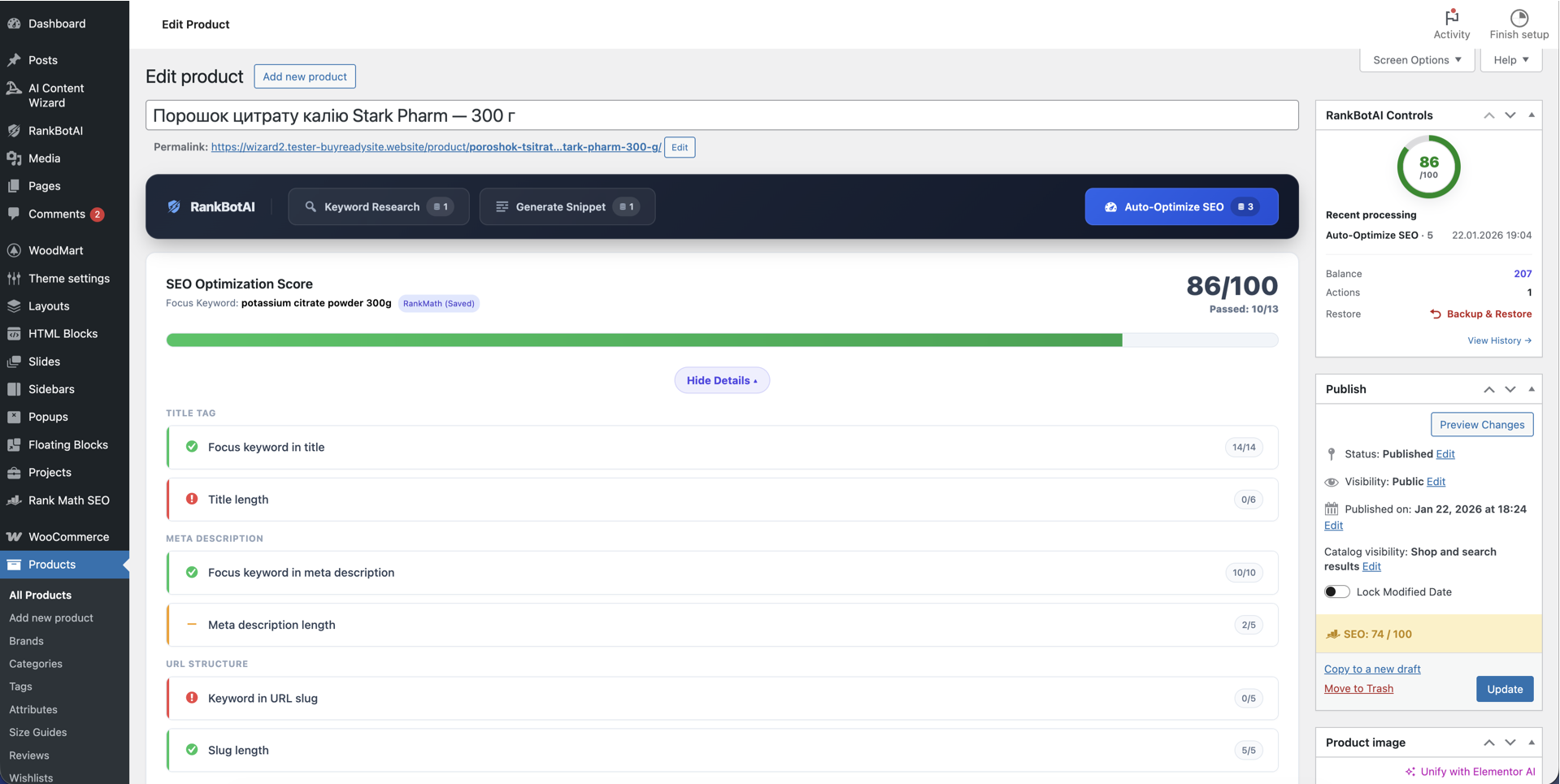
- 100-Point SEO Scoring — Real-time SEO analysis with actionable recommendations
- Rank Math & Yoast Integration — Reads and writes SEO fields for Rank Math, Yoast SEO, and AIOSEO
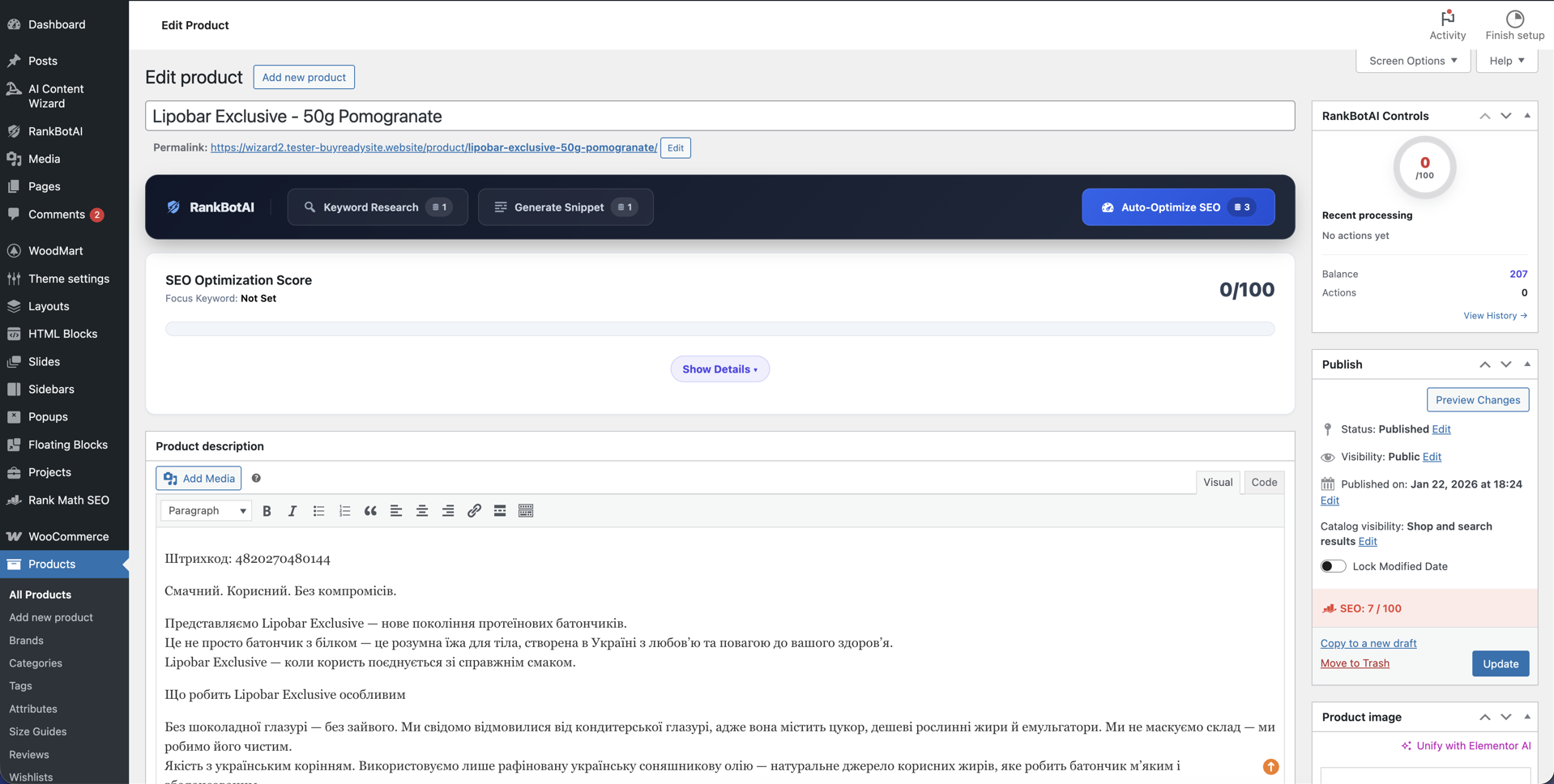
- WooCommerce Ready — Products, product categories and attributes, with a dedicated "RankBot AI" tab in Product Data
- Content Optimization — AI can improve your post/product content for better SEO (opt-in)
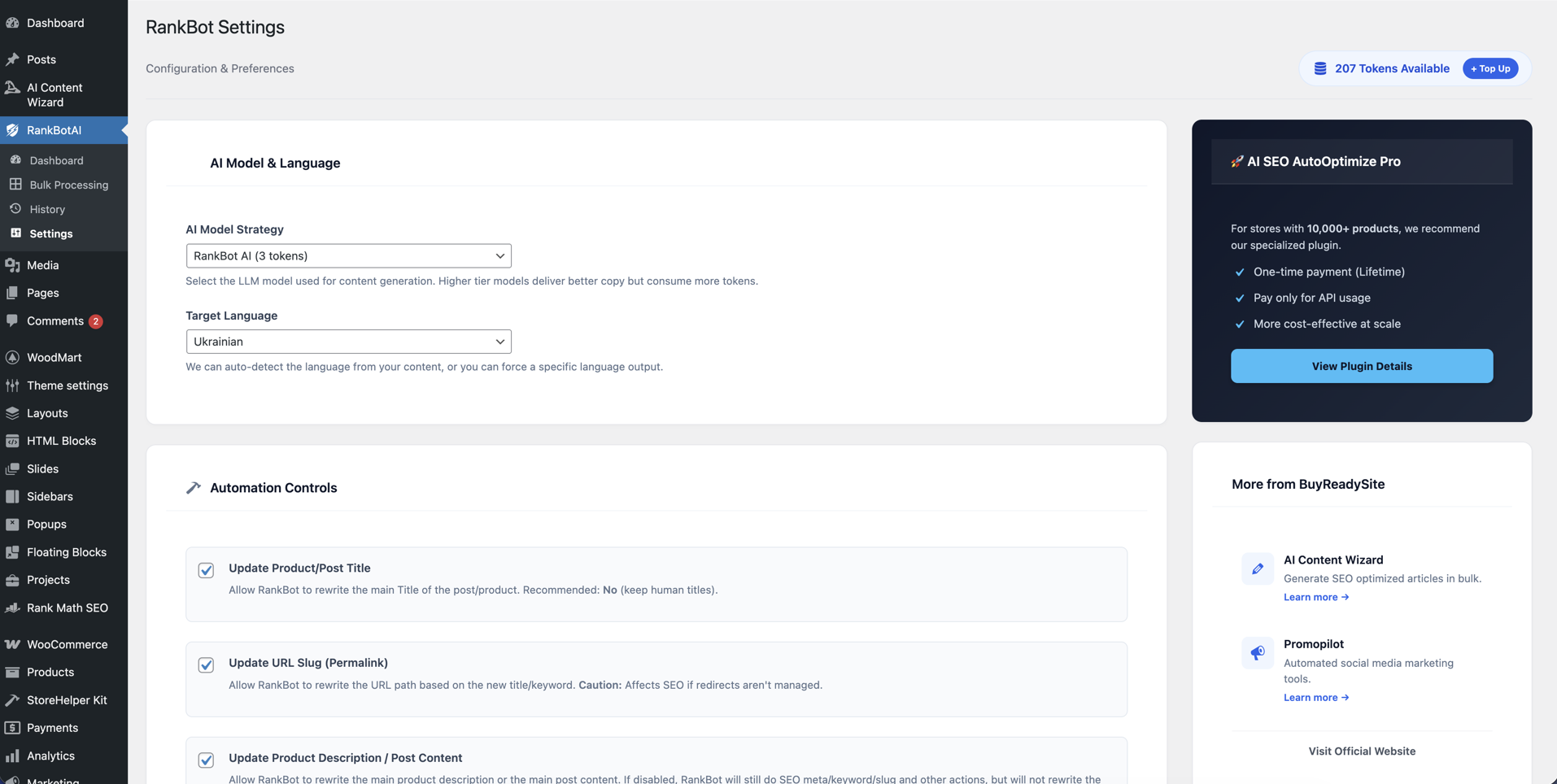
- Global Instructions for AI — Site-wide rules injected into every generation ("never mention free shipping", "always add this disclaimer")
- Local-First History — History is mirrored to a local table and read locally first, keeping dashboards instant even on 40,000+ item sites
- llms.txt Generator — Publish a structured site map for AI search engines
- Schema.org JSON-LD — Article and enhanced WooCommerce Product structured data
- A/B Testing — Rotate two meta title/description variants and track impressions
- CSV Export / Import — Bulk edit SEO data outside WordPress and import it back
- SEO Checklist & Gutenberg Sidebar — Score, checklist and one-click optimization inside the block editor
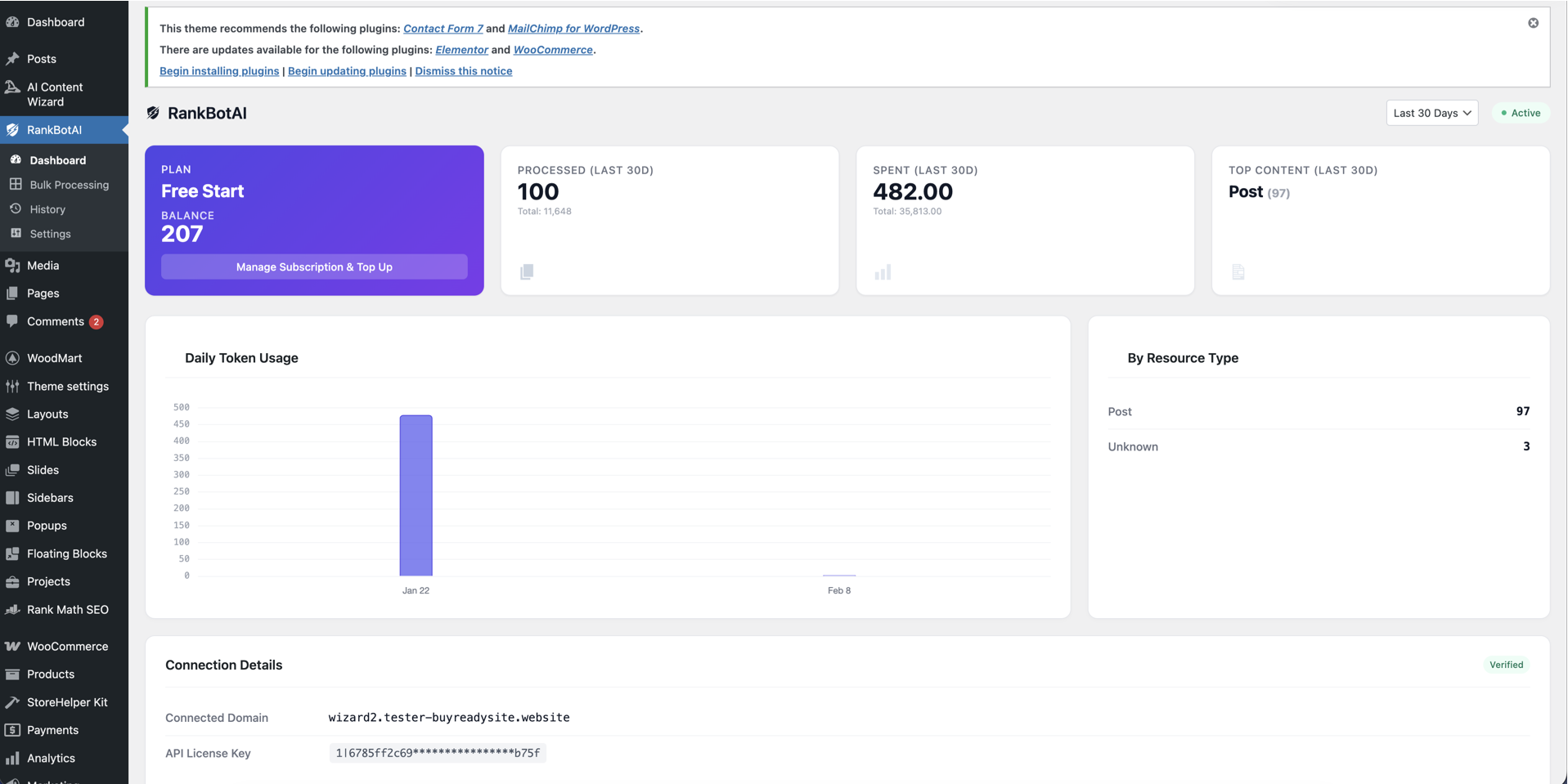
- Dashboard Widget & Admin Bar — SEO health overview and live job monitoring
- Free Credits & Referrals — Earn credits by inviting friends, sharing, or reviewing
- Advanced AI Engine — Multi-model system with automatic failover; nothing to configure
- Install and activate the plugin
- Connect your site to the RankBotAI service (free account)
- Start optimizing — click "Auto Optimize" on any post, or launch bulk processing
- AI generates optimized SEO data and applies it to your content
- Your SEO fields in Rank Math / Yoast are updated automatically
- Rank Math SEO — Full integration: reads/writes focus keywords, meta titles, and descriptions
- Yoast SEO — Full integration: reads/writes focus keywords, meta titles, and descriptions
- All in One SEO (AIOSEO) — Basic integration for meta fields
- WooCommerce — Optimized for products with enhanced Product JSON-LD schema
- WPML & Polylang — Per-post language detection for multilingual sites
- Works standalone — If no SEO plugin is installed, RankBotAI stores data in its own meta fields
安装:
- Upload the plugin folder to the
/wp-content/plugins/directory. - Activate the plugin through the 'Plugins' screen in WordPress.
- (Recommended) Install and activate Rank Math SEO or Yoast SEO for the best experience.
- Go to the RankBotAI menu in wp-admin and connect your site.
- Start optimizing your content!
屏幕截图:


常见问题:
Does this plugin require an external service?
Yes. The plugin connects to the RankBotAI service API to generate SEO suggestions and optimizations. A free tier with monthly free credits is available, and no credit card is required to start.
Is this plugin free?
The plugin is free and GPL-licensed. The RankBotAI service provides a free credit tier and offers paid plans for additional usage and higher limits.
Does RankBotAI work with Yoast SEO / Rank Math?
Yes! RankBotAI is specifically designed to complement Rank Math and Yoast SEO. It reads existing SEO data from these plugins and writes optimized values back into their own fields — so your SEO data stays exactly where it was, and nothing is lost if you deactivate RankBotAI.
Can I use RankBotAI without Rank Math or Yoast?
Yes. RankBotAI works standalone and stores SEO data in its own meta fields. However, for the best SEO results, we recommend pairing it with Rank Math or Yoast SEO.
Will it overwrite meta titles and descriptions I wrote myself?
Only the items you select. Bulk Optimization has filters such as "only items without a focus keyword" and "only unprocessed items", so you can target the gaps and leave your hand-written work untouched. And every change is snapshotted before it is applied.
Can I undo the changes?
Yes — that is the point of the Backups & Restore page. You can roll back a single post or product from the History log, roll back one content type, or roll back the entire site to its pre-RankBot state.
Does it work with WooCommerce products?
Yes. Products, product categories and product attributes are supported, including a dedicated "RankBot AI" tab inside the Product Data box. Bulk optimization of a full catalog is the most common use case.
Can it optimize categories and tags?
Yes. Any public taxonomy term — categories, tags, product categories, custom taxonomies — can be optimized individually or in bulk, with the same backup and restore guarantees.
What language will the generated text be in?
The same language as the source content. The AI detects the language of each post or product and writes in it. WPML and Polylang sites are detected per post.
Can I tell the AI what it must never write?
Yes. Global Instructions (Settings) let you set site-wide rules that are injected into every generation — for example "never promise free shipping", "always mention that packaging may vary", or "describe only the product in the title".
How fast is the optimization?
Most single-page optimizations complete in 5–15 seconds. Bulk optimization runs in the background at roughly 700 items/hour on a healthy connection, so 100+ pages typically finish within 15–30 minutes.
Does it slow down my site for visitors?
No. All AI processing happens on the RankBotAI service and in background WP-Cron jobs in wp-admin. On the frontend the plugin only outputs meta tags and JSON-LD structured data.
What data does the plugin send to the API?
It sends only the data needed for the action you trigger. This can include your site URL, environment info (WordPress/plugin version), and the post/product/term content you request to optimize.
What AI models are available?
RankBotAI uses its own RankBot AI engine — an advanced multi-model system with automatic failover. You don't need to choose or configure any models. The system automatically selects the best available model for each request.
Does RankBotAI modify my content?
Only if you explicitly enable content optimization in settings. By default, RankBotAI only updates SEO meta fields (title, description, focus keyword). Content changes require opt-in.
What is llms.txt and why should I care?
llms.txt is a plain-text map of your site aimed at AI crawlers (ChatGPT, Perplexity, AI Overviews). It helps them understand and cite your pages correctly. RankBotAI generates and manages it for you.
更新日志:
- COMPAT: Tested with WordPress 7.1. The block-editor sidebar, classic-editor toolbar and admin-bar widget were reviewed against the 7.1 iframed editor, persistent editor toolbar and updated editor components — no changes required. The plugin uses no jQuery UI, so the jQuery UI 1.14.2 update does not affect it.
- COMPAT: Minimum WordPress version raised to 6.2. The plugin uses
%itable-identifier placeholders in$wpdb->prepare(), which were introduced in WordPress 6.2 — on older versions those queries silently returned nothing. - FIX: Fatal error on PHP 7.4. The plugin declared PHP 7.4 support but called the PHP 8 functions
str_contains()/str_starts_with(), which crashed the site with "Call to undefined function". Polyfills added. - FIX: Duplicate structured data. RankBotAI emitted its own Article/Product JSON-LD block even when Rank Math, Yoast or AIOSEO already output a full schema graph, causing "Duplicate field" warnings in Search Console. It now extends the active SEO plugin's schema instead, and a
rankbot_ai_force_schema_outputfilter is available to restore the old behaviour. - SECURITY: Hardened the JSON-LD output — a title or meta description containing
</script>could break out of the structured-data block and inject markup into the page head. - SECURITY: The site-connection callback now requires a one-time
statevalue generated by this site, so an activation link crafted by someone else can no longer silently re-bind the site to another RankBotAI account. - FIX: A/B testing — the sticky-variant cookie was set from
wp_head, i.e. after headers were already sent, so it was never actually stored and visitors were re-randomised on every pageview. The variant is now resolved ontemplate_redirect. - FIX: A/B testing no longer prints a second
<meta name="description">next to Rank Math / Yoast. With an SEO plugin active, the variant is applied through that plugin's own description filter, so the test actually takes effect. - PRIVACY: Removed the Inter / JetBrains Mono webfont request to
fonts.googleapis.com. No admin IP addresses are shared with Google any more, and wp-admin loads one render-blocking request less. The UI falls back to the system font stack that the rest of the plugin already used. - IMPROVED: API request bodies are encoded with
wp_json_encode(), which sanity-checks UTF-8 — content with broken encoding no longer produces an empty request body. - IMPROVED: Random variant selection uses
wp_rand(). - DOCS: Readme rewritten — clearer positioning, expanded FAQ, and an honest statement of translation coverage (English/Ukrainian/Russian complete; German/Spanish/Polish partial). The following fixes were rolled out on the RankBotAI service on 2026-07-31 and reached every site without a plugin update. They are listed here for the record:
- SERVICE: Optimization no longer stalls on non-automotive catalogs. A validator rule that rejected wording like "universal", "fits any car" or "leather care" was written for auto-parts stores but was being applied to every product. On clothing, cookware or cosmetics — where "universal size" is perfectly normal copy — it rejected good output until the job hit max retries and was abandoned. The rule is now scoped to automotive context, and other niches get their own "use only the facts in the title, description and attributes" guidance.
- SERVICE: Top-ups fixed. Accounts whose
payments/user_subscriptionstables predated the gateway and billing-period columns could not pay at all — every top-up failed with "Unknown column 'billing_period'". The missing columns are now migrated automatically. - SERVICE: Paid models are no longer pushed into the shared dead-model cache after a transient provider error. That was the root cause of runs failing with "all free models exhausted" while the paid fallback sat disabled.
- SERVICE: Replaced the retired
gemini-2.0-flash-001model — the provider had started answering 404 "no endpoints" — withgemini-2.5-flash.
- NEW: Complete "Sunset Premium" v2.0 admin redesign — Dashboard, Bulk Processing, Onboarding, Settings, History, Restore and llms.txt rebuilt on a new design system (sunset gradient, Inter + JetBrains Mono, smooth animations, glow & particle effects).
- NEW: Dashboard now features a gradient plan/balance card with particles, an SEO success-rate donut, redesigned stat tiles, a token-usage chart and a Quick Actions panel.
- NEW: Local-first history storage — optimization history is mirrored to a local table and read locally first, so dashboards, History and Backups stay instant even on sites with 40,000+ processed items. Full history is back-filled from the cloud once in the background and kept in sync, drastically reducing server load and latency.
- NEW: Taxonomy AI-optimization — optimize categories, tags and any custom taxonomy term (single and bulk), with backups and restore.
- NEW: Per-item restore in History — roll back a single post, product or term to its pre-RankBot snapshot with one click. The Restore page was rebuilt with selective, by-content-type and full-site modes.
- NEW: Free Credits hub — invite friends, share on X, review on WordPress.org or subscribe to the digest. Referral credits are granted automatically when an invited site connects; one-time growth bonuses are credited instantly (one claim per account).
- NEW: Dedicated "RankBot AI" tab inside WooCommerce Product Data — the quick-access action bar above the product title is kept as well (two entry points).
- NEW: Sunset-themed Gutenberg editor sidebar and classic-editor toolbar.
- NEW: Two-column llms.txt editor with a live terminal-style preview.
- NEW: Full Ukrainian and Russian interface translations (all UI strings) on a regenerated translation template.
- IMPROVED: Database optimization and additional indexes for faster history and stats queries.
- FIX: Category/taxonomy optimization no longer retries indefinitely (the service now accepts
seo_title/seo_description/keywordresult aliases). - FIX: Resolved the "Undefined array key 'description'" PHP warning emitted by the JSON-LD schema output on product/post pages.
- FIX: Translations now load the bundled plugin language files first, preventing a stale global
.mo/.l10n.phpfrom shadowing fresh strings. - PERF: Added automatic retention/cleanup for backend
jobsandsite_operationspayloads (cron) — heavy AI request/response data is pruned after 30 days, preventing database bloat.
- FIX: Added hybrid stats source — API now falls back to
jobstable ifusage_logsis empty, fixing counter display for sites with historical data. - IMPROVED: Backward compatibility for old sites that haven't migrated to new
usage_logsbilling model yet. - FIX: Total processed count now properly returns historical job count instead of remaining at zero.
- FIX: Unified dashboard counters between plugin admin and cloud dashboard — processed and spent values now use a single source (
usage_logs) to avoid mismatches. - FIX:
/api/v1/historystats no longer inflate "processed" by counting internal lifecycle events fromsite_operations. - NEW: Added API stats fields for 7/30-day windows (
period_7_ops,period_7_spent,period_30_ops,period_30_spent) for accurate plugin period cards. - IMPROVED: Plugin dashboard now prefers API-provided period aggregates and does not depend on the first history page sample.
- IMPROVED: Replaced hardcoded UI version marker in Global Instructions block with dynamic plugin version.
- NEW: Global instructions for AI (custom prompt) — set site-wide rules that are injected into EVERY AI generation. Useful to ban specific topics ("do not mention free shipping"), enforce disclaimers ("note that the manufacturer can change package contents") or restrict scope ("describe only the product specified in the title — do not invent unrelated items"). Stored on the RankBotAI server, applied at prompt-build time. Max 2000 characters.
- NEW: Admin UI block on the main plugin page — connected sites get a textarea with live character counter and one-click cloud sync.
- NEW: Server endpoints
GET /api/v1/site/custom-promptandPOST /api/v1/site/custom-prompt(Bearer-auth, per-site). - NEW: Server endpoint
GET /api/v1/runtime-config— exposes the active AI pool mode (paid_first/free_with_paid_fallback/free_only) and the matching dispatch profile (parallel jobs, polling cadence, stuck-job timeouts). The bulk runner can read this on the fly to scale itself up/down without a plugin update. - NEW: Admin AI Models Pool in the cloud dashboard — three radio-card modes (PAID-FIRST, BALANCED, FREE-ONLY) with cost/speed/quality trade-off summary; per-model RPM/priority editing; one-click discovery of fresh free OpenRouter models.
- IMPROVED: Multi-key rotation — when one OpenRouter / Groq key hits its 20 RPM cap, the model is no longer blacklisted globally; another key for the same model is tried first.
- IMPROVED: Hallucination guard — global instructions are prepended as
CLIENT'S MANDATORY GLOBAL INSTRUCTIONSblock at the very top of the system prompt, with explicit "must override defaults" phrasing. - FIX:
Database::getInstance()typo inOpenAIServicewas silently falling back to default mode — pool mode and active models are now actually read from DB. - FIX:
Cache-Controlheader on/api/v1/runtime-configswitched tono-storeso mode changes propagate to WP within seconds (CDN was caching the old JSON).
- NEW: Rollback All button on Bulk page — one-click restore of every post & product to its pre-RankBot state (batched processing with a modern progress bar, ETA and live items/sec stats).
- NEW: Unique focus keywords in bulk mode — AI receives the list of focus keywords already used across the site and avoids duplicates between products.
- NEW: Universal niche-agnostic prompts — the plugin now produces high-quality SEO for any store type (auto parts, adult, pharmacy, services, electronics, fashion, food, etc.) with strict anti-hallucination rules (no invented prices, no competitor brands, no placeholders, facts-only).
- NEW: Source language auto-detection — AI always writes in the same language as the original product/post content. Supported: Ukrainian, Russian, Polish, German, Spanish, English and more.
- NEW: Infinite free retry on failed generations — failed jobs are re-tried without charging extra tokens, with an anti-cycle guard that prevents the same mistake repeating across attempts.
- NEW: AIMD throttle auto-recovery — bulk dispatch concurrency automatically recovers after transient provider errors (no more "stuck at 1 parallel").
- SPEED: Higher bulk concurrency for free OSS model — base 8 / max 12 parallel jobs (was 5 / 8). Target throughput: ~700 items/hour on healthy provider.
- SPEED: Faster AIMD ramp-up — concurrency now grows after every 1 successful tick (was 2) and shrinks by only -25% on errors (was -50%).
- SPEED: Hot-loop cron interval reduced from 5s to 2s while jobs are queued — fewer idle gaps between dispatches.
- IMPROVED: /api/v1/history endpoint up to 100× faster on warm cache (~0.27s vs ~31s) thanks to new composite indexes and 30s server-side file cache.
- IMPROVED: Output validation layer rejects hallucinated placeholders ([brand], {name}, TBD), wrong-length meta tags, and content written in the wrong language.
- IMPROVED: Purged dead and hallucinated model IDs from the free model pool; only verified working OpenRouter & Groq models remain.
- NEW: Speed & ETA indicators in bulk progress bar — shows items/hr, avg time per item, and estimated time remaining
- NEW: ETA display in admin bar badge during bulk processing
- IMPROVED: Server provides timing data for accurate speed calculations across page reloads
- FIX: Critical bulk processing bug — jobs were not saved to local tracking table, causing infinite retry loops
- FIX: Auto-recovery for missing local job rows — polls server to restore sync state
- FIX: Cron poll handler now recovers orphaned jobs from postmeta when local row is missing
- IMPROVED: Product optimization now sends weight, dimensions, tags, and review data to AI
- IMPROVED: AI prompt emphasizes attribute integration and specifications table
- IMPROVED: Short description generation now requires key attributes and focus keyword
- NEW: Schema.org JSON-LD — automatic Article & Product structured data output in wp_head
- NEW: A/B testing for meta titles & descriptions — cookie-based variant rotation with impression tracking
- NEW: Bulk CSV export/import of SEO data (title, description, keyword, score) for all posts, pages, and products
- NEW: Gutenberg block-level SEO tips — real-time analysis of selected blocks (headings, paragraphs, images, lists)
- NEW: Referral dashboard — view referral stats, earned tokens, and share link from the web cabinet
- NEW: API rate limiting — sliding-window per-endpoint limits with 429 Retry-After responses
- NEW: Webhook delivery retry with exponential backoff (up to 3 attempts)
- NEW: Automated cache & rate-limit cleanup cron job
- Settings page: Schema.org toggle + CSV export/import card
- NEW: Redesigned dashboard with 5-column stats grid, activity feed with clickable page links, and resource type bar charts
- NEW: Smart SEO Tips in editor sidebar — contextual suggestions based on on-page analysis (keyword placement, content structure, linking)
- NEW: WPML & Polylang multilingual support — automatic per-post language detection for AI optimization
- NEW: Weekly email digest reports with optimization stats, activity summary, and balance overview
- NEW: Prompt caching — avoids duplicate AI calls for identical keyword/snippet requests (24h TTL)
- NEW: Webhooks — receive POST notifications when jobs complete or fail, with HMAC-SHA256 signatures
- NEW: Referral program — earn 10 bonus credits for each referred user
- NEW: Analytics API endpoint — daily aggregated stats, action breakdowns, top optimized resources
- NEW: Top-up button integrated directly in the dashboard balance card
- NEW: Activation hero screen — beautiful onboarding page when plugin is not yet connected
- NEW: Menu items hidden until API key is activated for cleaner admin experience
- NEW: Full public REST API documentation in llms.txt
- Improved editor sidebar: SEO checklist + smart tips + H2 heading check + external link check
- Dashboard shows success rate, recent processed pages with direct links, and version number
- Settings page: weekly digest toggle in Interface section
- Various UI/UX improvements and performance optimizations
- NEW: Advanced AI engine with automatic multi-model failover for maximum reliability
- NEW: Intelligent model selection — the system automatically picks the best available AI model
- NEW: Improved generation quality with enhanced prompt engineering
- NEW: Automatic retry and recovery when a model is temporarily unavailable
- Simplified plugin interface — no more manual model selection needed
- Improved bulk processing stability for large catalogs (10,000+ items)
- Updated credit system with clearer pricing
- Performance optimizations and reduced API response times
- Various bug fixes and reliability improvements
- NEW: llms.txt Generator — create and manage llms.txt file for AI search engine visibility
- NEW: WordPress Dashboard Widget — SEO health overview with average score, missing meta descriptions, and keyword coverage
- NEW: SEO Checklist in post editor sidebar — real-time checks for title length, meta description, focus keyword, content length, image alt text, and internal links
- NEW: Toast notification system — beautiful slide-in notifications replacing standard WordPress notices
- NEW: CSS Design Tokens — unified design system with CSS custom properties for consistent theming
- NEW: Card entrance animations — smooth fade-in animations for dashboard and bulk page elements
- UI: Modernized visual appearance across all admin pages
- Various code quality improvements
- Added SEO plugin detection — recommends installing Rank Math or Yoast SEO if not present
- Improved compatibility with Rank Math and Yoast SEO field handling
- Enhanced plugin stability and error handling
- Updated AI model pricing and availability
- Improved bulk processing reliability with adaptive concurrency
- Added comparison data for SEO specialist vs AI optimization
- Extended plugin description and FAQ
- Version synchronization fix (header and constant now match)
- Various bug fixes and performance improvements
- Minor stability improvements.
- Initial release.