Remoji - Post/Comment Reaction and Enhancement
| 开发者 | Remoji |
|---|---|
| 更新时间 | 2026年7月8日 03:41 |
| PHP版本: | 4.4 及以上 |
| WordPress版本: | 7.0 |
| 版权: | GPLv3 |
| 版权网址: | 版权信息 |
详情介绍:
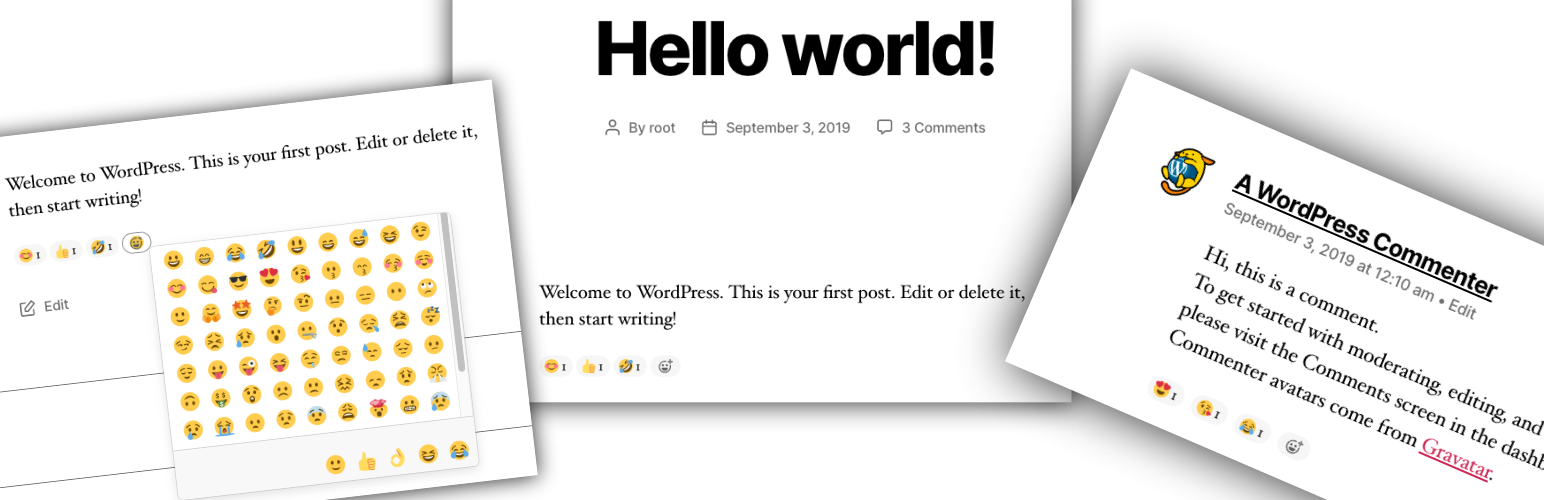
Add the slack style emoji to posts, pages or comments.
Features:
- React with emojis to any post or comment.
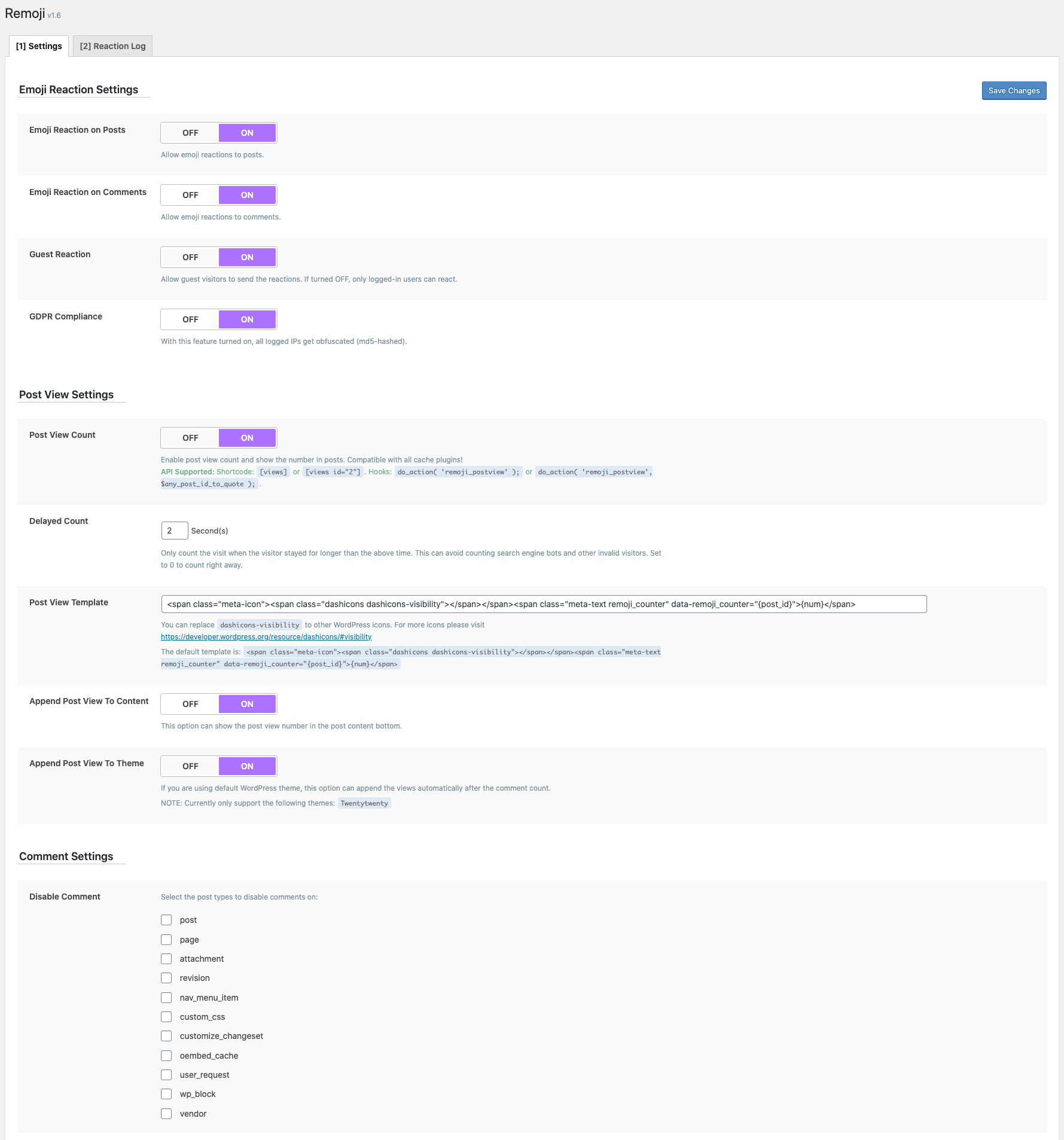
- Post View counter. Compatible with all cache plugins! Easy to use. Automatically exclude bots.
- Disable comment on any post type (pages, posts, attachments).
- Most Viewed widget. Recent Reacted Emoji Post widget.
- Allow guests reaction or logged-in user reaction only.
- GDPR compliant. With this feature turned on, all logged IPs get obfuscated (md5-hashed).
- Edit
wp-content/themes/<YOUR THEME>/index.phporarchive.php/single.php/post.php/page.php. - In the loop
while ( have_posts() ) {or anywhere you want to show the views, add the following codes:do_action( 'remoji_postview' );.
do_action( 'remoji_postview', $the_post_id_to_inquire );.
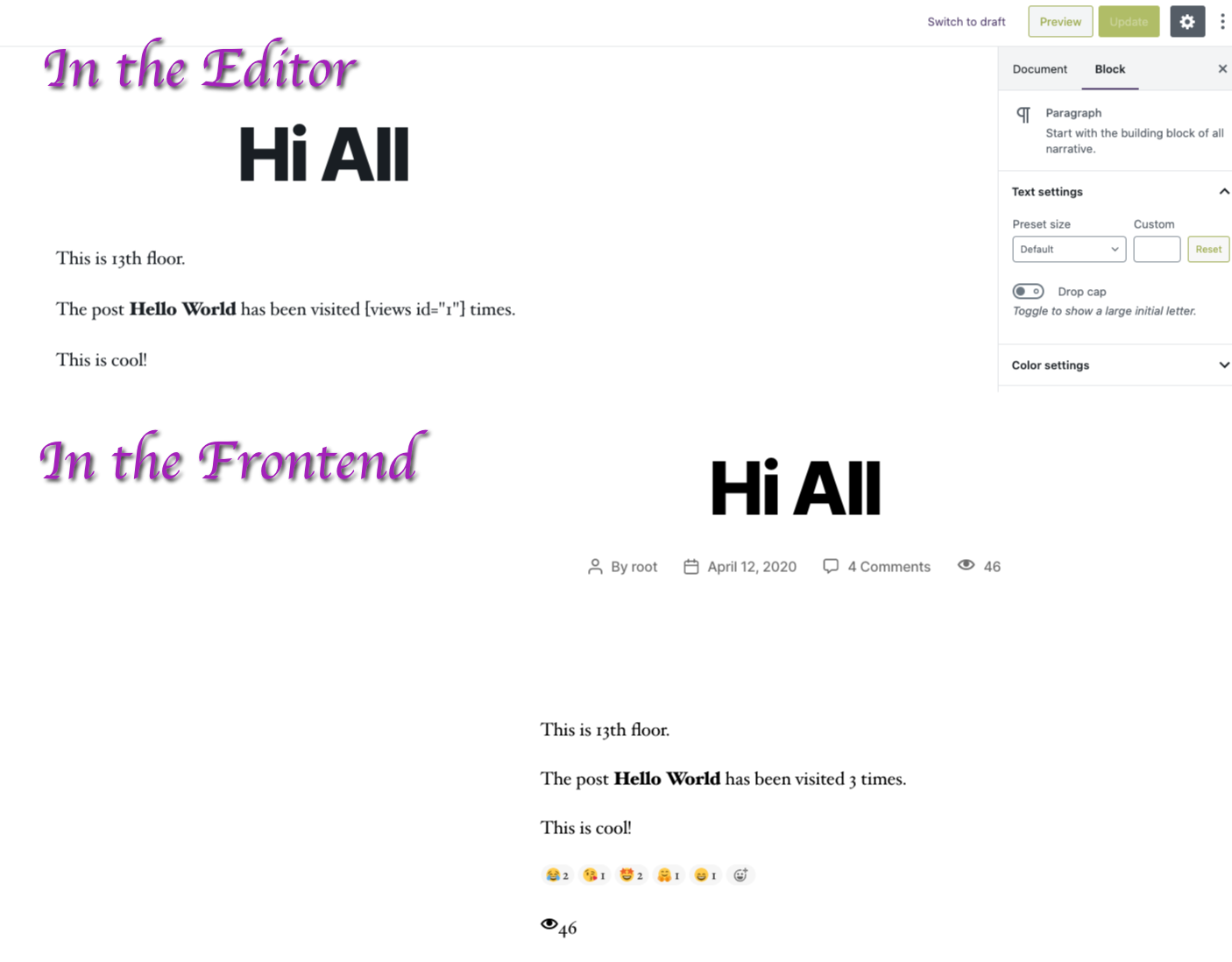
Shortcode [views] available
Use [views] or [views id="3"](To show the views of post ID 3) in your editor.
屏幕截图:
常见问题:
The reaction is not added / I see "Error happened"
Clicking an emoji sends a request to the REST endpoint /wp-json/remoji/v1/add. If reactions fail, the most common causes are:
- A security plugin, firewall (WAF) or server rule blocking the WordPress REST API.
- Another plugin overriding REST routes, or the REST API being disabled.
- Aggressive page caching serving a stale nonce to logged-in users (guests are unaffected as of 2.4).
add request returns rest_no_route (404), the route is being blocked/rewritten before it reaches the plugin — allow the remoji/v1 REST namespace in your security plugin/firewall.
How do I place reactions manually instead of auto-appending?
Turn OFF "Auto-Append To Content" in the settings, then use the shortcode [remoji] (or [remoji id="3"]) or the PHP hook do_action( 'remoji_reaction' ); where you want the reaction bar.
Can I limit which emojis are available, or add my own?
Use "Limit Emojis" in the settings to restrict the picker to a subset. Developers can add/replace emojis via the remoji_emoji_list filter.
更新日志:
2.6 - Jul 7, 2026
- 🌱 Add a per-post Remoji option to disable reactions for a single post and its comments.
- Bugfix Setting Max Emojis Per IP to 0 now means unlimited instead of blocking all reactions.
- Bugfix Harden reaction counters, Most Viewed widget defaults, and admin metabox visibility.
- Bugfix Emoji picker layout now works with limited emoji sets of any size.
- Bugfix Reaction notifications now go to the correct post/comment author.
- Bugfix Recent Reacted widget backfills visible entries after hidden/deleted targets are skipped.
- Security Password-protected posts/comments no longer render or accept reactions.
- 🌱 Withdraw your own reaction by clicking the same emoji again.
- 🌱 Optional email notification to the author on new reactions.
- 🌱 Show who reacted (logged-in user names) on hover.
- 🌱
[remoji]shortcode +do_action( 'remoji_reaction' )hook, with an option to disable auto-appending. - 🌱 Limit available emojis to a subset, plus a
remoji_emoji_listfilter for custom emojis. - 🌱 Disable reactions per post type (e.g. pages).
- 🌱 bbPress topics/replies support.
- Bugfix No longer renders the reaction bar (and "Error happened") inside excerpts/feeds.
- Bugfix Guest reactions now work on cached pages (nonce only sent for logged-in users).
- Bugfix Mobile-responsive emoji picker panel.
- Bugfix Correct text domain on all strings; clearer reaction error messages.
- Bugfix Admin reaction log: fixed pagination edge cases and escaped all output.
- Security Server-side validation of reaction targets (published post / approved comment on a public parent), plus post-type and emoji-whitelist enforcement.
- Security Client IP now uses REMOTE_ADDR by default and no longer trusts proxy headers unless the
remoji_trust_proxy_headersfilter is enabled — sites behind a CDN/proxy should enable it.
- Test up to latest WP.
- Translation fix. (@alexclassroom)
- Bypassed version check to speed up WP v6.
- Postview column in Posts list. (@inside83)
- Test up to WP v5.8.
- 🌱 Limit emoji amount per visitor per post.
- More accurate to detect IP.
- WordPress v5.5 REST compatibility.
- 🌱 Recent Reacted Emoji Post widget. (@wilcosky)
- 🌱 Most Viewed widget.
- 🌱 Disable comments on any post type (posts/pages/attachments).
- 🌱 Post view counter.
- 🌱 Reaction delete. (@wilcosky)
- 🌱 Guest Reaction Control. (@wilcosky)
- Bugfix Fixed repeated reactions issue when GDPR mode is ON.
- 🌱 Reaction log.
- Options to turn emoji ON/OFF on Post/Page/Comment.
- Reactive emoji for posts.
- Reactive emoji for comments.