
RoutineKit - Repeatable WordPress Workflow Checklists for Agencies
| 开发者 | codeleftover |
|---|---|
| 更新时间 | 2026年9月18日 02:15 |
| PHP版本: | 7.4 及以上 |
| WordPress版本: | 7.1 |
| 版权: | GPLv2 or later |
| 版权网址: | 版权信息 |
详情介绍:
- Workflow Builder - create reusable configuration checklists with step-by-step instructions
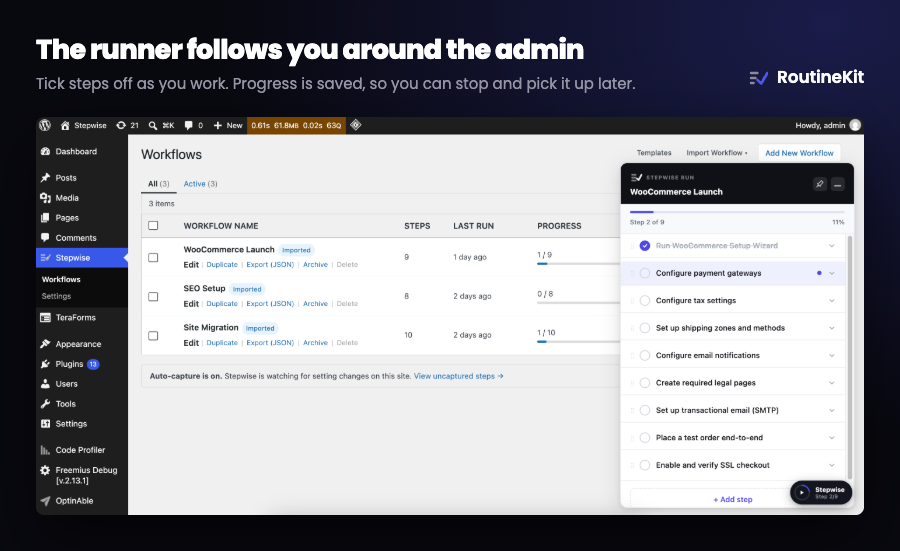
- Guided Runner - a floating sidebar that walks your team through each step and links directly to the right settings page. Put it in the admin bar, or hide it, if you would rather it stayed out of the way
- Auto-Capture - RoutineKit watches wp_options changes as you configure a site and offers to turn them into workflow steps automatically, with the exact values recorded for later
- Evidence Capture - attach screenshots or PDFs to a step as proof of what was done
- Step Notes - add private notes to any step while running a workflow
- Audit Trail - a timestamped log of who completed what and when, with before/after option snapshots
- Run History - review past executions per workflow
- 25+ Deep-Links - pre-built links to the most common WordPress, WooCommerce, Yoast SEO, Wordfence, and UpdraftPlus settings pages
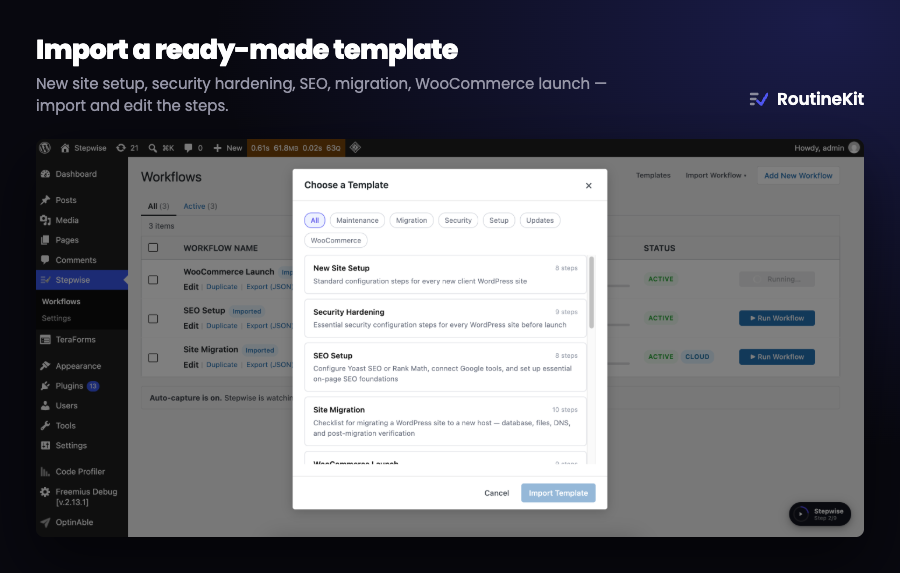
- 5 Starter Templates - New Site Setup, Security Hardening, WooCommerce Launch, SEO Setup, Site Migration
- JSON Export/Import - share workflows between sites via JSON file
- Paste a Checklist - paste any list from Notion, Google Docs, or plain notes and it becomes a workflow instantly
- Unlimited workflows - no cap on the number of workflows per site
- Up to 3 connected sites - connect up to 3 sites to your free RoutineKit account *
- RoutineKit Cloud dashboard - manage connected sites from one place *
- Fleet push & assignment - push a workflow to connected sites and assign it to a site group * (up to 3 sites on free)
- Up to 50 sites (Agency) or unlimited sites (Agency Pro) - connect your full client roster, not just 3
- Multiple site groups - organise sites into as many groups as you need, then push to a whole group at once
- Team members - invite colleagues to your RoutineKit account so they can manage and run workflows across sites
- Notes sharing - include step notes in a push so receiving sites see them alongside the workflow
- Progress sync - see run completions from every connected site in your central dashboard
- Priority support - dedicated email support (Agency Pro only)
安装:
- Upload the
routinekitfolder to/wp-content/plugins/ - Activate the plugin from the Plugins screen in WordPress
- Go to RoutineKit > Workflows to create your first workflow
- Use the Run button to open the guided Runner sidebar
屏幕截图:
常见问题:
Is RoutineKit an automation tool?
No. RoutineKit does not touch your site settings, run tasks automatically, or make changes on your behalf. It guides a human through a predefined process - your team member still opens each settings page, makes the changes, and marks each step complete. What RoutineKit adds is structure, consistency, and a full audit trail proving the work was done correctly.
Who is it for?
RoutineKit is built for WordPress agencies and freelancers managing multiple client sites. If you've ever onboarded a new client, launched a WooCommerce store, or hardened a site's security - and done it slightly differently each time - RoutineKit solves that. The core benefit: you build a workflow once, and every team member follows the exact same steps on every site, with a record proving it was done. It's most useful when you manage 5 or more client sites, have team members executing repetitive setup tasks, or need to show clients proof that their site was configured correctly. If you're a solo developer with one or two sites, the free plan still works - but the biggest value unlocks when you're managing a fleet.
How does the guided runner work?
When you start a workflow, a floating panel appears on every WordPress admin page showing your current step, instructions, and a direct link to the exact settings page you need. You complete each step, add notes or evidence if required, and move to the next. The runner stays visible as you navigate between pages so you never lose your place. When all required steps are done, the execution completes and the full audit trail is saved.
Is the free plan really free?
Yes - no trial period, no credit card, no expiry. The free plan is a fully functional WordPress plugin you install directly from the WordPress.org directory. You get unlimited workflows, unlimited runs, and all core features on your own site with no account needed. The paid Agency plans add cross-site fleet management via RoutineKit Cloud, which requires an account and a license key.
Can my team use it?
Yes. RoutineKit has role-based access controls. You decide which WordPress roles can run workflows or edit them. A team member can be given run access without being a full administrator - they'll see the runner panel and complete steps, but won't be able to create or modify workflows.
Does RoutineKit replace MainWP or ManageWP?
No. RoutineKit is complementary to multi-site management tools. It focuses on what needs to be configured on each site and provides a guided runner to do it, rather than managing plugin updates or security scans.
Can I share workflows between sites?
Yes. On any plan, you can export a workflow as JSON and import it on another site manually. On the free plan, you can also connect up to 3 sites to RoutineKit Cloud for direct push. Agency plans let you push any workflow to an entire group of client sites in one click - no exporting, no importing, no repeating yourself.
How does Auto-Capture work?
When you navigate to a WordPress settings page and save changes, RoutineKit detects which wp_options values changed and shows a notification offering to add them as a workflow step. The step includes a snapshot of the exact settings you changed.
Is my data sent anywhere?
On the free plan, all data stays on your own site. Agency plans optionally connect to RoutineKit Cloud for cross-site management - connection requires an explicit license key and can be revoked at any time from Settings > Cloud Connection.
What happens if I deactivate the plugin?
Deactivating preserves all your workflows and data. Deleting the plugin also preserves your data by default, so you can reinstall without losing anything. If you want a clean removal, enable Settings > Danger Zone > Delete All Data on Uninstall before deleting - RoutineKit will then drop its tables and options when the plugin is deleted.
Can multiple team members run the same workflow?
Yes - each run is tracked separately as an execution with its own audit trail. Multiple people can run the same workflow on different sites simultaneously.
更新日志:
- Fixed: a site disconnected from the RoutineKit Cloud dashboard now notices. Until this release it went on believing it was connected - the hourly sync failed silently every hour, the Cloud tab still showed Connected, and nothing said otherwise. The plugin now detects it, stops syncing, and explains what happened.
- Improved: your license key is kept when this happens. The license is still valid and still covers your team - only this site's registration was withdrawn - so reconnecting is one click rather than a hunt for the key.
- Fixed: Sync now reported success when the connection was already dead. It now says what is actually wrong, and no longer suggests trying again when retrying cannot help.
- Changed: refreshed the RoutineKit logo and admin icons - the sidebar menu, admin bar and page header now carry the new mark.
- Security: credentials stored under short field names like
passoraccess_oauth2_refreshare now redacted before reaching Auto-Capture - previously only names built from a recognizable word plus a suffix (likestripe_secret_key) were caught, so a plugin that named its own password field justpasswrote it to the capture buffer in plain text. - Improved: Auto-Capture now sees settings some plugins store in their own database tables instead of
wp_options- Wordfence and similar plugins previously went unnoticed no matter what was changed. - Improved: Auto-Capture now snapshots every option, not only the ones WordPress marks for autoloading. Some plugins store their entire configuration in a non-autoloaded option, which was invisible to captures before this.
- Fixed: activating a plugin no longer fills the capture queue with the defaults it seeds on install. Only genuine settings changes are offered as workflow steps now.
- Improved: the runner and toast notifications now sit above other plugins' floating admin UI instead of being covered by it.
- Improved: the plugin download is around 200KB smaller - the screenshot library used for step evidence was being bundled twice.
- Improved: that screenshot library now loads only when you actually take a screenshot, rather than on every admin page.
- New: a short guide below the workflow table covering the two ways to use Start Workflow - working through a checklist, and building one as you go by adding steps from the runner while you make the changes.
- Improved: deleting a workflow now says whether it worked, and when it is refused it gives the reason rather than failing quietly.
- Improved: the workflow list opens on Active, so the workflows you are likely to run are in front of you. It falls back to All when nothing is active.
- Improved: workflows now carry a Pushed or Received badge with its own icon, replacing the single Cloud tag, so it is clear at a glance which ones you published and which arrived from another site. Both explain themselves on hover.
- Changed: a workflow assigned to this site from the cloud can no longer be deleted here. Withdrawing an assignment is the sending site's to do, and a deleted copy only returned on the next check. Archive it to take it out of the way.
- Fixed: a workflow that had been run but never pushed could not be deleted. Your own workflows are now held back only once pushed, and the reason is given on hover.
- Fixed: stopping a run left the workflow list showing it as still running until the page was reloaded.
- New: choose where the launcher lives - a floating pill, an item in the admin bar, or hidden altogether. The admin bar option keeps RoutineKit to hand without anything sitting over the page.
- New: assigning a group asks whether to tag it only or to push straight away, so you can line up several groups before distributing.
- Improved: workflow table actions are now in a single ··· menu on each row, replacing the inline text links under the title.
- Improved: choosing to push a workflow to a group now says up front that doing so freezes its steps, rather than leaving it to the confirmation screen.
- Changed: a workflow freezes once you push it, so the checklist your peers hold always matches the one you kept. To revise it, use Duplicate to edit - the copy is a separate workflow you can edit and push on its own terms.
- Changed: toast notifications are off by default on new installs. Existing sites keep whatever they had set.
- Fixed: a captured step could be filed against a workflow already pushed to the cloud, adding steps to a checklist that was supposed to be frozen. The workflow picker no longer offers those workflows, and the server refuses them.
- Fixed: steps could not be added, edited, reordered or deleted on a pushed workflow even where the screen offered it - the change was rejected on save. Screens no longer offer an edit that would be refused.
- Fixed: pushing an edited workflow overwrote the copy held by sites that already had it, changing what they saw after the fact. Each set of steps is now kept as its own version, and a site only re-imports when a genuinely newer one arrives.
- Improved: captures now record which settings screen they came from.
- Security: sensitive option values - passwords, API keys, tokens and salts - are now redacted before they reach the Auto-Capture buffer. Values captured by earlier versions are overwritten automatically on upgrade.
- Fixed: background processes no longer trigger Auto-Capture. Cron jobs, WP-CLI commands, AJAX requests and page-builder saves are excluded, so captures reflect real settings changes only.
- Fixed: a settings save could write the same capture more than once.
- Security: removed an unused diagnostic that kept recent REST request and response data in a browser variable on admin screens.
- New: Paste a Checklist - paste a list from a Google Doc, Notion page or plain notes and it becomes a workflow. The first line is the title, every line after it becomes a step; bullets, numbering and [ ] checkboxes are stripped automatically. Available from Import Workflow, from the empty state, and once on first run.
- Changed: plan buttons on the Upgrade screen now open the pricing page at routinekit.dev while self-serve signup is being finished
- Fixed: a workflow whose steps are all optional no longer marks itself complete as soon as the first step is done
- Fixed: completing optional steps after the last required one no longer resends the completion email or re-pushes the run to RoutineKit Cloud
- Fixed: dismissing the "run is paused" notice in the Runner now sticks instead of reappearing on the next admin page
- Initial release
- Workflow Builder with step editor and deep-link selector
- Guided Runner floating sidebar
- Auto-Capture engine for wp_options changes
- 5 starter workflow templates
- JSON export and import (file and URL)
- Import from URL (requires connected RoutineKit account)
- Auto-Capture retention configurable by all users (default: 30 days)
- Pro: SaaS dashboard for cross-site fleet management and assignment push
- Pro: notes sharing across sites
- Pro: evidence upload per step
- Pro: full audit trail with user attribution and option snapshots