
SEOmarketeer Bot Flagger
| 开发者 | seomarketeer |
|---|---|
| 更新时间 | 2026年9月29日 19:06 |
| PHP版本: | 7.4 及以上 |
| WordPress版本: | 7.1 |
| 版权: | GPLv2 or later |
详情介绍:
- date and time, in site time and UTC
- IP address, stored whole or masked
- user agent
- referrer and referring domain
- requested path and query string
- HTTP status code
- whether the request started a new visit, which makes it a landing page
- the category and client name the rules assigned
- how long WordPress took to build the page
- Regular traffic — looks like a person in a browser
- Search bots — Googlebot, Bingbot, DuckDuckBot and friends
- AI bots — GPTBot, ClaudeBot, PerplexityBot, Bytespider, CCBot and around thirty others
- Malicious traffic — sqlmap, Nikto, WPScan, plus around 75 path signatures: config and env files, backup leftovers, SSH and private keys, AWS, Azure, Google Cloud, Oracle, OVH, Linode and Hetzner credentials, Docker and Kubernetes, Terraform state, Vite and Spring Actuator file disclosure, path traversal and SQL injection, and credential files for AI coding agents
- Other bots — SEO crawlers, uptime monitors, link previews, HTTP libraries
- Caching — your own cache plugins warming pages: WP Rocket preload and bot, WP Fastest Cache, LiteSpeed crawler, W3 Total Cache, WP Super Cache, FlyingPress, NitroPack, Cache Enabler, Swift Performance, Cloudflare Always Online
- Unclassified — empty or unrecognised user agents
- the typical page (median) and the slowest 5%, compared with the period before
- a chart per day, or per hour for the last 24 hours
- the slowest pages, each linking to its requests in the traffic log
- build times per visitor type, so you can see whether bots get slower pages
- IP addresses are masked before storage, to /24 for IPv4 and /48 for IPv6. Full addresses are stored only if you switch that on.
- Visitors are counted through a hash of the masked address, the user agent and a secret that changes every day, so nobody can be followed from one day to the next.
- Values that look like secrets in URLs, such as password reset keys and tokens, are removed before a row is written.
- Administrators are not logged by default.
- Entries are deleted after 90 days by default.
- Nothing leaves your server. There is no tracking script, no external service, no call home. The plugin author never sees your data.
https://your-site.tld/wp-json/sm-bot-flagger/v1/mcp
Transport: streamable HTTP, JSON-RPC 2.0 over POST
Auth: Authorization: Bearer <token>, or X-MCP-Token: <token> if a proxy
strips the Authorization header
Tools:
get_traffic_summary— totals and the category split for a periodget_timeseries— hourly or daily counts per categoryget_top— ranks pages, landing pages, referrers, referring domains, user agents, clients, categories, status codes, IPs, rules or hour of daysearch_hits— individual requests, with filtersclassify_user_agent— test a user agent against the current ruleslist_classification_rules— the rules in evaluation orderupsert_classification_rule— add or change a rule, write token onlydelete_classification_rule— remove a rule, write token only
SetEnvIf Authorization "(.*)" HTTP_AUTHORIZATION=$1
Hooks
Extension points for add-ons:
sm_bot_flagger_categories (array) — add your own traffic categories. They appear in the
rules editor, the charts, the filters and the MCP schemas automatically.
sm_bot_flagger_classification (array) — override the category, label or rule for a
request, after the rules have run.
sm_bot_flagger_mcp_tools (array) — register MCP tools. Include a callback key and the
free plugin will dispatch to it.
sm_bot_flagger_stats_where (array) — append conditions to every stats query.
sm_bot_flagger_admin_menu (action) — add a submenu page under SM Bot Flagger.
sm_bot_flagger_dashboard_cards / sm_bot_flagger_dashboard_panels (actions) — add to the dashboard.
sm_bot_flagger_log_columns (array) and sm_bot_flagger_log_column (action) — add columns to the log.
sm_bot_flagger_settings_fields (action) and sm_bot_flagger_sanitize_settings (array) — add settings.
SM_Bot_Flagger_Logger::current_classification() classifies the current request once and
caches it, so an add-on can act on a crawler early rather than at shutdown.
sm_bot_flagger_should_log (bool) — return false to skip logging a request.
sm_bot_flagger_hit_data (array) — change the row before it is written, or return an empty
array to drop it. Useful for adding a country lookup.
sm_bot_flagger_mcp_tools (array) — add your own MCP tools. Give each one a handler named
tool_<name> on a class of your choosing and hook tools/call accordingly.
Notes on accuracy
- Logging happens on
shutdown, so requests served entirely from a page cache or a CDN never reach PHP and are not counted. On a cached site, treat these numbers as a lower bound. - Bot detection relies on self-reported user agents. Anything determined to look like a browser will be counted as regular traffic.
- Only pick a proxy header for the IP if a proxy actually sets it. A client can send X-Forwarded-For itself, which would let anyone forge their address.
- Query string values for parameters like key, token, code, password and nonce are replaced with [redacted] before a row is written, so password reset links and OAuth callbacks do not end up sitting in the log table.
- CSV exports prefix any cell starting with =, +, - or @ with an apostrophe, so a crafted user agent cannot run as a formula when the file is opened.
- The MCP endpoint blocks an address for 15 minutes after 20 failed token attempts.
- Tokens are not accepted as a ?token= query parameter by default, because
query strings leak into access logs and referrers. Enable it with the
sm_bot_flagger_mcp_allow_query_tokenfilter if a client cannot send headers. - A regular expression that does not compile is switched off rather than being treated as literal text, so a typo cannot silently widen what a rule matches.
- Rule patterns are matched against at most the first 1000 characters of a header, which bounds the cost of a badly written expression.
MyScraper/2. rather than the whole
string, so the rule catches other versions too.
Saving puts the rule first in the evaluation order, so it beats the shipped
defaults. Tick the box to also rewrite requests that are already in the log,
which is matched on the user agent containing your pattern.
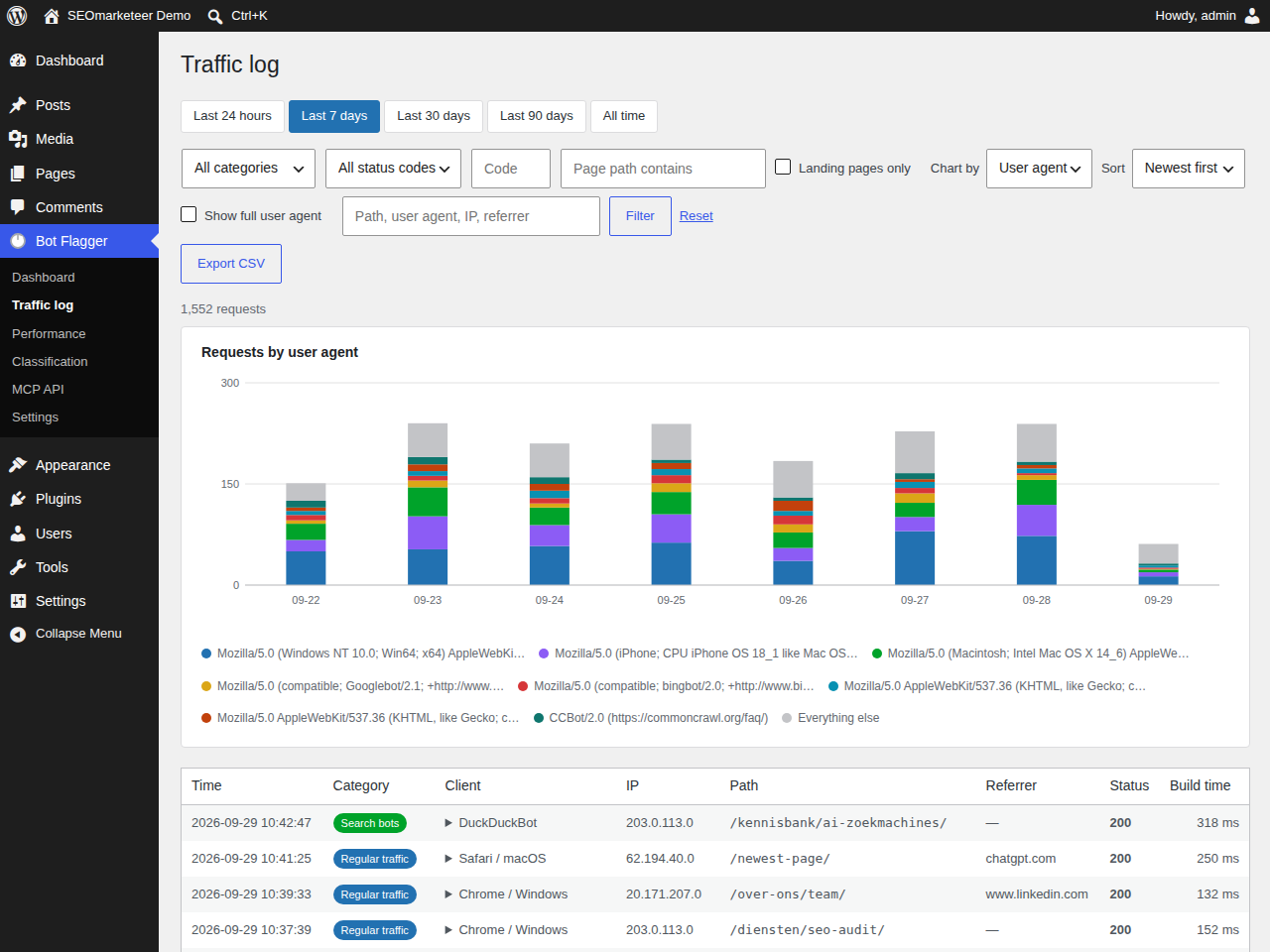
The chart above the table follows the filters, and can be grouped by category,
by client or by the raw user agent. The eight busiest values get their own band
and the rest are folded into "Everything else". "Show full user agent" prints
the whole string under each client name.
安装:
- Install through Plugins > Add New, or upload the zip.
- Activate. Logging starts straight away with privacy-friendly defaults.
- Open SM Bot Flagger in the admin menu. The dashboard fills as traffic arrives.
- Optional: under Settings, turn on the MCP endpoint and create a token to connect Claude or another MCP client.
屏幕截图:


常见问题:
Will it slow my site down?
Logging happens at the very end of each request, as one database write. Behaviour rules only keep counters for clients that have already requested a missing page.
Does it work with page caching?
Pages served straight from a cache never reach WordPress, so they are not logged. On a heavily cached site, read the numbers as a floor rather than a total. Your cache plugin's own warming requests are recognised and kept out of your visitor numbers.
Is it GDPR compliant?
It is built to keep as little as possible: masked addresses, a visitor hash that changes daily, secrets removed from URLs, administrators excluded, and 90-day retention. See the Privacy section. Compliance also depends on how you run your site: adapt the suggested privacy policy text, and record your legal basis.
Does any data leave my server?
No. There is no tracking script, no external service and no call home. The plugin author never sees your traffic.
What is the MCP endpoint?
A small server inside WordPress that lets an AI assistant or any MCP client read the traffic log and ask questions in plain language. It is off by default, needs a token you create, and read-only tokens cannot change anything.
Can I correct a classification?
Yes. Click a client in the traffic log, choose the category, and optionally match on the path or address instead of the user agent. Past requests are corrected too.
Is there a paid version?
Yes. The Pro add-on adds verified crawlers, so a fake Googlebot is caught by DNS rather than by name; blocking by category, behaviour or address, with a monitor mode; and priority support. See https://seomarketeer.eu.
Where do I get help?
In this plugin's support forum on WordPress.org, or through https://seomarketeer.eu.
更新日志:
- New: a Performance page showing how long WordPress takes to build your pages, as the typical page and the slowest 5%, compared with the period before.
- New: a build time chart per day or hour, a Slowest pages table and a By visitor type table.
- New: a Performance card on the Dashboard, replacing the Avg render tile.
- New: sort the traffic log slowest first, with a Build time column.
- Fixed: Ignore IPs now works with an address copied from the traffic log.
- New: the settings screen shows your own address, whether it is ignored, and an Add my address button.
- New: a warning when your site seems to sit behind a proxy or CDN.
- New: remove requests logged before an address was ignored.
- Faster address lookups on large logs.
- First public release.