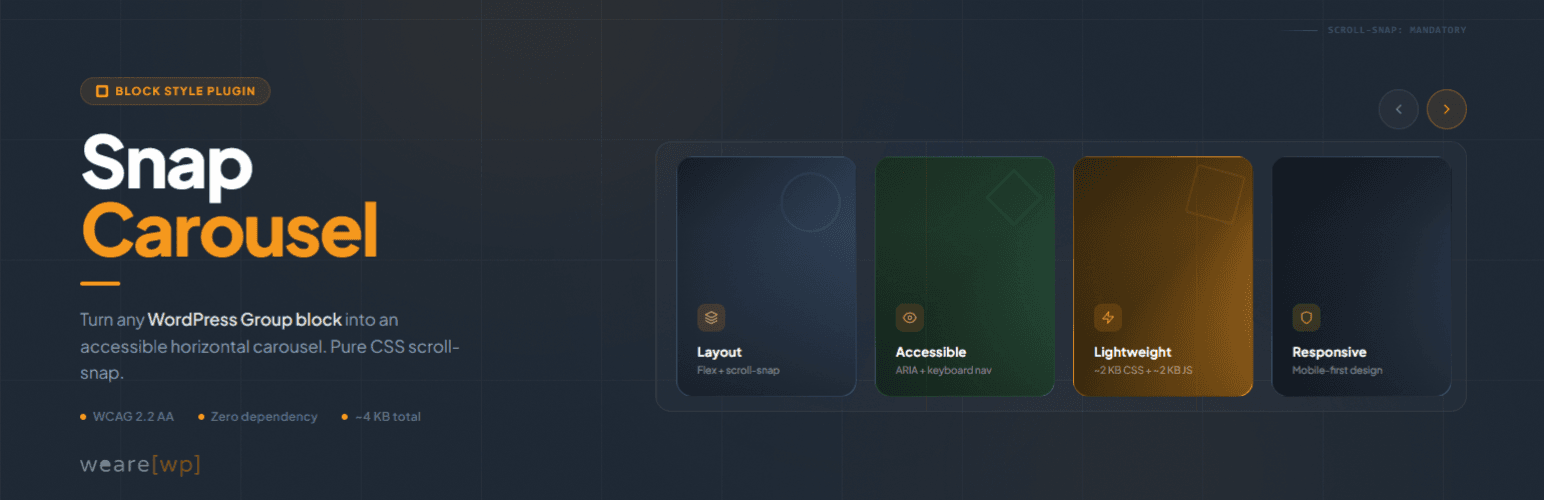
Snap Carousel — Block Style
| 开发者 | wearewp |
|---|---|
| 更新时间 | 2026年3月30日 21:54 |
| PHP版本: | 8.0 及以上 |
| WordPress版本: | 6.9 |
| 版权: | GPL-2.0-or-later |
| 版权网址: | 版权信息 |
详情介绍:
- Group block (
core/group) — any child blocks become slides - Query Loop block (
core/query) — posts scroll as carousel slides - Gallery block (
core/gallery) — images scroll as carousel slides
- Carousel (3 items) — 3 visible items + peek
- Carousel (1 item) — full-width slideshow
- Carousel (2 items) — 2 visible items + peek
- Carousel (4 items) — 4 visible items + peek
- 100% CSS scroll-snap — no Slick, no Swiper, no jQuery
- Prev/next navigation buttons
- Keyboard navigation (Arrow keys, Home, End)
- Full ARIA attributes (role="region", aria-roledescription, aria-live)
- Peek effect: partial visibility of the next item, signaling scrollable content
- Responsive (auto tablet/mobile adaptation)
- Respects
prefers-reduced-motion - Works with Group, Query Loop, and Gallery blocks
- Works with any child block (images, columns, groups, WooCommerce…)
- Lightweight: ~2 KB CSS + ~2 KB JS, zero external dependency
- Full RTL (right-to-left) language support
- Fully internationalized (i18n ready, French translation included)
- Easy to customize via CSS custom properties or overrides
role="region"+aria-roledescription="carousel"on the containerrole="group"+aria-roledescription="slide"on each itemaria-label="X of Y"for position contexttabindex="0"for keyboard focusaria-live="polite"to announce changes- Buttons with
aria-labelandaria-controls - Touch targets 44×44px minimum
- Visible focus indicator
安装:
- Upload the
snap-carousel-block-stylefolder to/wp-content/plugins/ - Activate the plugin in the Plugins menu
- You're all set!
屏幕截图:

常见问题:
Does this plugin work with any WordPress theme?
Yes. Snap Carousel uses standard WordPress Block Styles API and CSS custom properties. It works with any block theme (FSE) and most classic themes that support the Group block in Row layout. The navigation arrows automatically adapt to your theme's colors via --wp--preset--color--* design tokens.
What types of content can I put inside the carousel?
Any block that WordPress allows inside a Group, Query Loop, or Gallery block: images, columns, groups, cover blocks, WooCommerce product blocks, custom HTML… The carousel applies horizontal scroll-snap to the block's direct children (or posts/images for Query Loop and Gallery).
Is this plugin accessible?
Yes. Accessibility was a core design goal, not an afterthought. The carousel meets WCAG 2.2 AA requirements: full ARIA carousel pattern (role="region", aria-roledescription, aria-live), keyboard navigation (Arrow keys, Home, End), 44×44px minimum touch targets, visible focus indicators, and prefers-reduced-motion support.
What is the "peek" effect?
By default, items are slightly narrower than the visible area, so the next item is partially visible — signaling that there is more content to scroll. This is a well-known UX pattern that improves discoverability, especially on touch devices where navigation arrows may not be visible. You can disable it with a simple CSS override (see the Customization section).
Will this plugin slow down my site?
No. The total footprint is approximately 2 KB CSS + 2 KB JS (minified), with zero external dependencies. Assets are only loaded on pages that actually contain a carousel, so there is no performance penalty on other pages.
Can I use different carousel variants on the same page?
Yes. Each block independently gets its own style. You can have a 1-item slideshow hero at the top, a 3-item carousel in the middle, and a 4-item grid-style carousel at the bottom — all on the same page.
What happens if I deactivate the plugin?
Your content remains intact. Blocks revert to their default layout. No data is lost — the plugin only adds a visual style and does not modify your content in the database.
Can I customize the carousel appearance?
Absolutely. The plugin uses WordPress design tokens and semantic CSS classes. You can override arrow colors, sizes, shapes, spacing, focus indicators, and even disable the peek effect — all via simple CSS. See the Customization section for copy-paste examples.
Does it work with WooCommerce?
Yes. You can wrap WooCommerce product blocks inside a Group block, apply a carousel style, and it works out of the box. This is a great way to showcase featured products.
Does the carousel auto-play?
No, intentionally. Auto-playing carousels are a well-documented accessibility barrier (WCAG 2.2.2 Pause, Stop, Hide) and tend to lower engagement. The carousel is user-driven: scroll, swipe, keyboard, or click the navigation arrows.
Why does the Group justification setting have no effect on the carousel?
The carousel requires items to flow from the start edge for CSS scroll-snap to work properly. The justification control (left, center, right, space-between) is automatically overridden to ensure correct scroll behavior. This is a browser constraint, not a plugin limitation. RTL (right-to-left) languages are fully supported — items automatically flow from right to left.
Can I use the carousel with a Query Loop block?
Yes. Since version 1.0.4, you can apply any carousel style directly to a Query Loop block. Posts are rendered as horizontal slides with full ARIA attributes. This is ideal for "latest posts" or "related posts" sections.
Can I use the carousel with a Gallery block?
Yes. Apply a carousel style to any Gallery block and images scroll horizontally. The gallery caption (figcaption) is preserved and excluded from the carousel slides.
How does this compare to Slick, Swiper, or other carousel libraries?
Snap Carousel does not use any JavaScript carousel library. Scrolling is handled entirely by CSS scroll-snap, which is native to all modern browsers. JavaScript is only used for navigation buttons, keyboard handling, and screen reader announcements (~2 KB). This means fewer conflicts, better performance, and no library updates to track.
Does this plugin pass RGAA / WCAG accessibility audits?
Yes. The plugin was built specifically to pass RGAA and WCAG 2.2 AA audits. It implements the WAI-ARIA carousel pattern: role="region", aria-roledescription="carousel" on the container, role="group" on each slide, aria-live region for announcements, keyboard navigation (Arrow, Home, End), and 44×44px minimum touch targets.
Does the carousel support RTL languages?
Yes. The carousel detects the page direction automatically. In RTL mode (Arabic, Hebrew, etc.), items flow from right to left, navigation arrows adapt their direction, and keyboard navigation (ArrowLeft/ArrowRight) follows the expected visual direction.
更新日志:
- New: Query Loop block support — apply carousel styles to core/query blocks, posts scroll as slides
- New: Gallery block support — apply carousel styles to core/gallery blocks, images scroll as slides
- Enhancement: extracted shared PHP helpers (wearewp_snapcarousel_nav_html, wearewp_snapcarousel_wrap) for DRY rendering
- Enhancement: gallery figcaption excluded from carousel slides (CSS + JS)
- Enhancement: responsive rules for Query Loop and Gallery variants (tablet + mobile)
- Enhancement: editor preview CSS for Query Loop and Gallery blocks
- Fix: unique prefixes (wearewp_snapcarousel) for all defines, filters, handles and JS globals — WordPress.org Plugin Review compliance
- Fix: version constant centralized as WEAREWP_SNAPCAROUSEL_VERSION
- New: GitHub Actions release workflow for automated ZIP packaging
- Fix: Group justification (center, right, space-between) no longer breaks the carousel
- New: full RTL (right-to-left) language support — navigation, keyboard, and scroll detection
- Fix: improved scroll end detection tolerance for sub-pixel rounding
- Enhancement: navigation buttons use CSS logical properties (inset-inline-end)
- Fix: text domain aligned with plugin slug (snap-carousel-block-style)
- Fix: removed deprecated load_plugin_textdomain() call
- Fix: removed Domain Path header (not needed for wordpress.org hosted plugins)
- Initial release
- 4 carousel style variations (1, 2, 3, 4 items)
- Peek effect enabled by default (partial next item visible as scroll affordance)
- Full WCAG 2.2 AA accessibility
- i18n ready with French (fr_FR) translation
- CSS customization examples included in readme