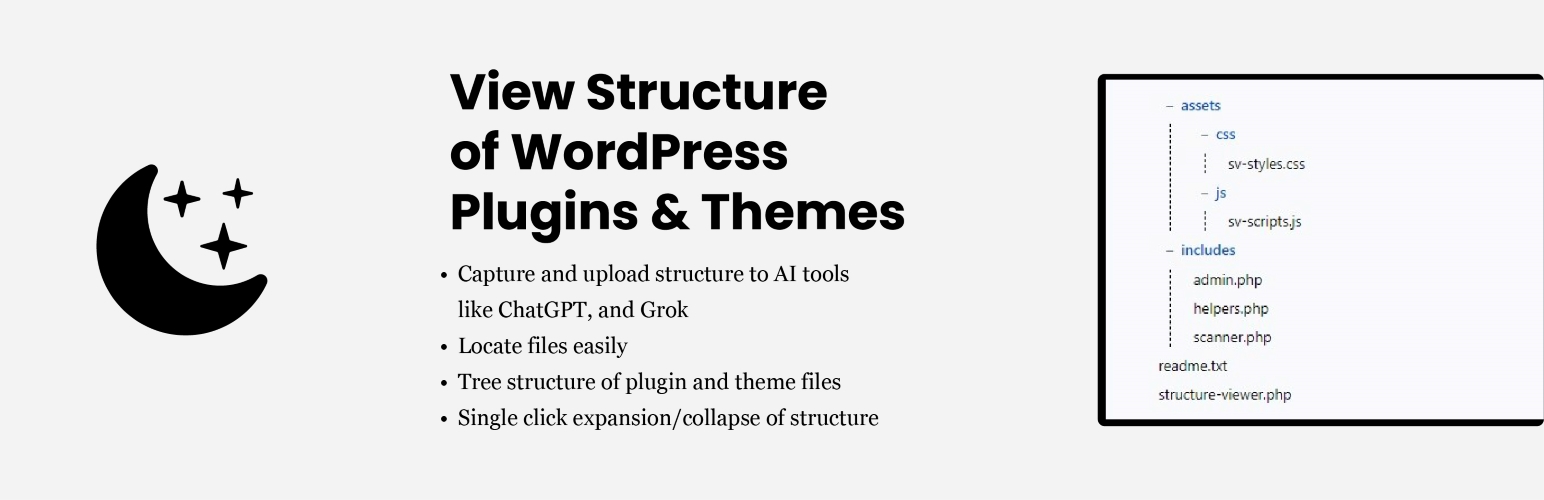
Structure Viewer
| 开发者 | blincks |
|---|---|
| 更新时间 | 2026年5月10日 01:52 |
| PHP版本: | 7.4 及以上 |
| WordPress版本: | 6.9 |
| 版权: | GPLv2 or later |
| 版权网址: | 版权信息 |
详情介绍:
- Tree-format exports purpose-built for LLM context windows — clean ASCII, no markdown noise, token-efficient
- One-click clipboard copy — emoji tree format that pastes into any AI chat with perfect alignment
- Filter before you export — exclude
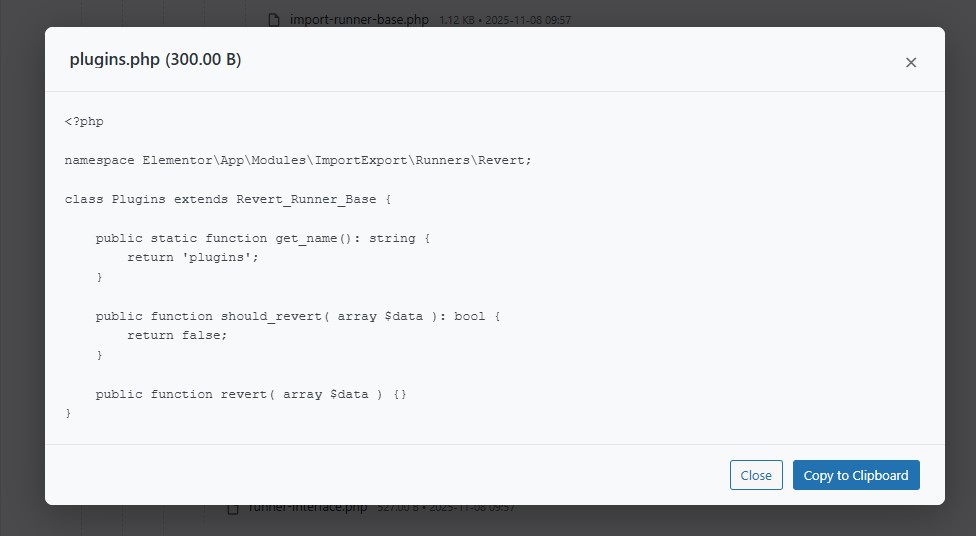
node_modules,vendor, build artifacts, or anything you don't want bloating your context - Read source inline — open any file in the browser modal, copy the snippet you need, paste into your AI conversation
- Pro: Comparator — diff two versions of a plugin and feed only the changed lines to your AI for targeted code review
- Pro: FlatPack — extract just the PHP, just the JS, or just the CSS from any plugin and hand the AI a focused codebase
- WP-CLI exports — script structure dumps directly into your AI agent's working directory
- Interactive tree view — expandable folders with icons for every file type (PHP, JS, CSS, images, JSON, XML, and more)
- Searchable item picker — switch between All Plugins, individual plugins, All Themes, and individual themes instantly
- Live tree search — type to filter files in real time, jump between matches with next/prev navigation
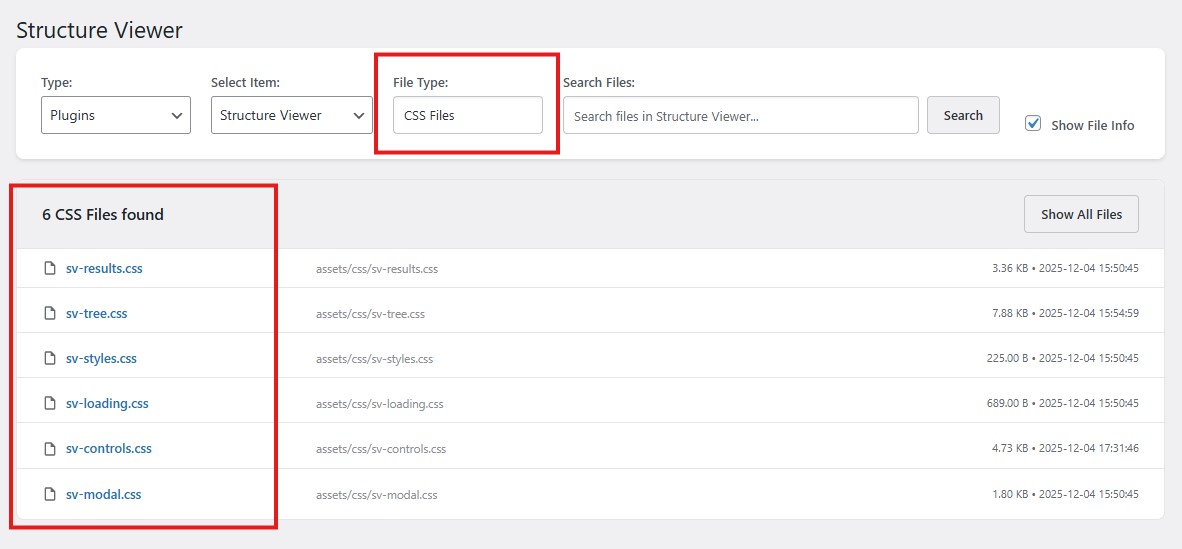
- File type tag strip — one click to show only PHP files, only CSS, only images — whatever you need
- File size and modification dates — see when each file was last changed, toggle on/off
- Recently Viewed panel — jump back to any file or folder you have already opened
- Inline modal with syntax highlighting for all common languages
- File metadata: size, line count, last modified timestamp
- Fullscreen mode for reading long files without scrolling the page
- One-click download — get any file with the correct MIME type and original filename preserved
- Real-time search — results appear as you type, no page reloads
- Extension search — prefix with a dot to filter by type:
.php,.js,.css,.json - File type dropdown for quick narrowing
- Results show full relative path, file size, and last modified date
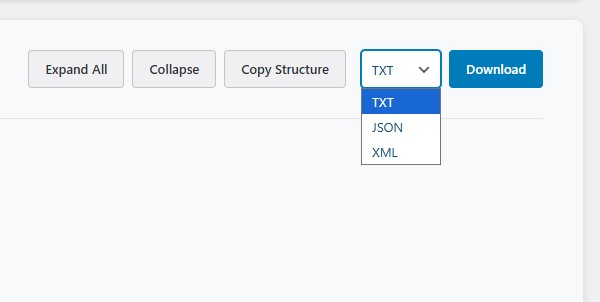
- TXT — clean ASCII tree, perfect for documentation, tickets, and AI context windows
- JSON — nested structure with file sizes and timestamps for programmatic use
- XML — standardized hierarchical format
- PDF — formatted document with header, page numbers, and automatic page breaks
- Clipboard — one-click emoji tree copy for pasting into Slack, Notion, or GitHub
- Stat tiles for total plugins, active/inactive split, total themes, and total files indexed
- Largest plugins table — instantly see which plugins are heaviest with file count and size bars
- WordPress environment strip: WP version, PHP version, active theme, site URL
- Dark mode / Light mode — applied server-side, no flash on load
- Accent color picker — Emerald (default), Violet, Blue, Amber, or Rose
- Exclude hidden files, system directories, and custom patterns (
node_modules,.git,vendor) - Settings auto-save with instant confirmation toast
wp structure-viewer export plugin <folder-name>
wp structure-viewer export theme <folder-name>
wp structure-viewer list plugins
wp structure-viewer list themes
🚀 Structure Viewer Pro
Unlock two powerful Pro tools for developers who need to go deeper.
🔀 Comparator — Know Exactly What Changed
Ever updated a plugin and wondered what actually changed? Comparator shows you a precise, color-coded, line-by-line diff between any two versions — so you can audit updates, review customizations, and catch unwanted changes before they cause problems.
- Compare two plugin ZIPs side by side
- Compare an installed plugin or theme against any uploaded ZIP
- Compare two individual files for a targeted spot-check
- Added lines in green, removed in red, changed lines clearly highlighted
- Works on large plugins and minified CSS/JS files — auto-tokenizes before diffing
- Expand/collapse per-file diff blocks to focus on what matters
- Upload any plugin or theme ZIP and see all its files in a live preview instantly
- Filter by PHP, CSS and JS, images, or any custom extension — preview updates live
- Only the filtered files are included in the output ZIP
- Smart collision-safe naming: duplicate basenames get a folder prefix automatically
- Download a single flat ZIP in seconds
- Nonce verification on all AJAX endpoints
manage_optionscapability required — administrators only, no public access- Path traversal prevention — file paths resolved with
realpath()and verified - Input sanitized with
wp_unslash()+sanitize_text_field()before use - All output escaped before rendering
- Pro upload directories protected with
.htaccessdeny rules
- Assets load only on the Structure Viewer admin page — zero impact on your site
- Dashboard stats cached with a 6-hour transient
- Lazy tree loading — only trees you expand are scanned
- FlatPack preview filtering is entirely client-side — no extra AJAX round-trips
- No external HTTP requests at runtime
安装:
- Go to Plugins → Add New in your WordPress admin.
- Search for Structure Viewer.
- Click Install Now, then Activate.
- Navigate to Tools → Structure Viewer to start exploring.
- Download the ZIP from WordPress.org.
- Go to Plugins → Add New → Upload Plugin, upload the ZIP, click Install Now.
- Activate and navigate to Tools → Structure Viewer.
屏幕截图:


常见问题:
What is Structure Viewer used for?
Structure Viewer is a WordPress developer tool that lets you browse, search, view, and export the file structure of any installed plugin or theme — directly from your WordPress admin dashboard. It is used for code audits, plugin reviews, documentation, debugging, AI-assisted development, and general development workflows.
How does Structure Viewer help with AI-assisted development?
When you prompt an AI tool like ChatGPT, Claude, Cursor, or GitHub Copilot to work on a WordPress plugin or theme, the quality of its output depends almost entirely on the context you provide. Structure Viewer is built to make that first step painless. Instead of opening files one at a time and copy-pasting code into a chat, you can: export the complete file tree of any plugin or theme as a single clean TXT, JSON, or XML payload; copy it to your clipboard with one click; paste it into your AI prompt as ready-to-use structural context. The AI now knows what files exist, how they're organised, and where to look — before you've even asked it a question. From there, you can drill into specific files in the browser modal and copy targeted snippets as needed. For larger workflows, Structure Viewer Pro adds Comparator (so you can give the AI just the diff between two versions instead of two whole codebases) and FlatPack (so you can hand the AI only the PHP files, only the CSS, or any subset that matters for the task).
Can I export a plugin's structure as AI prompt context?
Yes — that is one of the main use cases. Use the Export tab to generate a TXT, JSON, or XML representation of any plugin or theme. The TXT format is intentionally token-efficient — clean ASCII tree, no markdown noise — so it fits cleanly inside an AI context window. You can also use the one-click clipboard copy to paste an emoji tree directly into ChatGPT, Claude, Cursor, or any other AI chat interface.
Do I need FTP or server access to use it?
No. Structure Viewer works entirely through the WordPress admin interface. You do not need FTP, cPanel, SSH, or any server-level access. If you are a WordPress administrator, you have everything you need.
Who can access Structure Viewer?
Only users with the manage_options capability — WordPress administrators by default. There is no frontend component and the plugin adds no public-facing pages or scripts.
Can I view all my plugins at once?
Yes. Select "All Plugins" from the item picker to see a collapsed tree for every installed plugin. Expand any plugin heading to drill into its files. The same applies to themes with "All Themes".
Can I read the source code of a file?
Yes. Click any text-based file in the tree to open it in the inline file viewer with syntax highlighting. Image files open in a new browser tab. The viewer also shows file size, line count, and last modified date.
Can I download individual files?
Yes. The file viewer has a one-click Download button. The file is served with the correct MIME type and its original filename.
What export formats are available?
TXT (plain ASCII tree), JSON (nested with metadata), XML, PDF, and Clipboard (emoji tree for pasting anywhere). You can choose your preferred clipboard format (JSON, Text, or XML) in Settings.
Can I search inside a plugin's files?
Yes. The Search tab lets you search by filename or extension across any plugin or theme in real time. Results show the full path, size, and last modified date.
Can I exclude certain files or directories?
Yes. Go to Settings → Security and Exclusions to toggle exclusions for hidden files and system directories, and to add your own custom patterns such as vendor, node_modules, *.log, or .git.
Does it work with WP-CLI?
Yes. You can export plugin and theme structures from the command line:
wp structure-viewer export plugin <folder-name>
wp structure-viewer export theme <folder-name>
wp structure-viewer list plugins
wp structure-viewer list themes
Is there a Pro version?
Yes. Structure Viewer Pro adds two features: Comparator (compare any two plugin or theme versions with a color-coded diff view) and FlatPack (extract and filter files from any plugin or theme ZIP by file type). The free version includes the full Explorer, Search, Export, Dashboard, and Settings. Upgrade from Settings → Licence → Upgrade to Pro.
How does Comparator work?
Upload two plugin ZIPs — or select an installed plugin and upload a ZIP to compare against it. Comparator produces a color-coded, file-by-file diff showing exactly which lines were added, removed, or changed. It handles large files and minified CSS/JS by tokenising them before diffing, so you get meaningful per-rule output instead of single-line change blocks.
How does FlatPack work?
Upload any plugin or theme ZIP. FlatPack extracts all its files and shows you a live-filterable preview. Select which file types you want — PHP, CSS and JS, images, or custom extensions — and click Run FlatPack. Only the matching files are packed into a single flat ZIP for download, no nested directories included.
How does FlatPack handle files with the same name?
Files with unique basenames keep their original name. When two or more files share the same basename (for example multiple style.css files from different directories), each is prefixed with its relative folder path — for example assets-style.css and css-style.css. Any remaining collisions get a numeric suffix.
Does Structure Viewer affect site performance?
No. Plugin assets are loaded only on the Structure Viewer admin page and have zero impact on your website's frontend. Dashboard stat counts are cached. No external requests are made at runtime.
Does the plugin store any personal data?
Structure Viewer stores settings in the wp_options table under structureviewer_settings. Temporary files uploaded for Comparator or FlatPack are stored in the WordPress uploads directory and deleted immediately after processing. No user data or personal information is collected or transmitted.
Is Structure Viewer compatible with WordPress Multisite?
The plugin is designed for single-site use. It may function on individual subsites within a Multisite network but Multisite-specific administration is not officially tested or supported.
更新日志:
- UI improvements and bug fixes.
- New: Pro Comparator — compare two plugin or theme versions with a color -coded line-by-line diff; supports ZIPs, installed plugins/themes, and individual files; works with large and minified files
- New: Pro FlatPack — extract and filter files from any plugin or theme ZIP by type (PHP, CSS, JS, images, custom); download as a single flat ZIP with smart collision-safe naming
- New: Dashboard redesign — stat tiles with combined plugin and theme file count; async largest-plugins table; recently viewed panel; WordPress environment strip
- New: Explorer improvements — searchable item picker; live tree search with next/prev navigation; file type tag strip; lazy loading for all-items mode; AJAX refresh button (no page reload)
- New: UI — dark/light mode with server-side class; accent color picker with 5 options (default: Emerald); branded logo
- New: Copy format setting — choose JSON, Text, or XML as the clipboard copy format in Settings
- New: Pro upsell placeholders — free users see feature descriptions and a direct upgrade button in the Comparator and FlatPack tabs
- Improved: Comparator diff engine — patience algorithm for large files; correct deletion-before-addition ordering; minified file tokenization; similar-change pairing; raised limits (5 MB / 20,000 lines)
- New: Accent color picker — customize the plugin with the color you want to see.
- Improved: FlatPack workflow — extract-all-then-filter-live; reset on new file selection; filter pills built from actual ZIP contents
- Improved: Settings — auto-save with debounce and toast; exclusion patterns UI
- Fixed: WordPress admin notices — scoped text color to plugin container only; no longer overrides WP notice colors
- Fixed: FlatPack — protection files no longer appear in extracted file list
- Fixed: Export / clipboard — "undefined" output caused by buffer pollution resolved
- Fixed: Bug Fixes — Several bug fixes and security improvements
- Fixed: Copy Structure button not working in Safari.
- New: Download any individual file directly from the file viewer modal (all file types including binary)
- New: PDF export with styled header, monospace tree, page numbers, and automatic page breaks
- Security: download handler with path traversal prevention, nonce verification, and MIME type detection
- Complete UI/UX overhaul — modernized interface, modal file viewer with syntax highlighting
- Multi-format export: JSON and XML added alongside TXT
- Real-time search with file type filtering, one-click clipboard copy, keyboard navigation, WP-CLI
- Settings link added to plugin listing.
- Added TXT export.
- Initial release.