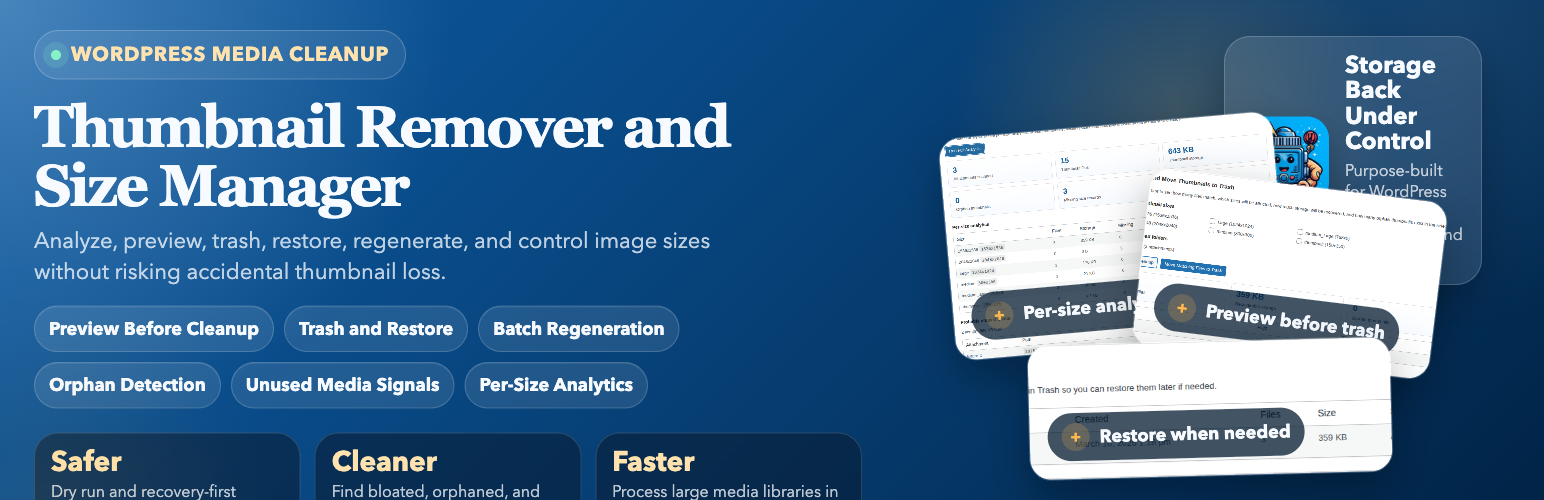
Thumbnail Manager
| 开发者 | mehdiraized |
|---|---|
| 更新时间 | 2026年7月6日 01:49 |
| 捐献地址: | 去捐款 |
| PHP版本: | 7.4 及以上 |
| WordPress版本: | 7.0 |
| 版权: | GPLv2 or later |
| 版权网址: | 版权信息 |
详情介绍:
- Preview cleanup results before removing files
- Work from focused WordPress-style tabs for Analysis, Sizes, Cleanup, Optimize, Backup, Reports, and Pro previews
- Move thumbnails to plugin Trash instead of deleting permanently
- Create a zip backup of the exact matching thumbnails before moving them to Trash
- Restore trashed thumbnails later if needed
- Process large libraries in batches with visible progress
- Detect orphan thumbnails left behind on disk
- Detect probably unused media items across post content, featured images, and common builder data
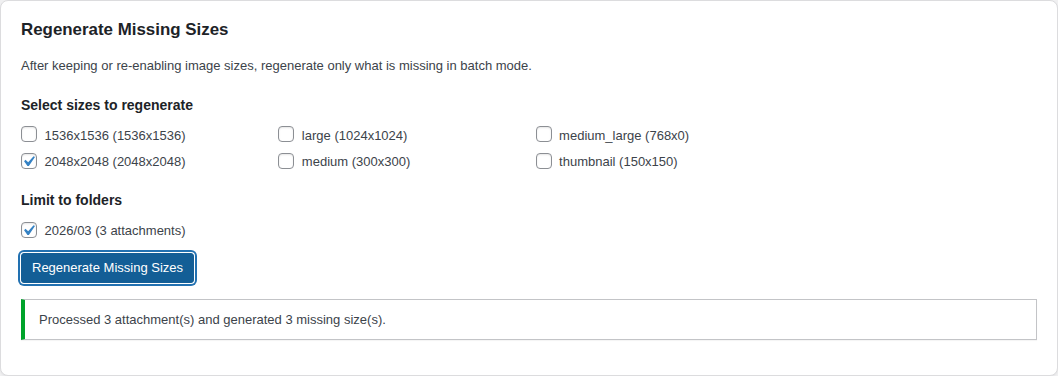
- Regenerate missing image sizes in batches
- Review per-size analytics including file counts, storage usage, missing sizes, and orphan counts
- Review recent activity logs and reporting summaries for cleanup, restore, backup, and regeneration workflows
- Disable selected image sizes for future uploads
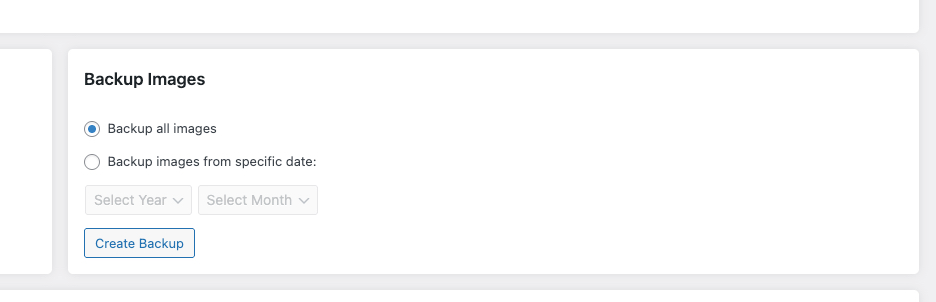
- Create zip backups for all uploads or a specific year/month folder
- Schedule recurring cleanup runs with configurable frequency, size scope, and folder scope
安装:
- Upload the plugin files to the
/wp-content/plugins/thumbnail-removerdirectory, or install the plugin through the WordPress plugins screen directly. - Activate the plugin through the
Pluginsscreen in WordPress. - Go to
Tools > Thumbnail Manager. - Use the Analysis tab before your first cleanup so you can review thumbnail usage, orphan counts, and unused media signals.
- Configure scheduled cleanup from the Cleanup tab if you want recurring maintenance.
屏幕截图:



常见问题:
Does the plugin permanently delete thumbnails?
Not during cleanup. Thumbnail Manager moves matching thumbnail files into plugin Trash first so they can be restored later. To free disk space permanently, use Delete Permanently for one trash batch or Empty Trash for all batches in the Trash and Restore table.
What does Preview do?
Preview performs a dry run and shows how many files match your current selection, which sizes are involved, how much space can be recovered, and how many orphan thumbnails were found.
What are orphan thumbnails?
Orphan thumbnails are files such as image-300x300.jpg that still exist on disk but are no longer tracked in WordPress attachment metadata.
How does unused media detection work?
The plugin scans image attachments and checks for usage in featured images, parent attachments, post content, and stored builder/meta content. The results are best treated as “probably unused” so you can review them manually.
Can I disable image sizes for future uploads without deleting old files?
Yes. The size-disable settings prevent selected image sizes from being generated for future uploads only. Existing thumbnails are not removed unless you explicitly preview and move them to Trash.
Can I regenerate missing sizes after enabling a size again?
Yes. Use the Regenerate Missing Sizes section to rebuild missing image sizes in batches, switch to a full rebuild mode when needed, or use Media Library bulk actions for selected images.
Can I limit cleanup to only orphan thumbnails or probably unused media?
Yes. The advanced filters can narrow analysis, cleanup, and regeneration jobs by image format, attachment usage status, and whether the thumbnail files are metadata-tracked or orphaned.
Can the plugin generate WebP copies for existing media?
Yes. The WebP generation tool can create .webp copies for JPEG and PNG originals plus their registered thumbnail sizes when your WordPress image editor supports WebP output.
Can the plugin bulk-optimize images without deleting them?
Yes. You can connect a TinyPNG API key and run bulk optimization against original uploads, generated thumbnails, or both while keeping the files in place.
Is the plugin suitable for larger media libraries?
Yes. Analysis, cleanup, and regeneration are processed in batches with visible progress to reduce timeout problems on larger WordPress sites.
Can I back up my files before cleanup?
Yes. You can create a zip backup for all uploads or for a selected year/month folder, and cleanup can also create a zip backup of the exact matching thumbnails before they are moved to plugin Trash.
Can I restore only one cleanup batch instead of everything?
Yes. Each cleanup run creates its own Trash batch, so you can restore a specific batch independently.
How do I empty the plugin Trash?
Use Empty Trash in the Trash and Restore table to remove every batch, or use Delete Permanently for a single batch. This deletes the stored trash files and any backup stored with those batches, and it cannot be undone.
Does scheduled cleanup delete files permanently?
No. Scheduled cleanup uses the same plugin Trash flow as manual cleanup, so matching thumbnails can still be restored later.
What is included in Reporting and Logs?
The reporting section shows recent analysis, preview, cleanup, restore, regeneration, backup, and scheduled cleanup activity along with summary totals for recovered storage and other media operations.
Does the plugin detect thumbnails that exist on disk but not in metadata?
Yes. That is exactly what orphan thumbnail detection is for. These files are included in analysis and preview results so you can decide whether to move them to Trash.
Should I trust unused media results as a final delete list?
No. The plugin marks items as probably unused based on several WordPress relationships and content checks, but you should still review those results manually before broader media cleanup decisions.
更新日志:
- Fixed Plugin Check annotations for WordPress 5.0 compatibility, nonce handling, translator comments, and prepared SQL checks
- Added a cache-safe version to the AdSense admin script enqueue
- Updated the GitHub Pages workflow to publish all seven tab screenshots
- Refreshed the admin screen with WordPress-style tabs across Analysis, Sizes, Cleanup, Optimize, Backup, Reports, and Pro
- Updated all plugin screenshots so each admin tab has its own WordPress.org screenshot
- Added the free-version Google AdSense support ad placement in the admin sidebar
- Updated plugin docs, readme copy, and release tooling for the new tabbed screenshot set
- Confirmed compatibility metadata for WordPress 7.0 while keeping the PHP requirement at 7.4 or newer.
- Added a Media Library column showing thumbnail totals, storage, orphan counts, and missing-size hints per image
- Added Media Library quick actions to move one image's thumbnails to Trash or regenerate missing sizes
- Added a custom size manager for registering, editing, and removing custom image sizes with visual previews
- Added TinyPNG-compatible bulk optimization for originals and generated thumbnails
- Added size-usage analysis so the analytics table reports which thumbnail sizes appear in content and meta references
- Expanded thumbnail regeneration with missing-only vs full rebuild modes and Media Library bulk actions
- Added batch WebP generation for JPEG and PNG originals plus registered thumbnail sizes
- Added WebP generation controls for include-original and overwrite-existing behavior
- Logged WebP generation runs in the Reporting and Logs section
- Added permanent delete actions for individual Trash batches and for emptying all plugin Trash.
- Added optional zip backups for matching thumbnails before they are moved to plugin Trash
- Stored cleanup backup links with Trash batches so previous cleanup backups remain downloadable from the Trash and Restore table
- Organized the admin screen into WordPress-style tabs while keeping the support and ad sidebar visible
- Added advanced filters for image format, attachment usage, and orphan-only versus tracked cleanup
- Reused the new filters across analysis, preview cleanup, and regeneration workflows
- Updated the admin UI and documentation to explain the extra filtering controls
- Added a Reporting and Logs section with recent activity history
- Added summary cards for recovered storage, restored files, regenerated sizes, and backup runs
- Logged manual operations and scheduled cleanup events in a bounded admin-visible activity history
- Added WP-Cron scheduled cleanup with daily, weekly, and monthly frequency options
- Added scheduled cleanup scope controls for image sizes and upload folders
- Added scheduled cleanup status, next-run visibility, and last-result summaries in the admin UI
- Kept scheduled cleanup on the same Trash and Restore workflow as manual cleanup
- Added dry-run preview before cleanup
- Added Trash and Restore workflow for thumbnail removal
- Added batch processing with progress for analysis, cleanup, and regeneration
- Added orphan thumbnail detection
- Added probably unused media detection
- Added missing-size regeneration workflow
- Added per-size analytics dashboard
- Refreshed admin UI for the safer cleanup workflow
- Updated plugin description and documentation
- Fixed a fatal error when disabling thumbnail sizes on PHP 8.x
- Hardened settings and AJAX input handling for string-based values
- Updated compatibility metadata for the latest WordPress release
- Added new feature: Media file backup functionality
- Improved user interface for backup options
- Bug fixes and performance improvements