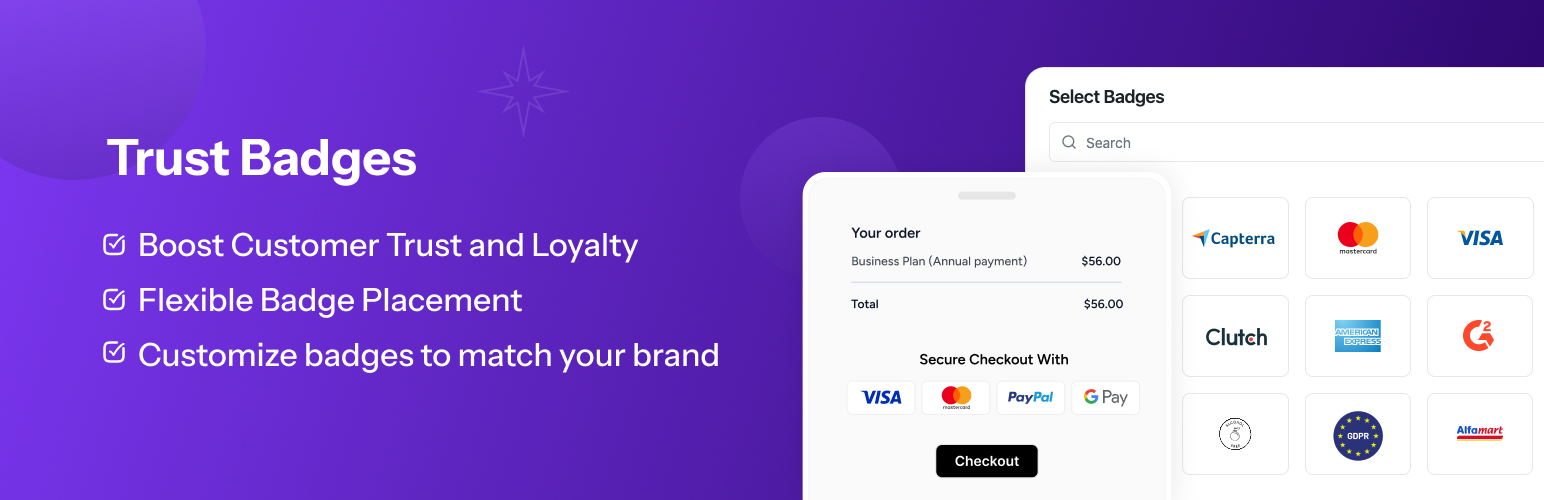
Trust Badges – Payment Icons & Secure Checkout Seals for WooCommerce
| 开发者 |
converswp
parvezvai shamsbd71 |
|---|---|
| 更新时间 | 2026年8月8日 02:41 |
| PHP版本: | 7.4 及以上 |
| WordPress版本: | 7.0 |
| 版权: | GPLv2 or later |
| 版权网址: | 版权信息 |
详情介绍:
- Faster front end. The badge manifest is now parsed once per request instead of once per badge, and results are cached. Badge rendering went from roughly 1 ms per badge to effectively zero.
- Lighter admin. The settings screen bundle is minified and no longer ships a source map — about 3 MB less to download.
- Fixed: WooCommerce Cart and Checkout blocks. A leftover filter in earlier versions disabled WooCommerce's Cart and Checkout blocks across the whole site. It has been removed.
- Fixed: monochrome badge styles. The "mono" and "mono-card" styles now render correctly on every supported WordPress version; their CSS mask was previously being stripped before output.
- Shortcodes now accept named groups too.
[trust_badges id="1"]and a bare[trust_badges]behave exactly as before;[trust_badges id="footer"]and other named groups now work as well, where previously they rendered nothing. - Fixed: settings changes appear immediately instead of after a one-hour cache delay.
- Security. Removed an unauthenticated REST endpoint that exposed badge configuration to anonymous visitors, and hardened input validation throughout.
- 459 ready-made SVG badges. Payment logos, security seals, delivery and money-back guarantees — all scalable vector graphics, so they stay sharp on any screen.
- Works where it matters. Automatic placement on WooCommerce product and cart pages, and EDD download pages. Anywhere else via shortcode.
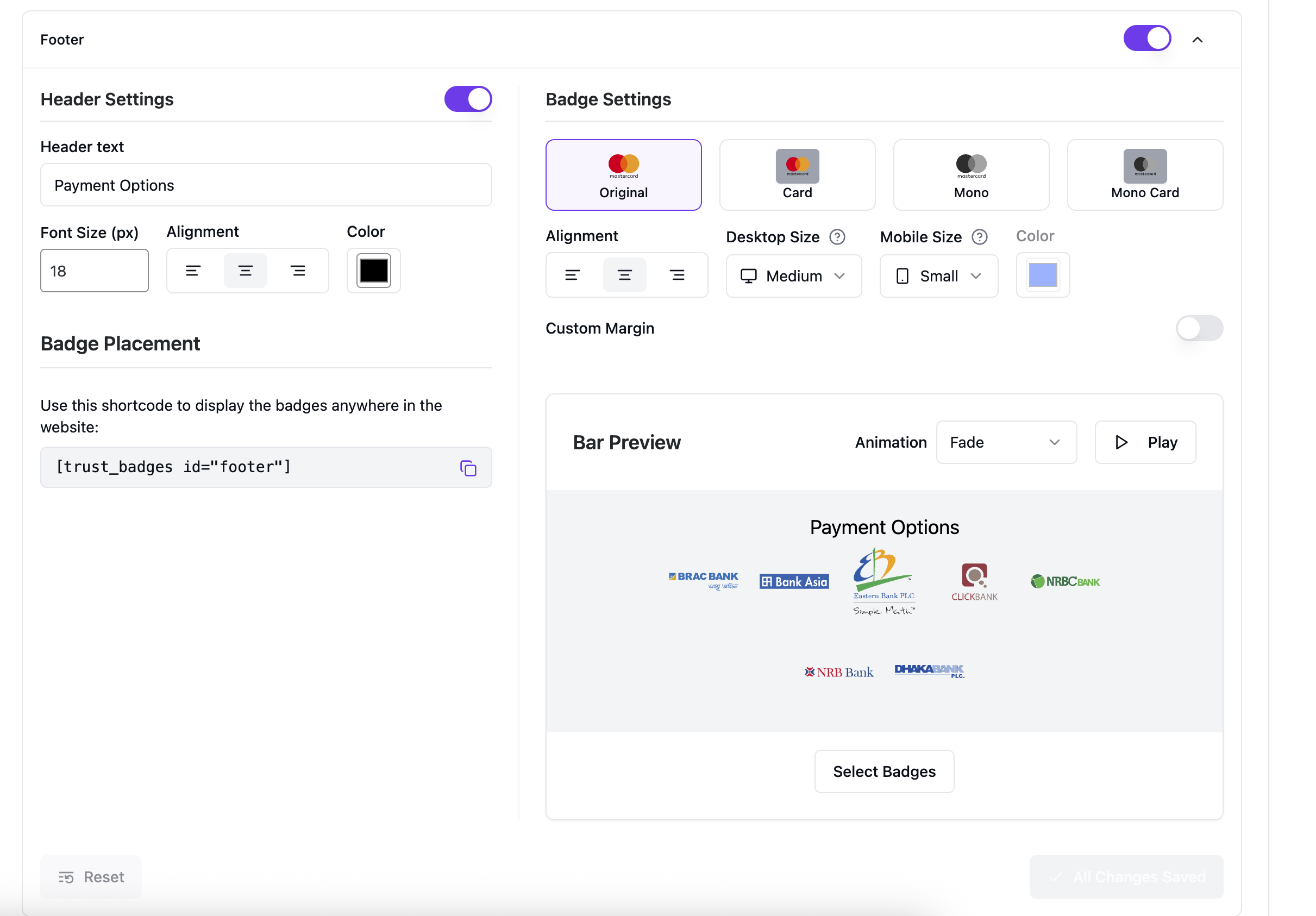
- Badge groups. Configure a different set of badges, with different styling, for each location.
- Four display styles. Original colour, monochrome, card, and monochrome card — recolour any badge to match your theme.
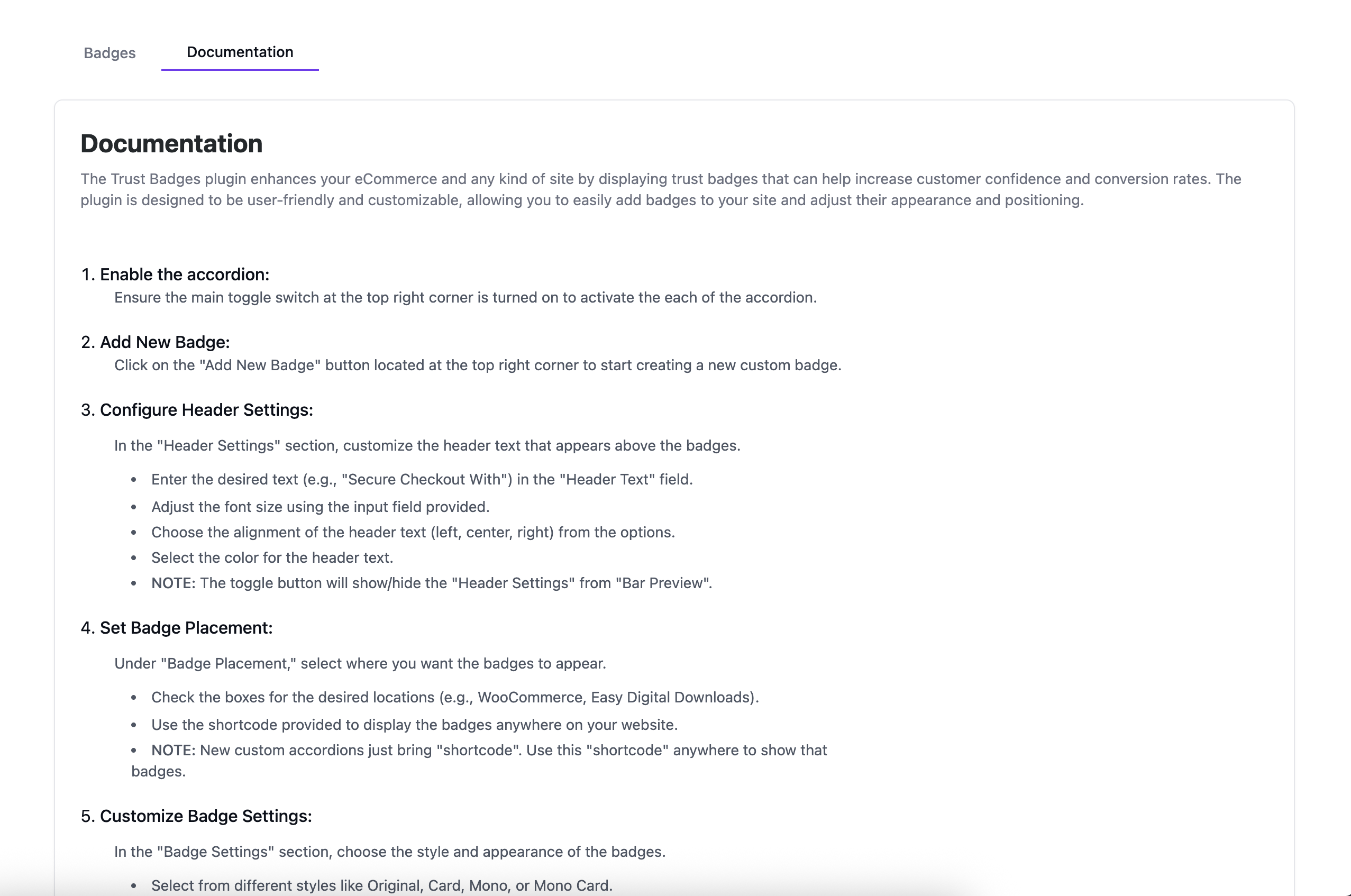
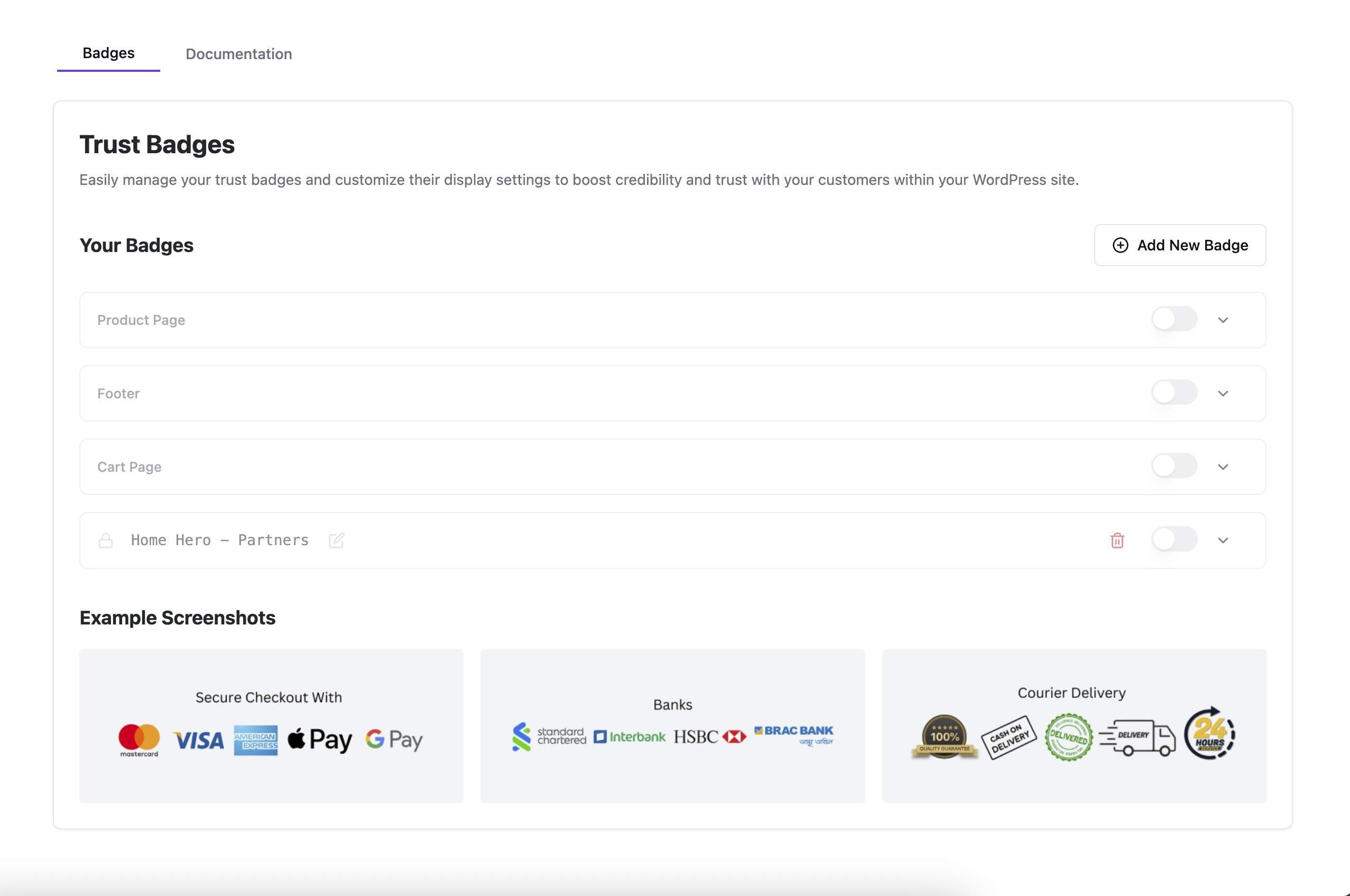
- No coding required. Everything is configured from Settings → Trust Badges.
- Lightweight. SVG badges, cached rendering, and no front-end JavaScript.
- Free and open source. GPLv2 or later, no paid tier required for any feature listed here.
- What it does: Displays payment icons, trust seals and guarantee badges on a WordPress site.
- Works with: WooCommerce, Easy Digital Downloads, or any WordPress theme via shortcode.
- Badge library: 459 SVG badges included.
- Automatic placements: WooCommerce product page, WooCommerce cart (classic and Cart block), EDD download page, site footer.
- Shortcode:
[trust_badges id="footer"] - Front-end JavaScript: None.
- Cost: Free, GPLv2 or later.
- Settings location: Settings → Trust Badges.
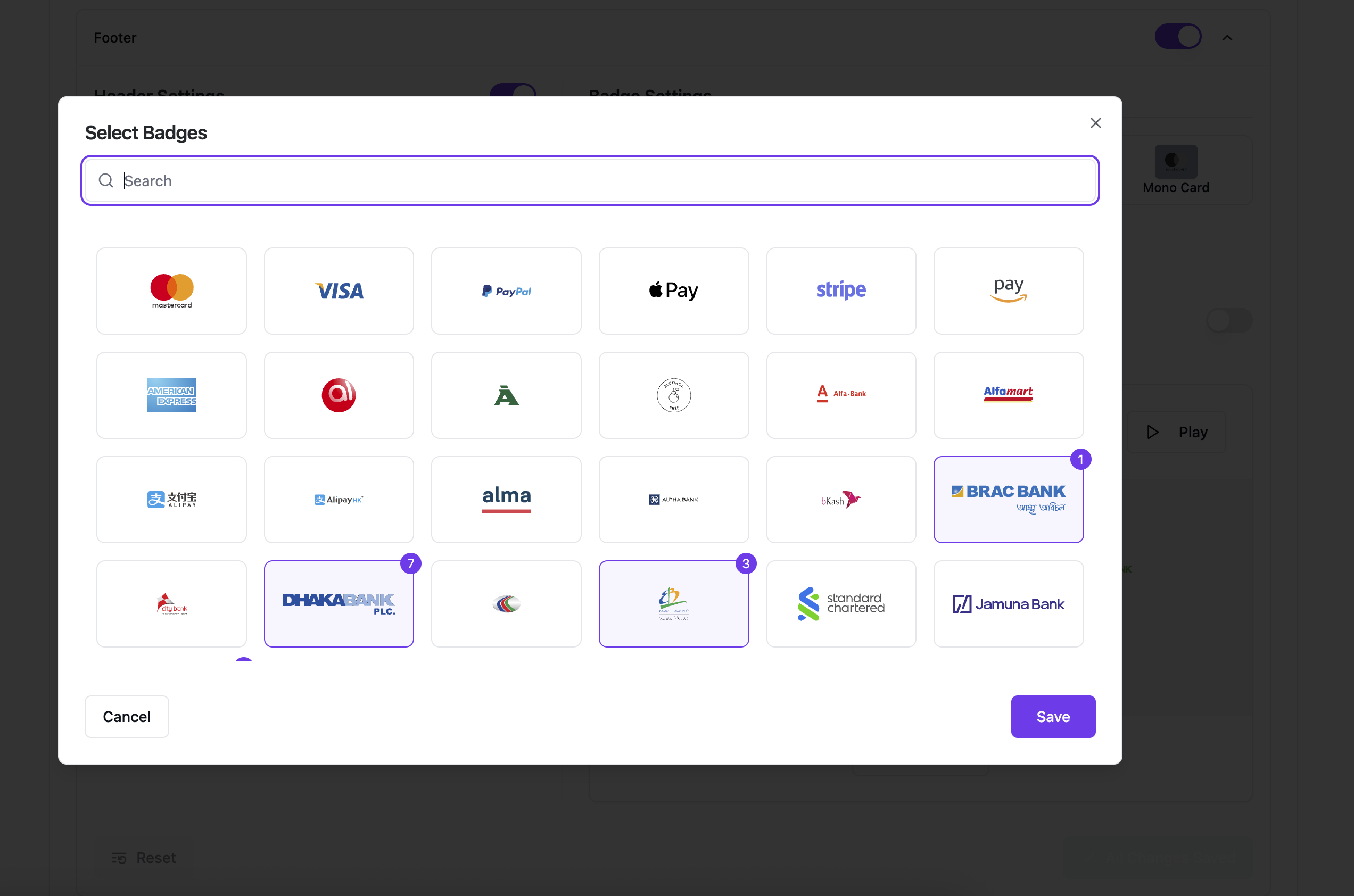
- Payment Methods: Visa, Mastercard, PayPal, Apple Pay, Stripe, Amazon Pay, and many more
- Security Badges: SSL certificates, secure checkout, and data protection
- Delivery & Shipping: Free delivery, fast shipping, and tracking options
- Guarantees: Money-back guarantee, satisfaction guarantee, and warranty
- Certifications: Industry certifications and compliance badges
- Custom Badges: Upload your own promotional or brand-specific badges
安装:
- Upload the
trust-badgesdirectory to the/wp-content/plugins/directory. - Activate the plugin through the 'Plugins' menu in WordPress.
- Navigate to Settings -> Trust Badges to manage your badges.
- Install directly from the WordPress plugin repository.
- Activate and start customizing your badges from the WordPress dashboard.
屏幕截图:
常见问题:
What is a trust badge?
A trust badge is a small icon shown near a purchase decision that signals the transaction is safe — a payment logo such as Visa or PayPal, an SSL or secure-checkout seal, or a guarantee like "30 day money back". They are most commonly placed under an add-to-cart button, on the cart page, or in the site footer.
Is Trust Badges free?
Yes. Trust Badges is free and open source under GPLv2 or later. Every feature described on this page is included; there is no paid tier or upsell required to use them.
Do I need WooCommerce to use this plugin?
No. WooCommerce and Easy Digital Downloads get automatic badge placement, but on any other WordPress site you can put badges anywhere with the [trust_badges] shortcode.
Where do badges appear automatically?
On WooCommerce product pages (under the add-to-cart form), on the WooCommerce cart page (both the classic cart and the Cart block), and on Easy Digital Downloads download pages (after the purchase link). The footer group displays on every page. Anywhere else, use the shortcode.
How do I add badges to my checkout page?
Use the shortcode in a block or template on the checkout page, for example [trust_badges id="checkout"] after creating a group with that ID. Automatic checkout placement was removed in 1.1.0 because it conflicted with block-based checkouts.
How many badges does the plugin include?
459 badges are bundled, all as SVG files. They cover payment methods, banks and wallets, security and SSL seals, shipping and delivery, and money-back and satisfaction guarantees.
Will this slow down my site?
It should not. Badges are SVG files rendered server-side, there is no front-end JavaScript, and badge lookups are cached. Version 1.2.0 specifically removed the largest cost: the badge manifest is now parsed once per request rather than once per badge.
Can I change badge colours to match my theme?
Yes. The "mono" and "mono-card" styles recolour any badge to a single colour of your choosing using a CSS mask, so payment logos can be made to match your palette. Size, spacing, alignment, border radius and hover effects are all configurable too.
Can I upload my own custom badges?
Yes, you can add your own images alongside the bundled library and style them the same way.
How many badges should I display?
There is no technical limit. Three to five is a common choice — enough to reassure without crowding the buy button.
Where are the settings?
Settings → Trust Badges in your WordPress dashboard.
Does the plugin work with block themes and the WooCommerce Cart block?
Yes. The Cart block is supported through a dedicated hook. Note that versions before 1.2.0 contained a bug that disabled the WooCommerce Cart and Checkout blocks site-wide; upgrading to 1.2.0 fixes it.
Does it collect any data?
No. The plugin makes no external requests and stores only your badge configuration in your own database.
Is it translation ready?
Yes, all interface strings use the trust-badges text domain.
更新日志:
- Removed the unauthenticated
/badgesREST endpoint, which exposed every badge group's stored configuration to anonymous visitors. - Removed an IP-keyed rate limiter that wrote a transient per request from a spoofable
X-Forwarded-Forheader, allowing the options table to be flooded. - Client IP detection now trusts only
REMOTE_ADDR; sites behind a reverse proxy can opt in via the newtrust_badges_client_ipfilter. - Database error messages are logged instead of being returned in REST responses.
- Group IDs are validated against a strict character set before use in markup, CSS selectors and queries.
- Settings payloads are recursively sanitised and depth-limited before being stored.
- Deleting a group now re-reads the
is_defaultflag from the database rather than trusting a cached value. - Added direct-file-access guards to all PHP files.
- Badge lookups no longer re-read and re-parse the 459-entry badge manifest once per badge. The manifest is parsed at most once per request and cached; badge rendering dropped from roughly 1 ms per badge to effectively zero.
assets/badges.jsonis 50% smaller and no longer embeds absolute URLs.- The admin bundle is now minified and ships without its source map, removing about 3 MB from the settings screen.
- The checkout-group cleanup no longer runs a database query on every page load; it runs once per version.
wp-admin/includes/plugin.phpis no longer loaded on every front-end request.- Groups that do not exist are now negatively cached instead of being re-queried on every page load.
- Badge images decode asynchronously.
- Removed a global
woocommerce_should_load_cart_block/woocommerce_should_load_checkout_blockoverride that disabled the WooCommerce Cart and Checkout blocks site-wide. - The "mono" and "mono-card" badge styles now render: their CSS mask was being stripped by wp_kses() before output. The mask is now applied from the enqueued stylesheet, which works on every supported WordPress version.
- Saving settings now clears the front-end cache, so changes appear immediately instead of after an hour.
- Shortcodes now also accept the built-in group names.
[trust_badges id="1"]and a bare[trust_badges]are unchanged;[trust_badges id="footer"],"cart"and"product_page"now work too, where previously they rendered nothing. - Added the missing "cart" badge group. The cart hooks have always looked for a group with this ID but no release ever created one, so cart placement could not work. Existing sites receive it switched off, so nothing changes until you enable it.
- The cart badge block is no longer emitted twice on the classic cart page, where two hooks fire.
- Unknown badge IDs are skipped instead of causing a fatal error.
- Removed two REST routes whose callbacks did not exist and which referenced a database column that was never created.
- Fixed a
wpdb::prepare()call with no placeholders that triggered a_doing_it_wrong()notice on WordPress 6.2+. - Added missing array-key guards that raised warnings, and could fatal, on PHP 8.
dbDelta()can now upgrade the schema on existing installs.- Corrected the shortcode and integration documentation, which described placements and group IDs that did not exist.
- Tested up to WordPress 7.0.
- Minimum supported WordPress version is unchanged at 4.7.
- Page support: Product, Cart
- Page footer support
- Custom short code support
- Initial release of the Trust Badges plugin.
- Added shortcode support for flexible badge placement.
- Customization options for badge appearance and position.
- Full compatibility with WooCommerce and Easy Digital Downloads.
- Pre-built library of 400+ trust badges.
- Custom badge upload functionality.
- Mobile-responsive design.
- Admin settings panel for easy management.