
UTM Manager – UTM Tracking, Lead Attribution & Campaign Analytics
| 开发者 |
wpfreshers
urldev kawsarahmedr beautifulplugins |
|---|---|
| 更新时间 | 2026年10月4日 11:48 |
| PHP版本: | 7.4 及以上 |
| WordPress版本: | 7.1 |
| 版权: | GPLv2 or later |
| 版权网址: | 版权信息 |
详情介绍:
?utm_source=google&utm_medium=cpc&utm_campaign=summer_sale), UTM Manager captures this data with a lightweight, deferred tracking beacon — so it never slows the page down and keeps working behind full-page caching. Each visitor gets a first-party visitor ID, and their lead record stores both the first touch (the campaign, landing page, and referrer that originally brought them in) and the last touch (their most recent campaign), plus their full page-by-page journey. If the visitor logs in, their WordPress account and email are automatically linked to the lead — turning anonymous traffic into identified leads. IP addresses are never stored raw — only a salted hash.
Example UTM URL:
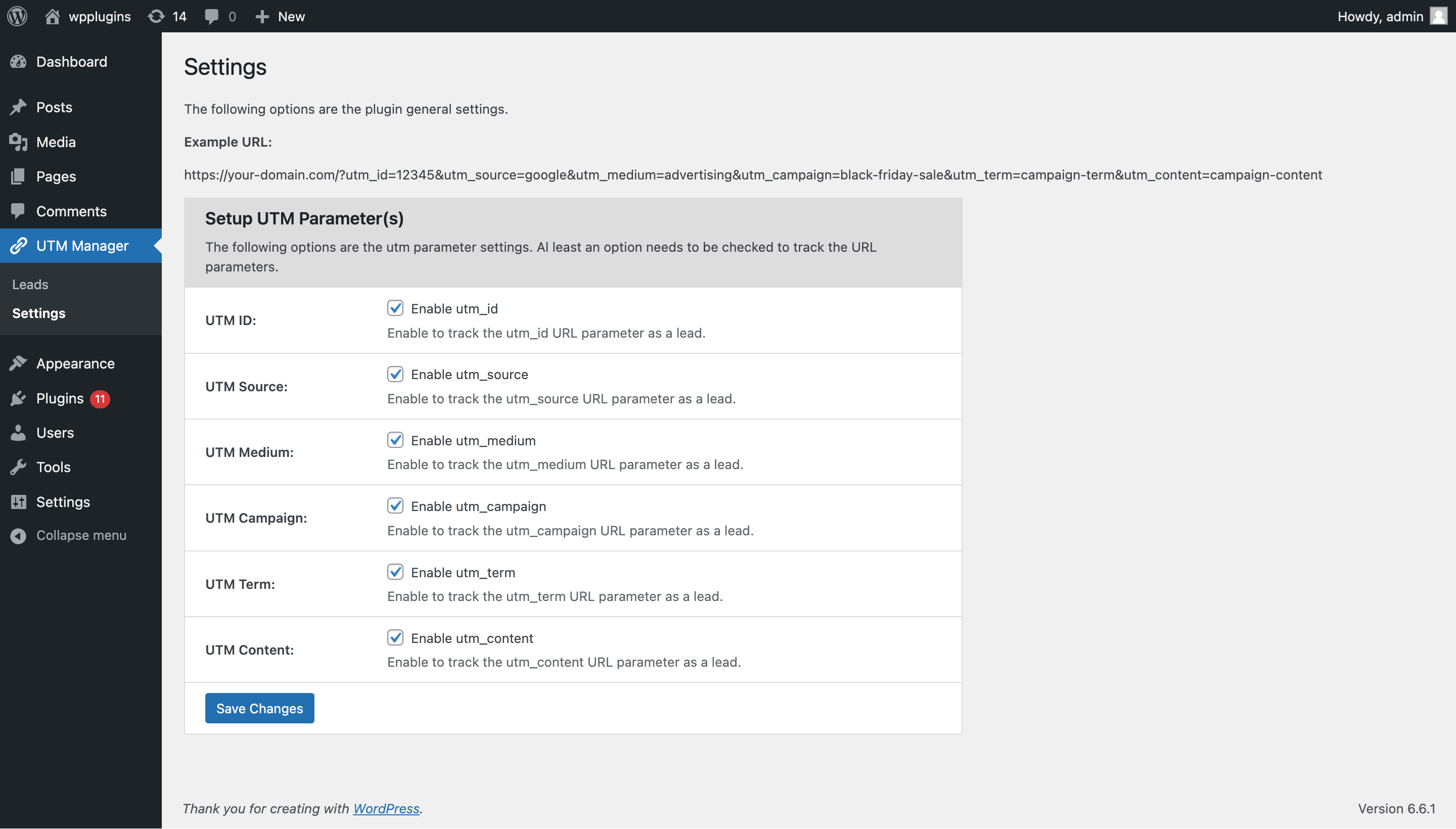
https://your-domain.com/?utm_id=12345&utm_source=google&utm_medium=advertising&utm_campaign=black-friday-sale&utm_term=campaign-term&utm_content=campaign-content
✨ Key Features
🎯 Automatic UTM Parameter Tracking
Capture all standard UTM parameters automatically from incoming URLs:
- utm_id – Unique identifier for tracking
- utm_source – Traffic source (google, facebook, newsletter)
- utm_medium – Marketing medium (cpc, email, social)
- utm_campaign – Campaign name (black_friday, summer_sale)
- utm_term – Paid search keywords
- utm_content – Differentiate ads or links
- Total leads, total visits, and new-leads trend chart
- Top Source / Medium / Campaign breakdowns at a glance
- All reporting runs on fast, indexed custom database tables
- Every lead stores the campaign, landing page, and referrer that first brought them in
- The last-touch attribution is refreshed on every new campaign visit
- First-touch data is never overwritten — you always know the original source
- Full page-by-page visit journey (browsing history) per lead
- Anonymous visitors are tracked with a random first-party visitor ID
- When a visitor logs in, their WordPress user account and email are linked to the lead automatically
- Identity priority: email → user account → visitor ID — once known, never lost
- Returning visitors update the same lead instead of creating duplicates
- View all captured leads in a clean, sortable table
- Filter by UTM source, medium, campaign, and date range
- Search leads by email, visitor ID, or UTM values
- Full visit journey timeline on the single-lead view
- Bulk delete leads with one click
- Customizable leads-per-page via Screen Options
- Export unlimited leads to CSV format
- Filter exports by custom date range
- Select exactly which fields to export (visitor ID, email, user ID, UTM values, visits, last seen)
- Process large datasets without timeouts — the export runs in batched steps
- Built-in protection against CSV formula injection when opening exports in Excel or Google Sheets
- Tracking happens through a deferred, non-blocking beacon (
navigator.sendBeacon) - Nothing runs during page render — zero impact on page speed and Core Web Vitals
- Works behind full-page caching (WP Rocket, LiteSpeed Cache, Cloudflare, Varnish, host-level caches)
- Data is stored in fast, indexed custom database tables — not post meta
- Enable or disable each UTM parameter individually
- Choose exactly which parameters to track
- Configure tracking to match your marketing strategy
- Simple, intuitive settings interface
- IP addresses are never stored raw — only a salted, irreversible hash (proxy/Cloudflare-aware detection)
- Visitors are identified by a random first-party ID, never by IP
- Developer filters to disable IP storage entirely or gate tracking behind a consent plugin
- All data stored locally in your WordPress database — no external data transmission, ever
- Proper input sanitization, output escaping, nonce verification, and capability checks throughout
- 📈 Track Campaign Performance – Know exactly which campaigns drive traffic and conversions
- 🎯 Understand Lead Sources – See where your leads come from with complete attribution
- 💰 Optimize Marketing ROI – Focus budget on channels that deliver results
- ⏱️ Save Time – Automatic tracking eliminates manual data entry
- 📋 Export & Analyze – Download lead data for advanced analysis in spreadsheets
- 🏠 Keep Data In-House – No third-party dashboards, external accounts, or monthly fees
- 🔧 Developer Friendly – Clean code with filters and hooks for customization
- Digital Marketers tracking paid advertising campaigns (Google Ads, Facebook Ads, TikTok, LinkedIn)
- E-commerce & WooCommerce Stores measuring customer acquisition sources
- SaaS Companies analyzing trial signups and conversions
- Affiliate Marketers monitoring traffic from partners
- Content Creators & Bloggers understanding audience sources
- Marketing Agencies managing multiple client campaigns
- Small Businesses wanting simple, effective campaign tracking without Google Analytics complexity
utmm_enable_tracking– Gate the tracker behind a consent/cookie plugin or exclude logged-in adminsutmm_store_ip– Disable (hashed) IP storage entirelyutmm_custom_param_keys– Track extra parameters such asgclid,fbclid, or partner IDs (no schema change needed)utmm_tracked– Action fired after every recorded hit, with the lead ID and captured datautmm_leads_table_query_args– Filter the Leads list-table queryutmm_exportable_fields– Add custom columns to the CSV export tool
gclid and fbclid, affiliate IDs, or any parameter you define) — stored alongside your UTM data with no extra setup.
System Requirements
- WordPress 5.3 or higher
- PHP 7.4 or higher
- MySQL 5.6 or higher / MariaDB 10.0 or higher
安装:
- Go to your WordPress Admin Dashboard
- Navigate to Plugins > Add New
- Search for "UTM Manager"
- Click Install Now and then Activate
- Download the plugin ZIP file from WordPress.org
- Go to Plugins > Add New > Upload Plugin
- Choose the downloaded file and click Install Now
- Activate the plugin after installation
- Download and extract the plugin ZIP file
- Upload the
utm-managerfolder to/wp-content/plugins/ - Go to Plugins in your WordPress admin and activate UTM Manager
- Navigate to UTM Manager > Settings in your WordPress admin
- Enable the UTM parameters you want to track
- Save your settings and start collecting lead data
- See totals and top sources under UTM Manager > Dashboard, and browse captured leads under UTM Manager > Leads
屏幕截图:
常见问题:
Which UTM parameters does the plugin track?
UTM Manager tracks all standard UTM parameters: utm_id, utm_source, utm_medium, utm_campaign, utm_term, and utm_content. You can enable or disable each parameter individually from the settings page. The Pro version (or a small code snippet using the utmm_custom_param_keys filter) can additionally capture custom parameters such as gclid, fbclid, or affiliate IDs.
How do I view my captured leads?
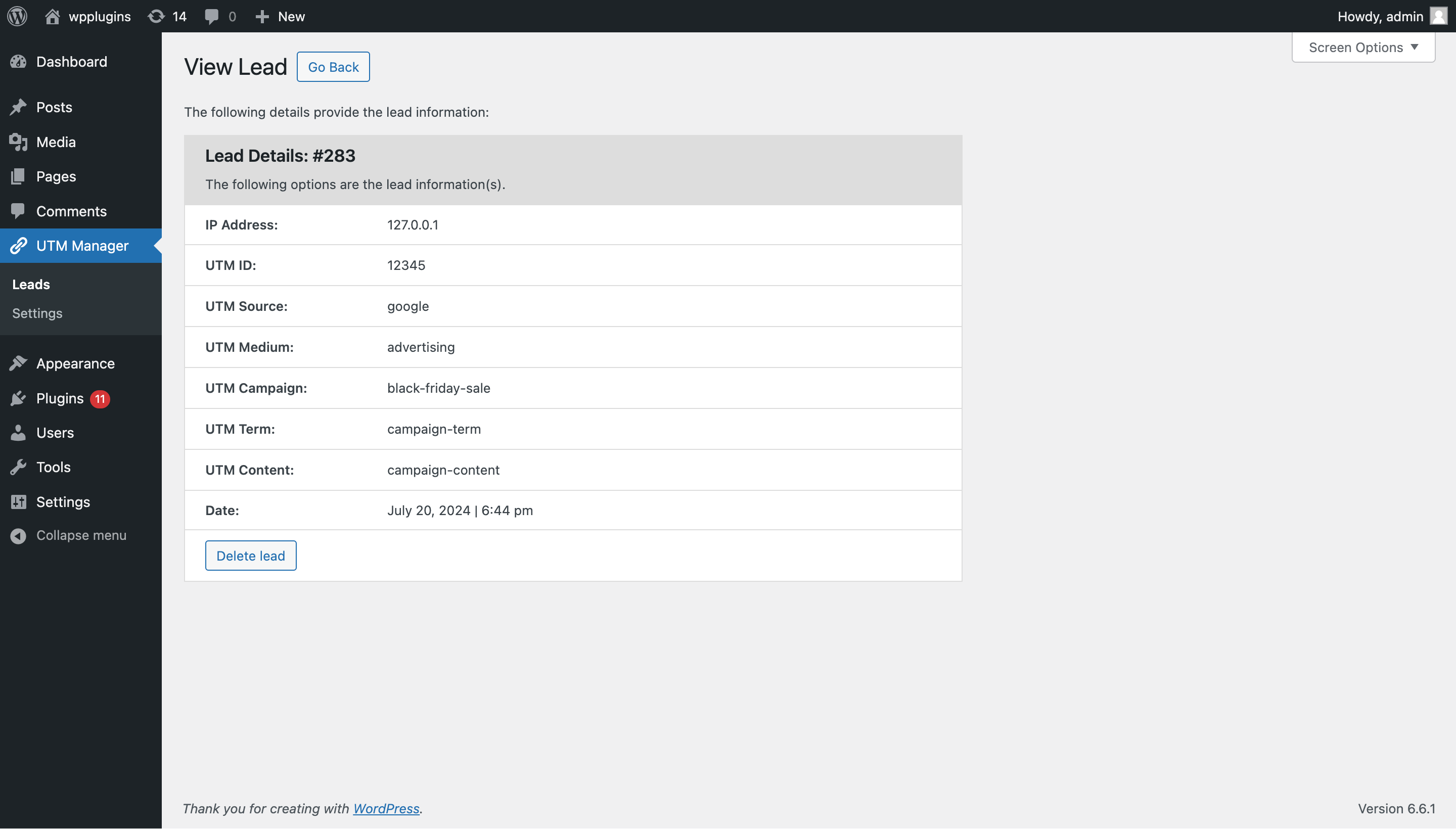
Navigate to UTM Manager > Leads in your WordPress admin dashboard. You'll see a table displaying all captured leads with their identity (email, user, or visitor ID), UTM attribution, visit counts, and dates. Click on any lead to view its complete details, including the full page-by-page visit journey. For a high-level overview, the UTM Manager > Dashboard page shows totals, a new-leads trend chart, and your top sources, mediums, and campaigns.
Does it work with caching plugins like WP Rocket, LiteSpeed Cache, or Cloudflare?
Yes. Tracking is performed by a lightweight JavaScript beacon that runs in the visitor's browser after the page loads, so it keeps working even when pages are served from a full-page cache where PHP never runs. This is a key advantage of the v2.0 tracking engine.
Will it slow down my website?
No. Tracking happens through a deferred script that reports in the background after the page has loaded (navigator.sendBeacon) — nothing runs during page render, so there is zero impact on page speed or Core Web Vitals.
Do I need Google Analytics for this to work?
No. UTM Manager is completely standalone — it captures and stores UTM data directly in your WordPress database. You can use it alongside Google Analytics, but no external analytics account or tracking service is required.
Does it capture the visitor's email address?
When a tracked visitor is logged in to WordPress, their user account and email address are automatically linked to their lead record — and once known, that identity is never lost. Anonymous visitors are tracked with a random first-party visitor ID until they can be identified.
Does it track returning visitors?
Yes. Each visitor gets a long-lived first-party ID, so a returning visitor updates the same lead: the original first-touch attribution is preserved, the last-touch attribution is refreshed, and the visit count grows. Leads are never merged or overwritten by IP address.
What happens if a visitor has no UTM parameters?
The visit is still recorded as part of the visitor's journey, so you keep a complete browsing history per lead. UTM attribution fields are only filled when UTM parameters are present, and existing attribution is never wiped by a parameter-less visit.
Can I export my lead data?
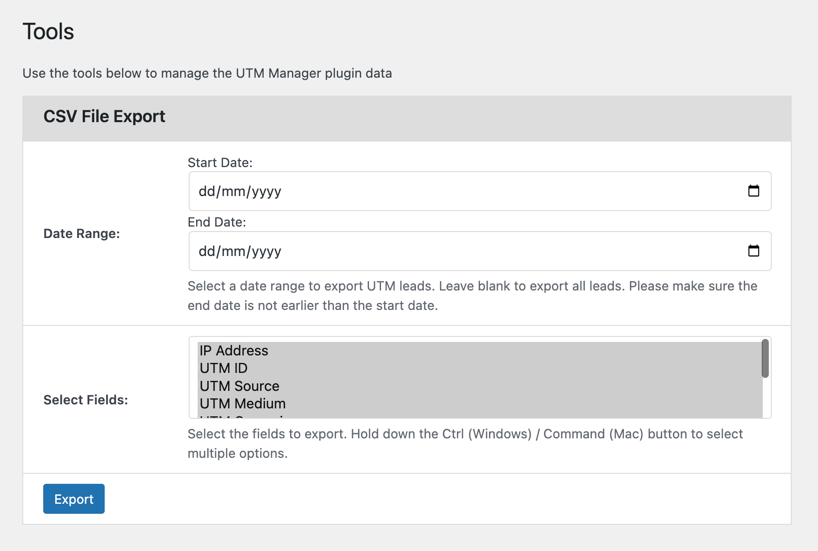
Yes! Go to UTM Manager > Tools, select your date range and fields, then click Export. The tool processes exports in batched steps, so it handles unlimited leads without timeout issues, and export values are automatically protected against CSV formula injection.
Can I customize which fields appear in exports?
Yes, the export tool lets you select exactly which fields to include: Visitor ID, Email, User ID, UTM ID, UTM Source, UTM Medium, UTM Campaign, UTM Term, UTM Content, Visits, and Last Seen. Developers can add custom fields via the utmm_exportable_fields filter.
Can I search and filter my leads?
Absolutely! The leads table includes a search function (email, visitor ID, or UTM values) plus dropdown filters for source, medium, and campaign, and a date-range filter.
Is UTM Manager GDPR compliant?
UTM Manager is designed with privacy in mind. Visitor IP addresses are never stored raw — only a salted, irreversible hash (and storage can be disabled entirely with the utmm_store_ip filter). Visitors are identified by a random first-party ID, all data stays in your WordPress database with no external transmission, and you can delete leads at any time. Developers can gate tracking behind a consent plugin using the utmm_enable_tracking filter. We recommend adding appropriate disclosures to your privacy policy about UTM tracking.
What happens to my existing data when I upgrade from version 1.x to 2.0?
Your data is migrated automatically. After updating, a background process moves your existing leads from the old storage into the new, faster database tables in small batches — no action needed on your part. Each record is verified as safely written before the old copy is cleaned up. We still recommend taking a backup before any major update.
Does it work with WooCommerce and e-commerce stores?
Yes. UTM Manager tracks any WordPress site, including WooCommerce stores. Logged-in customers are automatically linked to their leads by account and email, so you can see which campaign originally brought a customer in.
Does it work with any website or theme?
Yes, UTM Manager works with any WordPress theme and doesn't modify your frontend appearance. It operates entirely in the background, capturing UTM data from URLs when visitors arrive.
更新日志:
- Fix: Resolved minor known issues
- Compatibility: Tested with WordPress 7.1
- Fix: Logged-in visitors are now correctly linked to their WordPress account and email address. Previously the account details were never saved, leaving the Leads "Visitor" column, the email sort, and the CSV export Email / User ID columns empty.
- Fix: The "Upgrade to Pro" menu item now opens the Pro page instead of silently redirecting back to the dashboard.
- Enhance: Tracking now uses an authenticated request for logged-in visitors and falls back to anonymous tracking if it is rejected, so no visit is ever lost.
- New: Overview dashboard with lead totals, new-leads trend chart, and top Source / Medium / Campaign breakdowns
- New: First-touch and last-touch attribution per lead, plus the full page-by-page visit journey
- New: Automatic lead identification — logged-in visitors are linked to their WordPress account and email
- New: Leads table filters (source, medium, campaign, date range) and search across email, visitor ID, and UTM values
- New: Cache-proof, non-blocking tracking — a deferred beacon reports in the background instead of running during page render
- Enhance: Storage moved from custom posts to fast, indexed custom database tables (existing data is migrated automatically and the old records are cleaned up once safely transferred)
- Enhance: Privacy hardening — visitors are identified by a first-party ID and IP addresses are stored only as salted hashes
- Enhance: Developer hooks for consent gating, disabling IP storage, and custom tracking parameters
- Compatibility: Tested with WordPress 6.9
- Compatibility: Tested with WordPress 6.9
- Fix: Resolved minor known issues
- Ownership: Plugin ownership transferred to BeautifulPlugins
- Upcoming: New features & improvements in development
- Fix: Few minor known issues are resolved.
- New: Added CSV export tool for unlimited lead exports
- New: Date range filtering for lead exports
- New: Selectable export fields for customized reports
- New: Tools submenu page for data management
- Fix: Resolved known issues with lead data handling
- Enhance: Improved overall performance and stability
- Enhance: Better memory handling for large datasets
- New: Search leads by any column (IP, UTM parameters, date)
- Fix: Minor bug fixes and performance improvements
- Compatibility: Tested with WordPress 6.9
- Fix: Minor bugs and performance optimizations
- Fix: Resolved known issues
- Security: Enhanced security measures for data protection
- Update: Plugin name updated to match official slug
- Compatibility: WordPress latest version support
- Fix: Resolved known issues
- Compatibility: WordPress latest version support
- New: Updated plugin framework architecture
- Enhance: Optimized autoloader for better performance
- Compatibility: WordPress latest version support
- Compatibility: WordPress latest version support
- Fix: Plugin banner image display issue on WordPress.org
- Enhance: Added plugin banner and icon assets
- Fix: Minor known issues
- Remove: Unused assets
- Initial release