
WP Webhooks Automation - Automate repetitive tasks by creating powerful WordPress automation workflows
| 开发者 |
ironikus
cozmoslabs |
|---|---|
| 更新时间 | 2026年11月11日 20:14 |
| 捐献地址: | 去捐款 |
| PHP版本: | 4.7 及以上 |
| WordPress版本: | 7.1 |
| 版权: | GPLv3 |
| 版权网址: | 版权信息 |
标签
下载
详情介绍:
wp-webhooks/wordpress-create-post) with an input schema, an output schema and a permission check. Exposed abilities are available over the WordPress REST API, and with an MCP server such as the MCP Adapter they become tools for MCP clients like Claude and Cursor. You can also go the other way and run any ability registered on your site through a webhook. Requires WordPress 6.9 or newer.
To give you some practical automation examples, here are a few things you can do via our plugin:
Usage examples
- Create a WordPress user as soon as a new signup happens on Teachable
- Create a WordPress post using Alexa (Voice Control)
- Use Make, Pabbly, Zapier, etc. to update a user and its meta values
- Create a Woocommerce order from some Airtable data
- Send data once a Gravity Form submission was received
- Send data after a user filled out a WPForms form
- Send data to intercom when a user logs into your WordPress website
- Fire your own PHP code based on incoming data https://www.youtube.com/watch?v=EfagA_9Uy7o
安装:
- Activate the plugin
- Go to Settings > WP Webhooks and start automating
屏幕截图:

常见问题:
How do I get started with WP Webhooks Automations?
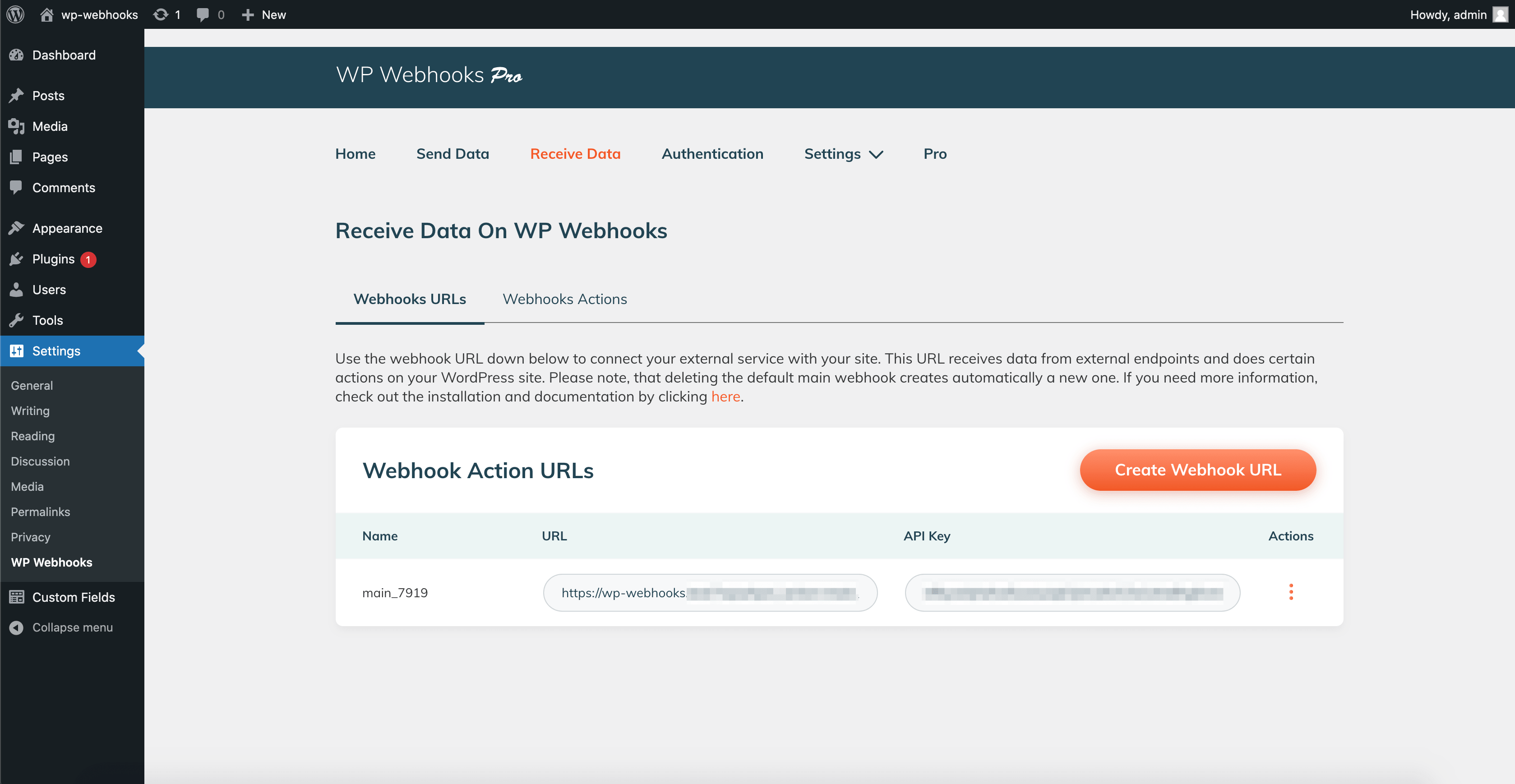
If you already have a specific picture about what webhook automation you want to create, you can check out each endpoint directly on our website. Here is an example for the LearnDash "Course completed" webhook trigger: https://wp-webhooks.com/integrations/learndash/triggers/ld_course_completed/. In case you would like to get started from scratch, we have a full documentation available here: https://wp-webhooks.com/docs/article-categories/get-started/
Can I request an integration or new automation feature?
Yes, you can! Please visit our Request an integration page and add your request there in case you cannot find it already.
What is the difference between your free and pro version?
If you are looking for a full list of differences between our free and pro version, we suggest taking a look at our comparison table.
Can AI assistants use my WP Webhooks actions?
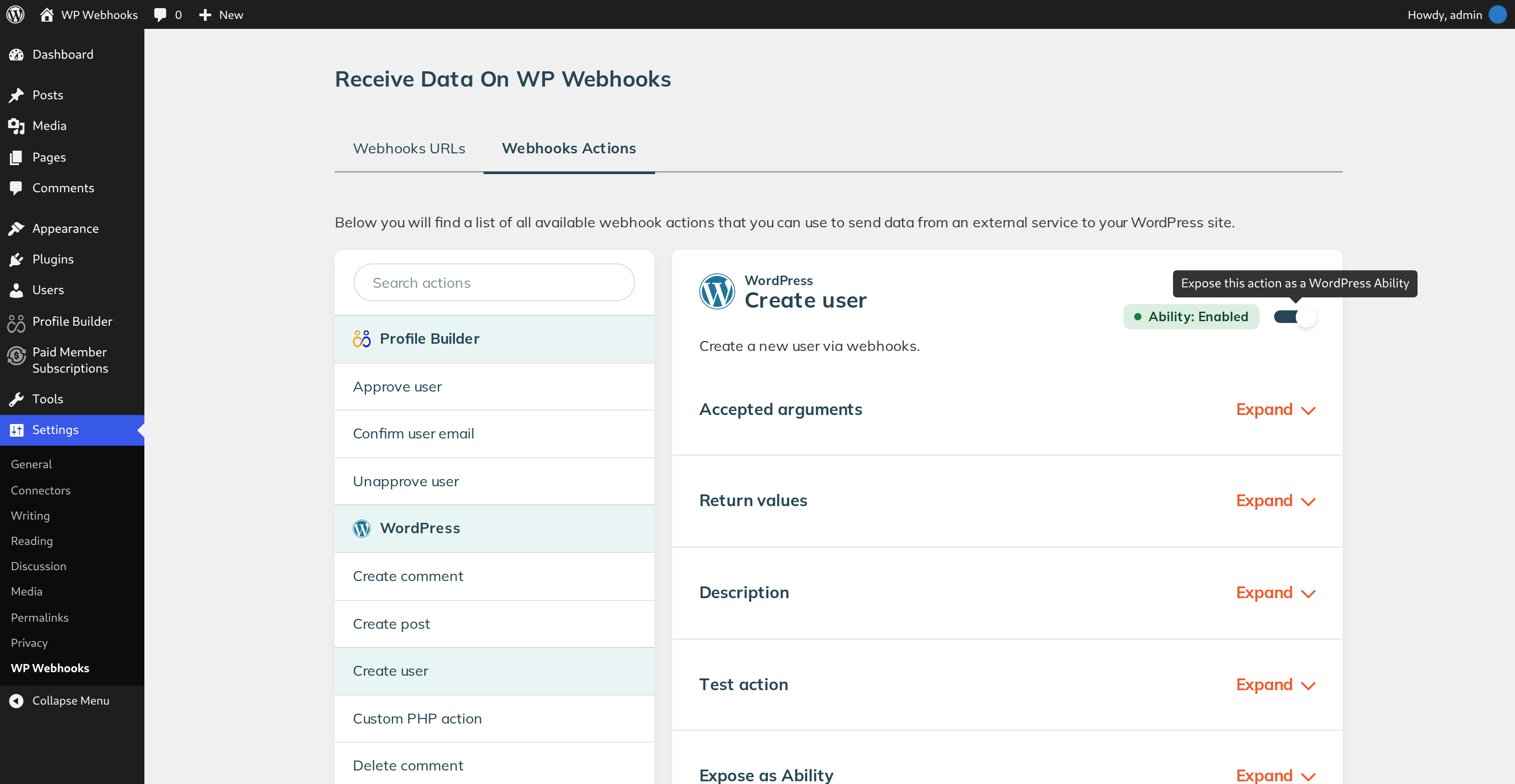
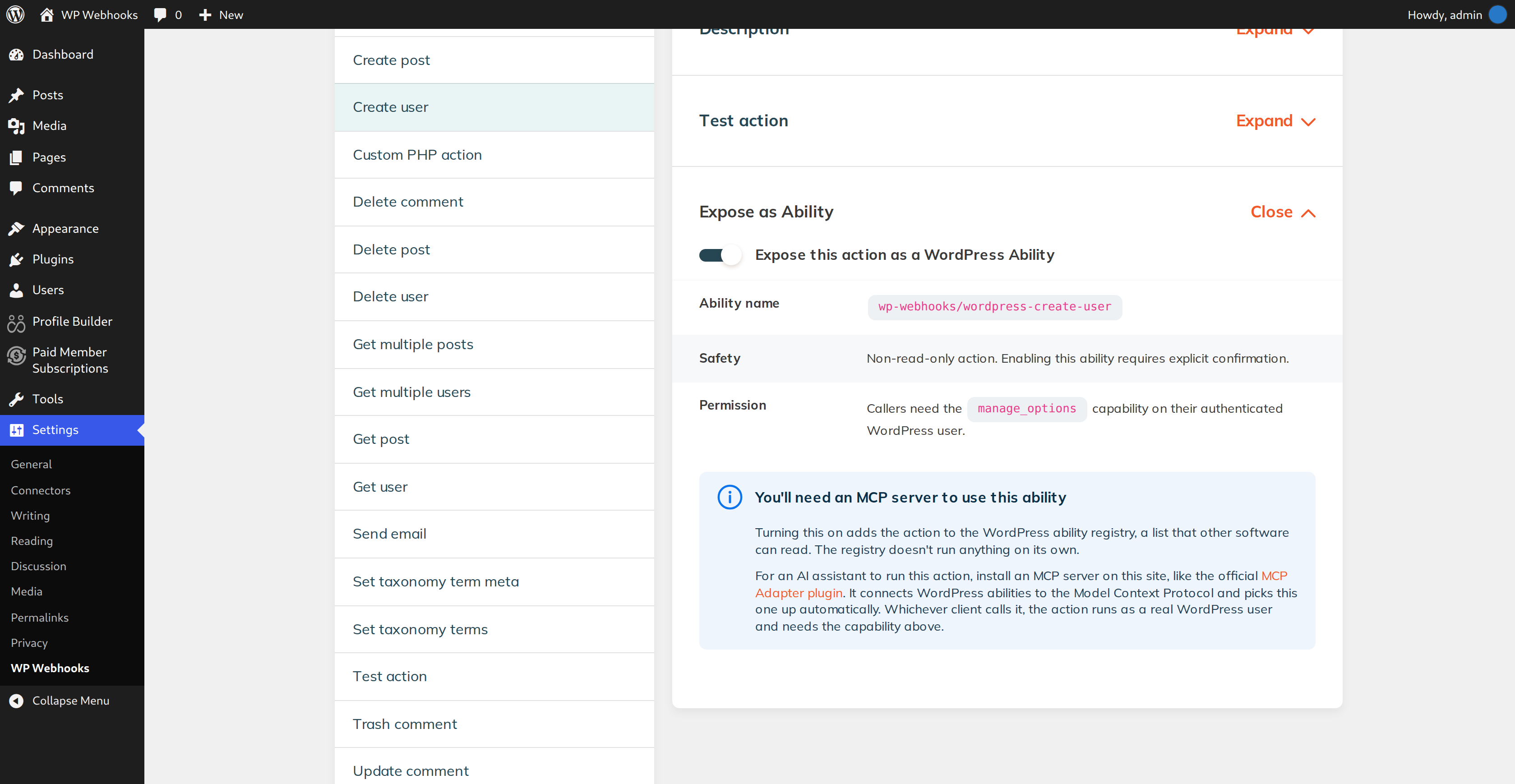
Yes. You can expose any WP Webhooks action as a WordPress Ability from the Receive Data screen. Each exposed action is registered with an input schema, an output schema and a permission check, so it can be discovered and run over the WordPress REST API or by an AI agent. To let an external assistant such as Claude or Cursor call your abilities, you also need an MCP server on your site, for example the free MCP Adapter. The REST API works without it.
Which actions are exposed to AI, and is it safe?
Nothing is exposed until you turn it on. Exposure is set per action and is off by default, so you publish only the operations you choose. Read-only actions (such as "Get post") are marked as read-only; exposing an action that changes or deletes data asks you to confirm first. Every ability runs behind a permission check, and premium actions require an active license before they can be exposed.
Can I run abilities from other plugins through a webhook?
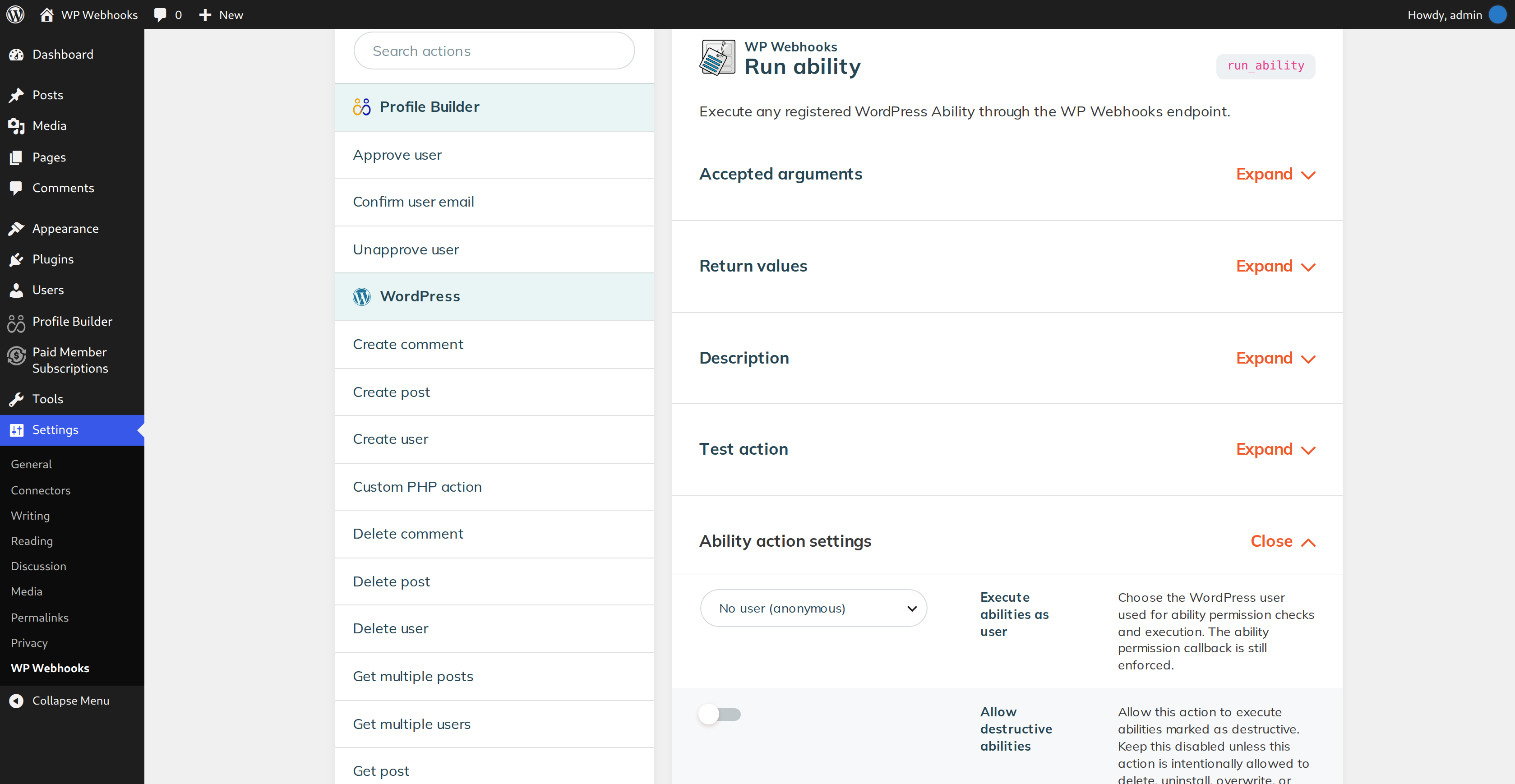
Yes. WP Webhooks includes three actions for this: Run ability, List abilities and Describe ability. They let an external service discover and execute any ability registered on your site, including abilities from WordPress core or other plugins, through a standard webhook URL. You can choose which user these actions run as, and running abilities that change data is kept behind a separate setting.
Where do I report security bugs found in this plugin?
Please report security bugs found in the source code of the WP Webhooks plugin through the Patchstack Vulnerability Disclosure Program. The Patchstack team will assist you with verification, CVE assignment, and notify the developers of this plugin.
更新日志:
- Security: the Contact Form 7 trigger now preserves only files that Contact Form 7 received, so a crafted form field can no longer copy other files from the server. Reported by Nathan Cross (CyberBadger)
- Security: dismissing an admin notice now accepts only the plugin's own notice IDs, so a logged-in user can no longer write other user meta on their account. Reported by Nathan Cross (CyberBadger)
- Security: the WordPress file actions keep every local path inside wp-content, including encoded traversal paths and the move_folder action. copy_file and move_file now accept only http and https remote sources
- Contact Form 7: preserved files are now deleted when their preserve duration expires
- WordPress Abilities API integration. Expose any WP Webhooks action as a WordPress Ability (WordPress 6.9+) with a per-action toggle on the Receive Data screen. Exposed actions are registered with input and output schemas and a permission check, and are available over the REST API and to MCP clients through an MCP server such as the MCP Adapter.
- New actions to consume abilities: Run ability, List abilities and Describe ability. Discover and run any ability registered on your site from an external service through a webhook, with a configurable run-as user.
- Exposing an action that is not read-only now asks for confirmation first, and read-only, destructive and idempotent annotations are added to each ability for AI clients.
- Trigger payload policy: choose which user fields are stripped from outgoing trigger data before it leaves your site. Configure per webhook on Send Data. New webhooks remove sensitive fields by default; existing webhooks are unchanged until you review them.
- Callback name for the EDD Subscription payment trigger
- Undismissable admin notice
- A security issue. Thanks to Artyom and the Cleantalk team
- Added a filter over the payload data that is sent from the Paid Member Subscriptions integration triggers so custom data can be added
- New actions for the “Profile Builder" integration: Approve User, Unapprove User, Confirm User Email
- Further fixes regarding unauthenticated arbitrary file copy issue coming from the Contact Form 7 integration when a certain setting was activated. Thanks to Phat RiO - BlueRock and the Patchstack team
- Fix security issue regarding PHP Object Injection in some cases. Thanks to Phat RiO - BlueRock and the Patchstack team
- Added allowed file extensions setting for the Contact Form 7 preserve uploaded files functionality. If you have this feature configured, you should edit the trigger and update the allowed extensions. By default only jpg, jpeg and png are allowed
- Fix installation of custom extensions
- Fix a PHP 8 deprecation notice
- Fixed issue with the WordPress get_post action returning success even when a post was not actually retrieved
- Fixed descriptions for the WordPress Create Comment and Update Comment actions, now the interface correctly mentions the meta_input key that is used to populate comment meta
- Fixed a deprecation error that started appearing with PHP 8.1
- Fix notice that could be triggered sometimes on the Receive Data tab
- Fixed exception handling issue when loading integrations
- Fixed descriptions for the WP Update User and WP Custom PHP actions
- Updated example payload for the create woocommerce order action
- New integration “Paid Member Subscriptions”
- Fixed security issue regarding unauthenticated arbitrary file copy coming from the Contact Form 7 integration when a certain setting was activated. Thanks to Phat RiO - BlueRock and the Wordfence team
- Fixed a deprecation notice coming from the Contact Form 7 integration
- Added missing integration for the Booking Approved trigger from the Events Manager plugin
- Fix payload data generation for the Events Manager - Booking Approved trigger
- New integration "Profile Builder"
- Fixed some WooCommerce issues
- Fixed edd_create_license action error
- Fixed more PHP 8 notices regarding dynamic properties
- Fix PHP 8 notices regarding dynamic properties
- New integration "Woocommerce"
- New webhook trigger "Order created" for the "Woocommerce" integration
- Added new "Fluent Support" integration
- New webhook trigger "Ticket created" for the "Fluent Support" integration
- Added new "WP Fusion" integration
- New webhook trigger "Tag added" for the "WP Fusion" integration
- Added new "GiveWP" integration
- New webhook trigger "Donation completed" for the "GiveWP" integration
- You can now use the get_post action to fetch an attachment (media) id from an URL
- Optimize integration items on single endpoint view for "Send Data" and "Receive Data"
- Optimized webhook descriptions and other text
- In case the wpwhpro/webhooks/validate_webhook_action was set to false, the function threw a notice and used the echo_action_data instead of echo_response_data
- Added new filter wpwhpro/webhooks/validate_webhook_action to prevent webhook actions from firing
- New integration "WP Webhooks"
- New integration "LearnDash"
- New integration "FluentCRM"
- New integration "Broken Link Checker"
- New integration "Amelia"
- New integration "AffiliateWP"
- New webhook action "Fire trigger" for the "WP Webhooks" integration
- New webhook action "Complete courses" for the "LearnDash" integration
- New webhook action "Add contact to list" for the "FluentCRM" integration
- New webhook action "Add contact to tag" for the "FluentCRM" integration
- New webhook trigger "Action fired" for the "WP Webhooks" integration
- New webhook trigger "Course completed" for the "LearnDash" integration
- New webhook trigger "Lesson completed" for the "LearnDash" integration
- New webhook trigger "Quiz completed" for the "LearnDash" integration
- New webhook trigger "Topic completed" for the "LearnDash" integration
- New webhook trigger "Contact added to list" for the "FluentCRM" integration
- New webhook trigger "Contact added to tag" for the "FluentCRM" integration
- New webhook trigger "Broken links detected" for the "Broken Link Checker" integration
- New webhook trigger "Booking added" for the "Amelia" integration
- New webhook trigger "Affiliate status changed" for the "AffiliateWP" integration
- New webhook trigger "New affiliate" for the "AffiliateWP" integration
- New trigger setting to prevent a trigger firing multiple times within the same WordPress instance
- Added permalink to the "Create post" webhook action response
- Added the permalink to "Delete post" webhok action response
- Added force_delete key to "Delete post" webhok action response
- Optimize sorting for custom trigger filter settings
- Optimized the overall layout and usability
- Optimized feature awareness
- Make sure we initialize the settings key for action webhook endpoints by default
- Added new dynamic action description
- Optimized webhook naming for trigger and actions
- Optimized output of response codes for triggers and demo data for actions
- Make sure the "Paid Memberships Pro" triggers return the most recent data
- Optimized various trigger responses to show more real data Fixed issues:
- The get_curret_url() helper returned a wrong host part in some cases, causing creating triggers and actions to not work properly
- A custom content type check prevented actions from shortening the logic
- Make sure we also correctly enqueue triggers
- The trigger callbacks did not return a value in case a filter or shortcode callback was given
- The Shop URL on the plugin overview page was broken
- Prevent undefined variable notice on the "Send Data" & "Receive Data" tab if default values are used
- The "User updated" and "User created" webhook triggers returned a wrongly formatted variable key if a multisite was used
- Prevent the file helpers to add absolute path on top of each other
- Optimize file helpers and fix issues for the file actions of the WordPress integration
- Added new function WPWHPRO()->auth->execute(); to execute the authentication hooks
- Added new function WPWHPRO()->extensions->execute(); to execute the extension hooks
- Added new function WPWHPRO()->integrations->get_integrations(); to to get a list of all available integrations
- Added new function WPWHPRO()->sql->column_exists(); to check if a table column exists
- Added new function WPWHPRO()->sql->prepare(); as an equivalent to WPDB's prepare
- Added new function WPWHPRO()->webhooks->reload_webhooks(); to reload all webhooks
- Added new function WPWHPRO()->webhooks->get_processed_triggers(); to get an array of all processed triggers within this instance
- Added new function WPWHPRO()->webhooks->get_processed_triggers(); to get an array of all processed triggers within this instance
- Added new function WPWHPRO()->webhooks->set_processed_trigger(); to register a processed trigger for this instance
- Added new argument for function WPWHPRO()->webhooks->built_url( $webhook, $api_key, $additional_args = array() ); to register custom query parameter
- The function WPWHPRO()->sql->run( $sql, $type = OBJECT, $args = array() ); accepts the $args for extra values (e.g. return_id)
- Return single triggers using the WPWHPRO()->integrations->get_triggers( $slug ); function
- New scheduled event "wpwh_maintenance" that runs once daily for various checks
- Introduce new filter wpwhpro/integrations/integration/is_active
- Introduce new filter wpwhpro/integrations/dependency/is_active
- Introduce new filter wpwhpro/integrations/get_integrations
- Introduce new filter wpwhpro/admin/webhooks/get_processed_triggers
- Introduce new filter wpwhpro/admin/webhooks/set_processed_trigger
- Prefilled action arguments with default values on return of get_actions
- Feature: Add "Advanced Custom Fields" integration (https://wp-webhooks.com/integrations/advanced-custom-fields/)
- Feature: Add "Paid Memberships Pro" integration (https://wp-webhooks.com/integrations/paid-memberships-pro/)
- Feature: Add "Elementor" integration (https://wp-webhooks.com/integrations/elementor/)
- Feature: Add "Fluent Forms" integration (https://wp-webhooks.com/integrations/fluent-forms/)
- Feature: Add "Formidable Forms" integration (https://wp-webhooks.com/integrations/formidable-forms/)
- Feature: Add "Forminator" integration (https://wp-webhooks.com/integrations/forminator/)
- Feature: Add "HappyForms" integration (https://wp-webhooks.com/integrations/happyforms/)
- Feature: Add "Newsletter" integration (https://wp-webhooks.com/integrations/newsletter/)
- Feature: Add "Ninja Forms" integration (https://wp-webhooks.com/integrations/ninja-forms/)
- Feature: Add "WP Simple Pay" integration (https://wp-webhooks.com/integrations/wp-simple-pay/)
- Feature: New trigger "Form submitted" for "Fluent Forms"
- Feature: New trigger "Form submitted" for "Formidable Forms"
- Feature: New trigger "Form submitted" for "Forminator"
- Feature: New trigger "Form submitted" for "HappyForms"
- Feature: New trigger "Form submitted" for "Newsletter"
- Feature: New trigger "Form submitted" for "Ninja Forms"
- Feature: New trigger "Membership canceled" for "Paid Memberships Pro"
- Feature: New trigger "Membership expired" for "Paid Memberships Pro"
- Feature: New trigger "Order created" for "Paid Memberships Pro"
- Feature: New trigger "Purchase completed" for "WP Simple Pay"
- Feature: New action "Add user to membership" for "Paid Memberships Pro"
- Feature: New action "Remove user from membership" for "Paid Memberships Pro"
- Feature: New action "" for ""
- Feature: New action "" for ""
- Feature: New optimized and reworked webhook descriptions
- Tweak: Display integration icon next to trigger and action title
- Tweak: Add the plugin version within the footer of WP Webhooks
- Tweak: Remove unnecessary headlines within the "Send Data" tab
- Tweak: Apply single array filter for incoming values only to strings
- Fix: Remove duplicated ids notices
- Fix: Prevent EDD Purchase Receipt email from being sent even though "send_receipt" was set to "no"
- Fix: The triggers edd_new_customer and edd_update_customer did not work properly due to a wrong check for a non-existent function
- Fix: Using the manage_term_meta action in combination with a numeric slug caused the slug to be the id instead
- Dev: New helper function WPWHPRO()->helpers->get_nonce_field( $nonce ) to fetch a nonce with a random id
- Dev: Add two new sql query tags: {posts} and {postmeta}
- Dev: New function WPWHPRO()->webhook->get_endpoint_description( $type = 'trigger', $data = array() ) to dynamically load descriptions
- Feature: New webhook action create_term to create taxonomy terms
- Feature: Add "Gravity Form" integration
- Feature: Add "WP Reset" integration to core
- Feature: Add "Manage Plugins" integration to core
- Feature: Add "Email integration" integration to core
- Feature: Add "Woocommerce" integration to core
- Feature: Add "Comments" integration to core
- Feature: Add "Manage Taxonomy Terms" integration to core
- Feature: Add "Remote File Control" integration to core
- Feature: Add "Manage Media Files" integration to core
- Feature: Add "Easy Ditigal Downloads" integration to core
- Feature: Switch triggers and actions to an integration-based setup
- Feature: Allow integration-based grouping for actions and triggers
- Feature: Add beautified namings to webhook actions
- Feature: Setting to toggle WP Webhooks between a sub menu item or a menu item in the main admin menu
- Tweak: Show the status of a webhook trigger or action next to the table item (green/red dot)
- Tweak: Display JSON constructs for webhook triggers instead of array notations
- Tweak: Add support for post trigger delay to wpwhh_shortcode trigger
- Tweak: Allow pretty-printing for Receive Data responses
- Tweak: Sort triggers and actions by name
- Tweak: Optimize performance for authentication feature (duplicated "if exists" statement)
- Tweak: Optimize performance of settings tab
- Tweak: Optimize performance of authentication feature
- Fix: If a custom URL port is used, the get_current_url() helper function returned the URL without the port
- Dev: Support centralized support for post-delayed triggers
- Dev: Make callback argument for triggers optional to support the integration based notation
- Dev: Make post delay filter wpwhpro/post_delay/post_delay_triggers more accessible - we added the webhook_group name and the webhook object
- Dev: New, public function WPWHPRO()->auth->maybe_setup_authentication_table()
- Dev: New helper function WPWHPRO()->helpers->get_folders( $path ) to retrieve a list of folders from a given path
- Dev: New helper function WPWHPRO()->helpers->get_files( $path, $ignore = array() ) to retrieve a list of files from a given path
- Dev: New action wpwhpro/integrations/callbacks_registered which fires after all integration callbacks have been registered
- Feature: Allow the "Send Data on Post Update" to only trigger on specific post statuses
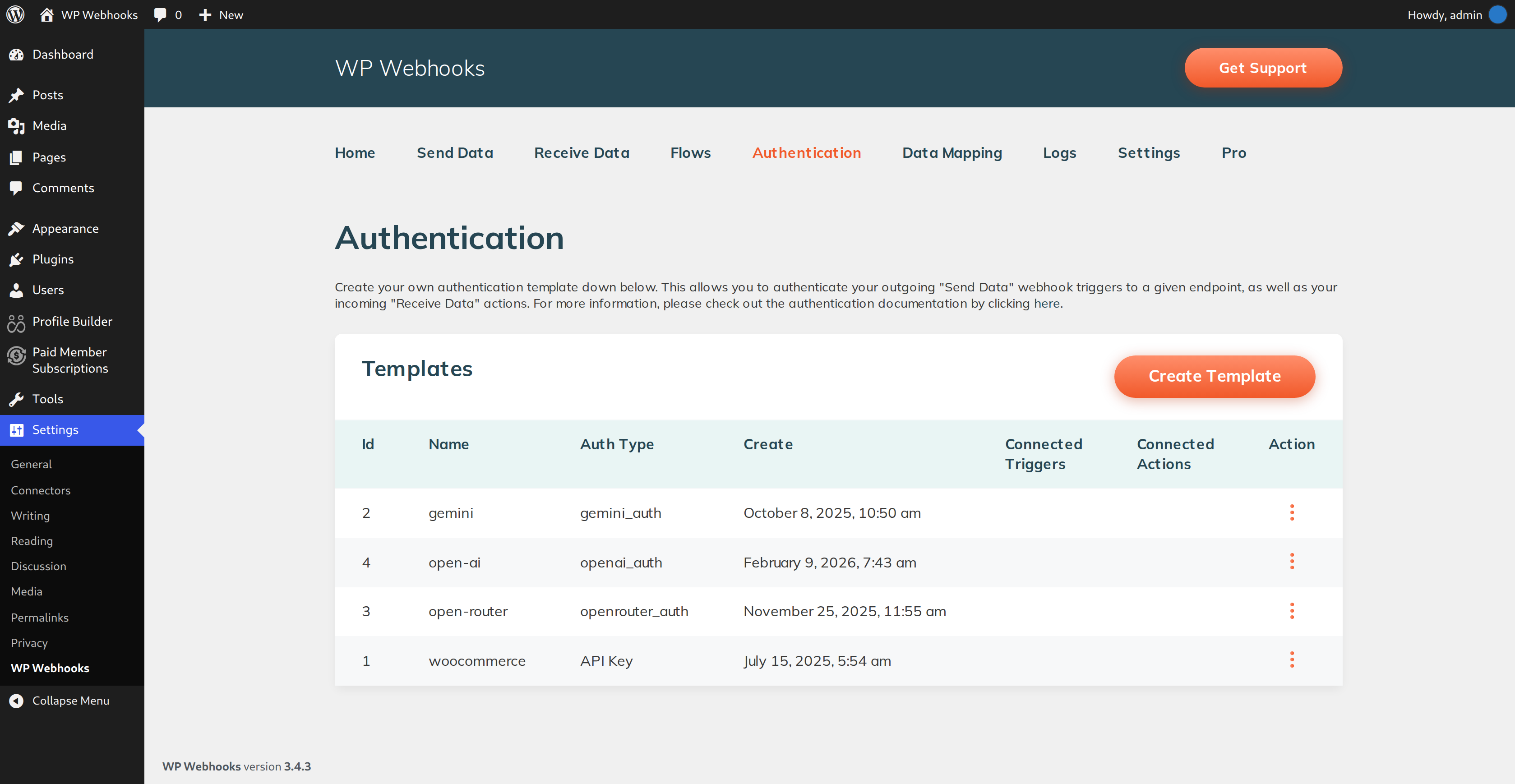
- Feature: Allow a custom bearer token scheme for auth templates
- Tweak: Better handling for webhook action responses (centralized through a new filter)
- Tweak: Correct response data for successful delete_post webhook
- Tweak: Add internal slug to triggers for better usability
- Fix: $response_data for trigger overwrote response if multiple webhooks have been used within webhook trigger groups
- Fix: Wrong logo was shown
- Fix: When no plugin updates have been available, the extension page threw a fatal error
- Dev: Switch webhooks to separate classes for a better and more constrolled handling
- Feature: Fully reworked and optimized design
- Feature: "Send Data On Post Update" can now be triggered only on specific post statuses
- Feature: Full ACF integration for the "Send Data On Register" trigger
- Feature: Full ACF integration for the "Send Data On Login" trigger
- Feature: Full ACF integration for the "Send Data On User Update" trigger
- Feature: Full ACF integration for the "Send Data On User Deletion" trigger
- Feature: Full ACF integration for the "Send Data On New Post" trigger
- Feature: Full ACF integration for the "Send Data On Post Update" trigger
- Feature: Full ACF integration for the "Send Data On Post Deletion" trigger
- Feature: Full ACF integration for the "Send Data On Post Trash" trigger
- Feature: Full ACF integration for the "get_users" action
- Feature: Full ACF integration for the "get_user" action
- Feature: Full ACF integration for the "get_posts" action
- Feature: Full ACF integration for the "get_post" action
- Feature: Add filter for webhook URL on webhook triggers
- Feature: Secure webhook actions with Basic Auth and API Keys
- Feature: New argument load_taxonomies for the get_posts action to also return the assigned taxonomies of your choice
- Feature: Add support for multipart/form-data
- Feature: Integrated details to each action argument (Popup)
- Feature: Add new webhook property called "webhook_url_name" to webhook trigger and action calls and logs
- Feature: Add new key to trigger response data called body_validated, which shows the original body filtered and validated for further use
- Tweak: Authentication is integrated into the core and always active
- Tweak: Optimize menu setup and group related menu items
- Tweak: Integrate Authentication into core, always active, and remove activate/deactivate possibility
- Tweak: All actions and triggers are active by default
- Tweak: Make trigger response connectable by using the trigger name as an array key
- Tweak: Optimize performance for previously available active_webhooks feature
- Tweak: Optimize webhook action return values
- Tweak: Optimize webhok action return value description
- Fix: Authentication for API tokens did not work properly if the API token was added only to the header
- Fix: Issue with same id namings within the "Receive Data" tab
- Fix: Optimize backwards compatibility for post status changes to also fire on multiple webhooks
- Fix: Notice with undefined identkey variable
- Fix: Not all data of WP Webhooks has been reset on the reset feature
- Dev: New helper function get_current_request_method()
- Dev: New function WPWHPRO()->webhook->get_current__webhook_action() to fetch the webhook action in case the current instance runs on an incoming webhook call
- Dev: New filter wpwhpro/webhooks/get_current_webhook_action
- Dev: Deprecated WPWHPRO()->settings->get_active_webhooks() and WPWHPRO()->settings->setup_active_webhooks()
- Dev: Add new webhook property called $webhook_url_name to default webhook trigger data
- Dev: Extend wpwhpro/helpers/validate_response_body filter by another variable called $custom_data
- Dev: New helper function to fetch server header: WPWHPRO()->helpers->validate_server_header( 'key' )
- Dev: Place the authentication response on the right position (after the webhook authentication)
- Dev: Trigger settings required the default_value to not be prefilled with a 1, now not anymore