
WT Waitlist
| 开发者 | webmastersteam |
|---|---|
| 更新时间 | 2026年7月21日 20:31 |
| 捐献地址: | 去捐款 |
| PHP版本: | 8.0 及以上 |
| WordPress版本: | 7.0 |
| 版权: | GPLv2 or later |
| 版权网址: | 版权信息 |
详情介绍:
- Signup form replaces Add to cart for out-of-stock products, with variation support (per size/color).
- Custom database tables (
{prefix}_waitlist_subscriptions) - we do not clutterwp_postmeta, the plugin scales to tens of thousands of subscriptions. - Action Scheduler queue (bundled with WooCommerce): batch of 50 emails per tick, automatic retries, retry log visible in
WooCommerce → Status → Scheduled Actions. - 5 min throttle per product - prevents duplicate sends when multiple hooks fire (e.g. quantity change followed by status change).
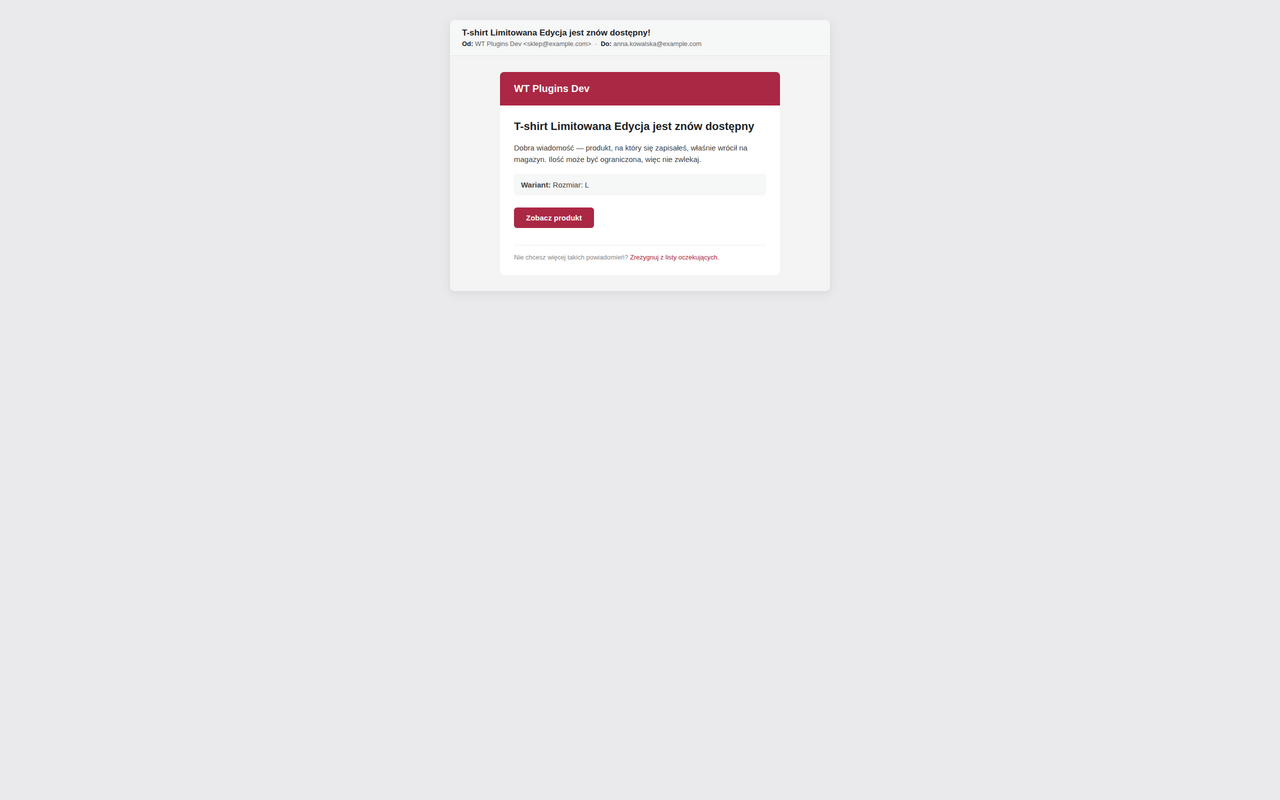
- One-click unsubscribe via a link in the email (SHA-256 token), no confirmation or login required.
- GDPR-ready: consent logging (anonymized IP, timestamp, user agent), integration with WordPress Privacy Tools (export and erasure of data per email).
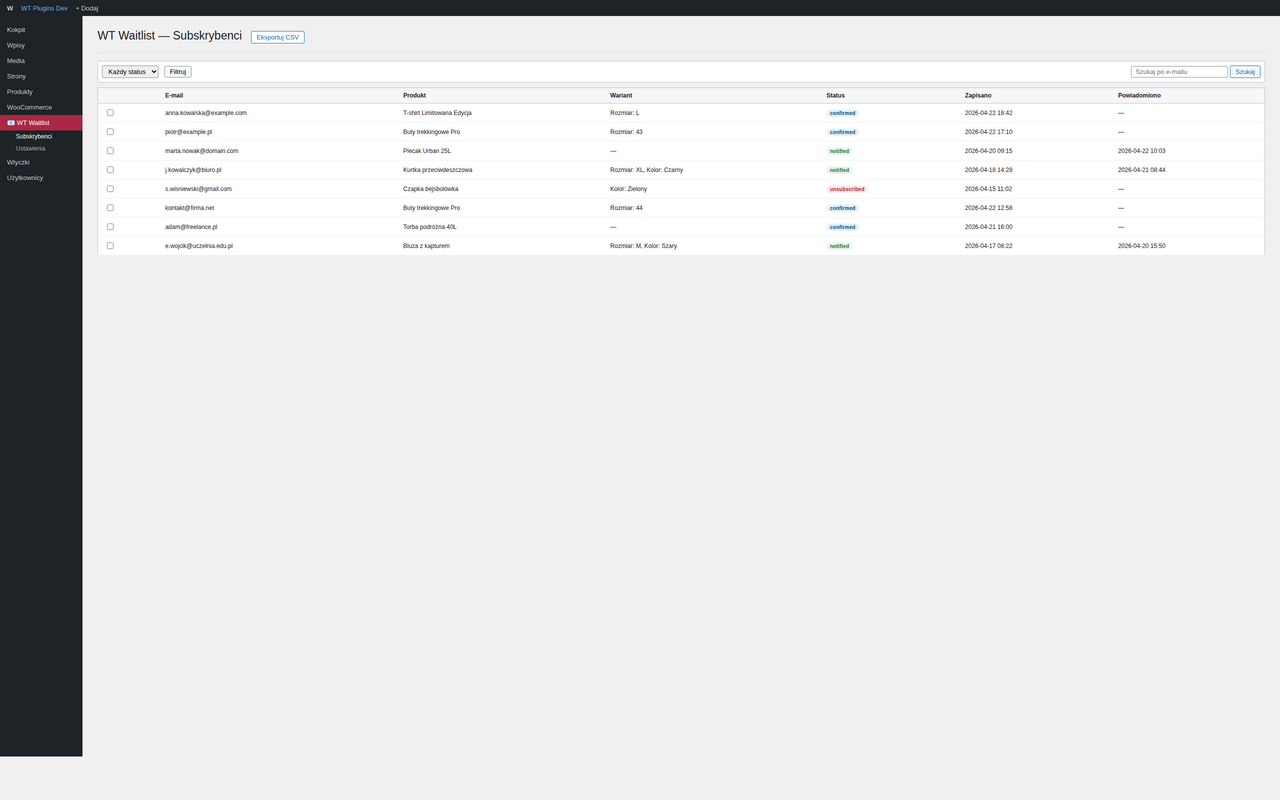
- CSV export of subscribers from the admin panel (streamed, no timeouts on large lists).
- Anti-spam: honeypot plus rate limiter per IP (10 submissions per hour).
- Theme compatibility: classic themes (Storefront, Twenty Twenty-One/Two/Three) plus block themes (Twenty Twenty-Four/Five) - the form attaches through a hook for classic templates and through a
render_blockfilter for FSE. - Zero external dependencies: apart from WooCommerce, requires only plain PHP 8.0+.
[wt_waitlist product_id="123"] - use this if your custom product template does not fire the standard hooks.
What WT Waitlist does NOT do (by design)
- No SMS, no Mailchimp/MailerLite integrations in the free version.
- No double opt-in (minimal flow - leave email, get notification).
- No WYSIWYG editor for email templates (HTML template lives in the plugin file, override with the
wt_waitlist/notification_contextfilter).
安装:
- Install and activate WooCommerce (required).
- Install WT Waitlist via WP Admin → Plugins → Add new, or manually over FTP (folder
wt-waitlistinwp-content/plugins/). - Activate the plugin.
- Open the WT Waitlist menu in the admin panel and configure data retention plus the administrator notification email address.
屏幕截图:
常见问题:
How does the form appear on the product page?
Automatically - the plugin hooks into the standard WooCommerce action (woocommerce_single_product_summary) for classic themes and into the render_block filter for block themes (FSE). The form is shown only when the product is out of stock.
What if my theme or template does not fire WooCommerce hooks?
Use the shortcode [wt_waitlist product_id="123"] - it works everywhere, from page builders to custom single product templates.
How many emails are sent at once?
Action Scheduler processes batches of 50 subscribers per tick. For a product with 1000 subscribers we queue 20 batches, each processed asynchronously, without blocking the PHP request.
Do emails go through my WP Mail configuration?
Yes. We use wp_mail() - if you have WP Mail SMTP, SendGrid, Amazon SES etc. configured, the mail travels through them. The plugin does not hardcode any provider.
What happens to the data after uninstalling the plugin?
The uninstall.php file drops the tables and deletes the options. Clean. If you deactivate without deleting, the data stays - you can reactivate without losing subscriptions.
GDPR compliance?
The plugin stores anonymized IPs (last octet zeroed), consent timestamp and user agent. It integrates with WordPress Privacy Tools - a customer can request data export or deletion through the standard WordPress flow.
The signup form does not appear on my product page. What now?
First check whether the product is actually out of stock - the form replaces the Add to cart button only when stock is zero (or the variation is unavailable). If the product is out of stock and the form still does not appear, your theme likely uses a custom single-product template that bypasses the standard WooCommerce hooks. Drop the shortcode [wt_waitlist product_id="123"] directly into the product description or template. The shortcode also works inside page builders (Elementor, Bricks, Divi).
Customers submit the form but no notification email arrives.
Open WT Waitlist → Settings and click Send test email to admin. If the test email arrives - wp_mail() works and notifications will be delivered as soon as the product returns to stock (give Action Scheduler 1–2 minutes to process the batch). If the test email does not arrive, the problem is on your mail pipeline, not on the plugin. Install the free WP Mail SMTP plugin and route mail through a transactional provider (SMTP2GO, Brevo, SendGrid, Amazon SES). Shared hosting often blocks mail() silently.
How do I check whether stock notifications are queued?
Open WooCommerce → Status → Scheduled Actions and filter by hook wt_waitlist_*. You will see pending and completed jobs with timestamps. If nothing appears after a stock change, check the System status panel inside WT Waitlist → Settings - it shows whether Action Scheduler is available and how many wt_waitlist_* jobs are pending.
Something is broken and I want to send a support ticket.
Open WT Waitlist → Settings, click Copy diagnostic info and paste the resulting block into your email to support. It includes plugin/WP/WC/PHP versions, theme info, table state, subscription counts, recent email log, Action Scheduler status and a sample of out-of-stock products with their purchasable / backorders state - everything we need to diagnose the issue without going back and forth.
I use Flatsome / Avada / Enfold / Porto and the form does not appear.
Themes with custom product-page templates (Flatsome UX Builder, Avada Builder, Enfold templates, Porto) often replace the standard WooCommerce single-product template, which bypasses the hooks WT Waitlist uses to attach the signup form. As of v1.0.3 we ship multiple compatibility layers, including a wp_footer JS DOM-injection fallback that should handle most of these themes automatically. The plugin also detects these themes and shows a compatibility note inside WT Waitlist → Settings → System status.
If the form still does not show:
- In Flatsome, switch the product template to Default in Flatsome → Theme Options → WooCommerce → Product Page.
- Or place the shortcode
[wt_waitlist product_id="123"]directly inside the product description / UX block / Custom HTML block.
My product is marked out of stock but customers can still add it to the cart, and the waitlist form does not appear.
That means the product has backorders enabled (Product → Inventory → Allow backorders). WooCommerce treats it as purchasable even though is_in_stock() returns false - and your customers see the standard "Add to cart" button alongside a backorder notice. WT Waitlist still renders its signup form for such products (so both signup paths coexist), but if the form is missing on a backorder-allowed product, check the Sample out-of-stock products section inside the diagnostic info (button Copy diagnostic info) - it lists is_purchasable / backorders_allowed / subscribers per OOS product so you can see exactly how WooCommerce treats each item.
更新日志:
- Security: hardened client-IP detection. The signup rate-limiter and the GDPR consent log previously trusted the
X-Forwarded-For,CF-Connecting-IPandX-Real-IPheaders, which are spoofable on sites that are not behind a trusted reverse proxy - allowing the rate limit to be bypassed and the recordedconsent_ipto be forged. The client IP is now read fromREMOTE_ADDRby default; proxy headers are honoured only via the newwt_waitlist_trust_proxy_headersfilter. - Security: the CSV subscriber export now neutralises formula-injection payloads - values starting with
=,+,-,@, TAB or CR are prefixed with an apostrophe so a crafted e-mail address submitted through the public form cannot execute as a formula when the export is opened in Excel or LibreOffice. - Compatibility: pass an explicit escape character to
fputcsv()to avoid the PHP 8.4 deprecation notice.
- Polish: friendlier empty state on the Subscribers admin screen with a hint pointing users to the shortcode fallback when the signup form does not appear automatically.
- Fix: signup form rendered twice on most themes. Two of the rendering layers shared one callback that did not check the "already rendered" guard, so the form appeared duplicated. Resolved - the form now renders exactly once.
- Fix: signup form not appearing on variable products when a selected variation is out of stock or on backorder. The variation-aware JavaScript relied on
is_in_stock, which istrueforonbackordervariations. The plugin now tags each variation server-side (woocommerce_available_variation) with an explicit waitlist flag, so the form shows correctly for every non-instockvariation. - New: Editable signup form text - the form heading, description, button label and success message can now be customized under WT Waitlist → Settings → "Signup form text". Leave a field empty to keep the built-in translated default.
- i18n: translated the last two hardcoded Polish fallback strings in the frontend script (connection / generic error messages).
- Fix: signup form was not appearing on backorder-allowed products. WooCommerce has three stock statuses -
instock,outofstockandonbackorder- andWC_Product::is_in_stock()returnstruefor bothinstockandonbackorder. The previous version's check!is_in_stock()therefore skipped backorder products entirely. We now useget_stock_status() !== 'instock'so the form is rendered (and accepts signups) for both true-OOS and backorder products. This is the primary fix in 1.0.3 - strongly recommended for any store using WooCommerce backorders. - New: Two additional rendering layers for theme compatibility -
woocommerce_after_single_product_summary(Layer 4) andwp_footer+ JS DOM injection (Layer 5). Fixes "signup form does not appear" on themes that bypass the standard WooCommerce summary hooks (Flatsome UX Builder, Avada Builder, Enfold, Porto and similar page-builder driven themes). - New: Sample out-of-stock products section in System status - for the first 5 OOS products shows
is_in_stock / is_purchasable / backorders_allowed / subscribersso backorder vs. waitlist conflicts are immediately visible. - New: Theme compatibility hints - System status now reports the active theme template slug and surfaces a known-incompatibility note for Flatsome / Avada / Enfold / Porto.
- i18n: All user-facing strings translated to English (admin Settings labels, signup form, error messages, email templates, unsubscribe page, admin list table). Polish-only release is over - the plugin now ships in English by default.
- Docs: new FAQ entries covering Flatsome/builder-theme rendering and backorder-vs-waitlist behavior.
- New: System status panel inside WT Waitlist → Settings - versions, DB tables, subscription counts, Action Scheduler state and recent email log at a glance.
- New: Send test email to admin button - one-click verification that
wp_mail()works on this site (surfaces PHPMailer error string on failure). - New: Copy diagnostic info button - generates a paste-ready support snippet so you do not have to copy values by hand.
- New: Quick start panel at the top of the settings page explaining the out-of-stock → form → Action Scheduler → email flow in four lines.
- Tweak: fixed
WT_WAITLIST_VERSIONconstant that still reported0.1.0in cached environments.
- Fix: replaced inline
<style>block in the unsubscribe page withwp_register_style()+wp_print_styles()(WP guideline compliance).
- Waitlist form on product pages (simple + variable), classic and block theme support.
- Custom database tables (
{prefix}_waitlist_subscriptions,{prefix}_waitlist_email_log). - Stock-status change detection through WooCommerce hooks.
- Notification queue through Action Scheduler with 5 min throttle and batches of 50.
- One-click unsubscribe with SHA-256 token.
- Admin panel: subscriber list with filters and CSV export.
- Product-edit widget showing waitlist count.
- Integration with WordPress Privacy Tools (export + eraser).
- Shortcode
[wt_waitlist]as fallback. - Honeypot plus rate limiter (10/hour per IP).
- Automatic purge of old subscriptions (configurable retention).