
EmiCache – Faster Elementor, Better PageSpeed
| 开发者 | ismeteroglu |
|---|---|
| 更新时间 | 2026年5月29日 22:05 |
| PHP版本: | 7.4 及以上 |
| WordPress版本: | 7.0 |
| 版权: | GPLv2 or later |
| 版权网址: | 版权信息 |
详情介绍:
media="print" onload swap pattern, hero images get fetchpriority="high" preload hints, and entry animations are optionally disabled so scrolling and navigation feel instant on mobile. WooCommerce cart, checkout, my-account, and add-to-cart pages are auto-excluded from the cache, the heavy wc-cart-fragments AJAX call can be limited to actual cart pages, and WooCommerce-only CSS and JS are dequeued from blog posts and landing pages where they would otherwise bloat every request. Compatibility is also tested and tuned for Divi, WoodMart, Avada, Astra, GeneratePress, Kadence, Blocksy, OceanWP, Hello Elementor, WPBakery / Visual Composer, Slider Revolution, AOS, Element Pack, and Animate.css.
Why EmiCache
- Fastest free cache for Elementor and WooCommerce — outperforms popular free alternatives on real PageSpeed Insights, Lighthouse, and GTmetrix benchmarks
- Works on LiteSpeed, Nginx, and Apache — full feature parity across every stack, with LiteSpeed Cache (LSCache) coexistence support so you can keep server-level caching while EmiCache handles minification, lazy loading, WebP, critical CSS, and CDN delivery
- All-in-one performance suite — full-page cache, HTML / CSS / JS minify and combine, lazy loading, WebP and AVIF conversion, critical CSS, CDN integration, database cleanup, and persistent object cache in one plugin
- Lightweight frontend — vanilla JavaScript runtime under 3 KB, zero external services, no telemetry, no premium upsell walls, no account required
- Server-aware — auto-detects AVIF, Brotli, OPcache, Redis, and Memcached and enables the matching modules automatically
- Standards-compliant — GPL-2.0, sanitized inputs, escaped outputs, nonce-verified AJAX, no
eval(), no obfuscated code, no encrypted PHP - PHP 7.4 → 8.3 and WordPress 5.4 → 7.0 tested across thousands of real sites
.html.gz and .html.br so a single try_files rule serves Brotli or GZIP responses with zero runtime CPU cost, and the Compression module ships ready-to-paste Nginx snippets for static asset delivery. On Apache and LiteSpeed the bundled .htaccess rules handle GZIP via mod_deflate, Brotli via mod_brotli, browser cache headers, ETag and 304 Not Modified responses, and direct-file protection out of the box. Whether your host is a shared cPanel plan, a managed WordPress platform like Cloudways, Hostinger, SiteGround, Kinsta, or WP Engine, or a self-managed VPS with Docker and PHP-FPM, EmiCache adapts to the environment without manual .htaccess edits or wp-config.php constants beyond the standard WP_CACHE define that the plugin sets for you on activation.
Core Web Vitals Optimization
Every EmiCache module is built around the three Core Web Vitals metrics that Google uses for search ranking — Largest Contentful Paint (LCP), Interaction to Next Paint (INP), and Cumulative Layout Shift (CLS) — plus the supporting metrics like Time to First Byte, First Contentful Paint, and Total Blocking Time that PageSpeed Insights and Lighthouse report. LCP is improved through automatic hero image preload with fetchpriority="high", critical CSS inlining per page type, render-blocking stylesheet elimination, font preloading with font-display: swap, and HTML pre-generation so the server returns a static .html file before WordPress even boots. INP is improved through JS Delay (which holds non-essential scripts like Google Tag Manager, Facebook Pixel, Hotjar, and Microsoft Clarity until the first user interaction), JS Defer for everything else, a lightweight jQuery shim that queues inline jQuery calls until the library loads, and Heartbeat API throttling that keeps admin-ajax.php quiet on idle tabs. CLS is prevented through SVG placeholders sized to match each lazy-loaded image, automatic width and height attribute injection on unsized images, and font-display tuning with size-adjust fallbacks. The result is a real, measurable PageSpeed score lift on real-world Elementor and WooCommerce sites — typically a +20 to +40 point gain on mobile when starting from a stock theme plus page builder install, and a stable green Core Web Vitals report in Google Search Console after the next 28-day data window.
Performance Modules
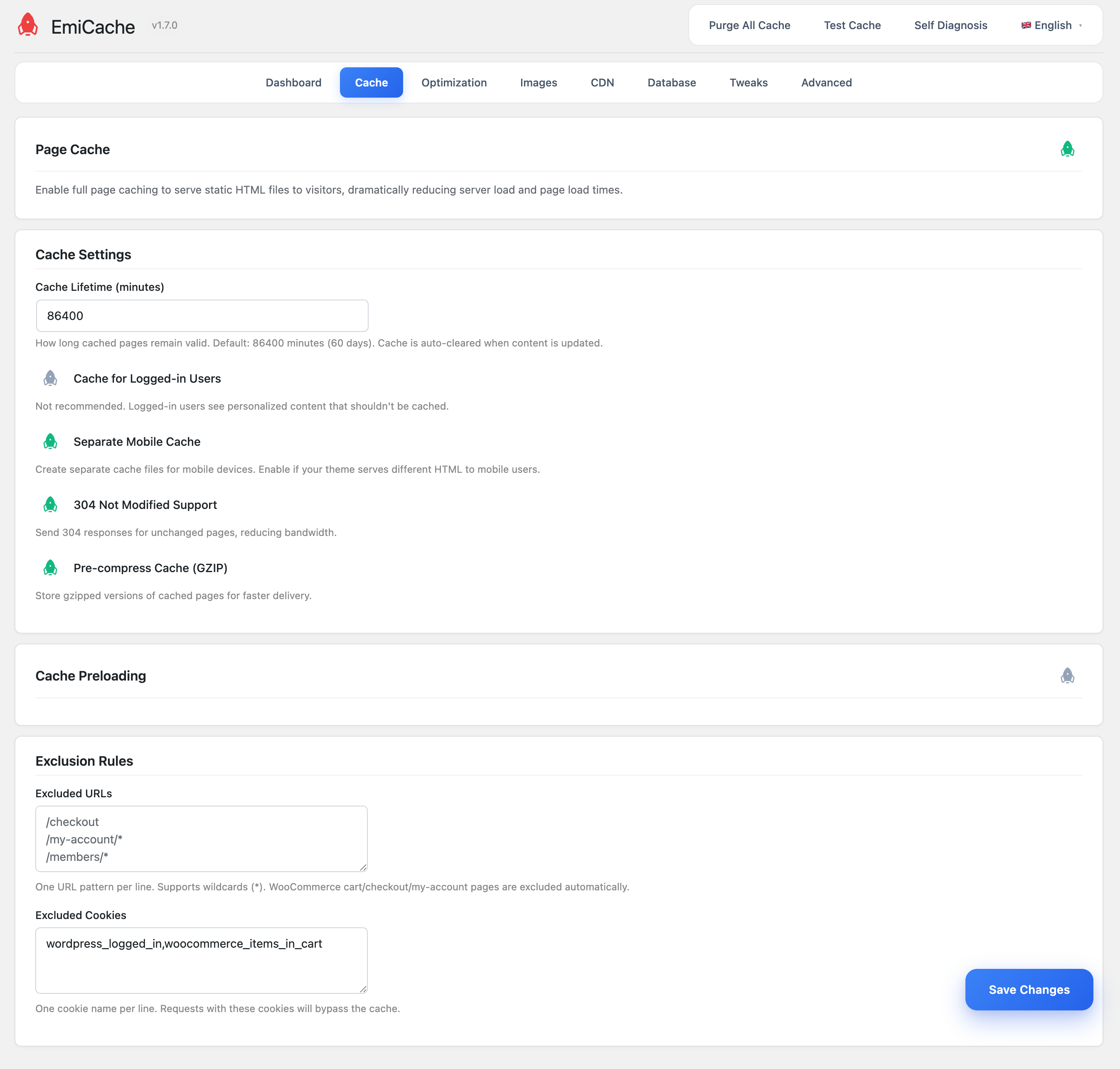
Full Page Cache. Static HTML files served before WordPress loads. GZIP and Brotli pre-compression, ETag headers, 304 Not Modified support, mobile-separate cache, stampede protection, and sitemap-based preload.
HTML, CSS, and JS Minification. Removes whitespace and comments from output. Preserves content inside pre, code, textarea, script, and style tags. Combine option for stylesheets and scripts.
Smart CSS Defer. Eliminates render-blocking plugin stylesheets via the media="print" onload swap pattern. Theme stylesheets and builder dynamic CSS stay render-blocking so the first paint is layout-stable.
JS Defer + JS Delay. Defer attribute injection for non-critical scripts, delay-until-interaction for tracking and widget code (Google Tag Manager, Facebook Pixel, Hotjar, Clarity, and 24 more).
Lazy Loading. Images, iframes, videos, and CSS background images load only when they enter the viewport. YouTube and Vimeo facade placeholders replace the heavy default iframe with a lightweight preview. SVG placeholders prevent CLS on unknown-dimension images.
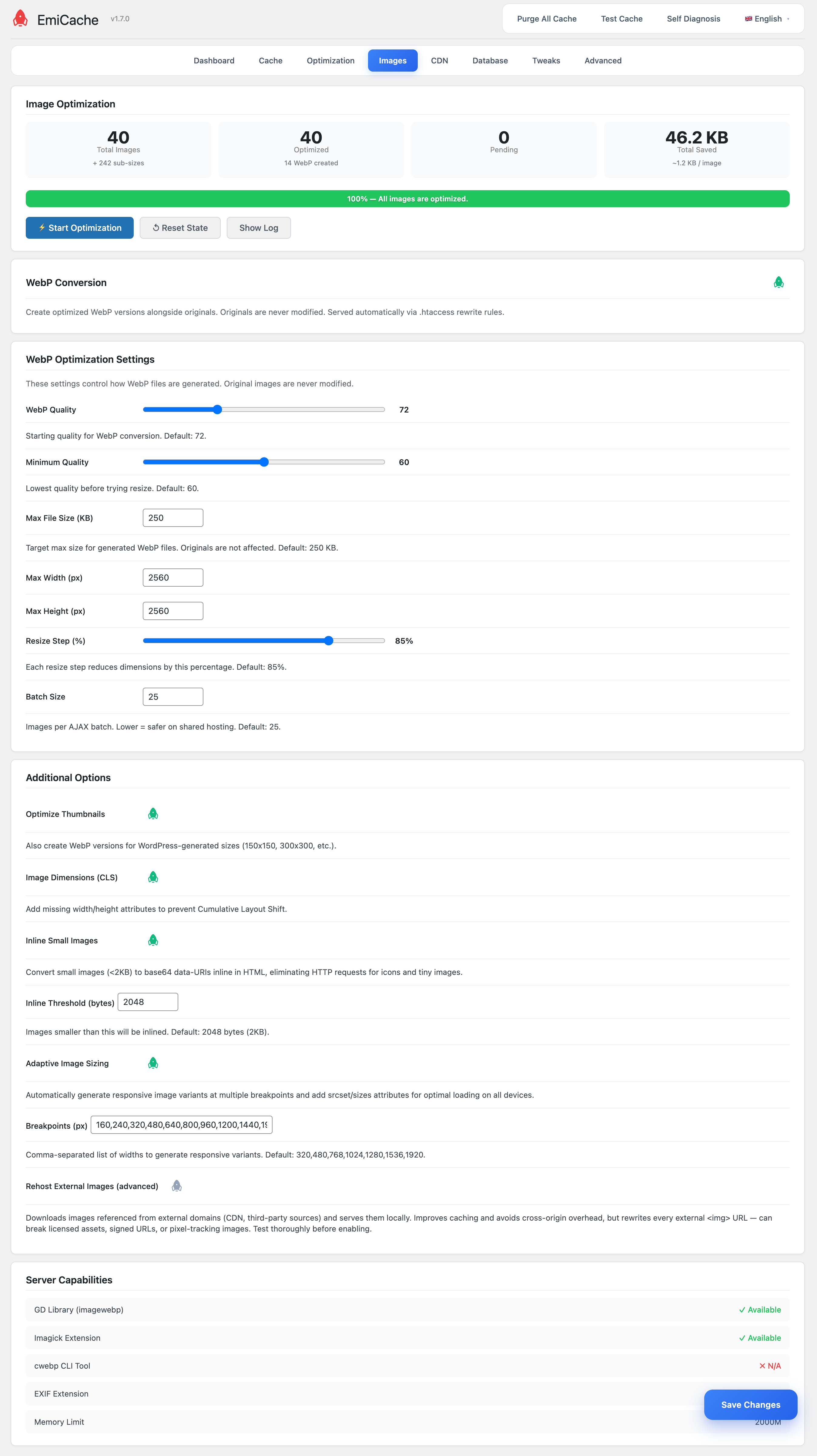
Image Optimization. Automatic WebP and AVIF conversion using GD, Imagick, or command-line tools (cwebp, avifenc) — whichever is available. Adaptive responsive sizing generates variants at 7 breakpoints with proper srcset / sizes. Original files are never modified.
LCP Image Preload. Auto-detects the largest above-the-fold image and injects a <link rel="preload" as="image" fetchpriority="high"> hint into <head> so the LCP candidate downloads in parallel with HTML.
Disable Entry Animations. Skips scroll-triggered fade-in / slide-up entry animations from Elementor, AOS, Element Pack, WoodMart, and Animate.css. Interactive transitions (sliders, dropdowns, modals) stay active.
Smart Prefetch. Browser-native speculation rules in prefetch mode warm assets for likely navigations without re-firing entry animations.
Critical CSS. Inline above-the-fold CSS per page type. Non-critical stylesheets deferred with preload/onload plus loadCSS polyfill.
CDN Integration. URL rewriting for any CDN. Built-in CloudFlare API (purge URL, purge all, dual auth) and Bunny CDN API. Automatic cache purge on content changes.
Object Cache. File-based persistent object cache drop-in (object-cache.php) with multisite global groups, gzip compression, and file locking. Auto-detects Redis and Memcached and recommends them when available.
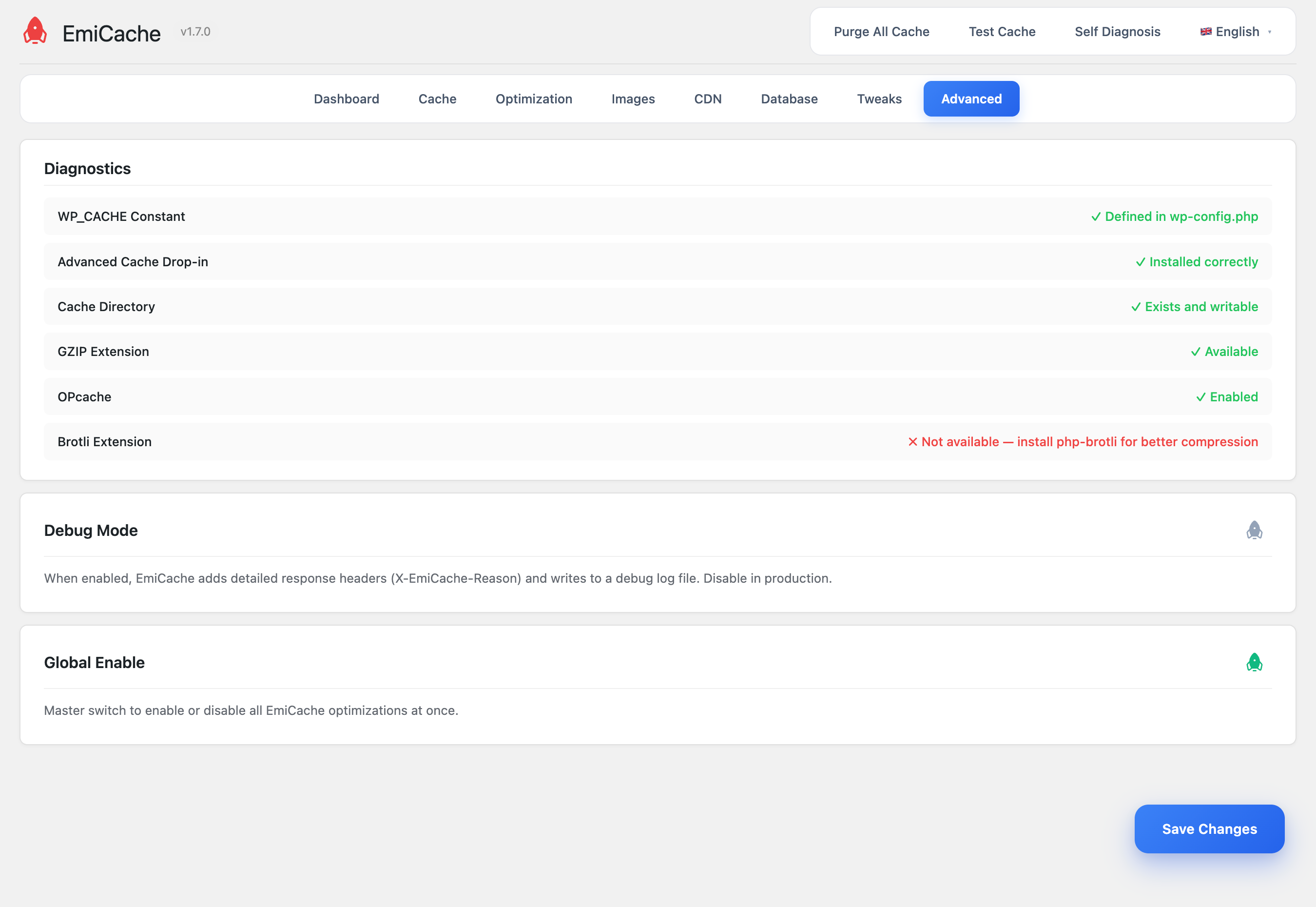
Compression. GZIP via mod_deflate and Brotli via mod_brotli (Apache / LiteSpeed). PHP-level Brotli pre-compression for static assets on Nginx.
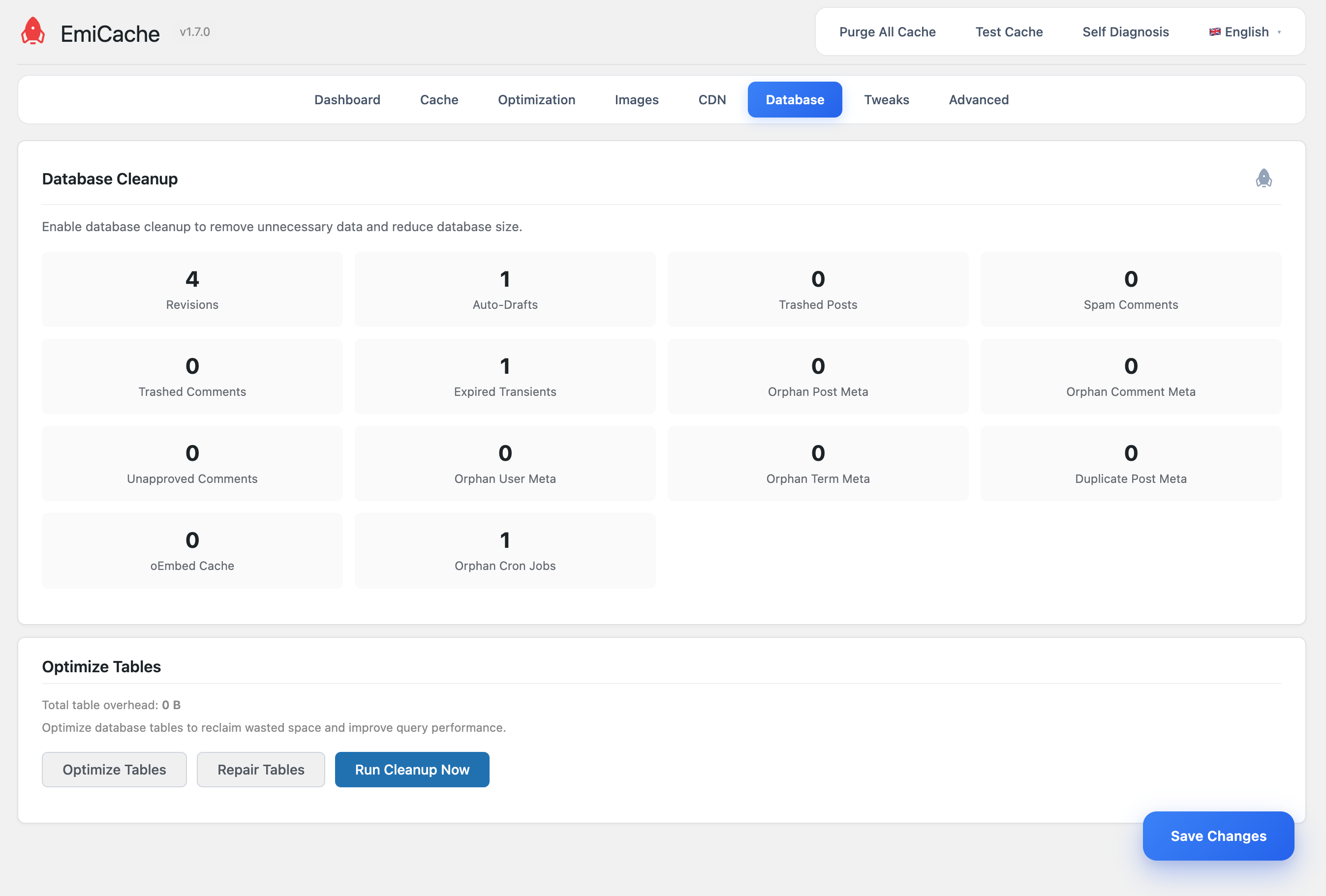
WordPress Tweaks. Heartbeat API control, emoji script removal (~50 KB saved), oEmbed disable, query string removal from static assets, post revision limiter, WooCommerce-specific optimizations.
Privacy
EmiCache runs entirely on your own server. It does not phone home, does not load remote scripts, does not track users, and does not collect telemetry. The only outbound HTTP requests are the optional CDN API calls described in the "External services" section below, made only when you explicitly configure them.
安装:
- Upload the
emi-cachefolder to/wp-content/plugins/(or install via Plugins → Add New → Upload). - Activate through the Plugins menu in WordPress.
- Navigate to EmiCache in the admin sidebar.
- Click Apply Recommended Preset on the Dashboard for safe defaults that auto-adapt to your server.
- Run a PageSpeed test on a frontend page (logged out) to verify improvements.
屏幕截图:


常见问题:
Will it work with my theme?
Yes — EmiCache works with any properly coded WordPress theme. Tested with Astra, GeneratePress, WoodMart, Avada, Divi, OceanWP, Kadence, Blocksy, and the default Twenty-* themes. If a specific module conflicts, every toggle has a per-module exclusion field on its settings page.
Is it compatible with WooCommerce?
Yes. Cart, checkout, my-account, and add-to-cart pages are excluded from caching automatically. WooCommerce-specific tweaks (cart fragment control, script limiting on non-shop pages) are available in the Tweaks panel.
Can I use it alongside another caching plugin?
No — running two page caching plugins at once corrupts cached output. EmiCache detects and warns about WP Rocket, W3 Total Cache, WP Super Cache, LiteSpeed Cache, Cache Enabler, and 10 other known plugins.
Does it modify wp-config.php?
Yes. On activation EmiCache adds define('WP_CACHE', true); and creates a wp-config.php.emi-cache-backup first. On deactivation the constant is removed. Uninstall removes all data: cache directory, drop-ins, cron events, and the WP_CACHE define.
How do I purge the cache?
Click Purge All Cache on the EmiCache Dashboard or in the WordPress admin bar. The cache is also purged automatically when posts are published, updated, or deleted, and when comments are approved.
Does it support Cloudflare?
Yes. Enter your Cloudflare API credentials on the CDN settings page. EmiCache automatically purges Cloudflare cache when local cache is purged. Both API Token and Global API Key authentication are supported.
Are WebP and AVIF images served safely?
Originals are never modified. WebP and AVIF variants are generated alongside the original (image.jpg + image.jpg.webp) and served via <picture> tags or .htaccess rewrite. Browsers without support fall back to the original automatically.
Is it multisite compatible?
The Object Cache module supports multisite with global groups and per-blog isolation. Full multisite page caching is on the roadmap.
Does it work on Nginx and LiteSpeed servers?
Page caching, minification, lazy loading, image optimization, and CDN integration are server-agnostic and work everywhere.
The bundled .htaccess (used by Apache and LiteSpeed) blocks direct access to .php, .log, and .json files inside the cache directory. For Nginx, add the following to your server block as a defense-in-depth measure:
location ~* /wp-content/cache/emi-cache/.+\.(php|log|json)$ { deny all; }
GZIP and Brotli rewrite rules generated by the Compression module apply to Apache and LiteSpeed only. On Nginx, enable gzip on / brotli on at the server level — EmiCache pre-compresses cached pages to .html.gz and .html.br regardless of server.
Why is "Reduce unused JavaScript" still flagged in Lighthouse?
That audit measures third-party script efficiency (Google Tag Manager, Facebook Pixel, etc.) which EmiCache cannot tree-shake. JS Delay does prevent these scripts from blocking your LCP and FCP — the audit itself is informational ("unscored") and does not affect your PageSpeed score.
更新日志:
- NEW: Static Serve — optional pre-WordPress cache delivery for near-instant page navigation
- IMPROVED: SVG logos and icons now stay eager to prevent header layout shift
- IMPROVED: Cache purge now clears every cache layer, including the static-serve mirror
- IMPROVED: Dashboard cache statistics are now accurate and consistent
- FIX: "Cache Directory" status reported the wrong path on fresh installs
- Tested up to WordPress 7.0
- IMPROVED: Stabilized PageSpeed Insights scores by aligning response headers with industry best practices for cached HTML
- FIX: Several optimization toggles in the dashboard were not persisting on save under certain code paths
- FIX: Preset switching now refreshes the full pipeline (settings file, .htaccess rules, and all cached output) so server-level rules immediately match the selected preset
- NEW: Background-image lazy loading now also handles CSS rules inside inline blocks, not just inline style attributes
- IMPROVED: LCP performance on text-heavy pages (Recommended/Aggressive)
- IMPROVED: Smart Lazy now enabled in Recommended for image-heavy pages
- IMPROVED: Mobile responsive image delivery — smaller payload per request
- FIX: Preset switching could leave stale optimized assets in place until a second settings save
- FIX: Edge case in preload tag rewriting that left empty attribute fragments
- FIX: Responsive image source set could break when image data URIs were inline
- IMPROVED: Cache and generated files now stored under the WordPress uploads directory for cleaner deployments and better compatibility with managed hosting
- IMPROVED: Tree-Shake now preserves responsive layout, sticky variants, and popup/overlay styles across all themes — no more broken headers or misplaced modals when aggressive purging is on
- IMPROVED: JS Bundle no longer combines scripts that depend on WordPress core globals (wp.i18n, wp.hooks, wp.element, etc.), preventing initialization errors in plugins like Contact Form 7 and block-based editors
- IMPROVED: JS Delay leaves Google Maps, reCAPTCHA, hCaptcha, Cloudflare Turnstile, Mapbox, and Leaflet scripts untouched so embedded maps and form challenges always load
- IMPROVED: Presets now only toggle dashboard modules — hidden behaviors no longer change behind the scenes when switching between Safe / Recommended / Aggressive
- IMPROVED: Heartbeat module deregisters dependent core scripts together to silence WP_DEBUG notices
- FIX: 404 errors for combined CSS/JS and responsive image variants caused by an old internal path
- FIX: Critical error during activation on sites with case-sensitive filesystems
- FIX: Various code-quality and security hardening updates required for WordPress.org directory compliance
- NEW: Smart CSS Defer — eliminates render-blocking plugin stylesheets while keeping theme and builder CSS for a layout-stable first paint
- NEW: jQuery Defer (Lite) — defers WordPress core jQuery via a shim that queues inline jQuery() calls until the library loads
- NEW: Disable Entry Animations — skips scroll-triggered fade-in / slide-up animations from Elementor, AOS, Element Pack, WoodMart, and Animate.css; interactive transitions like sliders and modals stay active
- NEW: Smart Prefetch — browser speculation rules in prefetch mode warm assets without re-firing entry animations on navigation
- NEW: Hero Preload — auto-detects the LCP candidate (largest above-the-fold image) and injects a
<link rel="preload">hint withfetchpriority="high" - NEW: Environment Auto-Detect — Recommended preset auto-enables AVIF, Brotli, and Object Cache only when the server actually supports them
- IMPROVED: Mobile UX — JS Delay no longer consumes the first touch; scroll and link taps work immediately
- IMPROVED: Image Optimizer — sub-size counter, WebP savings tracking, theme-registered size protection (preserves slider thumbnails and other custom variants)
- IMPROVED: Admin panel — third-party plugin notices suppressed inside EmiCache pages for a clean working area
- IMPROVED: Score map balanced to exactly 100 with fair weighting based on real PageSpeed impact
- NEW: Self-Pushing Task Runner — background queues (image rehost, cache preload, critical CSS, DB cleanup) drain even on low-traffic sites where WP-Cron rarely fires
- IMPROVED: External Image Rehosting drains right after the request that queued the URL instead of waiting for the next cron tick
- NEW: External Image Rehosting — pulls third-party hosted images into local cache so they benefit from WebP, lazy load, and CDN rewriting
- NEW: YouTube and Vimeo facade placeholders now match the real video aspect ratio via oEmbed, fixing CLS on vertical and square embeds
- NEW: De-inline Large Images — oversized base64 images extracted from HTML into static files so they flow through the WebP, lazy load, and CDN pipeline
- NEW: SVG Lazy Placeholders — every lazy image reserves layout space with a properly sized SVG placeholder to prevent CLS
- NEW: Per-Stage Pipeline Timing — debug mode records how long each optimization step takes for bottleneck diagnosis
- FIX (critical): fatal error "Call to undefined function sanitize_text_field()" in
advanced-cache.phpthat broke page caching on every site running 1.2.0 — all 1.2.0 users should upgrade
- NEW: Brotli pre-compression for cached pages and static assets
- NEW: Font Inlining and Critical Font Auto-Detection — small fonts embedded as data-URIs, above-the-fold fonts auto-preloaded
- NEW: 3-Tier CSS System — Critical (inline) / Fonts (high priority) / Non-Critical (deferred)
- NEW: Adaptive Image Sizing — responsive variants at 7 breakpoints with automatic
srcsetandsizes - NEW: JS Aggregation and per-region combining (head / body)
- NEW: Builder Compatibility Pack — Elementor, Slider Revolution, OWL Carousel, WooCommerce gallery, AOS, WOW.js trigger preservation
- NEW: Setup Wizard with Safe / Recommended / Aggressive presets
- NEW: Batch Image Optimizer for bulk WebP conversion without modifying originals
- NEW: Self-Diagnosis system with automated health checks and one-click auto-fix
- NEW: Async Task Queue for background processing via WP-Cron
- NEW: Admin bar quick-purge, browser cache headers, CDN
s-maxagesupport - IMPROVED: Object Cache gains gzip compression, file locking, and TTL support
- IMPROVED: Lazy loading skip patterns for logos, sliders, and hero images
- Initial release with 12 optimization modules: page cache, HTML/CSS/JS minify, lazy loading, critical CSS, WebP/AVIF conversion, CDN integration with Cloudflare and Bunny APIs, database cleanup, object cache drop-in, GZIP/Brotli compression, WordPress tweaks, WooCommerce optimizations, and performance dashboard