
ID Image Ad Popup & Roadblock
| 开发者 |
InDesignMedia
indesignmedia |
|---|---|
| 更新时间 | 2026年8月11日 19:07 |
| PHP版本: | 7.4 及以上 |
| WordPress版本: | 7.0 |
| 版权: | GPLv2 or later |
| 版权网址: | 版权信息 |
详情介绍:
- Create unlimited popups, each with its own settings.
- Manage everything from the dedicated Popup Ad menu in the WordPress admin. Modernized Admin UI (new in 2.0.0)
- Rounded pill-tab navigation for Media, Display Rules, Appearance, and Tracking.
- Clean white card layout for every settings section.
- Rounded buttons, consistent input styling, and modern toggle switches.
- Fully backward compatible with popups saved in earlier versions. Smart Display Rules
- Show on Entire Website, Home Page Only, All Pages, or All Single Posts.
- Target Specific Page(s) or Specific Post(s) using a live search picker.
- WooCommerce: target All Product Pages or Specific Product Page(s) when WooCommerce is active.
- Home Page detection now works reliably with Elementor and custom template setups. Responsive Image Support
- Separate images for Desktop and Mobile via the native WordPress Media Library.
- Popup is automatically suppressed on a device if no image is set for it.
- Desktop Max Width in pixels (default 900px).
- Mobile Max Width as a percentage of the viewport (new in 2.0.0, default 90%). Show Site Logo (new in 2.0.0)
- Optional per-popup toggle to display your site logo (from Customizer, Site Identity, Logo) at the top of the popup.
- The logo is scaled responsively so it looks right on any device. Popup Scheduling
- Independent Start Date and Time and End Date and Time per popup.
- Each date bound is evaluated on its own, set only a start, only an end, or both.
- Timezone-aware (fixed in 2.0.0): dates are now parsed using the WordPress timezone from Settings, General, instead of the server timezone. Appearance and Behavior
- Configurable Delay Before Opening (default 3 seconds).
- Auto Close After timer, set to 0 to disable (default 15 seconds).
- Customizable Overlay Color and Overlay Opacity.
-
Linkable popup image with Target URL (opens in a new tab,
rel="noopener noreferrer"). Analytics and Tracking (new in 2.0.0) - Optional per-popup Tracking tab, with an on/off switch and a unique Popup ID slug.
- When tracking is enabled, the popup link gets an HTML
idmatching your Popup ID slug, so any existing GTM click trigger or Element Visibility trigger can target it directly with zero GTM changes. - The plugin also pushes standardized events to
window.dataLayer: popup_viewwhen the popup appears.popup_clickwhen the popup image/link is clicked.popup_closewhen the popup is closed (X, overlay, or auto-close).-
Every event carries
popup_idandpopup_title. Click events also addlink_url. Close events also addclose_reason(button,overlay, orauto) andtime_shown_ms. Use these in GA4 to filter and report per popup. Native WordPress Integration - Built on Custom Post Type, no custom database tables.
- Native WordPress Media Uploader, no third-party dependencies for uploads.
- Automatic one-time data migration from the old single-setting version.
- Clean uninstall (new in 2.0.0), a proper
uninstall.phpremoves all popup posts and plugin options when you delete the plugin.
- Flash sales and limited-time promotions
- New product announcements
- Email list opt-ins and lead capture
- WooCommerce product-specific upsells
- Event announcements and countdowns
- Site-wide notices and alerts
安装:
- Upload the Plugin
- Go to Plugins, Add New, Upload Plugin in your WordPress admin.
- Select the
id-popup.zipfile and click Install Now. - Activate
- Click Activate after installation completes.
- Create Your First Popup Ad
- Go to Popup Ad, Add New Popup Ad in the WordPress admin sidebar.
- Add a title, upload a desktop image (and optionally a mobile image), pick a display rule, then Publish.
- Optional: Enable Tracking
- Open your popup ad from Popup Ad, All Popup Ads, click the Tracking tab, turn on Enable Tracking, and set a unique Popup ID slug (for example,
homepage_summer_sale). - Add matching Custom Event triggers in Google Tag Manager if you want
popup_view,popup_click, andpopup_closeevents in GA4. - Add More Popup Ads
- Repeat step 3 for each popup ad. Each one has independent settings.
屏幕截图:
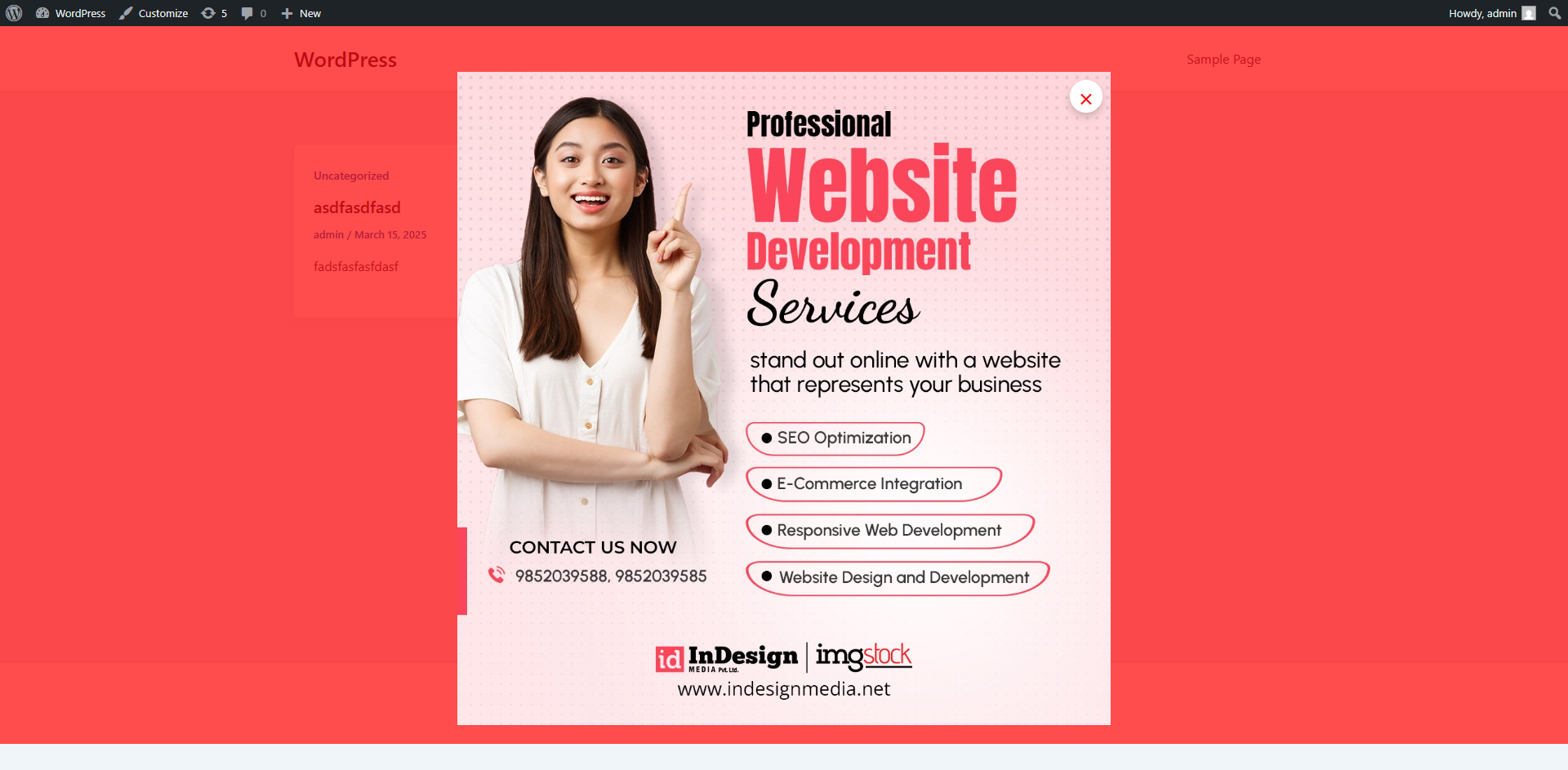
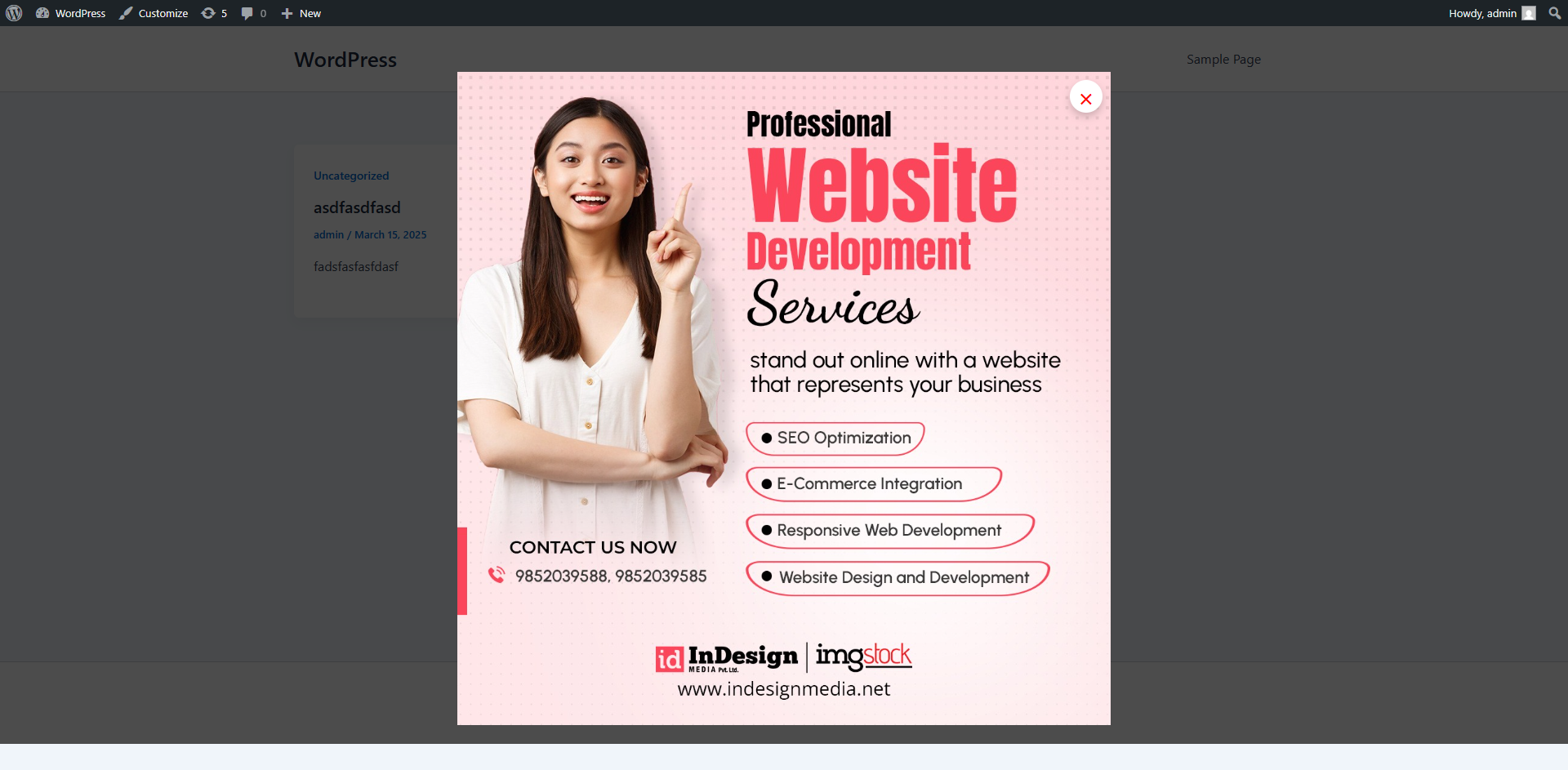
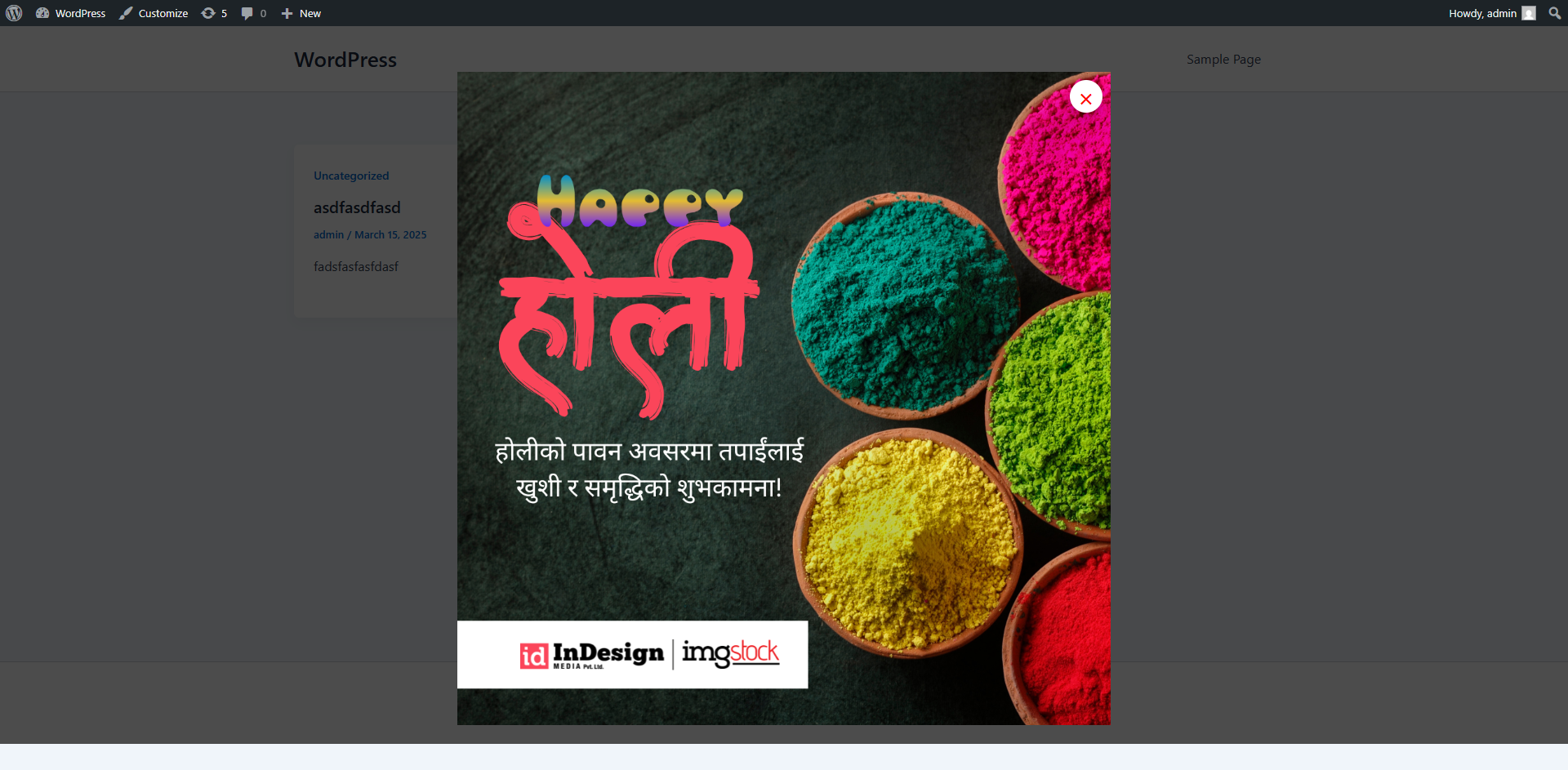

常见问题:
Can I create multiple popups?
Yes. Version 1.2 introduced a Custom Post Type architecture and later versions keep it. You can create unlimited independent popups, each with its own images, display rules, schedule, and tracking, all managed from the Popup Ad menu in your admin sidebar.
Can I use different images for desktop and mobile?
Yes. Upload a desktop image and a mobile image in the Media tab. If one is missing, the popup is automatically hidden on that device so you never see broken images or empty containers.
How does Mobile Max Width work?
It controls the popup width on devices under 768px, as a percentage of the viewport. Default is 90%. Set a lower value if you want smaller popups on phones, or 100% for edge-to-edge.
What does the Show Logo toggle do?
When on, the popup displays your site logo (the one set in Customizer, Site Identity, Logo) above the popup image at the top-left. It uses the current logo automatically, so if you change the logo in the Customizer, the popup updates too.
Can I schedule the popup to appear only on specific dates?
Yes. Set a Start Date and Time, an End Date and Time, or both. Each boundary is evaluated independently, so you can run an end-date-only sunset campaign without setting a start date.
Does the plugin honor my WordPress timezone?
Yes. As of 2.0.0, start and end dates are compared using the WordPress timezone from Settings, General, Timezone. Before 2.0.0 the plugin used the server timezone, which could cause popups to fire early or late on hosts where the two differed.
Can I target specific pages, posts, or WooCommerce products?
Yes. Use the Display Rules dropdown and pick Specific Page(s), Specific Post(s), or (when WooCommerce is active) Specific Product Page(s). A live search picker lets you find items by name without needing to know IDs.
Does it work with WooCommerce?
Yes. When WooCommerce is active, two extra rules appear: All Product Pages and Specific Product Page(s).
Does it work with Elementor and other page builders?
Yes. The Home Page rule was improved in 2.0.0 to reliably detect the site root even on Elementor-built or custom-template homepages that bypass the standard WordPress main query.
How do I track popup interactions in Google Analytics 4?
Open your popup ad from Popup Ad, All Popup Ads, click the Tracking tab, turn on Enable Tracking, and set a unique Popup ID slug. The plugin then pushes popup_view, popup_click, and popup_close events to the browser dataLayer, and also adds an HTML id matching your slug to the popup link so existing DOM-based GTM triggers work. Wire matching Custom Event triggers in GTM and register popup_id as a custom dimension in GA4 to see per-popup reports.
What if I already have a GTM trigger watching a CSS ID like #technology_popup_ad?
Just enter that same slug (technology_popup_ad) in the Popup ID field on the Tracking tab. The plugin will output the popup link with that HTML ID, and your existing trigger and tag will fire without any GTM changes.
How does Auto Close work?
Auto Close After (s) sets how many seconds after opening the popup automatically closes. Set it to 0 to disable auto-close entirely and keep the popup open until the visitor closes it.
Can I have multiple popups showing on the same page?
Yes. Every popup is rendered independently. If two published popups both match the current page and current schedule, both will show. Use scheduling and display rules to control which one appears when.
What happens if I had the old single-settings version installed?
The plugin automatically detects your old settings and migrates them into a new popup post called Default Popup on the first admin load after upgrading. No data is lost, no manual steps are needed.
What happens when I delete the plugin?
As of 2.0.0, the plugin ships with a proper uninstall.php that removes all popup posts (Custom Post Type entries and their meta) and clears the plugin's own options. If you only Deactivate the plugin, your data stays intact.
Is it compatible with popups from earlier versions?
Yes. All 2.x versions preserve every option key, meta key, hook, and shortcode from previous versions. Your existing popups keep their settings and keep working without any manual changes.
更新日志:
- Popup on mobile now uses viewport units (vw/vh) instead of percentages so it is always bound to the actual viewport, even on themes that apply a CSS transform to
body(Bootstrap, some builders) which previously could stretch or push the layout. - Enforced
overflow-x: hiddeninside the popup container on mobile so oversized images cannot spill sideways. - Enforced
img { max-width: 100% }on mobile with priority so the popup image can never exceed the popup width. - Added a body-scroll lock: while any popup is open,
bodygets anid-popup-openclass that disables page scroll, so tapping the popup cannot accidentally move the page underneath. - Overlay z-index bumped to 999998 and popup container to 999999 so themes with sticky headers or high-z-index elements cannot render above the popup.
- Replaced the
inset: 0shorthand on the overlay with explicittop/right/bottom/left: 0for compatibility with older mobile browsers (pre Chrome 87 / Safari 14.1). -
Added
-webkit-transformfallback on the popup container for older mobile Safari. Close Button on Mobile - On screens under 768px the close (x) button is now positioned INSIDE the popup at the top-right (top 6px, right 6px), instead of hanging off the corner. This prevents the button from being clipped off-screen on narrow phones and keeps it tappable. Site Logo on Mobile
- When Show Logo is enabled, the logo now scales down on mobile (max-height 36px, max-width 140px) so it does not crowd the popup image on small screens.
- Mobile Max Width (%) setting per popup, controls popup width on devices under 768px as a percentage of the viewport (default 90%).
- Show Logo toggle, displays the site logo from Customizer, Site Identity, Logo at the top of the popup, sized responsively.
- Tracking tab for Google Tag Manager and Google Analytics 4 integration:
- Per-popup Enable Tracking switch and unique Popup ID slug.
- When enabled, the popup link renders with an HTML
idmatching your slug (works with existing DOM-based GTM click and Element Visibility triggers). - Standardized events pushed to
window.dataLayer:popup_view,popup_click,popup_close. -
Event parameters:
popup_id,popup_title,link_url,close_reason(button, overlay, auto),time_shown_ms. Modernized Admin UI - New pill-tab navigation on the popup edit screen (Media, Display Rules, Appearance, Tracking).
- Clean white card layout for every settings section, with rounded corners.
- Consistent rounded pill buttons, unified input styling, modern toggle switches, and a matching Publish button.
- Fully backward compatible: all existing option keys, meta keys, hooks, and shortcodes are preserved. Timezone Correctness
- Scheduling now honors the WordPress timezone from Settings, General, instead of the server timezone. Start and end dates compare correctly across all hosting environments. Improved Home Page Detection
-
The Home Page Only rule now matches WordPress
is_front_page()andis_home(), plus a URL-path fallback, so page builders and custom templates that bypass main-query conditionals (Elementor, custom themes) still resolve the site root correctly. Bug Fixes - Close button position stays anchored to the popup image top-right corner whether or not the site logo is enabled.
- Close button glyph is now visually centered inside its circle across browsers (Arial fallback plus zero line-height eliminates cross-browser glyph drift). Housekeeping
-
Added
uninstall.phpthat removes all popup posts and plugin options on plugin deletion (multisite-safe). - Bumped Tested up to to 7.0.
- Updated short description and tags.
- Synchronised plugin version with stable tag.
- Added
wp_die()afterwp_send_json_error()in AJAX handler to prevent continued execution after unauthorized access. - Whitelisted the
typeparameter in the AJAX search handler against known post types, unknown types are rejected withwp_die(). - Switched
popup_linksanitization fromsanitize_text_field()toesc_url_raw(), the correct WordPress standard for URL fields stored in the database. - Added strict allowlist validation for
display_rulesusingin_array()with type checking. - Cast all
specific_idsto integers usingintval, eliminating string injection risk through ID fields. - Applied
esc_html()to post titles andabsint()to IDs in AJAX JSON responses. -
Applied
esc_attr()todesktop_max_widthin inline style output. Bug Fixes -
Fixed auto-close value of
0not working.parseInt(0) || 15000was incorrectly evaluating to15000. Now usesisNaN()check so0correctly disables auto-close. - Fixed mobile skip logic.
data()returns a string but was compared with=== 0(integer). Wrapped withparseInt()for correct type coercion. - Fixed scheduling logic. Previously required both start AND end dates to evaluate, now each date boundary is checked independently.
-
Removed dead
$preview_stylePHP variable that was computed but never used. Performance -
Added
no_found_rows: trueandupdate_post_term_cache: falseto the frontendWP_Queryto skip unnecessary database queries. - Popup HTML is now skipped in PHP entirely if neither desktop nor mobile images are set.
- Added All Product Pages display rule, shows the popup on any WooCommerce single product page.
- Added Specific Product Page(s) display rule, target individual products by name using the Select2 search interface.
- WooCommerce rules only appear in the admin dropdown when WooCommerce is active (
class_exists('WooCommerce')). -
AJAX search handler supports
productpost type whenspecific_productsrule is selected. Select2 Improvements - Placeholder text updates based on the selected rule: "Search pages...", "Search posts...", or "Search products...".
-
Search field also appears for
specific_productsrule. Display Rule Precision -
All Single Posts now uses
is_singular('post')instead ofis_single(), correctly excluding custom post types and WooCommerce products. - Specific Post(s) uses
is_singular('post')+get_queried_object_id()matching, consistent with the specific pages and products pattern. - Specific Page(s) uses
get_queried_object_id()for ID matching instead of passing an array tois_page().
- Migrated from a single WordPress Options API settings page to a Custom Post Type (
id_popup). - Each popup is now an independent WordPress post with its own title, settings, and lifecycle.
- Dedicated Popups menu item in the WordPress admin sidebar with a custom dashicon.
- Three separate WordPress Meta Boxes replace the single settings form: Media Setup, Display Rules and Scheduling, and Appearance and Behavior.
- Meta box headers styled with the plugin's red theme.
-
Automatic one-time data migration from the old
id_popup_settingsoption into a new "Default Popup" post, no data loss on upgrade. Frontend Multi-Popup Support -
Frontend uses
WP_Queryto loop all publishedid_popupposts. - Each popup evaluated independently for scheduling and display rules.
- HTML output switched from singleton IDs (
#id-popup) to classes (.id-popup-container,.id-popup-overlay) to support multiple popups on one page. -
Per-popup delay and auto-close timings passed via
data-delayanddata-autocloseattributes, no global JS variables. Image Handling - Each popup independently skips rendering if no image is configured for the current device type.
- Device detection (
data-has-desktop,data-has-mobile) evaluated fresh per popup per page load.
- Replaced plain URL input fields with the native WordPress Media Uploader.
- Plugin now stores WordPress Attachment IDs instead of raw image URLs.
- Image URLs resolved at render time using
wp_get_attachment_image_url(). - Added
attachment_url_to_postid()fallback for legacy string URL values. - Added live image previews in the admin for both desktop and mobile images.
- Added remove (x) button on image thumbnails, clears the attachment ID and hides the preview without a page reload. Display Rules Expansion
- Added All Pages display rule.
- Added All Single Posts display rule.
- Added Specific Page(s) display rule with Select2 live search.
- Added Specific Post(s) display rule with Select2 live search.
- "Specific Page/Post" field dynamically shows/hides based on the selected rule. Select2 Integration
- Integrated Select2 library for the specific page/post ID selection.
- AJAX-powered live search for pages and posts.
- Selected items displayed as removable pill tags.
- Automatically clears selections when an incompatible display rule is chosen. Field Defaults
- Desktop Max Width defaults to 900px.
- Auto Close defaults to 15 seconds.
- Delay Before Opening defaults to 3 seconds.
- Target URL defaults to
#.
- Initial release.
- Responsive popup image support for desktop and mobile.
- Popup scheduling with start and end dates.
- Display location control: entire site, homepage, or single post.
- Overlay color and opacity controls.
- Linkable popup image.
- Auto-close timer.
- Popup delay setting.