
iG:Syntax Hiliter
| 开发者 | amit |
|---|---|
| 更新时间 | 2026年8月22日 23:45 |
| PHP版本: | 8.4 及以上 |
| WordPress版本: | 7.1.0 |
| 版权: | GPLv2 or later |
| 版权网址: | 版权信息 |
详情介绍:
- WordPress 6.9 or above
- PHP 8.4 or above
安装:
update now link below the plugin listing on the plugins page in your wp-admin. That's quite easy!!
Do read the Important changes in 6.0.0 section above first. Your existing posts keep working, but there are a few things worth knowing before you open an old post in the block editor.
UPGRADING from v3.x
Just deactivate plugin in WordPress admin, delete the syntax_hilite.php file & ig_syntax_hilite directory from plugins folder and follow the installation process below. That's quite easy!!
UPGRADING from v2.1 or lower
Just deactivate plugin in WordPress admin, delete the syntax_hilite.php and geshi.php files & geshi directory from plugins folder and follow the installation process below. That's quite easy!!
Installing The Plugin
- Login to your WordPress
wp-adminarea. - Click
Add Newin thePluginsmenu on left. - Enter
iG:Syntax Hiliterin the search bar on the right on the page that opens and press Enter key. - WordPress would show the iG:Syntax Hiliter plugin with install button, click that to install the plugin.
- Click on
Activate Pluginlink on the page that opens after the plugin has been installed successfully.
屏幕截图:
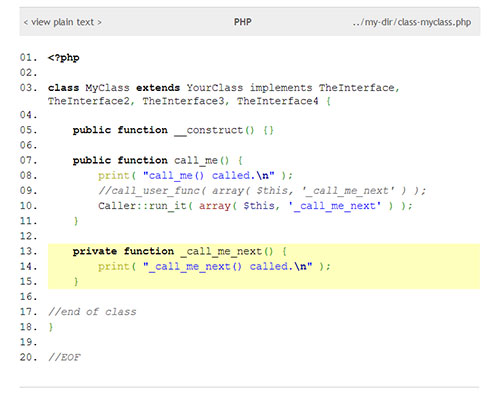
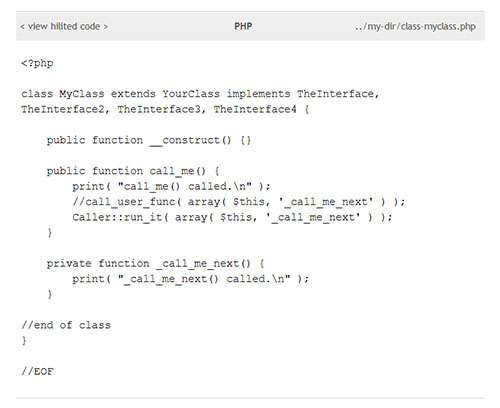


其他记录:
常见问题:
My code looks all odd, characters appear as HTML entities. Why is your plugin screwing up my code?
If you are writing your post in the classic editor's Visual (WYSIWYG) tab then that is what is messing things up for you. That tab is TinyMCE, it treats your code as HTML and it does its damage before this plugin ever sees the content. It has never been supported. Use the block editor or the classic editor's Code view. If you are using either of those and still see this, please report it.
I opened an old post in the block editor and my code blocks turned into iG:Syntax Hiliter blocks. Why?
Because leaving them alone was worse. See the Important changes in 6.0.0 section above for the full explanation. Short version: the block editor loads a classic post into one big TinyMCE block, TinyMCE eats code and converting the snippets to blocks first is the only way to stop that. The conversion is only written to the post if you save it and it leaves the rest of your post byte-for-byte as it was.
What happens to my code if I deactivate the plugin?
Snippets still stored as shortcodes stay visible as [sourcecode]…[/sourcecode] text — ugly, but you can see them and do something about them. Snippets that have been converted to blocks render as nothing at all, because the block is no longer registered, and a Gist block goes the same way. Before deactivating, use the tool in the Before you deactivate section of the plugin's settings page to turn those blocks back into shortcodes — [sourcecode] for a code block and [github] for a Gist block. Every block converts, this plugin's own tags in the code included.
I used to add languages by putting GeSHi language files in the plugin's or my theme's geshi directory. What now?
Both of those mechanisms are gone with GeSHi. Approx 300 languages ship with the plugin now, so start by checking whether yours is one of them — use it with [sourcecode language="…"] or pick it in the block.
How do I show one of this plugin's own tags inside a code box?
Double its brackets. [[php]] shows a reader [php] and [[/php]] shows [/php], so a whole example fits inside a snippet:
[sourcecode language="php"]
[[sourcecode language="php"]]
echo 'hello';
[[/sourcecode]]
[/sourcecode]
Without this the snippet would end at the first closing tag in its code and everything after it would be lost. What is stored is what you typed — the extra brackets come off on the way to a reader and nowhere else — and the rule applies to itself, so [[[/php]]] shows a reader [[/php]].
I see some code that I can improve. Do you accept pull requests?
By all means, feel free to submit a pull request.
I want XYZ feature. Can you implement it?
Please feel free to suggest a new feature. Its inclusion might be speedier if you can provide the code to make it work.
更新日志:
- Minimum requirements are now PHP 8.4 and WordPress 6.9. Below either of those the plugin refuses to load — no fatal error, no half-loaded plugin, just an admin notice naming the versions it needs.
- The GeSHi library has been dropped, along with its 37 bundled language files. Highlighting now happens in the browser with Prism.js 1.30.0, which is bundled with the plugin (MIT licensed). Prism's files load only on pages that contain a snippet and only the languages those snippets need.
- NEW: Gutenberg block editor support has been added. A block for the block editor, titled iG:Syntax Hiliter, is now available. Code is stored in the block's attributes as plain text, out of reach of the editor and of every content filter.
- NEW: Opening a post containing this plugin's legacy shortcodes in the block editor converts those snippets to blocks automatically; saving the post persists that. The rest of the post is left byte-identical. This is here because the block editor loads a classic post as one Classic (TinyMCE) block, and TinyMCE destroys code — it reads
<?php echo "<div>x</div>"; ?>as HTML. Posts never opened in the block editor are never converted, and editing in the classic editor's Code view converts nothing. Snippets are lifted out of the post before the block editor's parser reads it, so a post quoting block markup as an example is no longer taken apart on screen. - NEW: A Before you deactivate section on the settings page with a tool that converts this plugin's blocks back to shortcodes sitewide — a code block to
[sourcecode language="…"]and a Gist block to[github gist="…"]. Either kind of block is invisible if the plugin is deactivated, so this is the way back out. It always writes the[sourcecode]form for code — semantically identical to the original[php]-style tag, but not a byte-for-byte round trip — and for a Gist it writes the address the block was already embedding. Every block converts: where the code holds one of this plugin's own tags, its brackets are doubled, which is how a snippet says a tag is text. - NEW: A block for embedding a GitHub Gist, titled iG:Syntax Hiliter Gist. It renders through the same pipeline
[github]has always used, so the id handling, the link instead of a script in an excerpt and the Gist-in-comments setting all apply to it unchanged. Existing[github]shortcodes are not converted and go on working. The Before you deactivate tool converts the block back the other way, because a Gist block vanishes on deactivation just as a code block does. - NEW: An option to limit the height of Gist embeds, on by default. Each file in an embedded Gist is kept inside a box of its own and given a scrollbar when it is taller than that. A file shorter than the box is untouched.
- NEW: 35 more themes for the code boxes, from the prism-themes collection, which is also MIT licensed. The theme dropdown now offers 43 in all: Prism's own eight, plus One Dark, Nord, Dracula, VS Code Dark+, Gruvbox, Material, Night Owl and the rest, listed by name with None at the top. One stylesheet is loaded per page whichever theme is chosen, so the longer list costs a visitor nothing. Hopscotch is the one theme of that collection which is not bundled — it fetches a font from Google, and no page of yours should have to call another server to show a code box.
- NEW: Two options for brackets. Point out matching brackets outlines a bracket and its partner when you hover over one, and keeps the pair outlined when you click it — on by default, since nothing shows until someone hovers. Colour brackets by depth gives each level of nesting its own colour — off by default, since it repaints every code box on your site as soon as you switch it on. Four of the bundled themes colour these themselves and will use their own colours; everywhere else they are the plugin's. Nothing is loaded on a page unless one of the two is on, and the preview shows both before you save.
- NEW: A live preview on the settings page. A sample code box sits beside the settings and repaints as you change them, so picking one of 43 themes no longer means saving it, opening your site and coming back. The theme, the font, the toolbar, the copy button, the line numbers and both bracket options all show in it. Nothing in the preview is saved.
- NEW: A Font setting, under the theme. Fifteen monospaced fonts are offered: Azeret Mono, Cascadia Code, Fira Code, Fira Mono, Google Sans Code, IBM Plex Mono, Inconsolata, JetBrains Mono, M PLUS Code Latin, Nova Mono, Roboto Mono, Source Code Pro, Space Mono, Ubuntu Mono and Victor Mono. The dropdown is split into With Ligature and Without Ligature with None above both, because that is the one question worth asking about a font you are going to read code in: four of them — Cascadia Code, Fira Code, JetBrains Mono and Victor Mono — draw
=>,!==and&&as single glyphs, and the preview shows you what that looks like before you choose. None is the default, and it is the only choice that costs your visitors nothing: any other loads the font from Bunny Fonts, so each reader's browser makes one request tofonts.bunny.net. Bunny sets no cookies, keeps no logs and needs no account, but it is still a server that is not yours, so the plugin never calls it unless you ask it to. With None, code boxes keep the font your theme or your own CSS gives them, exactly as before. The chosen font is used in the block editor too, for the code inside the block as you type it, without the ligatures — in an editing box a merged glyph reads as though a character has gone missing. - CHANGED: Settings which cannot work on their own now move with the setting they need. The copy button lives in the toolbar, and the bracket colours are painted on the brackets the matching finds — so switching either on switches on what it needs, and switching the toolbar or the matching off switches off whatever depended on it. Switching a dependent one off leaves the other alone: a toolbar with no copy button is a perfectly ordinary thing to want.
- IMPROVED: Code is lifted out of the content before any content filter runs and put back after the last one, both when displaying and when saving.
wptexturize,wpautop, autoembed, KSES and other plugins' filters now run over content containing no code at all, and what is stored is byte-for-byte what the author typed — including for users without theunfiltered_htmlcapability. - CHANGED: Only the 37 language tags the plugin actually shipped are recognised, plus the aliases
as,html,js, plus[sourcecode]and[github]. Any other tag is left completely alone so it cannot collide with another plugin's shortcode. - REMOVED: Adding languages by dropping GeSHi language files into a
geshi/directory — in the plugin (v3.0) or in a theme (v4.1) — is no longer supported. The plugin has nogeshi/directory any more and does not look for one in a theme either. Such snippets will show up as ordinary post text with the[tag]markers visible. Approx 300 languages ship with the plugin now, so there is almost certainly one for what you were adding. - CHANGED: The
filelabel sits above the code box, at the left, and is always visible whatever the toolbar setting says — in v5 it lived in the toolbar, so turning the toolbar off hid it too. A snippet given nofilelabel gets no label element at all, but it still gets the wrapper — see the markup change below. - CHANGED:
highlightused together withfirstlinenow refers to the line numbers as displayed, offset byfirstline. GeSHi used the physical line numbers of the code. - BUGFIX:
langactually works now. In v5 bothlanguageandlangdefaulted tocode, so the alias was never reached andlang="php"was silently ignored. - BUGFIX: Language-only tags such as
[php]and[css]did not render on many sites running v5.1, as several people reported. They work again. - CHANGED: The
highlightattribute is capped at 10,000 lines in total — not per range. Once that many lines have been collected the rest of the attribute is ignored. v5 had no guard, sohighlight="1-999999999"would build an enormous array. - CHANGED: The
<pre>element carries the language class as well as the<code>inside it — every Prism theme selects onpre[class*="language-"]. - CHANGED: Every code box is wrapped in
<div class="igsh-code-box">, which carries the box'sid. Before, the wrapper appeared only when afilelabel was given and theidsat on the<pre>. Theme CSS selecting a code box as a direct child, such as.entry-content > pre, needs a descendant selector instead. Selectors onpre[class*="language-"]still work, and the<pre>keeps its classes anddata-attributes. - CHANGED: Language names map onto Prism's ids at render time —
html,html4strict,html5andxmlbecomemarkup;mysqlandpostgresqlbecomesql;oracle11becomesplsql;jqueryandjsbecomejavascript;railsbecomesruby;pcrebecomesregex;actionscript3andasbecomeactionscript;java5becomesjava;apachebecomesapacheconf;vbandvbnetbecomevisual-basic;codeandtextbecomenone, a styled but deliberately unhighlighted box. Three of these change the language rather than just its name:aspis now highlighted as ASP.NET (GeSHi'saspwas classic ASP, which Prism has no component for),perl6as Perl (Prism has no Raku component) andc_macas plain C. The code itself is untouched in every case, only the colouring differs. A snippet converted to a block stores the mapped name rather than the tag, so that the block's language dropdown shows it. - CHANGED: The
plaintext,toolbarandstrict_modeattributes are accepted and ignored — GeSHi-era ideas with no Prism equivalent. Leaving them in an old post is harmless, they never reach the markup. - CHANGED: Settings. Plugin CSS becomes a Prism theme dropdown, defaulting to Okaidia; plain text view becomes copy-to-clipboard; GeSHi strict mode, its exception list and "link to manual" are gone; a new Limit the height of Gist embeds option ships switched on. Toolbar, line numbers, code in comments and Gist in comments carry over and existing values are migrated on update.
- NEW: A snippet can quote this plugin's own tags. Double the brackets of a tag inside the code and it is written as text —
[[php]]shows as[php],[[/php]]shows as[/php]— so a post about this plugin can put a whole[sourcecode]…[/sourcecode]example inside a code box. Until now a snippet ended at the first closing tag in its code and everything after it was lost. What is stored is what you typed, the extra brackets come off on the way to a reader and nowhere else, and the rule applies to itself, so[[[/php]]]shows a reader[[/php]]. This is not the same as WordPress's escape for a whole shortcode, which is the next entry and is unchanged. - Escaped tags stay text.
[[php]x[/php]]is stored with both pairs of brackets exactly as typed and stays that way across edits; on screen the outer pair comes off and you see[php]x[/php], the same thing WordPress does with any escaped shortcode. No code box is built for one, and an excerpt drops it along with the real snippets. - BUGFIX:
[github gist="https://gist.github.com/…"]embeds the Gist it names. In v5 the embed ran at priority 10 onthe_content, behindwptexturize, which curled the quotes around the URL before the plugin could read it — so every one of those embeds pointed athttps://gist.github.com/.jsand showed nothing.[github id="…"]escaped that only because it has no URL to mangle. The embed now runs at priority 9, ahead ofwptexturize— and therefore ahead of anything else you have hooked tothe_contentat priority 10. Everything else about Gist embeds, including the option to allow them in comments, is unchanged. - CHANGED:
strip_shortcodes()now removes this plugin's tags as well, anywhere on the site, because the plugin hooksstrip_shortcodes_tagnames. This is what stops an automatic excerpt printing a snippet as prose, but it is wider than excerpts — any caller ofstrip_shortcodes()is affected.
- Minimum required PHP version bumped to 7.4.0. The plugin simply won't load its code on lower versions.
- Refactored plugin code for PHP 7.4.x for better performing code.
- This is the last release using the GeSHi library. GeSHi library has not been updated in several years and it looks unlikely that it will continue. Next release of the plugin will use a different syntax highlighting library. All existing shortcodes will continue to work and so the update and transition would be seamless for the most part, except a feature or two that will phase out and a few changes in plugin configuration options.
- Minimum required PHP version bumped to 5.3.0. The plugin simply won't load its code on lower versions.
- Major re-write of plugin for cleaner, modular & better performing code.
- Assets are enqueued only if needed.
- NEW: You can now disable plugin stylesheet which styles code boxes. People who have their own styling don't need it anyway.
- NEW: 2 new options allow more control on GeSHi behaviour.
- BUGFIX: Language name cache was not re-building automatically.
- BUGFIX: some language file names got snipped when building language name cache
- BUGFIX: Shorthand tags for all languages supported now - props to Karol Kuczmarski for spotting it
- NEW: Added C++ language file
- BUGFIX: Github Gist URL XSS security hole
- BUGFIX:
__dir__doesn't work below PHP 5.3 - props to Karol Kuczmarski for spotting it - NEW: Added "lang" as shorthand for "language" attribute
- NEW: Additional GeSHi language files can be put in "geshi" directory in theme, which will prevent their deletion on plugin upgrade
- IMPROVED: If a code block is repeated with same attributes then its parsed only once and output is reused
- NEW: Ability to embed Github Gist in post and comments (configurable)
- NEW: Ability to highlight one or multiple lines in a code block to show them as different
- NEW: New code box layout
- NEW: Ability to escape plugin tags to prevent their processing
- NEW: New GeSHi core (v 1.0.8.11)
- IMPROVED: Removed quirks from plain text view & its now much more smoother
- IMPROVED: Handling of how code is prevented from beautification. The rest of the post/comment text is not affected as wptexturize is not removed anymore.
- IMPROVED: Simpler and faster options page in wp-admin
- BUGFIX: BB Tags except the ones of iG:Syntax Hiliter are allowed. The language file's existence is checked before parsing the code. If the language file does not exist then the code is not parsed.
- BUGFIX: 'C' code hiliting is now fixed.
- BUGFIX: 'Plain Text' has been improved to strip the extra blank lines and spaces in Opera and FireFox.
- The latest stable GeSHi core(v1.0.7.6).
- NEW: Code Hiliting for Comments has been implemented. This feature can be Enabled/Disabled from the admin interface for iG:Syntax Hiliter. The tags are same for hiliting the code.
- NEW: A cross-browser Colour Picker(tested in IE6, FireFox1.5 and Opera8.5) is now available to easily set the line colours displayed in the code box.
- NEW: A new type of view implemented for seeing "Plain Text" code. Besides opening the plain text code in a new window, you can have it displayed in the code box itself with an option to display the hilited HTML code back again. The "Plain Text" view type can be set in the admin interface.
- The language file for Ruby that I created a while back is now bundled with the plugin and its also a part of the default GeSHi package.
- BUGFIX: Critical bug, which broke the plugin when the square brackets([ & ]) were used in the posts in places other than tags, has been fixed.
- BUGFIX: Another bug, which allowed any attribute in the tags besides the 'num' and also allowed any attribute value for it, affecting the processing. Now only the 'num' attribute is accepted and if you specify the 'num' attribute then its value must be a positive number otherwise your code won't be hilited. The 'num' attribute is optional and you can leave it out without any problems.
- BUGFIX: Fixed the unclosed tags in the Plugin GUI code.
- GeSHi BUGFIX: Fixed a bug in GeSHi where the first line colour was not used when using FANCY LINE NUMBERS thus resulting in just one colour being used for the alternate lines.
- There's a problem in WordPress due to which the starting delimiters of ASP, PHP were not displayed correctly, as whitespace was inserted between the '<' and the rest of the delimiter. This has been patched so that its displayed correctly, but its not saved in the database, so the database still contains the delimiters as formatted by WordPress.
- Complete re-write of the plugin resulting in reduction of code from 750+ lines to about 400 Lines.
- New GeSHi Core(v1.0.7) which has some bug-fixes, please see GeSHi Website for its changelog.
- New languages added are C#, Delphi, Smarty & VB.NET.
- ASP language file structure updated & more keywords added.
- Drag-n-Drop usage of new languages. The plugin now supports all languages that GeSHi(v1.0.7) supports. You just need to drop the language file in the "geshi" directory & use the filename as the tag for the language(like if file is "pascal.php", then the filename is "pascal" & the tags will be [pascal] & [/pascal]).
- Language name which is displayed in the Code-Box can now be turned ON or OFF easily.
- No more need to set the physical-path to the "geshi" directory if you are doing a default installation.
- Plain-Text View of the code hilited in the code-box is now possible. This feature can be enabled/disabled easily in the Configuration Interface in WordPress Administration.
- NO NEED TO EDIT THE PLUGIN FILE ANYMORE. You can now configure the plugin settings from a GUI located under the OPTIONS menu in your WordPress Administration(WordPress 1.5 & above only).
- BUGFIX: Fixed a bug by removing a tag from the function pFix() which lead to closing of an unnecessary tag making the code not xHTML valid(as per my desires).
- Implemented the new version of GeSHi core, v1.0.2 which has some bug fixes & which uses OL(Ordered Lists) for Line Numbering and supports starting of a Line Number from any given number.
- The ASP(Active Server Pages) language file has been updated to the new Language File structure of GeSHi as well as more keywords added & hiliting is more effective now.
- iG:Syntax Hiliter now also supports ActionScript, C, C++, JavaScript, Perl, Python, Visual Basic & XML.
- The whole plugin has been re-written & all the hiliting code is now in a class. You can just use the class anywhere else too for hiliting the code. But to also use the Code Tags to wrap your code & then hilite them, you will need to use all other functions. You can remove the WordPress Filter calls at the end of the plugin & use the rest of the code as you want somewhere else.
- BUGFIX: The issue of multi-line comments not being hilited properly in v2.0 Preview has been sorted out.
- Implemented the new version of GeSHi core, v1.0.1 which has some bug fixes including the extra quote(") bug that broke the xHTML validation of the code.
- I've created a new language file for ASP(Active Server Pages) which has been added to this release & will also be a part of the next GeSHi release.
- Line numbering is now done through Ordered Lists(
- ) & the code is xHTML compliant.
- Auto-Formatting disabled for posts that contain the iG:Syntax Hiliter code tags so that your code is good for copy-paste operations.
- Implemented the line numbering of code.
- The code box is now of fixed dimensions without word-wrap & with scrollbars(if required).
- Hilites code between the special tags, all of them differently.
- Uses GeSHi for syntax hiliting.
- Supports HTML, CSS, PHP, JAVA & SQL codes.