
Leaving Notice Popup For External Links - nofollow, noopener & New Tab
| 开发者 | josevarghese |
|---|---|
| 更新时间 | 2026年8月25日 03:46 |
| 捐献地址: | 去捐款 |
| PHP版本: | 7.2 及以上 |
| WordPress版本: | 7.1 |
| 版权: | GPLv2 or later |
| 版权网址: | 版权信息 |
详情介绍:
rel attributes like nofollow, noopener, noreferrer, sponsored, ugc, and external; display SVG icons next to external links; choose whether the Continue button opens links in a new tab or the same tab; and whitelist trusted domains so they bypass the popup entirely.
It is an essential tool for affiliate marketers, government sites, educational portals, and any site that needs an exit popup, exit intent modal, outbound link interstitial, or legal disclaimer before visitors leave for third-party content.
Why use this plugin?
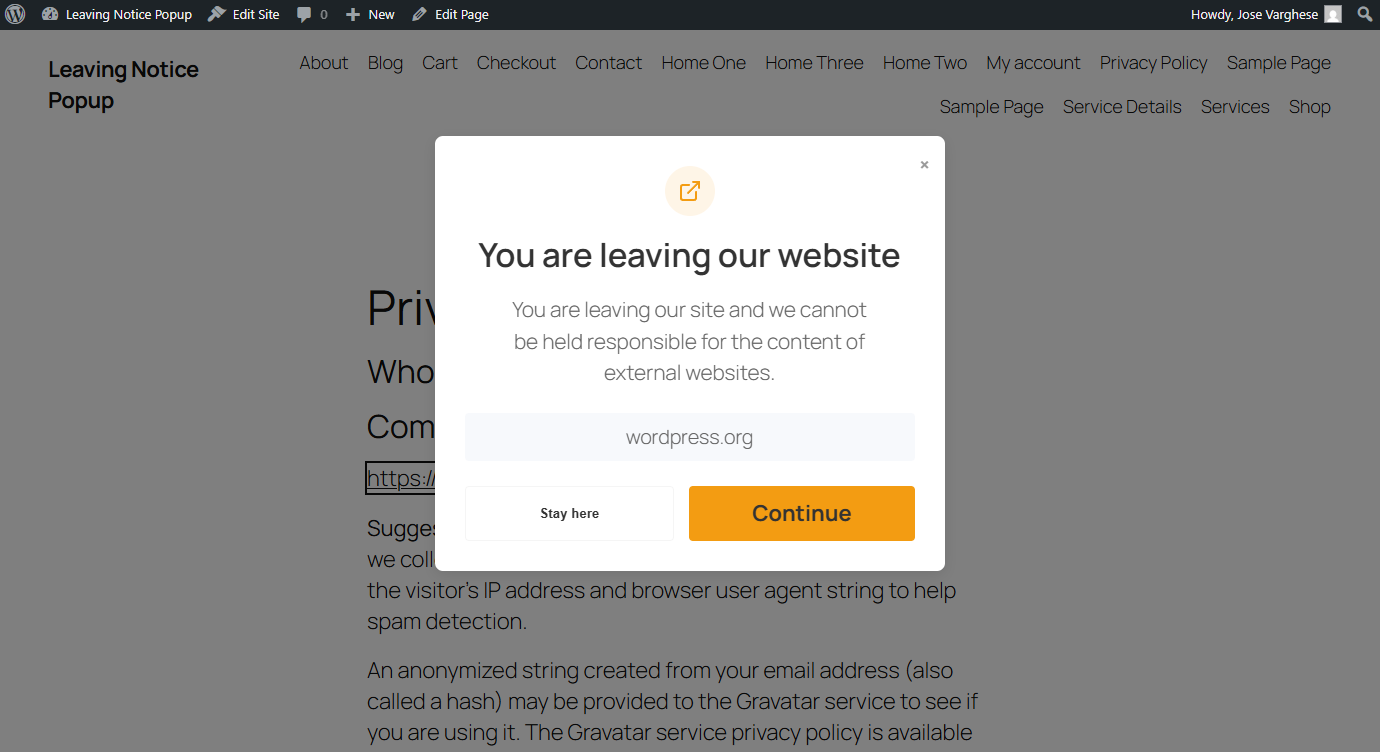
- Exit Popup / Leaving Notice: Show a fully customizable exit confirmation modal (exit popup, exit intent dialog, or outbound link warning) whenever a visitor clicks an outbound link, protecting your traffic and reducing unintended exits.
- nofollow, noopener & More: Automatically add
rel="nofollow",rel="noopener",rel="noreferrer",rel="sponsored",rel="ugc", orrel="external"attributes to external links for better SEO control and security. - Open in New Tab Control: Choose whether the Continue button opens external links in a new tab or the same tab.
- External Link Icons: Display one of 5 built-in SVG icons next to outbound links, with left/right positioning and an option to skip icons on linked images.
- Smart Domain & URL Whitelist: Exclude trusted affiliate partners or sister sites by domain, exact URL, or wildcard pattern (e.g.
https://www.facebook.com/sharer/*); they will open without triggering the popup. - CSS Class Exclusion: Skip the popup and rel attribute processing entirely for links that carry specific CSS classes.
- Advanced Page Filtering: Restrict the leaving notice to specific Page IDs, or enable it conditionally on archives, categories, and the home page using built-in filters.
- Customizable Popup: Change the title, message, and button text to match your brand
- Button Color Control: Choose custom colors for both the "Continue" and "Stay" buttons
- rel Attributes: Add nofollow, noopener, noreferrer, sponsored, ugc, or external to outbound links
- New Tab Toggle: Control whether Continue opens the external link in a new tab or same tab
- SVG Link Icons: Show one of 5 icons beside external links, positioned left or right
- Domain Whitelist: Exclude specific domains from triggering the notice
- URL Whitelist with Wildcard Support: Exclude specific URLs or wildcard patterns (e.g.
https://example.com/share/*) from triggering the notice - CSS Class Exclusion: Skip links that carry a specified CSS class
- Page-Level Filtering: Show the popup only on chosen pages, posts, archives, or categories
- Widget Support: rel attribute processing also applies to widget text areas
- Responsive Design: Works perfectly on all devices and screen sizes
- Accessible: Built with accessibility best practices
- Lightweight: Minimal impact on page load time with deferred script loading
- Easy Setup: No coding required, just activate and configure
- Show an exit popup or exit confirmation dialog when visitors click outbound links
- Add nofollow to external links to protect SEO link equity
- Add noopener and noreferrer to external links for security
- Mark affiliate links with rel="sponsored" per Google's guidelines
- Display an external link icon to signal outbound navigation
- Provide a legal disclaimer before visitors leave for third-party sites
- Whitelist trusted domains so affiliate partners open without interruption
- Meet legal or compliance requirements for certain jurisdictions
- Super Web Share - For Native social sharing
- Copy Link to Heading - quickly add a copy icon near to your headings
- Social Profile Frame Generator - Custom Social Media Frames Creator
安装:
- Upload the
leaving-notice-popup-for-external-linksfolder to the/wp-content/plugins/directory - Activate the plugin through the 'Plugins' menu in WordPress
- Go to Settings > Leaving Notice Popup to configure the plugin
屏幕截图:

常见问题:
Will this work with all themes?
Yes, Leaving Notice Popup is designed to be compatible with all WordPress themes. The popup is added to the page dynamically and does not interfere with your theme's design.
Does this work for all external links?
The plugin works for all standard links that lead to external domains. It will not trigger for special links like mailto:, tel:, javascript: or anchor (#) links.
Can I exclude certain domains from triggering the notice?
Yes, in the plugin settings you can add domains to a whitelist. Links to these domains will not trigger the leaving notice popup.
Can I exclude specific URLs from triggering the notice?
Yes, you can add specific URLs to a whitelist in the plugin settings. These URLs will not trigger the leaving notice popup.
You can also use * as a wildcard to match any characters in a URL. For example, entering https://www.facebook.com/sharer/* will whitelist all Facebook share URLs (like https://www.facebook.com/sharer/sharer.php?u=...) without whitelisting the entire Facebook domain. This is useful for social sharing links, affiliate redirect paths, or any URL pattern where you need partial matching.
Can I show the notice only on specific pages?
Yes, you can use the externallinknotice_allowed_pages filter for specific pages (Pages, Posts, Custom Post Types).
Example:
add_filter( 'externallinknotice_allowed_pages', function( $pages ) { return array( 10, 25 ); // Replace with your Page IDs } );
Note: This will ONLY work for singular pages/posts. It will not work for archives or categories.
Can I show the notice on Archives, Categories, or Home page?
Yes, for more advanced control, use the externallinknotice_is_enabled filter.
Example:
add_filter( 'externallinknotice_is_enabled', function( $enabled ) { if ( is_home() || is_archive() ) { return true; } return $enabled; } );
Will the notice appear when clicking on internal links?
No, the popup only appears when users click on links that lead to domains other than your own website.
Does the plugin work with embedded content or iframes (YouTube, Google Maps, etc.)?
No, the Leaving Notice Popup does not detect or intercept links inside embedded content or iframes. This is by design and is a technical limitation that applies to all similar plugins. Here's why:
Embeds and iframes (such as YouTube videos, Google Maps, social media widgets, or any other third-party embed) are sandboxed content rendered entirely by the external provider's server inside an isolated frame. They are not standard anchor (<a>) links on your page; they are self-contained mini-pages loaded from a third-party domain. Because of browser security policies (specifically the Same-Origin Policy), no WordPress plugin or JavaScript running on your site can access, modify, or listen to click events happening inside an iframe from a different domain.
In short:
- Embedded/iframe content is not detectable as an external link by our plugin because it is not a clickable link on your page.
- Attempting to intercept iframe interactions could break the embed's functionality entirely (e.g., stopping a YouTube video from playing or a map from being interactive).
- The plugin is intentionally scoped to standard HTML anchor links (
<a href="...">) that exist directly in your page's DOM. If you are using embeds and notice that those links do not trigger the popup, this is expected and correct behaviour. The popup will continue to work for all regular external links on your page.
My website uses advertisements or ads. Should I use this plugin?
We do not recommend using this plugin on websites that rely on advertisements or ad networks for revenue. Here's why: Ad clicks are essential for generating revenue on your website. Since ads typically link to external domains, the Leaving Notice Popup will treat those ad links like any other external link and display a warning popup when a visitor clicks on them. This can significantly disrupt the ad click flow and negatively impact your ad revenue. However, you can give a try whether it works for you or not as some ads uses embed and it will not trigger the popup as mentioned in the FAQ section. While you could technically whitelist all the domains and URLs used by your ad networks, this is not practical because:
- Ad networks serve links from a large and constantly changing pool of advertiser domains.
- You would need to manually whitelist every single ad domain or URL path, which is nearly impossible to maintain.
- Missing even one domain would cause the popup to appear on that ad, potentially costing you revenue. Our recommendation: If your website's primary monetisation strategy involves display ads, native ads, or any click-based advertising, we strongly advise against installing this plugin to avoid interfering with your ad revenue.
Is the plugin GDPR compliant?
Yes, the plugin does not collect, store, or process any personal data.
Can I add nofollow to all external links automatically?
Yes. In the plugin settings under the SEO & Security attributes section, enable the rel="nofollow" option. The plugin will automatically add nofollow to every external link on your site without you needing to edit any post or page manually.
What is the difference between nofollow, noopener, and noreferrer?
These are all values for the rel attribute on links, but they serve different purposes:
- nofollow: tells search engines not to pass SEO link equity (PageRank) to the linked page. Useful for outbound links you don't want to endorse.
- noopener: a security attribute that prevents the newly opened page from accessing your site via
window.opener. Recommended whenever you open external links in a new tab. - noreferrer: hides your page's URL from the destination site's referrer logs and also implies noopener.
Can I mark affiliate links as sponsored?
Yes. The plugin supports rel="sponsored", which is Google's recommended attribute for paid or affiliate links. Enable it in the SEO & Security settings and it will be applied automatically to all external links, or combine it with the domain whitelist to control which links are excluded.
Can I show an icon next to external links?
Yes. The plugin includes 5 built-in SVG icons that you can display beside external links. You can choose left or right positioning and optionally skip the icon when the link wraps an image.
Can I open external links in a new tab?
Yes. There is a dedicated toggle in the settings that controls whether the Continue button inside the leaving notice popup opens the external link in a new tab or the same tab.
Can I skip the popup for links with a certain CSS class?
Yes. You can enter one or more CSS class names in the plugin settings under the exclusion options. Any link that carries one of those classes will be skipped entirely: no popup will appear and no rel attributes will be added to it.
Does the plugin affect links in widget areas?
Yes. The rel attribute processing (nofollow, noopener, noreferrer, sponsored, ugc, external) also applies to links inside widget text areas via the widget_text filter.
Will adding nofollow or noopener change my existing post content in the database?
No. The plugin processes links on the fly as WordPress renders the page. Your original post and page content in the database is never modified. If you deactivate the plugin, all links revert to exactly how they were before.
Is the plugin compatible with page builders like Elementor or Divi?
Yes, the plugin works with links output by page builders as long as they render standard HTML anchor tags (<a href="...">) in the page's DOM. Since processing happens at the output level rather than in the editor, it is compatible with most page builders and themes.
更新日志:
- New feature: Added an option in Icon Settings to choose a custom color for the link icon, applied on the frontend when enabled.
- Modal icon now uses the Continue Button Color for both its icon color and background (at 10% opacity), instead of a hardcoded color.
- Added wildcard () support in the Whitelisted URLs field — e.g. https://www.facebook.com/sharer/ whitelists share URLs without exposing the entire Facebook domain.
- Added rel="sponsored", rel="ugc", and rel="external" attribute options for external links.
- Added open in new tab toggle: choose whether the Continue button opens links in a new tab or the same tab.
- Added exclude by CSS class: links with specified CSS classes are skipped entirely (no popup, no rel attributes).
- Added icon support: display one of 5 original SVG icons next to external links in content, with left/right positioning and skip-on-image option.
- Extended rel attribute processing to widget text areas (widget_text filter).
- Added Copy Technical Info button in settings sidebar for easier support requests.
- Improved script loading performance by adding defer strategy to the frontend script.
- Fixed settings page fields not showing pre-filled values when options are not yet saved to the database.
- Fixed color picker fields now use WordPress native color picker (wp-color-picker) to display the hex value alongside the color swatch. Props to @orpheus55 for reporting the issue.
- Fixed PHPCS warnings: prefixed main plugin class
- Improved the Settings UI and minor tweaks
- Added
externallinknotice_allowed_pagesfilter to restrict popup to specific Page IDs, read FAQ for more details - Added
externallinknotice_is_enabledfilter for advanced control (e.g. Archives, Home, Taxonomies)
- Added accessibility (Learned this from the WCEU live website review session)
- Added option to configure the external links with SEO and security attributes like nofollow, noopener and noreferrer
- Already existing "rel" attributes for the external links will now be passed to the Continue button rel atttributes within the popup modal window.
- Minor enhancements to the settings page
- Initial release