
Prevent Browser Caching
| 开发者 | kostyatereshchuk |
|---|---|
| 更新时间 | 2026年10月15日 03:56 |
| 捐献地址: | 去捐款 |
| PHP版本: | 7.2 及以上 |
| WordPress版本: | 7.1 |
| 版权: | GPLv2 or later |
| 版权网址: | 版权信息 |
详情介绍:
- CSS & JS versions. WordPress loads assets with a "ver" URL parameter (e.g.
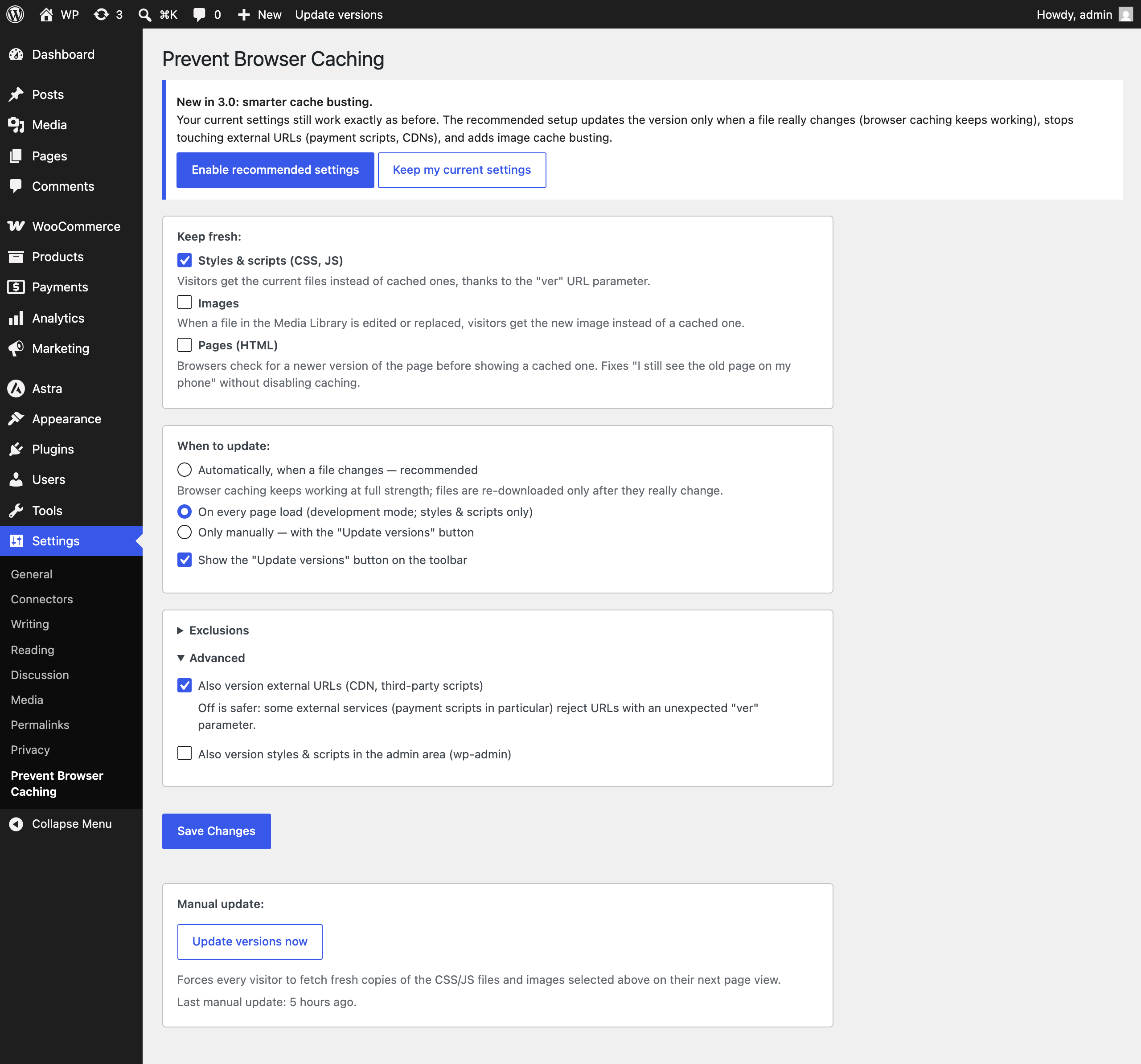
style.css?ver=4.9.6). Browsers cache the file until this parameter changes. In the recommended automatic mode the plugin sets the version from the file's own modification time: browser caching works at full strength, and the moment you update a file every visitor gets the new one. - Image versions. When you edit or replace a file in the Media Library, visitors get the new image instead of the cached one.
- HTML page freshness. Asks browsers to check for a newer version of a page before showing a cached copy — fixes "I still see the old page on my phone".
- One-click update. The "Update versions" toolbar button forces fresh copies of all assets for every visitor — and shows a short report of what exactly happened.
- Page cache stays in sync (opt-in). If a page-cache plugin is active, updating versions can also clear its cache — so cached HTML stops referencing the old file versions and every visitor sees the new site immediately. One checkbox turns it on, and after every update the plugin reports what was refreshed and what happened to the page cache. Works with WP Rocket, LiteSpeed Cache, W3 Total Cache, WP Super Cache, WP Fastest Cache, WP-Optimize, Breeze, Cache Enabler, Hummingbird, SiteGround Optimizer, Swift Performance and Comet Cache.
- Faster repeat visits (opt-in, new in 3.2). Because versioning guarantees freshness, the plugin can safely serve your static files with one-year browser caching headers — the exact fix for the Lighthouse audit "Serve static assets with an efficient cache policy". It writes the rules through WordPress's own .htaccess API on Apache/LiteSpeed (removed again on deactivation), shows a ready-to-copy snippet for nginx, and then actually fetches one of your CSS files to verify the headers really work — the result is shown on the settings page.
- Auto refresh after updates (opt-in, new in 3.2). Plugin, theme and WordPress updates change CSS and JS files. With this option every update — including automatic background updates — is followed by a version refresh (and a page-cache clear when that option is on), so visitors never see a broken layout after an update.
- CLI & AI agents. WP-CLI commands (
wp pbc update,wp pbc status) and WordPress Abilities let deploy scripts and AI agents update versions safely.
- External URLs (payment scripts, CDNs, third-party services) are left untouched — some of them break when an unexpected "ver" parameter is added. You can turn external versioning back on with one checkbox.
- Specific files (by part of the URL) or script/style handles can be excluded from versioning — CSS, JS and images alike.
- If a page-cache plugin is active, the HTML freshness headers step aside automatically.
- Another plugin's page cache is never cleared unless you enable that yourself — the purge-on-update integration is opt-in, and the report after every update tells you whether the page cache was cleared or left alone.
- The long-caching headers are opt-in too, and only available while CSS/JS versioning is on — the plugin never lets browsers hold files for a year without a way to bust them. Disabling the option (or deactivating the plugin) removes the rules completely.
- Automatically, when a file changes (recommended) — version = file modification time. Zero clicks, full caching.
- Every time a page loads — development mode: CSS & JS are never cached (images and pages are unaffected). Use it only while actively developing.
- Manually — versions change only when you press the "Update versions" button.
pbc_assets_version filter. Add this to the functions.php file of your theme and change the value whenever you need to update assets:
add_filter( 'pbc_assets_version', function( $ver ) { return '123'; } );
Because it uses WordPress's own add_filter(), it keeps working safely even if the plugin is ever deactivated — your site won't break.
Filters for fine-tuning:
pbc_skip_src( $skip, $src, $handle )— returntrueto leave a given asset URL untouched.pbc_assets_version( $ver, $src, $handle )— change the version applied to a given asset.pbc_purge_page_cache( $purge, $plugin_name )— returnfalseto prevent the page-cache purge on version updates.pbc_after_bump( $result )— action fired after every version update, with the new timestamp and the purge outcome.pbc_cache_policy_rules( $rules, $options )— change the generated long-caching rules before they are written to .htaccess (or shown as a snippet).pbc_after_auto_bump( $context )— action fired after an automatic post-update refresh, with the update type and the purge outcome.PBC_DISABLE_HTACCESS_WRITE— define this constant astrue(e.g. in wp-config.php) and the plugin will never write to .htaccess itself; the settings page shows the rules for manual setup instead.
wp pbc update— updates the versions (and clears the detected page cache when the settings option is on). Add--skip-purgeto leave the page cache alone for that run.wp pbc status— shows the mode, what is versioned, the last manual update and the detected page-cache plugin. Supports--format=table|json|yaml.
prevent-browser-caching/bump-versions— update the versions; optional boolean inputpurge(setfalseto skip the page-cache purge).prevent-browser-caching/status— read-only report of the current configuration.
manage_options capability.
Legacy: earlier versions documented a prevent_browser_caching() function instead. It still works exactly as before — it disables the plugin's admin settings and gives you full control — but I recommend the filter above: a bare function call in functions.php triggers a fatal error if the plugin is ever deactivated. If you keep using the function, guard it:
if ( function_exists( 'prevent_browser_caching' ) ) { prevent_browser_caching( array( 'assets_version' => '123' ) ); }
Thank you
Many of the recent improvements started as reports and questions in the support forum — thank you to everyone who took the time to describe a problem or share an idea. If something doesn't work as expected on your site, please open a topic there: it genuinely helps make the plugin better for everyone.
安装:
- Visit "Plugins > Add New".
- Search for "Prevent Browser Caching".
- Install and activate Prevent Browser Caching plugin.
- Download Prevent Browser Caching plugin.
- Upload the "prevent-browser-caching" directory to your "/wp-content/plugins/" directory.
- Activate Prevent Browser Caching on your Plugins page.
屏幕截图:

常见问题:
Does it affect site speed or SEO?
It can only help. In the recommended automatic mode browser caching keeps working at full strength — repeat visitors load CSS/JS from their cache until a file really changes, so repeat views are as fast as ever (faster than the old 2.x default, which re-downloaded assets on every visit). And the opt-in "Speed up" option goes further: one-year caching headers for your static files — the exact fix for the Lighthouse "efficient cache policy" audit. The server cost is a few file-time lookups per page — negligible. The "ver" URL parameter is the same mechanism WordPress core uses, search engines are perfectly used to it, and the plugin does not change your page content, markup or URLs seen by crawlers.
Does it work together with page caching plugins?
Yes — and since 3.1.0 they can actively cooperate. Versioned asset URLs end up in the cached HTML like any others, so serving stale HTML used to mean serving old asset versions with it. When the "Also clear the page cache" checkbox on the settings page is enabled, pressing "Update versions" (toolbar, settings page, WP-CLI or an ability) also clears the detected page-cache plugin's cache, so that HTML is regenerated with the new versions. Supported: WP Rocket, LiteSpeed Cache, W3 Total Cache, WP Super Cache, WP Fastest Cache, WP-Optimize, Breeze, Cache Enabler, Hummingbird, SiteGround Optimizer, Swift Performance, Comet Cache. The checkbox is off by default — another plugin's cache is only touched when you say so (for example, if your page cache serves logged-out visitors only, you may prefer not to rebuild it on every update). Either way, the report shown after every update says whether the page cache was cleared, and the version update always completes even if a purge fails. The plugin also keeps leaving HTML cache headers to the page-cache plugin.
Does it work with page builders (Elementor, Divi, Beaver Builder…)?
Yes. Builders generate their CSS as real files (usually in the uploads folder) and give them a fresh time-based version whenever they regenerate — Elementor, for example, serves its per-page CSS as post-123.css?ver=<generation time>, and that version changes every time the file is rewritten. On top of that, in the automatic mode this plugin adds its own version component from the file's modification time, so even a builder file rewritten in place busts its cache immediately. Together that makes the long-caching option safe for builder files too: their URLs always change when their content does.
Does it work with minification plugins (Autoptimize, WP-Optimize)?
Yes — verified against both. Minifiers put a content hash and the source files' modification times into their generated file names, so those files bust their own cache by name — and the long-caching option here is exactly the right policy for them: WP-Optimize's minified CSS/JS get the one-year headers and change URL whenever a source file changes, while Autoptimize serves its cache folder with its own equivalent one-year immutable policy, so the two never fight. Files the minifier leaves untouched keep this plugin's "ver" parameter — even when the minifier's "remove query strings" option is on (this plugin adds its version after them on purpose).
Does the automatic mode clear my page cache when a file changes?
No — and that's by design, not an oversight. In the automatic mode the version comes from the file's modification time, read at the moment a page is rendered; nothing "happens" on the server when you upload a changed file, so there is no event to clear the page cache on. Cached HTML keeps the old asset versions until the page cache expires or is cleared. After bigger changes, press "Update versions" — with the "Also clear the page cache" option enabled, that both updates the versions and clears the detected page cache in one click.
How do I fix the Lighthouse audit "Serve static assets with an efficient cache policy"?
Enable "Let browsers keep static files for a year" in the "Speed up" section of the settings page (available while CSS/JS versioning is on). The plugin serves static files with Cache-Control: public, max-age=31536000, immutable, which is exactly what the audit asks for — and it is safe here, because the plugin changes a file's URL whenever the file changes, so visitors never get stuck with an outdated copy. After enabling, the settings page tells you whether the headers were verified on your site. The same option also resolves the older name of this recommendation — "Leverage browser caching" — still shown by GTmetrix and other testing tools.
Does the plugin edit my .htaccess?
Only if you enable the long-caching option, and only using WordPress's own API (the same one core uses for permalinks): a clearly marked block between # BEGIN Prevent Browser Caching and # END Prevent Browser Caching. The block is updated when you change related settings, and removed completely when you turn the option off, deactivate or delete the plugin. On multisite, on nginx, or if you define the PBC_DISABLE_HTACCESS_WRITE constant, the plugin never writes the file — it shows you the rules to add manually instead.
My caching plugin already adds browser-caching (expires) headers. Do I need both?
No — manage them in one place. If your caching plugin already serves long-lived headers for static files, you can leave the "Speed up" option here off: versioning keeps everything fresh either way. Nothing breaks if both end up enabled — the rules don't conflict, the later block simply wins — but a single source is cleaner. The advantage of managing them here is that the headers are tied to versioning (URLs change whenever files change, so a year-long cache can never show anyone an outdated file) and the settings page verifies that the headers actually work on your server.
The settings page says the caching headers are not showing up. What now?
The rules are in place, but your server did not apply them — most often the host's Apache lacks the mod_headers/mod_expires modules, or .htaccess overrides are disabled. Ask your host to enable them, or copy the rules shown on the settings page into the server configuration. Saving the settings re-runs the check. Until the headers work, nothing breaks — browsers simply keep caching the way they did before.
I excluded a file from versioning — will it still be cached for a year?
If it is a local CSS/JS file served from your site: yes, the long-caching rules work by file extension and cannot see your exclusion list. Exclusions are almost always external URLs (payment scripts, CDNs), which the rules never touch — but if you exclude a local file because it must not be cached long, either keep the long-caching option off or add a narrower rule for that file in your server configuration.
Why don't external files get a version by default?
Several external services — payment scripts in particular (PayPal, Braintree, Authorize.net) — reject requests with an unexpected "ver" query parameter, which used to break checkout forms. Since 3.0.0 only local files are versioned by default; there is a checkbox to include external URLs again if you relied on that.
Do I lose browser caching with this plugin?
Not in the recommended automatic mode. Files are cached normally; the version only changes when the file itself changes. The "every time a page loads" mode does disable caching of CSS/JS — use it during active development only.
The version does not update every X minutes as I set it. Why?
The legacy "every N minutes" mode works per visitor, using a cookie — it does not rebuild anything on the server by cron. Each visitor gets a new assets version no more often than the chosen interval. Since 3.0.0 the automatic mode is a better choice for almost every case.
Does it version images inside post content?
Yes, when "Images" is enabled: attachment URLs rendered by WordPress get versions immediately, and image URLs hardcoded in post content get the site-wide media version after the first update (the "Update versions" button or replacing a media file).
My CDN ignores query strings.
Then query-parameter versioning cannot bust that CDN's cache for those files. Configure the CDN to include query strings in its cache key, or use filename-based versioning (e.g. replace a file under a new name).
My site shows an error after I deactivate the plugin.
If you added prevent_browser_caching( ... ) to your theme's functions.php, that line calls a function this plugin provides. Once the plugin is deactivated the function no longer exists, so PHP stops with a fatal error. Two ways to fix it: switch to the pbc_assets_version filter (recommended — it never causes this), or wrap the call in if ( function_exists( 'prevent_browser_caching' ) ) { ... }. See "For developers" above.
更新日志:
- Improved: AI agents now see the plugin's two Abilities directly. They are marked public for the Abilities API and the official WordPress MCP Adapter (
meta.public,meta.mcp.public), carry the complete set of tool annotations, and are listed as first-class tools namedprevent-browser-caching-bump-versionsandprevent-browser-caching-statuson the adapter's default MCP server, so an agent no longer has to call discover-abilities first (opt out with theprevent_browser_caching_mcp_direct_toolsfilter). No other changes.
- Fixed: a caching plugin that is installed but has its page caching switched off (for example WP-Optimize used only for database cleanup or image compression) is no longer treated as an active page cache. The "... is active, so page caching headers are left to it" note and the "Also clear the page cache" option now appear only when page caching is really enabled, and the "Pages (HTML)" option works in that situation instead of silently stepping aside. The check mirrors each supported plugin's own on/off state and safely falls back to the previous behavior when that state can't be read. Props @jcollier for the report.
- New: "Let browsers keep static files for a year" (opt-in, in the new "Speed up" settings section) — serves CSS, JS, fonts and images with long-lived
Cache-Control/Expiresheaders. Safe by design: versioned URLs change whenever a file changes, so visitors still get updates immediately. Fixes the Lighthouse audit "Serve static assets with an efficient cache policy". On Apache/LiteSpeed the rules are written through WordPress's own .htaccess API and removed again when the option is turned off or the plugin is deactivated/deleted; on nginx and multisite the settings page shows a ready-to-copy snippet instead. - New: the plugin verifies the long-caching headers by fetching one of the site's own CSS files and shows the result on the settings page — so you know whether your server actually applied the rules (some hosts lack the needed Apache modules; the plugin tells you instead of silently assuming).
- New: "Refresh versions automatically after plugin, theme or WordPress updates" (opt-in) — covers manual, bulk and automatic background updates, and clears the page cache when that option is on. Uses the least invalidation your mode allows: in the recommended automatic mode file versions already update by themselves, so only the page cache is cleared. Image versions are never touched by this feature.
- New: a one-time "what's new" note after upgrading, shown only on the plugin's own settings page (dismissible; nothing is added anywhere else in wp-admin).
- New for developers: the
pbc_cache_policy_rulesfilter, thepbc_after_auto_bumpaction, and thePBC_DISABLE_HTACCESS_WRITEconstant (force snippet-only mode, no file writes). wp pbc statusand the status ability now also report the cache-policy state (including the verification result) and the auto-refresh setting.- Fixed: a valueless "ver" query parameter no longer turns into "ver=.123" after a version update.
- New: "Update versions" can now also clear the page cache when one of the supported caching plugins is active — WP Rocket, LiteSpeed Cache, W3 Total Cache, WP Super Cache, WP Fastest Cache, WP-Optimize, Breeze, Cache Enabler, Hummingbird, SiteGround Optimizer, Swift Performance, Comet Cache. Fixes "I updated the versions, but visitors still got the old design from the page cache". Opt-in: a settings checkbox turns it on (off by default — another plugin's cache is only touched when you say so). Each plugin is purged through its own public API; every call is guarded, and the version update always completes even if a purge fails.
- New: after every "Update versions" click the plugin reports what happened — which asset types got new versions (per your settings) and whether the detected page cache was cleared. The report shows inline on the settings page and as a one-time notice after using the toolbar button.
- New: WP-CLI support —
wp pbc update [--skip-purge]andwp pbc status [--format=table|json|yaml]. - New: on WordPress 6.9+ the plugin registers two Abilities for AI agents and automation,
prevent-browser-caching/bump-versionsandprevent-browser-caching/status(Abilities API / REST / MCP adapter; require themanage_optionscapability). - New for developers: the
pbc_purge_page_cachefilter (veto the purge) and thepbc_after_bumpaction (observe every version update and its purge outcome). - Fixed: image URLs inside RSS feeds no longer get a "ver" parameter.
- Fixed: an existing "ver" query parameter in image URLs is now detected precisely — a "ver=" fragment inside another parameter name no longer counts as one.
- Housekeeping: uninstall on multisite now cleans up networks with more than 100 sites.
- New automatic mode (now the recommended default): the assets version is taken from the file modification time, so browser caching works at full strength and busts exactly when a file changes.
- External URLs (payment scripts, CDNs) are no longer versioned by default — this used to break PayPal/Braintree/Authorize.net checkouts. A checkbox brings external versioning back; sites upgrading with saved settings keep their previous behavior until they switch.
- New: image cache busting. Attachment URLs are versioned; editing or replacing a media file busts its cache.
- New: HTML page freshness — optional Cache-Control header asking browsers to revalidate pages, plus a back/forward-cache guard for stale pages on mobile. Steps aside automatically when a page-cache plugin is detected.
- New: exclusions list (URL substrings or script/style handles) and
pbc_skip_src/pbc_assets_versionfilters for developers. - New: optional cache busting in the admin area.
- New settings screen: a few clear switches, details unfold when you need them. Sites upgrading from 2.x get a one-click "Enable recommended settings" banner (reversible).
- The toolbar button is now called "Update versions": it updates the versions of CSS/JS files and images.
- After activation the plugin opens its settings page.
- Full backward compatibility: the
prevent_browser_caching()function, all 2.x options and the filter timing work exactly as before. - Recommended for developers: use the
pbc_assets_versionfilter instead of theprevent_browser_caching()function — unlike a bare function call, it never causes a fatal error if the plugin is deactivated. - Fixed: PHP warning "Cannot modify header information" when another plugin printed output before the cookie was set.
- Fixed: the manual update button on the settings page submitted the whole form.
- Housekeeping: uninstall now removes all plugin options (multisite-aware); all strings are translatable; added a POT file; direct-access guards on all files.
- Raised the minimum PHP version to 7.2 (matches the WordPress minimum). Tested on PHP up to 8.5.
- Fixed a bug with URLs that contain repeated query params: only the last one survived after adding the "ver" param. For example, Google Fonts URLs with several "family" params lost all font families except the last one.
- Tested the plugin in WordPress 7.0.
- Declared the minimum required PHP version (5.6).
- Tested the plugin in WordPress 6.9.
- Tested the plugin in WordPress 6.5.
- Tested the plugin in WordPress 6.1.
- Tested the plugin in WordPress 6.0.
- Fixed "Update CSS/JS" button in the admin bar.
- Tested the plugin in WordPress 5.1.
- Tested the plugin in WordPress 5.0-beta1 and optimized the code.
- Added function "prevent_browser_caching" which disables all admin settings of this plugin and allows to set the new settings.
- Changing "ver" param instead of adding additional "time" param.
- Added option to show "Update CSS/JS" button on the toolbar.
- Added setting page to the admin panel.
- Added automatically updating CSS and JS files every period for individual user
- Added manually updating CSS and JS files for all site visitors
- Added plugin text domain.
- First version of Prevent Browser Caching plugin.