
VideoFlowEngine HLS Streaming
| 开发者 | videoflowengine |
|---|---|
| 更新时间 | 2026年7月5日 14:06 |
| PHP版本: | 7.4 及以上 |
| WordPress版本: | 7.0 |
| 版权: | GPLv2 or later |
| 版权网址: | 版权信息 |
详情介绍:
[vfhls_player id="123"] or the Gutenberg block. Five minutes from install to live HLS stream.
🎯 Built for:
- Course creators on LearnDash, Tutor LMS, LifterLMS, LearnPress — replace Vimeo without rebuilding your lessons
- WooCommerce stores — add fast product demo videos without slowing down your store
- Membership sites that don't want YouTube recommendations pulling members away mid-lesson
- Agencies managing video for multiple client sites from a single WordPress dashboard
- SaaS / marketing sites that need a clean, branded, ad-free video player
- Upload videos directly from the WordPress dashboard
- Automatic multi-resolution HLS encoding — 360p, 720p, 1080p adaptive
- Fast global delivery via Cloudflare CDN — streams like Netflix, not like a raw MP4 file
- Drop into any page, post, or LMS lesson via shortcode or Gutenberg block
- Works with ACF fields — any
<video>tag pointing to a.m3u8URL is auto-detected and streamed via HLS - Built-in analytics: views, watch time, drop-off — right inside WordPress admin
- No ads, no external branding, no "watch on Vimeo" recommendations
- Direct-to-cloud uploads (no server transcoding, no PHP upload size limits)
- Adaptive HLS streaming — quality switches automatically based on the viewer's connection
[vfhls_player id="123"]shortcode for single videos[vfhls_gallery columns="3"]shortcode for video grids- Gutenberg block for the block editor
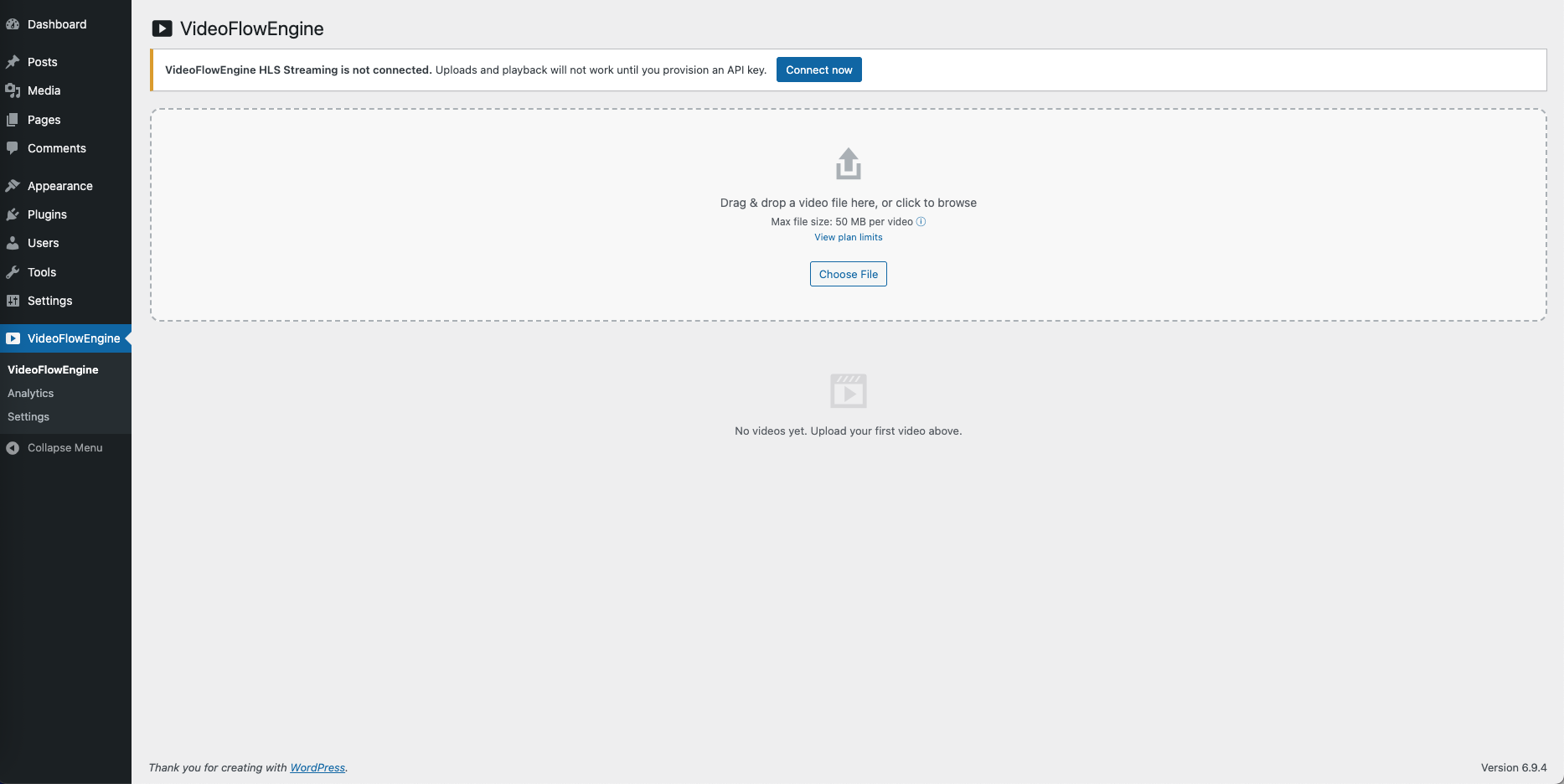
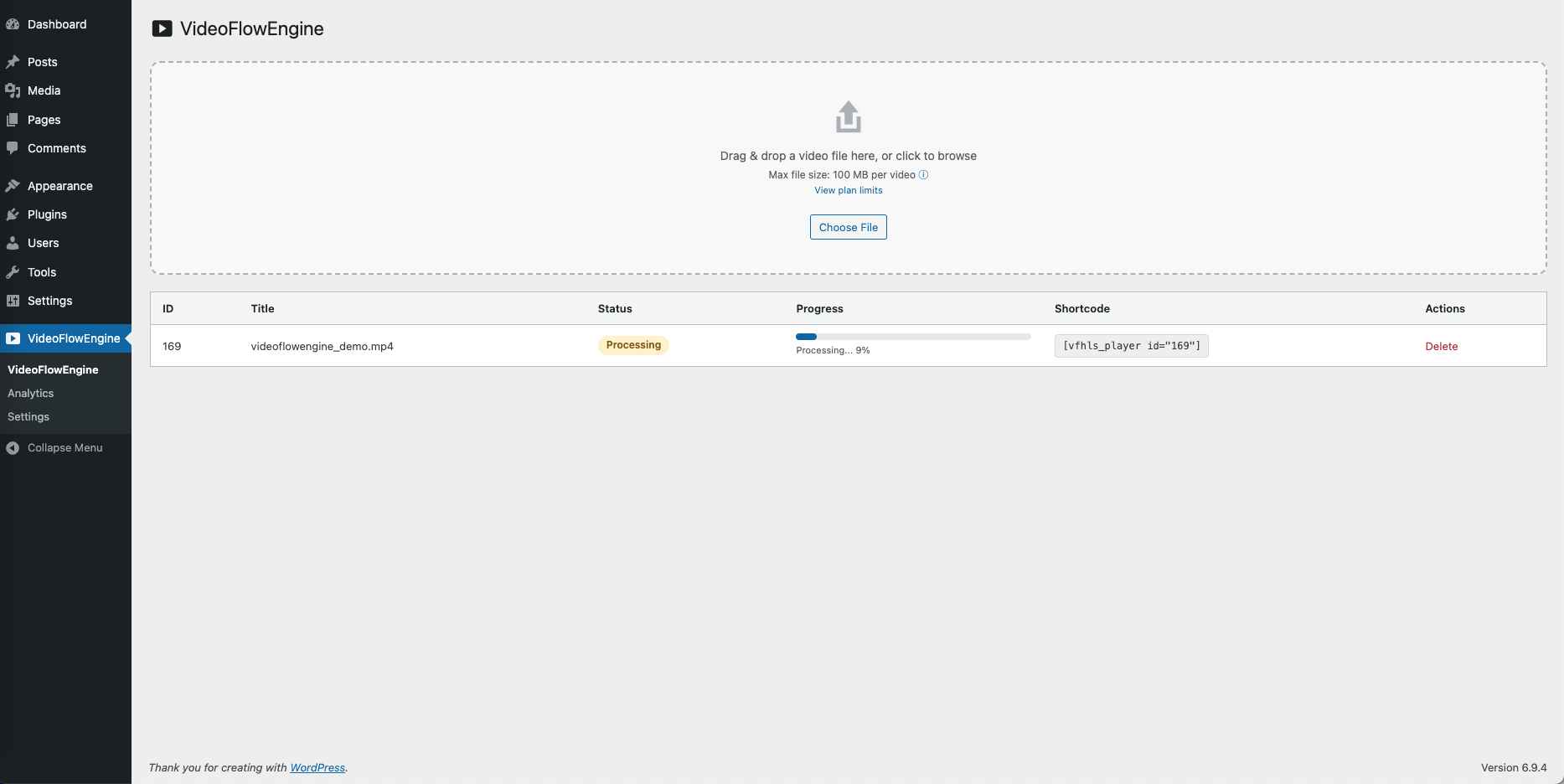
- Drag & drop upload with real-time encoding progress
- Built-in analytics dashboard — views, watch time, drop-off, device breakdown
- Free tier — no credit card required
[vfhls_player id="123" hero] to embed it. Switch which video is your Hero anytime from Settings.
- Instant playback — plays on first tap, no buffer wheel, even on slow mobile connections
- Faster page load — adaptive HLS, no full-file pre-download before playback starts
- Full HD 1080p for the designated hero video
- One-click switch — reassign the Hero to a different video anytime
- LearnDash — lessons, topics, quizzes, Focus Mode
- Tutor LMS — lesson video blocks, course builder
- LifterLMS — lesson and course content
- LearnPress — lesson content
- Any LMS that accepts standard WordPress shortcodes or Gutenberg blocks
- No per-view charges — flat plan pricing, never metered per play
- No ads or platform branding — your player, your domain, your look
- No YouTube-style recommendations pulling viewers out of your paid course
- Analytics inside WordPress — views, watch time, drop-off without a separate dashboard
- Private by default — videos are not surfaced on any public platform
- WordPress capability checks on every admin action
- Pre-signed upload URLs — video files never publicly exposed during upload
- No data leaves your site until the admin explicitly clicks "Connect"
- Visitor analytics are opt-in — disabled by default, toggled from Settings
- Viewer IP used only for 1-hour view deduplication, not stored long-term
- Install and activate the plugin
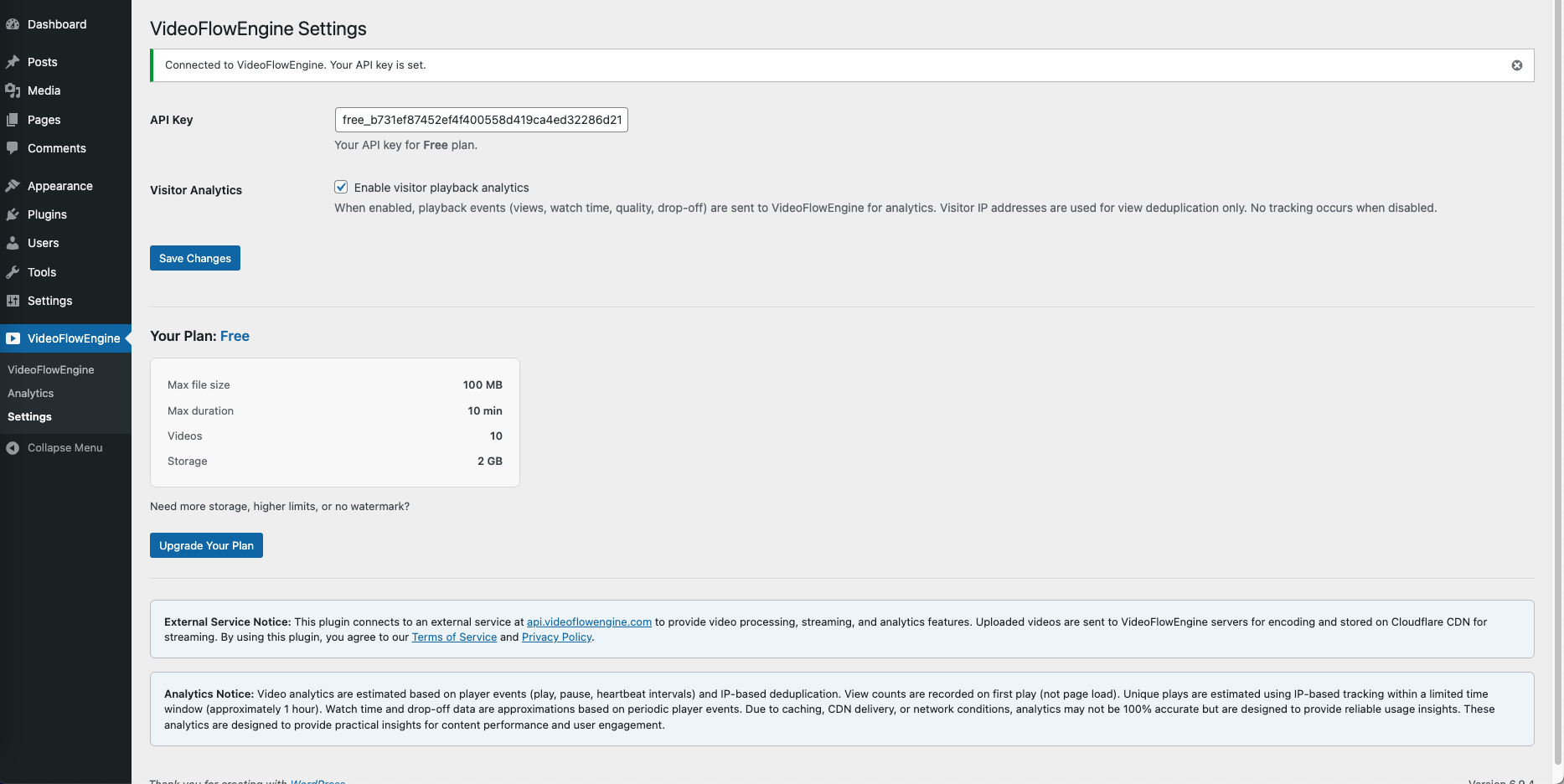
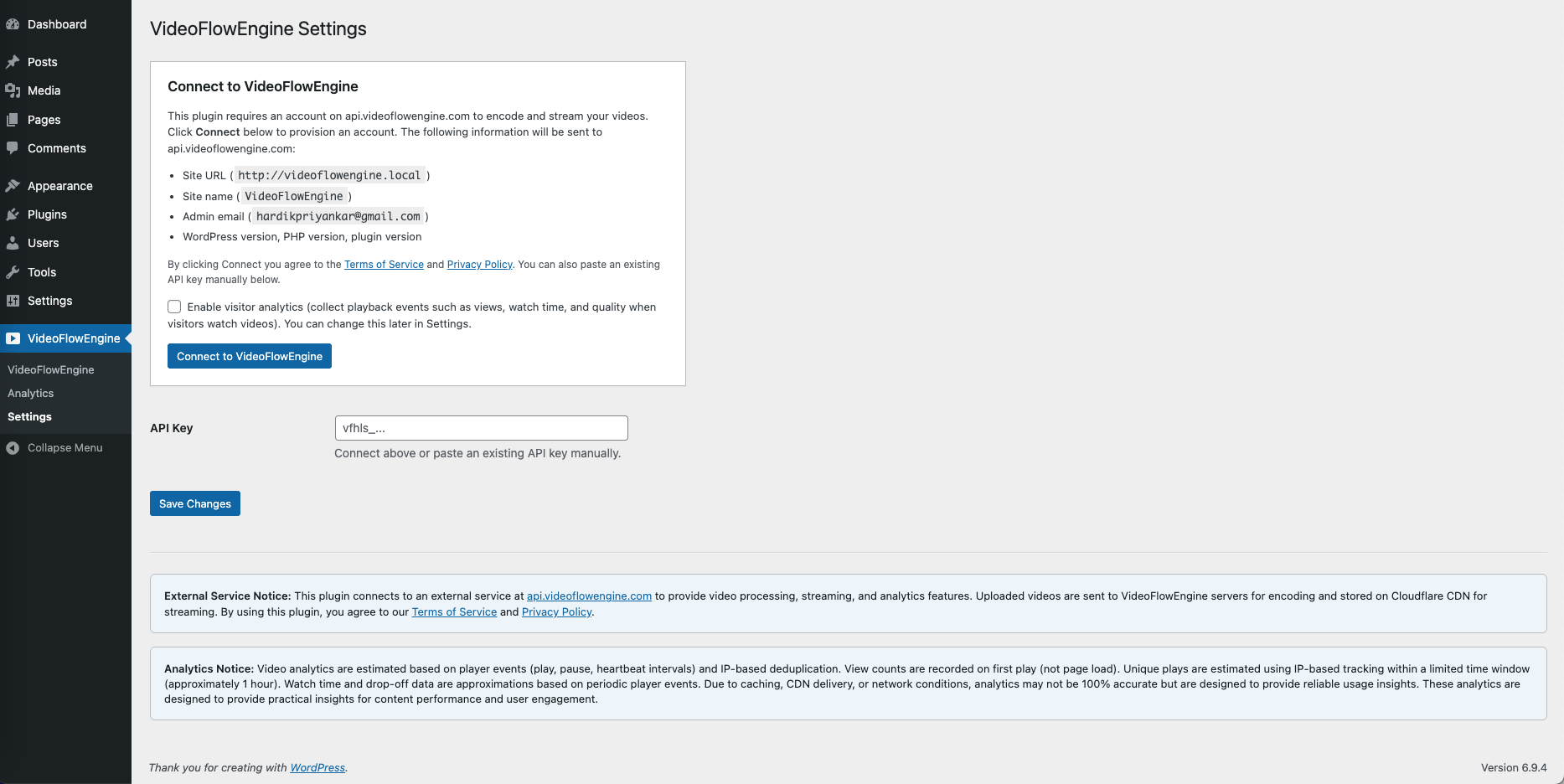
- Go to VideoFlowEngine → Settings → click Connect to VideoFlowEngine (a consent screen shows exactly which data is sent before you confirm)
- Upload from the VideoFlowEngine menu — drag & drop, then wait a few minutes for HLS encoding
- Paste
[vfhls_player id="123"]into any page, post, or LMS lesson — or use the Gutenberg block
安装:
- Upload the
videoflowengine-hls-streamingfolder to/wp-content/plugins/, or install directly via the WordPress plugin directory - Activate through the Plugins screen in WordPress
- Go to VideoFlowEngine → Settings and click Connect to VideoFlowEngine (a consent screen lists exactly which data is sent to the API)
- Upload your first video from the VideoFlowEngine menu
屏幕截图:
常见问题:
Is VideoFlowEngine free?
Yes. Every install includes 30 free encoding minutes — no credit card required. That covers around 30 minutes of finished video. When you need more, buy a one-time credit pack: Starter (300 min), Standard (700 min), or Large (2,000 min). Credits never expire. All plans get full HD 1080p encoding, no watermark, and the full analytics suite.
Is this a real Vimeo replacement for WordPress?
Yes. VideoFlowEngine covers the full Vimeo workflow — upload, encode, embed, analytics — with managed cloud hosting and WordPress-native embeds. There are no per-view fees and no external player branding. To switch: download your source files from Vimeo (Settings → Distribution → Video File Download), re-upload to VideoFlowEngine, and swap the embed code. Most sites migrate in under an hour.
Will this work with LearnDash?
Yes. Add [vfhls_player id="123"] or the VideoFlowEngine Gutenberg block to any LearnDash lesson, topic, or quiz — the same way you'd add any WordPress content block. The player works in Focus Mode and alongside LearnDash's quiz and certificate triggers. Full setup guide on our website.
Will this work with Tutor LMS, LifterLMS, or LearnPress?
Yes — any LMS that accepts standard WordPress shortcodes or Gutenberg blocks works with VideoFlowEngine. That covers Tutor LMS, LifterLMS, LearnPress, WP Courseware, and most others on the market.
What is HLS streaming and why does it matter?
HLS (HTTP Live Streaming) is the adaptive streaming protocol used by Netflix and YouTube. Instead of downloading the entire video file before playback starts, HLS sends short segments and adjusts quality in real time based on the viewer's connection speed. The result: videos that start instantly and play without buffering on slow mobile connections — and no page-load penalty from a large MP4 file being fetched before a single frame plays.
How is VideoFlowEngine different from Vimeo?
The core difference is pricing model. Vimeo charges a monthly subscription — and the bill grows as your audience grows. VideoFlowEngine uses one-time credit packs: pay for encoding minutes once, they never expire, and there are no recurring charges or per-view fees. Beyond pricing: video is hosted under your domain (not Vimeo's), there are no ads or "watch on Vimeo" prompts, and analytics live inside WordPress admin rather than a separate Vimeo dashboard.
Do I need to set up Cloudflare R2 or any CDN myself?
No. VideoFlowEngine provides the storage, encoding servers, and Cloudflare CDN delivery as part of the managed service. There is nothing to configure. Install, connect, upload.
Can I migrate existing videos from Vimeo or YouTube?
Yes, by re-uploading. Download your source files from Vimeo (Settings → Distribution → Video File Download) or YouTube, then drag and drop them into VideoFlowEngine. Direct import from Vimeo/YouTube is not built in, but the upload-and-encode flow is the same as any new video. For bulk migrations, the migration guide on our website walks through the full process.
Do I need an API key?
Yes. After activation, click Connect to VideoFlowEngine in the Settings screen. This provisions a free API key automatically — no separate account registration or credit card needed.
Does this work without creating an account first?
Yes. Clicking "Connect to VideoFlowEngine" in the plugin Settings creates your account and provisions a free API key in one step. You will see exactly what data is sent before confirming.
What video formats are supported for upload?
MP4, MOV, AVI, MKV, WebM, and most other common video formats. Files are transcoded to adaptive HLS regardless of source format.
Does this work with ACF (Advanced Custom Fields) or custom theme video fields?
Yes. If your theme outputs a <video> tag with a .m3u8 URL — for example via an ACF URL field used for a homepage hero or product video — the plugin automatically detects it and streams it via hls.js with full adaptive quality switching. No shortcode or extra configuration needed. This works with ACF, custom PHP templates, page builders, and any other mechanism that outputs a standard HTML <video> tag.
Does this work in Elementor, Beaver Builder, Bricks, or other page builders?
Yes. Any page builder that renders WordPress shortcodes or Gutenberg blocks will display the VideoFlowEngine player — including Elementor, Beaver Builder, Bricks, Divi, GeneratePress, Astra, and Kadence.
What is the Hero add-on?
The Hero add-on lets you designate one video as the "Hero" on your site. It gets full-HD 1080p encoding and an instant-play player optimised for homepage hero sections, course intros, and sales-page testimonials. Activate in VideoFlowEngine → Settings and embed with [vfhls_player id="123" hero]. The Hero can be reassigned to any other video at any time (24-hour cooldown between switches).
Can my homepage hero video autoplay silently?
Yes. The Hero player handles browser autoplay policies — muted-autoplay-then-unmute is supported out of the box. Use [vfhls_player id="123" hero] on your homepage.
Can I switch which video is my hero?
Yes. Go to VideoFlowEngine → Settings → Hero card → Change video. The new video re-encodes to the hero stream in a few minutes; the previous one reverts to your plan's standard encoding.
更新日志:
- Credits model — replaced monthly subscription tiers with one-time encoding-minute packs (Starter 300 min / Standard 700 min / Large 2,000 min). Credits never expire. No recurring charge.
- Credits balance in plugin — Settings and Upload pages now show your current encoding-minute balance with a low-balance warning when under 30 minutes remaining.
- Buy Credits from within WordPress — purchase a credit pack without leaving the admin dashboard. Stripe checkout opens in a new tab; balance updates automatically once payment completes.
- Minutes Used column — the video list now shows how many encoding minutes each video consumed, calculated from its actual duration.
- Purchase history — a read-only table on the Settings page lists all past credit pack purchases with date, pack name, and amount.
- Full HD for everyone — removed the 720p cap on the free tier. All accounts (including free) encode to the highest resolution the source allows, up to 1080p.
- No watermark on free tier — removed the watermark that previously appeared on free-tier videos.
- Max file size raised to 2 GB — up from 500 MB. Client-side guard added to catch oversized files before upload starts.
- Max video duration: 60 minutes — hard limit shown clearly in the upload interface. Source files longer than 60 minutes are rejected before upload.
- ACF & custom theme video support — VideoFlowEngine now streams any
<video>tag on your site that points to an HLS.m3u8source, including videos output via Advanced Custom Fields, custom PHP templates, or page builder fields. No shortcode required. Hero videos, product videos, and ACF-powered video fields all get adaptive HLS streaming automatically. - Hero videos play at full HD instantly — eliminated the quality ramp-up that caused hero and loop videos to start at 360p before switching to 720p or 1080p. Hero videos now open at the highest available quality from the first frame, delivering a faster, sharper first impression on homepages and landing pages.
- Copy HLS URL button — the video list now shows a one-click Copy URL button next to each encoded video. The button appears immediately when encoding finishes — no page refresh needed. Use the URL to embed videos in ACF fields, custom templates, or any third-party player.
- Cleaner admin interface — streamlined the Upload & Encode button and aligned the shortcode and Copy URL controls for a more consistent WordPress admin experience.
- New: Hero add-on — designate one video as your site's Hero for instant-play full-HD 1080p delivery. Activates from Settings; embed with
[vfhls_player id="X" hero] - New: First-ready toast — after the first video finishes encoding, a prompt appears with the shortcode ready to copy
- New: In-plugin subscription cancel button for Starter and Pro plans
- Improvement: Hero shortcode column in the video list now auto-shows the
[vfhls_player id="X" hero]variant for the assigned Hero video - Improvement: Hero video-chooser modal now uses inline status messages instead of native browser dialogs
- Fix: Stripe checkout no longer redirects the current tab when opening the payment page in a new tab
- Fix: Plugin reactivation now correctly records the analytics consent state and writes the GDPR audit log entry
- Fix: Removed a duplicate analytics line that appeared on plan upgrade pages
- Security: Added a WordPress capability check to the review-prompt dismissal AJAX handler
- Initial release — WordPress video hosting with upload, HLS encoding, CDN delivery, and analytics
- Direct-to-cloud uploads via pre-signed URLs (no server-side transcoding, no PHP upload limits)
- Adaptive HLS encoding to 360p, 720p, and 1080p with automatic quality switching
- Drag & drop upload interface with real-time encoding progress in WordPress admin
[vfhls_player id="123"]shortcode,[vfhls_gallery]shortcode, and Gutenberg block- Built-in analytics: views, watch time, drop-off, device breakdown
- Visitor analytics opt-in — disabled by default, toggled from Settings
- Free tier — no credit card required